AI verifies bereavement leave by scanning documents, checking policy eligibility, and guiding employees through self-attestation. Solutions like CloudApper hrPad give employees clear answers during sensitive moments, while helping HR teams manage leave fairly and efficiently without delays or second-guessing.

Table of Contents
- The Mistrust vs. Misuse Dilemma
- Comparing Manual vs. AI-Driven Bereavement Leave Handling
- How a National Retailer Used AI to Fix Bereavement Leave Confusion
- Why Bereavement Leave Needs AI Support
Bereavement leave is a workplace policy that gives employees time off when they experience the death of a loved one, such as a spouse, parent, child, or other close family member. It allows employees space to grieve, attend funerals, manage related tasks, and begin emotional recovery without the added pressure of work responsibilities.

Depending on company policies, bereavement leave can be paid or unpaid, and the duration and eligibility can vary widely between organizations. Despite being a widely offered benefit, bereavement leave often suffers from unclear communication and inconsistent enforcement. Employees struggle to understand what the policy covers, who qualifies, and what documentation might be necessary. Managers may interpret policies differently across departments, and HR teams can become overwhelmed with manual reviews and ad-hoc clarifications.
It’s precisely these challenges that make AI-powered solutions like CloudApper hrPad a game changer in managing bereavement leave fairly and consistently. It’s an AI-powered ESS solution that not only simplifies how employees access and understand bereavement leave policies, but also verifies leave eligibility using automation, OCR, and policy logic. Most importantly, it works seamlessly with platforms like UKG, Workday, and Dayforce, extending their functionality with AI-driven clarity and compliance.
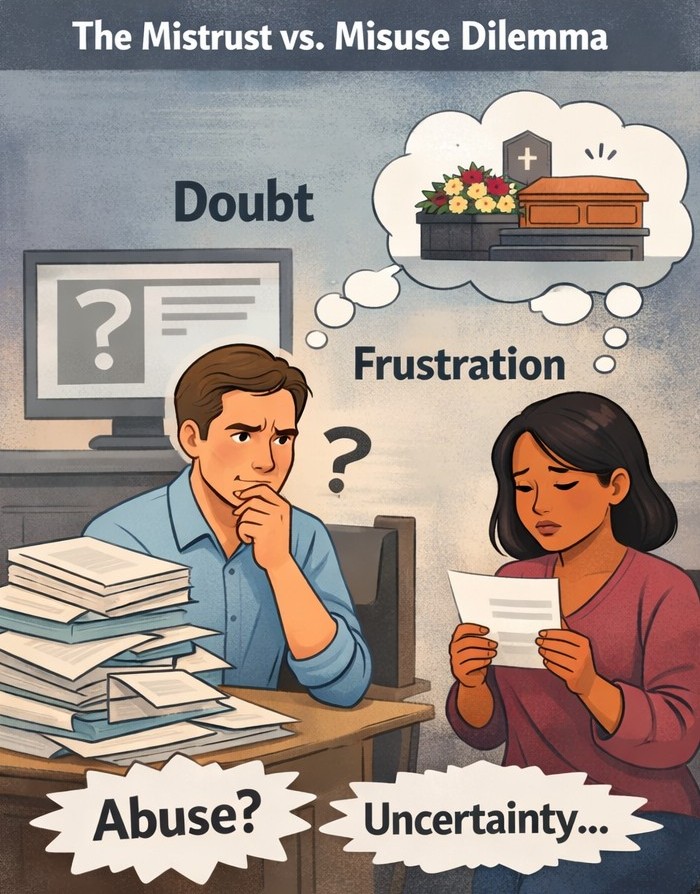
The Mistrust vs. Misuse Dilemma
Bereavement leave is one of those policies that most companies offer but few manage well. It’s emotional, time-sensitive, and often unclear. Most employees don’t know what’s covered. Most managers enforce it inconsistently. And HR ends up buried in one-off clarifications and manual reviews.
When policies lack clarity, employees either make wrong assumptions or hesitate to ask. On the other side, managers and HR teams begin to doubt the intent behind time-off requests, especially when documentation is inconsistent or late.
CloudApper hrPad bridges this gap. Employees can ask an AI assistant directly—on a tablet, mobile device, or shared kiosk—about their bereavement leave rights. The system delivers clear, role-specific answers instantly. This eliminates manager bottlenecks and confusion.
When documentation is submitted, hrPad uses OCR to scan and validate the file, ensuring that names, relationships, and dates align with policy. The platform also guides employees through attestation flows, a lightweight but powerful way to confirm eligibility and reduce misuse without introducing conflict or friction.
Because hrPad integrates natively with UKG, Workday, and Dayforce, it leverages existing HR data—such as employment status, location, and relationship mappings to apply policies dynamically. This makes it far more intelligent than static intranet documents or manual HR replies.
Comparing Manual vs. AI-Driven Bereavement Leave Handling
| Process Area | Manual Handling | AI-Driven via hrPad |
| Policy Access | PDF or HR contact required | 24/7 AI assistant with instant answers |
| Document Review | Manual by HR | OCR-enabled, pattern-matched automatically |
| Attestation | Rare or informal | Built-in self-verification prompts |
| Misuse Risk | Moderate to high | Significantly reduced |
| Employee Experience | Awkward, uncertain | Private, fast, clear |
| HR Admin Time | High | Low |
| Manager Trust | Low or inconsistent | Consistent and structured |
How a National Retailer Used AI to Fix Bereavement Leave Confusion
A multi-location U.S. retail chain with over 3,000 hourly employees was facing a growing problem: inconsistent bereavement leave usage and increasing friction between staff and managers. Employees weren’t sure who was eligible for time off after a loss, and some managers were asking for proof that others didn’t. The policy was technically documented—but no one could find it when it mattered. After implementing CloudApper hrPad, the organization connected its UKG system to the AI assistant, enabling:
- Instant answers to bereavement policy questions at any time (especially helpful for night and weekend staff)
- Automated document verification using OCR to check names, dates, and relationships on submitted obituaries
- Simple attestation during leave requests to add a layer of soft accountability
The result?
- A 61% drop in policy misuse complaints within 90 days
- A 47% reduction in HR time spent handling bereavement leave cases
- Over 88% of employees reported that they now “fully understand the bereavement policy” in a follow-up pulse survey
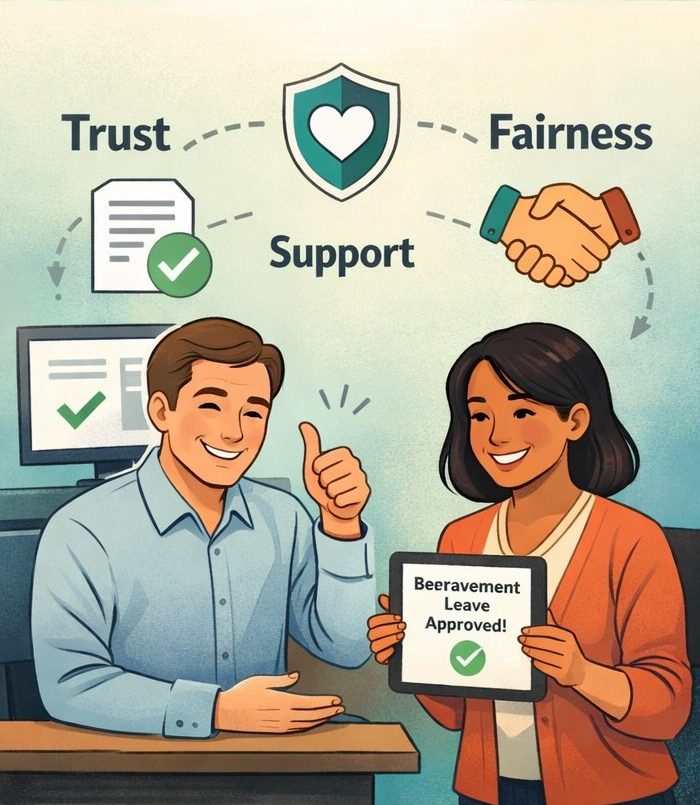
This isn’t just an automation win, it’s a trust win.
Why Bereavement Leave Needs AI Support
Despite being one of the most emotionally sensitive policies in the workplace, bereavement leave is often the least understood and least consistently enforced. According to a SHRM study, 42% of employees don’t fully understand their company’s bereavement leave policy, and a 2023 survey by Limeade found that nearly half of employees who experienced a loss felt unsupported by their organization. The issue isn’t always compassion, it’s structure.
Most companies have inaccessible policies, inconsistent enforcement across locations, and no system for verifying requests without making employees feel interrogated.
“You can’t operationalize empathy without technology. If your people policies aren’t accessible, consistent, and automated, your culture suffers—no matter how good your intentions are.”
This creates a lose-lose situation: employees mistrust the process, while HR and managers struggle to spot misuse without crossing sensitive boundaries. As HR tech analyst Jason Averbook puts it
Why Trust Is the Real Goal
An inaccessible policy may seem like a small operational issue but in moments of grief, it can break an employee’s confidence in your company. Mistrust cuts both ways: when employees feel like they need to “prove” their loss, and when managers start quietly doubting those requests.
By automating both communication and validation, hrPad helps HR teams enforce policies fairly and consistently, without losing the human touch. It lets AI handle repetitive checks, so HR professionals can focus on compassion, not compliance headaches.
“Trust isn’t built through intention—it’s built through consistency,” says Josh Bersin, global HR thought leader. AI allows HR to deliver that consistency at scale.”
And CloudApper hrPad delivers exactly that.
Frequently Asked Questions
What makes HR design “frontline-first”?
It means starting with the unique needs of deskless employees — not adapting an office tool for them. Frontline-first tools are accessible, fast, and easy to use in environments like retail floors, warehouses, or hospitals.
Can traditional HCM systems be frontline-first?
Not really. Most legacy systems weren’t built with frontline roles in mind. While they can add mobile apps or extensions, the user experience still tends to favor office-based workflows. That’s why specialized solutions like hrPad exist.
Why is it so important now?
The deskless workforce has been overlooked for too long, and now that labor shortages and retention issues are real concerns, companies can’t afford to ignore them. The organizations that invest in tools designed for their frontline teams are seeing better engagement, performance, and retention.
Isn’t this just about clocking in and out?
Not even close. While time tracking is part of it, true frontline-first HR design includes self-service access, communication tools, wellness check-ins, and even hiring capabilities. It’s about giving frontline workers the same digital experience and support that office workers already expect.
Conclusion
Bereavement leave is about more than just time off—it’s a moment where company values and employee experience intersect. If your policy is vague, hard to access, or inconsistently enforced, it creates friction. Employees feel unsupported. Managers feel unsure. HR gets overwhelmed. CloudApper hrPad changes that completely by combining AI assistants, OCR verification, attestation workflows, and seamless integration with UKG, Workday, and Dayforce, hrPad delivers a modern, automated, and trusted way to handle bereavement leave and much more.It ensures that employees get instant answers when they need them most, that managers no longer have to guess, and that HR can focus on empathy instead of admin. In doing so, hrPad not only prevents misuse and it restores trust at every level.
If your HR team is still manually managing bereavement leave, now’s the time to upgrade. With hrPad, leave policies finally become what they should be: clear, fair, and human.

What is CloudApper AI Platform?
CloudApper AI is an advanced platform that enables organizations to integrate AI into their existing enterprise systems effortlessly, without the need for technical expertise, costly development, or upgrading the underlying infrastructure. By transforming legacy systems into AI-capable solutions, CloudApper allows companies to harness the power of Generative AI quickly and efficiently. This approach has been successfully implemented with leading systems like UKG, Workday, Oracle, Paradox, Amazon AWS Bedrock and can be applied across various industries, helping businesses enhance productivity, automate processes, and gain deeper insights without the usual complexities. With CloudApper AI, you can start experiencing the transformative benefits of AI today. Learn More
- Useful Links:
- Agentic AI
- No-Code/Low-Code
- Custom Software
- HCM Personalization
- iPaaS
- FedRAMP
Brochure
CloudApper hrPad
Empower Frontline Employees with an AI-Powered Tablet/iPad Solution
Download Brochure
CloudApper AI Solutions for HR

- Works with







- and more.
Similar Posts
Certified Payroll Compliance: Why Davis-Bacon Failures Start at the Time…
Shift Swap Pay Rate Accuracy: Confirming Who Actually Worked Before…