There is no single best AI for HR — there are four categories solving different problems. A vendor-neutral comparison, the compliance obligations that now apply, and a seven-point evaluation checklist.
Table of Contents
- What Is the Best AI for HR?
- Why “Best AI for HR” Is the Wrong Question
- The Four Categories of AI for HR
- Comparing the Four Categories
- The Compliance Question Buyers Now Have to Ask
- A Buyer’s Evaluation Checklist
- Where CloudApper Fits
- Frequently Asked Questions
What Is the Best AI for HR?
There is no single best AI for HR. There are four distinct categories — employee-facing assistants, task-executing agents, AI embedded in your HCM, and process-layer platforms — and each solves a different problem. The right choice depends on whether your gap is answering questions, doing work, or closing what your system of record cannot.
Why “Best AI for HR” Is the Wrong Question
Ask ten vendors which AI is best for HR and you will get ten answers, each of them their own. The question is unanswerable as posed, because the tools grouped under it are not competing products — they are different layers of a stack.

A better question is: what is actually broken? An HR team drowning in repetitive policy questions has a completely different problem from one whose onboarding takes three weeks because six systems do not talk to each other. Buy the wrong category and the tool works exactly as advertised while changing nothing that mattered.
The Four Categories of AI for HR
1. Employee-facing assistants
Conversational tools that answer employee questions about policy, benefits, PTO balances and payroll. They deflect tickets. They read from your existing documents and data, and their value is measured in questions your HR team no longer has to answer personally.
Right when: your HR inbox is the bottleneck. Wrong when: the questions are hard because the underlying process is broken — an assistant will explain a bad process very politely, forever.
2. Task-executing agents
Tools that do something rather than describe it: screen applicants, schedule interviews, chase documents, complete onboarding steps. The distinction from an assistant is consequential — an agent writes back to your systems, which means accuracy, audit trail and permissions matter far more.
Right when: a specific high-volume process eats recruiter or HR-ops time. Wrong when: nobody has agreed what the process actually is.
3. AI embedded in your HCM
Features your existing vendor ships inside the platform. Zero integration effort and no new contract. The constraint is the roadmap: you get what the vendor built, when they build it, shaped to how they think the process should run.
Right when: the capability exists today and fits your process. Wrong when: you are waiting on a release to solve a problem you have now.
4. Process-layer platforms
A configurable layer that sits on top of the system of record and handles the work between its stages — the approvals, interfaces, exception handling and cross-system steps the HCM was never designed to own. You keep the system of record; you change what happens around it.
Right when: the gap is between your systems, or between your process and the one your vendor assumed. Wrong when: a native feature already does it.
Comparing the Four Categories
| Assistant | Agent | Embedded HCM AI | Process layer | |
|---|---|---|---|---|
| Primary job | Answers questions | Completes tasks | Enhances existing features | Closes gaps between systems |
| Writes back to your HCM | Rarely | Yes | Native | Yes |
| Typical time to value | Weeks | Weeks to months | Whenever the vendor ships | Weeks |
| Integration burden | Low | Medium | None | Medium, one time |
| Who can change it later | Vendor | Vendor or admin | Vendor only | Your team |
| Handles processes your vendor never built | No | Sometimes | No | Yes |
| Main risk | Automating a bad process | Acting on bad data | Roadmap dependency | Scope creep |
Most organizations end up with more than one, and that is fine. What causes trouble is buying a category that does not match the gap.
The Compliance Question Buyers Now Have to Ask
Under the EU AI Act, AI systems used in employment — recruitment, selection, promotion decisions, task allocation and performance evaluation — fall under Annex III as high-risk. That classification carries real obligations: risk management, data governance, logging, human oversight, transparency to affected people, and documentation you can produce on request.
The timing has moved, and a lot of published guidance is now out of date. High-risk obligations were originally due to apply from 2 August 2026. Under the Digital Omnibus agreed by EU institutions in May 2026, application of the Annex III high-risk obligations was deferred to 2 December 2027, per analysis from firms including Gibson Dunn.
Read that as a reprieve, not a reversal. The obligations were deferred, not weakened, and the systems you buy in 2026 are the ones that will have to satisfy them. Anything you procure now should be assessed against the rules as they will stand, because replacing an HR AI system in 2027 because it cannot produce an audit log is a far more expensive project than asking the question during procurement.
Note also that this is separate from US requirements. New York City’s Local Law 144 already requires annual bias audits of automated employment decision tools, and several US states have their own rules. If you operate in both, you are complying with two regimes, not one.
A Buyer’s Evaluation Checklist
- Name the gap before the category. Write one sentence describing what is broken. If you cannot, you are not ready to evaluate vendors.
- Ask what happens to your system of record. Anything requiring you to migrate off your HCM is a replacement project wearing an AI label.
- Ask who can change it in six months. If the answer is only the vendor, you have swapped one roadmap dependency for another.
- Ask for the audit trail. For anything touching hiring or evaluation, require a per-decision record you could hand to a regulator or a plaintiff.
- Ask where the data goes and who trains on it. Get it in the contract, not the sales deck.
- Ask how quickly a change ships. Weeks is a platform. Next release is a roadmap.
- Pilot one process end to end. Not a demo environment — one real process, with real data, measured before and after.
Where CloudApper Fits
Your HCM holds the data. It records what happened — who was hired, who was paid, who requested leave. It was never built to handle what needs to happen next, and that is the gap CloudApper occupies as a process layer, not an assistant and not a replacement.
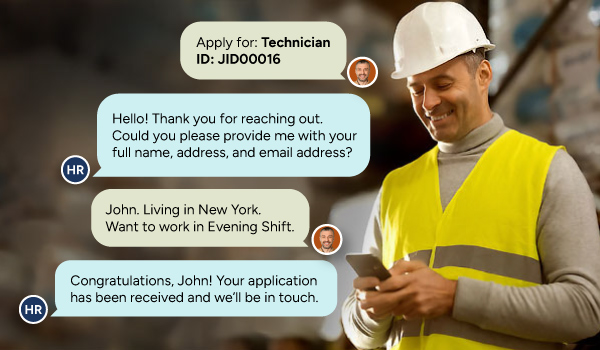
CloudApper’s hrGPT works as the employee-facing layer on top of leading HCM platforms, answering policy questions, handling PTO and payroll queries, and running the onboarding steps your HCM leaves to email — giving a new starter a genuinely complete onboarding process rather than a checklist. Because it sits on top of the system of record, your HCM stays authoritative and reporting stays intact. For the broader shift this represents, see how artificial intelligence in human resources is changing what HR teams are able to take on, and the practical questions of how to roll out artificial intelligence in your organization.
If you have identified your gap and want to see the commercial detail, AI in HR is the place to start.
Know your gap? See what a process layer does on top of the HCM you already run.
Frequently Asked Questions
What is the best AI for HR?
There is no single best option, because the tools fall into four categories that solve different problems: employee-facing assistants, task-executing agents, AI embedded in your HCM, and process-layer platforms. The right choice depends on whether your gap is answering questions, completing work, or closing something your system of record cannot do.
What is the difference between an HR AI assistant and an AI agent?
An assistant answers questions and rarely changes anything. An agent completes tasks and writes back to your systems. That difference matters for evaluation: because an agent acts, accuracy, permissions and audit trail become procurement requirements rather than nice-to-haves.
Should I use the AI built into my HCM or a separate tool?
Use the native feature when it exists today and fits how your process actually runs, because integration effort is zero. Look outside when you are waiting on a vendor release to solve a current problem, or when the process you need was never one your HCM vendor designed for.
Is AI used in HR regulated?
Yes. The EU AI Act classifies AI used in recruitment, selection, promotion, task allocation and performance evaluation as high-risk under Annex III, carrying obligations for risk management, data governance, logging, human oversight and transparency. In the United States, New York City Local Law 144 already requires annual bias audits of automated employment decision tools, and several states have their own rules.
When do EU AI Act high-risk obligations apply to HR systems?
They were originally scheduled for 2 August 2026, but under the Digital Omnibus agreed by EU institutions in May 2026 the Annex III high-risk obligations were deferred to 2 December 2027. The obligations themselves were postponed rather than weakened, so systems bought today should still be assessed against them.
How do I evaluate an AI tool for HR?
Start by writing one sentence describing the gap, then match it to a category rather than to a vendor. Ask what happens to your system of record, who can change the configuration in six months, whether it produces a per-decision audit trail, where your data goes, and how quickly a change ships. Then pilot one real process end to end and measure it before and after.
CloudApper is the process layer that closes the gaps enterprise software can’t — across HR, ERP, CRM, and beyond, on any platform, in weeks not quarters. Because the organizations that move fastest aren’t the ones with the biggest budgets or the best vendors. They’re the ones that stopped waiting for permission to close the gap.

What is CloudApper AI Platform?
CloudApper AI is an advanced platform that enables organizations to integrate AI into their existing enterprise systems effortlessly, without the need for technical expertise, costly development, or upgrading the underlying infrastructure. By transforming legacy systems into AI-capable solutions, CloudApper allows companies to harness the power of Generative AI quickly and efficiently. This approach has been successfully implemented with leading systems like UKG, Workday, Oracle, Paradox, Amazon AWS Bedrock and can be applied across various industries, helping businesses enhance productivity, automate processes, and gain deeper insights without the usual complexities. With CloudApper AI, you can start experiencing the transformative benefits of AI today. Learn More
- Useful Links:
- Agentic AI
- No-Code/Low-Code
- Custom Software
- WorkBridge
- iPaaS
- FedRAMP
CloudApper AI Solutions for HR

- Works with







- and more.
Similar Posts

Why Complex Workforce Environments Need More Than a Standard HCM…

Auto-Clear Timesheets Using API Workflows: Save HR Hours