AI in banking is transforming customer interactions, risk management, and efficiency. CBA and BBVA use AI to streamline operations and enhance service. CloudApper Conversational AI offers banks tools to improve engagement, reduce costs, and optimize workflows.

Every bank now has an AI governance framework. Very few have an AI governance capability.
The distinction shows up the moment something moves from pilot to production. A framework is a document describing principles the institution intends to uphold. A capability is the property of a system that makes upholding them automatic, so that a model in production is auditable, explainable, permissioned, and reversible without anyone having to remember to make it so.

Most AI tooling sold into banking today produces the opposite. It generates artifacts: code, models, integrations, scripts. Someone at the bank then reviews that output, secures it, deploys it, monitors it, and patches it for as long as it runs. Every one of those steps is a governance obligation the bank absorbed by accepting the tool. The AI accelerated the building. It also accelerated the accumulation of things to govern.
That trade looks acceptable during a pilot. It compounds badly at scale.
What Is AI Governance in Banking?
AI governance in banking is the set of controls that make an AI system’s behaviour explainable, auditable, permissioned, and correctable throughout its life in production. In a regulated institution it covers who approved the system, what data it uses, how its decisions can be reconstructed after the fact, who can change it, and how it gets withdrawn if it drifts. Unlike general AI ethics guidance, banking AI governance has to satisfy supervisors who will ask for evidence.
Banks already run this discipline for models. Model risk management has been supervisory expectation for over a decade, and every institution has validation, documentation, and challenge processes for models that affect credit, capital, or conduct. The gap is not that banks lack governance practice. It is that generative AI arrived faster than the practice could absorb it, and it arrived in a form that produces artifacts rather than governed systems.
Why the Regulatory Picture Changed the Question, Not the Answer
Two things happened in 2026 that together reframe this.
The EU AI Act’s Article 50 transparency obligations for AI-generated content took effect on 2 August 2026. Institutions operating in or serving the EU now carry live obligations around disclosing AI-generated content.
At the same time, the Digital Omnibus agreement deferred the harder deadlines: high-risk obligations for standalone systems moved from August 2026 to 2 December 2027, and embedded high-risk systems to August 2028. Prohibitions on unacceptable-risk uses and AI literacy obligations have applied since February 2025, and general-purpose AI obligations since August 2025.
The temptation is to read the deferral as breathing room. The more useful reading is that the compliance deadline stopped being the forcing function. What remains is the operational question: when a supervisor asks how a production AI system reached a decision, can you answer from records, or do you have to reconstruct it?
Institutions that treated the original deadline as the goal now have eighteen extra months and no clearer answer. Institutions that treated governance as an operating requirement were never waiting for a date.
What the Institutions Furthest Ahead Actually Did
Two of the most-cited generative AI deployments in banking share a pattern that gets lost in the coverage of their scale.
Commonwealth Bank of Australia published Our Approach to Adopting AI in February 2026, an unusual step for a bank: a public account of its own governance architecture. It describes a dedicated governance forum overseeing AI risk framework development, built on six principles spanning fairness, transparency, privacy, reliability, accountability, and environmental and social responsibility.
The operational results sit alongside that governance, not in spite of it. CBA analyses more than 20 million payments daily and sends an average of 40,355 proactive fraud warning alerts per day, contributing to a 20% reduction in customer fraud losses in the first half of FY2026 against the same period a year earlier. Its Compass AI has answered more than 500,000 inquiries since July 2024, delivering them roughly three times faster than previous methods. Earlier disclosures put customer messaging volume above 50,000 inquiries daily and credited AI-powered app messaging with a 40% reduction in call centre wait times. The bank also reports 27,600 employees engaged with its AI learning series by the end of 2025, which is a governance investment as much as a training one: people who understand a system’s limits use it within them.
BBVA scaled in a sequence worth studying. It began with 3,000 ChatGPT Enterprise licences in May 2024, deployed explicitly with support from legal, compliance, and IT security teams. Within five months, 83% of licensed users had incorporated it into weekly work, employees had built nearly 3,000 custom GPTs, and around 700 were published to an internal GPT store. One Retail Banking legal assistant handles over 40,000 client legal questions annually, returning responses in under 24 hours.
Only after that did BBVA expand: to 11,000 employees, and then in December 2025 to all 120,000 employees across 25 countries, with the 11,000-employee cohort reporting nearly three hours saved per week and over 80% engaging daily.
The pattern in both cases is the same, and it is the opposite of how most organisations sequence this work. Governance came before scale. Neither institution scaled first and governed afterward. BBVA built with legal and compliance in the room at 3,000 users, which is what made 120,000 defensible. CBA built a governance forum and published its principles, which is what makes 40,355 daily automated alerts something a supervisor can examine rather than something a supervisor discovers.
Where the Current Generation of AI Tooling Creates the Problem
The governance burden in most AI adoption is not created by the model. It is created by what the tooling hands over.
AI that generates code hands you code to own. Whatever an assistant produces, your team reviews, secures, deploys, monitors, and patches for the life of the system. The productivity gain is real. So is the maintenance and security liability, and it grows with every accepted output.
Pilots that cannot pass model risk review never reach production. Many bank AI pilots stall not because they failed but because they were never built to produce the documentation, lineage, and explainability that validation requires. Retrofitting those properties costs more than building with them.
Ungoverned adoption happens anyway. When sanctioned tooling is slow, staff use unsanctioned tooling. The governance gap moves from visible to invisible, which is worse.
Integrations multiply the surface. Every connection between an AI system and a core banking platform is a control point somebody has to own, document, and re-certify after changes.
None of this argues for slowing down. It argues that the unit of adoption is wrong. If what you receive is an artifact, you inherit its governance. If what you receive is a governed application, you inherit its controls.
What to Require of Any AI System in a Regulated Environment
A practical procurement filter, in the order that matters:
Does it deliver a running application or source code? If the answer is code, price in the review, security, deployment, and patching that follows, for as long as the system lives.
Can it reconstruct any decision after the fact? Auditability is not logging. It means reproducing the inputs, version, and rules that produced a specific output on a specific date.
Are the rules yours to see and change? Criteria you cannot inspect are criteria you cannot defend to a supervisor, and criteria you cannot change are criteria that will eventually be wrong.
Does it inherit security and compliance controls, or bolt them on? Access control, encryption, data residency, and retention should be properties of the platform, not per-project work.
Does a human hold the decision? In consequential domains, systems that decide rather than inform raise the evidentiary bar sharply and narrow your defence.
Can you withdraw it cleanly? Reversibility is a governance control. A system you cannot switch off without breaking something else is a system you do not fully control.
Governance as a Property of the Platform
This is the argument for treating AI adoption as a platform decision rather than a tooling decision.
CloudApper delivers complete, production-ready applications rather than generated code. Every application inherits the platform’s security, governance, and compliance framework, which means access control, audit trails, data handling, and permissioning are properties of the environment rather than work repeated on every project. There is no codebase handed to your team to secure and maintain, and no separate compliance exercise per deployment. Applications reach production configured, documented, and auditable, and they connect to the systems of record a bank already runs rather than displacing them.
For institutions modernising older systems, the same principle applies in reverse: rebuilding capability on modern architecture leaves no legacy code to untangle, which removes rather than relocates the governance debt.
The Institutions That Move Fastest Are the Ones That Can Prove the Most
There is a persistent assumption in financial services that governance is the tax you pay for moving slowly, and that the institutions willing to accept more risk will move faster. The evidence from the two banks furthest along argues the reverse. BBVA reached 120,000 employees because it could demonstrate control at 3,000. CBA can run 40,355 automated interventions a day because it built a forum that can account for them.
Governance is not what slows AI down in a bank. Ungoverned AI is what stops it, at the exact moment it tries to leave the pilot.
CloudApper is the process layer that closes the gaps enterprise software cannot. Your core systems hold the record. They were never built to run the governed applications the work now requires. The institutions that close that gap deploy in weeks rather than quarters, and they do it with the evidence a regulator will ask for already in hand.
Frequently Asked Questions
What is AI governance in banking?
AI governance in banking covers the controls that keep an AI system explainable, auditable, permissioned, and correctable in production. It defines who approved the system, what data it uses, how anyone can reconstruct a past decision, who may change it, and how the institution withdraws it if it drifts. Supervisors expect evidence, not intent.
What does the EU AI Act require of banks right now?
Article 50 transparency obligations for AI-generated content took effect on 2 August 2026. Prohibitions on unacceptable-risk uses and AI literacy obligations have applied since February 2025, and general-purpose AI obligations since August 2025. The Digital Omnibus agreement deferred high-risk obligations for standalone systems to 2 December 2027 and for embedded systems to August 2028.
Did the EU AI Act delay remove the pressure on banks?
It moved the deadline, not the requirement. Institutions still need to answer how a production system reached a specific decision, and that answer depends on how the system was built rather than on when the rules apply. Teams that treated the original date as the goal gained time without gaining capability.
Why does AI-generated code create a governance problem?
Generated code becomes an asset the institution owns. Your team reviews it, secures it, deploys it, monitors it, and patches it for as long as it runs, and each accepted output adds to that obligation. A governed application delivers the capability without transferring the maintenance and security burden.
How did CBA and BBVA govern AI at scale?
Both governed before they scaled. CBA established a dedicated governance forum and published a six-principle AI risk framework in February 2026. BBVA deployed its first 3,000 ChatGPT Enterprise licences with legal, compliance, and IT security involved from the start, then expanded to 11,000 and later to all 120,000 employees.
What should banks ask AI vendors during procurement?
Ask whether the vendor delivers a running application or source code, whether the system can reconstruct any past decision, whether your team can inspect and change the decision criteria, whether security and compliance controls are inherited from the platform, whether a human holds consequential decisions, and whether you can withdraw the system cleanly.
Does AI governance slow down deployment?
Building governance in early tends to shorten time to production, because the documentation, lineage, and explainability that model risk review requires already exist. Retrofitting those properties into a working pilot usually costs more than building with them, and it is the most common reason bank AI pilots stall.

What is CloudApper AI Platform?
CloudApper AI is an advanced platform that enables organizations to integrate AI into their existing enterprise systems effortlessly, without the need for technical expertise, costly development, or upgrading the underlying infrastructure. By transforming legacy systems into AI-capable solutions, CloudApper allows companies to harness the power of Generative AI quickly and efficiently. This approach has been successfully implemented with leading systems like UKG, Workday, Oracle, Paradox, Amazon AWS Bedrock and can be applied across various industries, helping businesses enhance productivity, automate processes, and gain deeper insights without the usual complexities. With CloudApper AI, you can start experiencing the transformative benefits of AI today. Learn More
- Useful Links:
- Agentic AI
- No-Code/Low-Code
- Custom Software
- HCM Personalization
- iPaaS
- FedRAMP
Brochure
CloudApper hrPad
Empower Frontline Employees with an AI-Powered Tablet/iPad Solution
Download Brochure
CloudApper AI Solutions


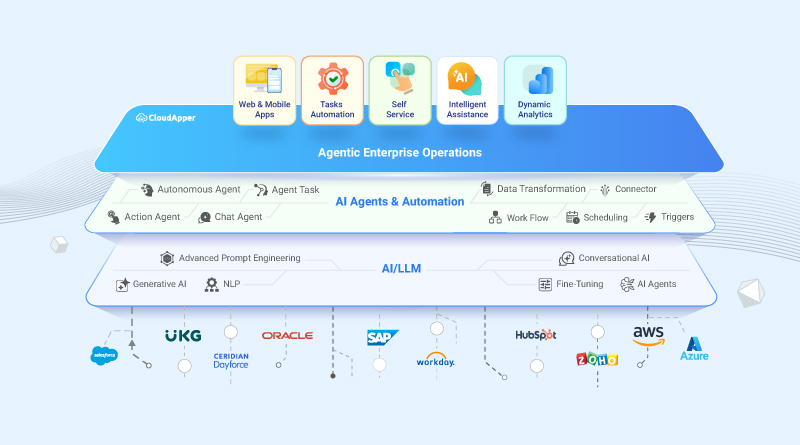
- Works with








- and more.
Similar Posts
Revolutionize Enterprise Applications with AI-Powered Chatbots
5 Ways CloudApper’s Conversational AI Chatbot Can Assist