Boost hiring speed and improve candidate quality by adding AI to your ATS. Learn how CloudApper AI Recruiter automates scoring, prescreening, and scheduling—enhancing your current system without replacing it.
TL;DR
AI for ATS adds intelligent automation to your existing recruiting system—without replacing it. With features like semantic resume matching, automated candidate scoring, AI-powered interview scheduling, and data consolidation, you can accelerate hiring, improve candidate quality, and reduce manual workload
Table of Contents
- Why Your ATS Alone Isn’t Enough
- AI vs ATS Recruiting: A Smarter Hybrid Approach
- Who Benefits from AI for ATS?
- Key Benefits at a Glance
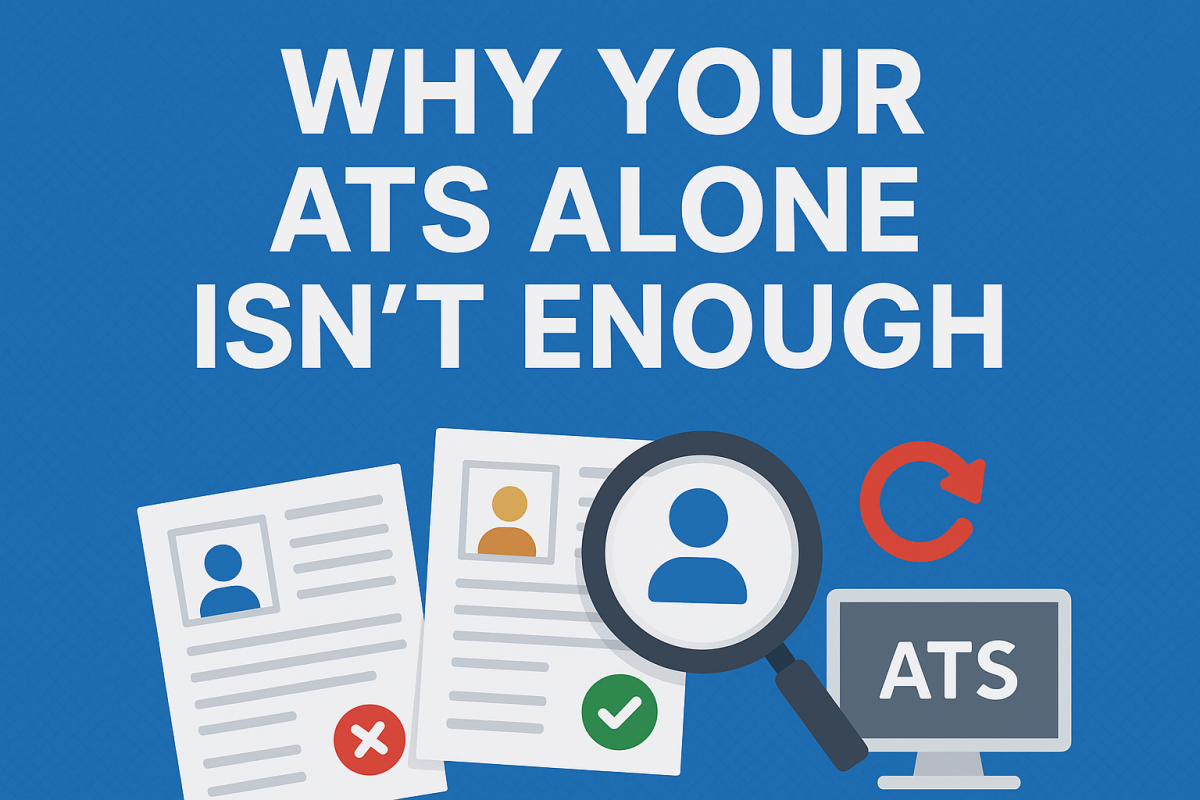
Most organizations rely on Applicant Tracking Systems (ATS) to post jobs, collect resumes, and manage applicant pipelines. While useful, ATS platforms have a serious limitation: they weren’t designed to make hiring decisions. That’s why forward-thinking talent acquisition teams are now layering in AI for ATS—enhancing existing platforms with automation and intelligence that speeds up hiring, improves candidate quality, and eliminates manual bottlenecks.
From semantic matching and resume scoring to AI interview scheduling and ATS data integration, tools like CloudApper AI Recruiter are transforming the recruiting stack—without the need to replace it.
Why Your ATS Alone Isn’t Enough
1. Keyword Filters Miss Great Candidates
Most ATS platforms rely on rigid keyword filters. If a resume doesn’t use exact phrasing, strong candidates can be excluded entirely.
This is where semantic matching ATS AI makes the difference. AI understands the meaning behind words, not just the words themselves. For example, it recognizes that “sales advisor” may align with “account executive” based on role intent—something legacy filters can’t do.
2. Lack of Intelligent Resume Scoring
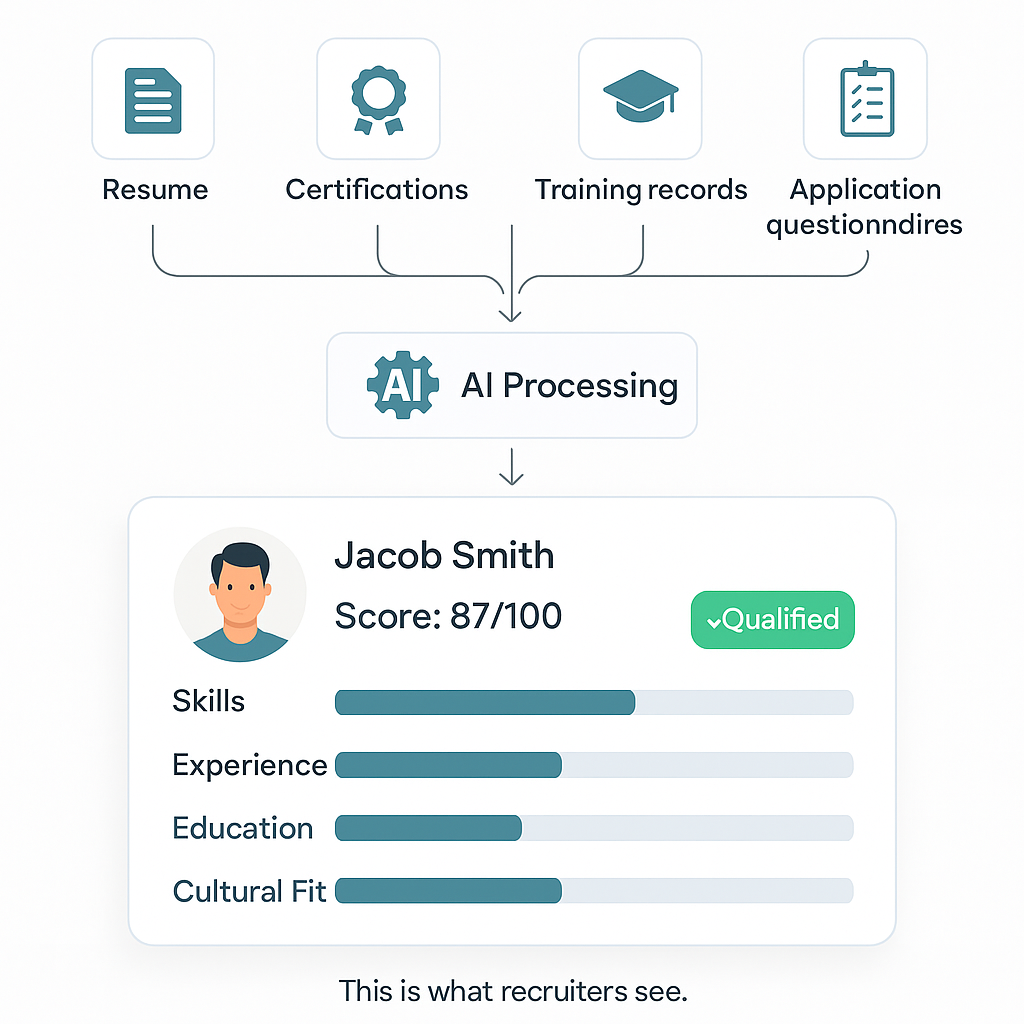
ATS platforms can store applications, but they can’t analyze them. Recruiters are still spending hours manually shortlisting resumes.
With AI for ATS, candidate scoring becomes automated. AI analyzes:

-
Core and soft skills
-
Certifications and education
-
Work history and progression
-
Role relevance and job match scores
-
Screening question responses
This results in ranked, ready-to-review candidates—automatically.
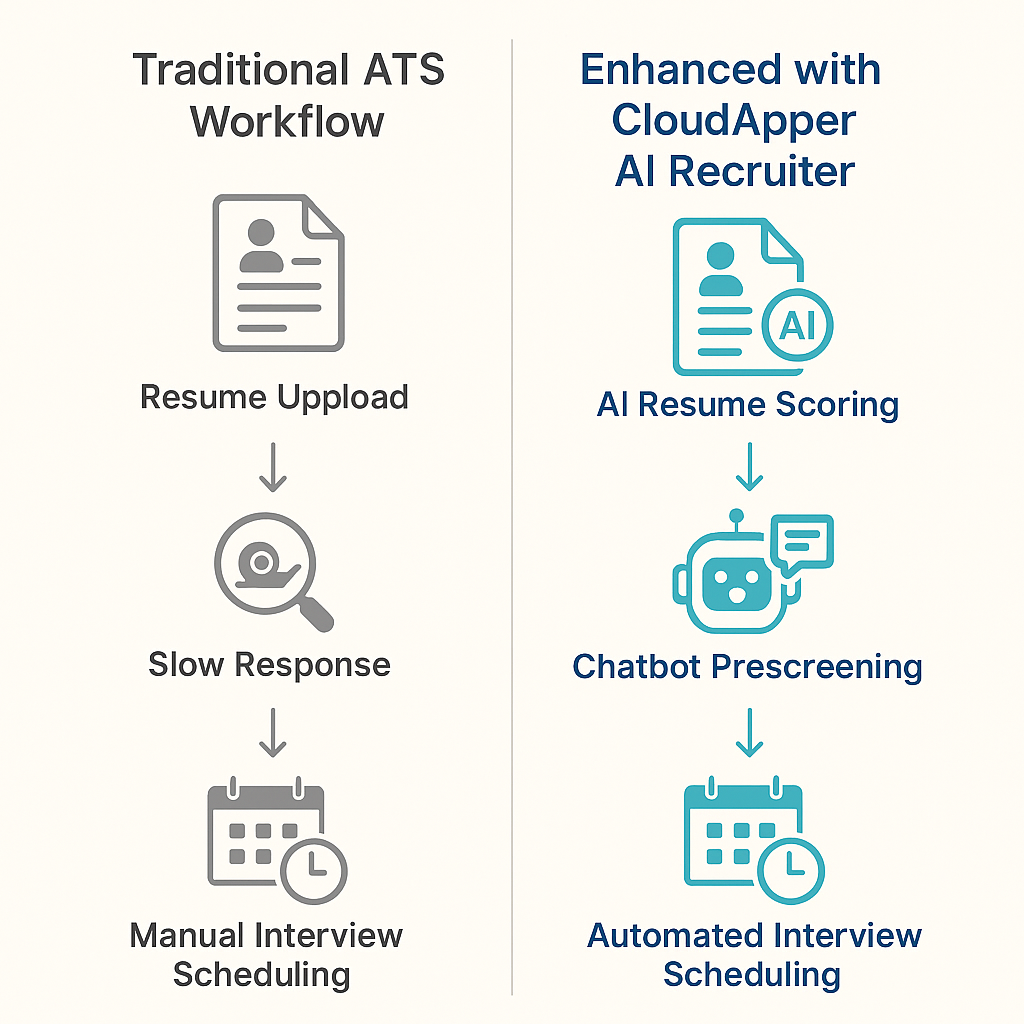
3. Manual Interview Scheduling Causes Delays
A major drag on the hiring process is coordination—recruiters emailing candidates and hiring managers to find mutually available times.
AI interview scheduling eliminates this hassle. Once a candidate meets scoring criteria, an AI chatbot sends a prescreening session and automatically shares a calendar link for interview scheduling. No emails, No waiting, No manual input.
4. Scattered Candidate Data Slows Decisions
Many teams pull candidate data from 4–6 different sources—ATS, HCM, training platforms, and more.
Through ATS data integration, AI aggregates this information into a single, unified profile. Now hiring managers can see:
-
Resume details
-
Assessment results
-
Certifications and training logs
-
Skills extracted from external systems
-
Communication history
This saves time and improves decision quality at every stage.
AI vs ATS Recruiting: A Smarter Hybrid Approach
This isn’t about ATS vs AI recruiting—it’s about convergence.
Your ATS handles application tracking. AI handles what comes next: scoring, engagement, and insights. Together, they create a complete hiring engine.
According to LinkedIn’s Future of Recruiting report:
-
73% of talent professionals say AI will fundamentally change how they hire.
-
AI saves recruiters up to 20% of their weekly workload—about one full day.
-
Companies using AI-assisted messaging see a 9% increase in quality hires.
With tools like CloudApper AI Recruiter, you can achieve all this while keeping your existing tech stack intact.
Who Benefits from AI for ATS?
If your team struggles with:
-
Reviewing high volumes of resumes
-
Delayed interview scheduling
-
Manual screening and scoring
-
Candidate drop-offs due to slow response
-
Juggling multiple data systems
…then AI for ATS is your most immediate, low-friction upgrade.
Whether you’re hiring 10 or 1,000 roles per month, AI gives your team the speed, accuracy, and automation edge to compete for top talent.
Key Benefits at a Glance
| Challenge | Solved by |
|---|---|
| Rigid keyword filters | Semantic matching ATS AI |
| Manual resume screening | AI-powered candidate scoring |
| Time-consuming scheduling | AI interview scheduling |
| Siloed systems | ATS data integration |
| Recruiter overload | Intelligent automation via AI |
You Don’t Need a New ATS—Just a Smarter One
Traditional ATS platforms were built to store and track applicants—not to evaluate, prioritize, or engage them.
By adding AI for ATS, you enhance what you already have:
-
Intelligent resume ranking
-
Real-time scheduling
-
Predictive insights for hiring decisions
-
Unified candidate data in one view
Solutions like CloudApper AI Recruiter do exactly that—bridging the gap between data and action, between applicant and hire.

What is CloudApper AI Platform?
CloudApper AI is an advanced platform that enables organizations to integrate AI into their existing enterprise systems effortlessly, without the need for technical expertise, costly development, or upgrading the underlying infrastructure. By transforming legacy systems into AI-capable solutions, CloudApper allows companies to harness the power of Generative AI quickly and efficiently. This approach has been successfully implemented with leading systems like UKG, Workday, Oracle, Paradox, Amazon AWS Bedrock and can be applied across various industries, helping businesses enhance productivity, automate processes, and gain deeper insights without the usual complexities. With CloudApper AI, you can start experiencing the transformative benefits of AI today. Learn More
- Useful Links:
- Agentic AI
- No-Code/Low-Code
- Custom Software
- HCM Personalization
- iPaaS
- FedRAMP
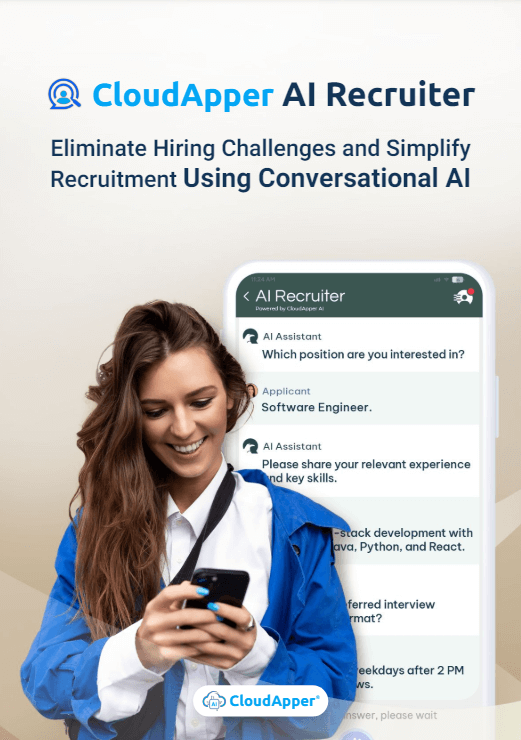
CloudApper AI Solutions for HR

- Works with








- and more.
Similar Posts

How to Assess Candidate Communication Skills Before the First Interview

How to Reduce Interview Rounds Without Lowering Your Hiring Standards