Using AI for Recruiting transforms the traditional hiring process from a manual, tedious chore into a highly efficient workflow. By automating screening, reducing unconscious bias, and managing interview schedules, AI helps hiring managers secure top talent faster.
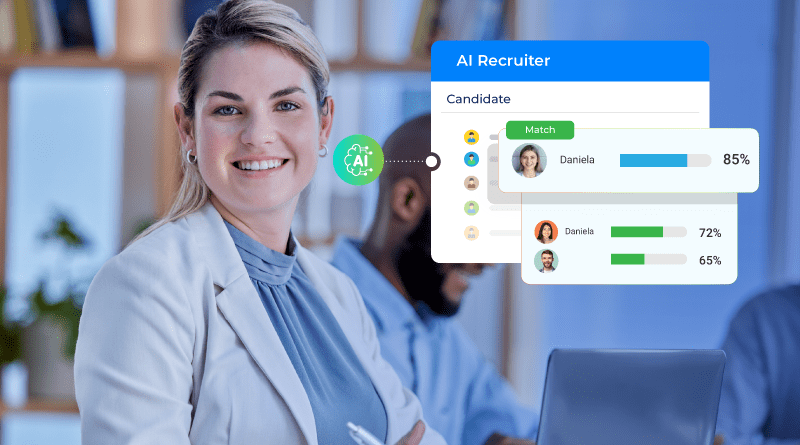
Table of Contents
- TL;DR: The Core Benefits of Using AI for Recruiting
- What Does it Mean to Use AI for Recruiting Talents?
- Top 8 Benefits of Using AI for Recruiting New Talents
- Frequently Asked Questions
As a hiring manager myself, I know how frustrating it gets when you start a new recruiting phase. Sometimes, the resume formats aren’t good enough, the skillsets aren’t good enough, or even worse, candidates with no relevant experience are applying for a senior position. These things sometimes become frustrating when you manually sift through all the resumes. But your frustrations will be long gone if you consider using an AI Recruiter. In this article, I will show you the top benefits of using AI for recruiting new talents to your organization.

TL;DR: The Core Benefits of Using AI for Recruiting
-
Eliminates manual screening: AI instantly parses unstructured resumes to extract objective candidate data.
-
Reduces unconscious bias: Algorithms evaluate applicants strictly on verifiable skills and experience rather than demographics.
-
Automates scheduling: Smart digital assistants sync with your team’s calendars to book interviews without the back-and-forth emails.
-
Accelerates time-to-hire: 24/7 conversational chatbots engage applicants instantly, preventing top talent from losing interest.
-
Lowers cost-per-hire: Automating repetitive administrative tasks drastically reduces the time and money spent on the recruitment cycle.
What Does it Mean to Use AI for Recruiting Talents?
Using AI for recruiting goes far beyond just setting up automated email replies or basic keyword filters. At its core, it means integrating intelligent technologies—specifically Machine Learning and Natural Language Processing —into your hiring workflow to transform how you find, organize, and engage with candidates.
In a traditional setup, recruiters often spend the majority of their day on administrative tasks: sifting through hundreds of unqualified resumes, playing phone tag to schedule interviews, and manually entering data.
When you implement AI for recruiting, you shift from a reactive hiring model to a proactive, highly efficient one. Here is what that actually looks like in practice:
-
Contextual Understanding: Instead of relying on rigid, exact-match keyword filters, AI can “read” resumes and cover letters to understand the actual context of a candidate’s experience. It can recognize relevant skills and capabilities even if the candidate uses slightly different terminology than your job description.
-
Smart Data Parsing and Organization: AI algorithms can instantly extract key information from unstructured documents—like complex PDFs, portfolios, or even text-based responses—and organize it into clean, standardized candidate profiles. This gives hiring managers a clear, objective, birds-eye view of an applicant’s core qualifications without hours of manual data entry.
-
Intelligent Automation: The software acts as a tireless digital assistant. It can interact with candidates 24/7 via conversational chatbots, guide them through standardized pre-screening questions, and autonomously schedule interviews by syncing directly with your team’s calendars.
Ultimately, using AI in recruiting doesn’t mean replacing the human element. It means delegating the heavy lifting of data processing and administration to algorithms so your HR team can focus their energy on what humans do best—building relationships, assessing cultural fit, and securing top-tier talent.
Top 8 Benefits of Using AI for Recruiting New Talents
From candidate screening to scheduling interviews, everything can be automated by using AI for recruiting. CloudApper’s AI Recruiting solution offers a comprehensive suite of features designed to streamline your recruitment efforts.
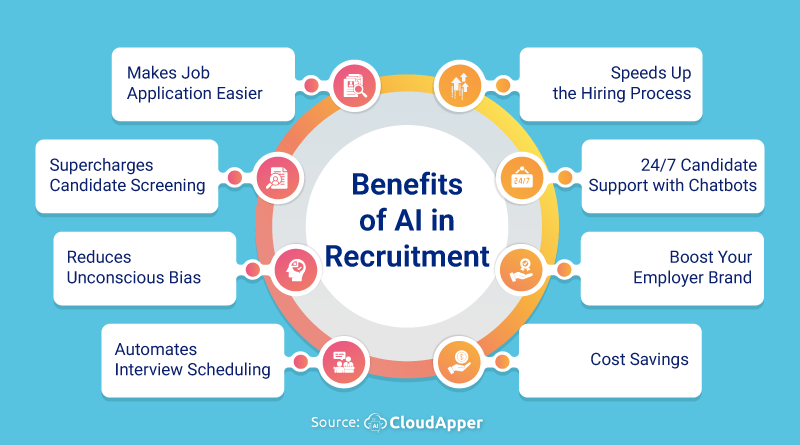
1. Makes Job Application Easier
Asking the candidates to fill out an online form, upload a resume and cover letter, and create a candidate profile is not an efficient process. All these things usually contain the same information. Continuously inputting redundant information makes the candidates frustrated and ultimately, they lose interest in applying for your vacant positions. I have seen a significant drop in new applications when I used to leverage this old-fashioned application system. Rather than picking up the best candidates, you end up with the desperate ones.
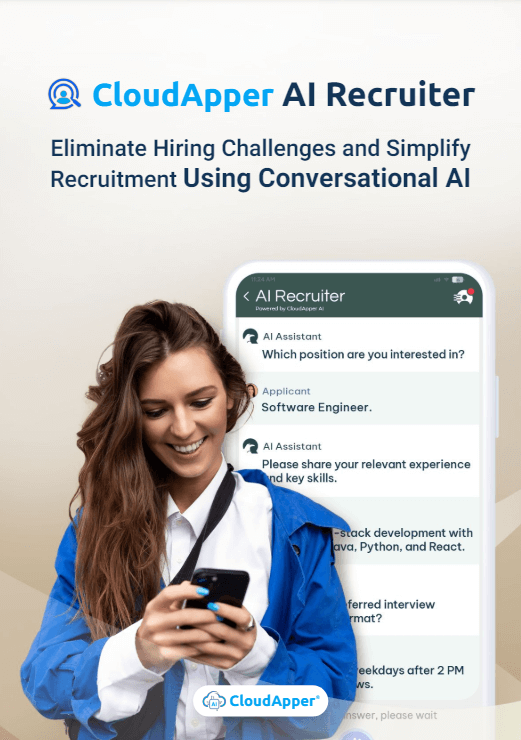
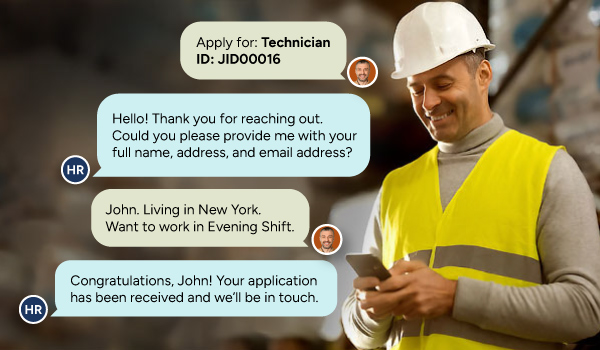
CloudApper AI allows candidates to apply for a position by simply having a conversation with a built-in recruitment chatbot. The chatbot will ask the candidates all the necessary pre-screening questions before asking for their resumes. If a candidate passes the pre-screening phase, only then they will be asked to upload their resumes. Having such a simple application process, you will receive a wave of good candidates.
2. Supercharges Candidate Screening
CloudApper AI can scan and parse information from resumes and cover letters, and can give you a birds-eye-view of a candidate’s qualifications. This automated candidate screening feature can also extract information from video resumes and it only takes a few moments. So, you will no longer have to go through all those resumes one by one and waste your valuable time.
3. Reduces Unconscious Bias
When screening candidates manually, unconscious bias can unintentionally influence hiring decisions. There’s always a chance that you’re choosing candidates based on some stereotypical information after being frustrated with seeing all the bad resumes. This not only makes it hard for talented candidates to get a chance but also hampers one of the most important recruitment metrics which is diversity & inclusion. CloudApper AI evaluates candidates based on objective criteria, mitigating the impact of factors like educational background or ethnicity. This levels the playing field and ensures you discover top talent based on true merit.
Success Story
With the help of CloudApper’s AI Recruiter, we were able to cut down our time-to-hire by almost 50%
HR Director, a large construction company in New Jersey*
4. Automates Interview Scheduling
By leveraging AI in recruiting, you can achieve an automated interview scheduling process. After candidates upload their resumes, the AI recruiter analyzes the resumes to check if they meet all the criteria to be called for interviews. The best-fit candidates are then prompted to a new page to schedule their interviews. You can preset a time and date range for the interview slots and candidates will only be able to schedule their interviews in those preset ranges.
5. Speeds Up the Hiring Process
Using AI for recruiting new talents can speed up your hiring process significantly. Just as I’ve said before, CloudApper AI runs conversations with candidates, scans through their resumes, and allows candidates to schedule interviews by themselves. All this can be done with multiple candidates simultaneously. Workflow automation of this level reduces the time to hire new candidates significantly.
6. Cost Savings
Recruitment processes are not cheap by any means. Hiring agencies, marketing, ATS platforms, etc. requires a lot of money. If your recruitment process is slow, that cost goes up quickly. If you use AI for recruiting, you can minimize cost per hire significantly. CloudApper AI can cut down your hiring costs by automating most of your recruitment tasks.
Statistics
According to a recent study, using AI reduces the average cost of hiring a candidate by 71% and increases recruiter efficiency by up to three times
7. 24/7 Candidate Support with Chatbots
Candidates often have questions, especially outside of business hours. With the AI chatbot for recruitment that is built into CloudApper AI, candidates can ask any question at any time, regardless of business hours. This communication availability makes the hiring process even easier and creates a great candidate experience.
8. Boost Your Employer Brand
A positive candidate experience goes a long way. With the easy application process, quick screening process, and automated interview scheduling, CloudApper AI creates a great candidate experience and with a great candidate experience, you can create a strong employer brand among them.
Frequently Asked Questions
Q1: What are the benefits of AI in recruiting?
The major benefits of using AI In recruiting are that it makes hiring efficient, eliminates unconscious human biases, helps to cast a wide talent pool, and saves hiring time and hiring costs.
Q2: How does an AI recruiter actually improve the candidate experience?
AI improves the candidate experience by providing instant engagement and a friction-free application process. Instead of forcing candidates to fill out repetitive, multi-page forms, AI allows them to apply through a simple conversational interface. Coupled with 24/7 chatbot support to answer their immediate questions, candidates feel valued and informed right from the start.
Q3: How does AI reduce unconscious bias if it doesn’t rank candidates?
AI reduces bias during the initial screening phase by focusing entirely on objective data. Through smart parsing, the AI extracts verifiable skills, certifications, and relevant work experience while ignoring demographic indicators or subjective formatting choices. This ensures every applicant is evaluated on a level playing field based purely on their core qualifications.
Q4: What specific administrative tasks can AI automate aside from scheduling?
Beyond automated interview scheduling, AI handles the heavy lifting of data entry. It can instantly parse information from complex resumes (including PDFs and text documents), administer standardized pre-screening questionnaires via chat, and automatically build clean, organized candidate profiles for your HR team to review.
Q5: Is AI recruiting software only suitable for large enterprises?
Not at all. While large corporations rely on AI to manage massive volumes of applicants, small to medium-sized businesses use it to scale their capabilities. AI allows smaller, resource-stretched HR teams to automate tedious manual work, acting as a digital assistant so they can operate with the efficiency of a much larger recruitment department.
Q6: How does an AI recruitment platform handle candidate data privacy?
Reputable AI recruiting solutions are built with strict data security and compliance standards in mind. The AI securely extracts and stores applicant information in encrypted databases, ensuring that sensitive personal data is protected, compliant with modern privacy regulations, and accessible only to authorized hiring personnel.
Elevate Your Recruitment Strategy with AI
The traditional recruitment process can be a bottleneck for large organisations. CloudApper AI Recruiter, with its suite of AI-powered features, can revolutionise your hiring efforts. From supercharged screening to saving hiring costs, AI for recruiting empowers you to find the best talent faster, improve your employer brand, and operate more efficiently.
Contact us today to get a personalised demo of CloudApper AI Recruiter.
*Disclaimer: Due to privacy reasons, the identity of the person or company cannot be revealed.

What is CloudApper AI Platform?
CloudApper AI is an advanced platform that enables organizations to integrate AI into their existing enterprise systems effortlessly, without the need for technical expertise, costly development, or upgrading the underlying infrastructure. By transforming legacy systems into AI-capable solutions, CloudApper allows companies to harness the power of Generative AI quickly and efficiently. This approach has been successfully implemented with leading systems like UKG, Workday, Oracle, Paradox, Amazon AWS Bedrock and can be applied across various industries, helping businesses enhance productivity, automate processes, and gain deeper insights without the usual complexities. With CloudApper AI, you can start experiencing the transformative benefits of AI today. Learn More
- Useful Links:
- Agentic AI
- No-Code/Low-Code
- Custom Software
- HCM Personalization
- iPaaS
- FedRAMP
CloudApper AI Solutions for HR

- Works with







- and more.
Similar Posts

Hiring During ATS Migration: How to Keep Your First Round…

Hiring Freeze? How to Keep Qualified Candidates Engaged Until the…