Marketing efficiency is critical for small businesses with limited time and resources. This article explains why efficiency is hard to achieve, how AI improves marketing efficiency in practical ways, and how tools like CloudApper AI RevOps help teams work smarter without added complexity.


TL;DR
- What marketing efficiency means: Getting better results from the same time, budget, and resources.
- Why small businesses struggle: Limited teams, manual processes, and inconsistent follow-up reduce efficiency.
- How AI helps: AI automates routine marketing tasks and improves lead qualification and follow-up.
- Key benefits: Lower costs, faster engagement, better consistency, and improved conversions.
- Who benefits most: Small businesses that need to scale marketing without adding staff or complexity.
Table of Contents
- Why Small Businesses Struggle With Marketing Efficiency
- How AI Improves Marketing Efficiency
- Example: Using AI to Improve Marketing Efficiency
- Benefits of AI Marketing Efficiency for Small Businesses
Marketing efficiency is one of the biggest challenges you face as a small business. You have limited time, a limited budget, and a small team that often wears multiple hats. Every campaign, email, and follow-up has to count. When marketing efforts feel scattered or slow, growth stalls. This is where AI starts to matter. Tools like CloudApper AI RevOps help you bring structure to your marketing and revenue activities by automating routine work, improving follow-up, and keeping your efforts focused on what actually drives results.
AI does not replace your marketing team. It supports you by handling repetitive tasks that drain time and energy. CloudApper AI RevOps is designed to help small businesses improve marketing efficiency by managing leads, personalizing outreach, and keeping customer engagement consistent. In this article, you will learn what marketing efficiency really means, why small businesses struggle with it, how AI improves it in practical ways, and how AI-driven tools help you work smarter without adding complexity.
Why Small Businesses Struggle With Marketing Efficiency
Small businesses do not struggle with marketing efficiency because they lack ideas or effort. The struggle usually comes from how marketing work is executed day to day. Limited resources, manual processes, and inconsistent follow-up make it difficult to maintain momentum.
Limited Teams Handling Too Many Tasks
In many small businesses, the same person manages campaigns, responds to inquiries, follows up on leads, and tracks performance. When responsibilities overlap this much, important tasks get delayed or rushed. Marketing becomes reactive instead of planned.
Because time is limited, teams focus on what feels urgent rather than what drives long-term results. This reduces efficiency and makes it harder to scale marketing efforts as the business grows.
Manual Processes That Slow Everything Down
Manual work creates friction. Copying lead information, sending follow-up emails one by one, and tracking conversations in spreadsheets all take time. These tasks are necessary, but they do not directly contribute to growth.
When marketing relies heavily on manual steps, errors increase and consistency suffers. Leads can be missed, follow-ups can be forgotten, and performance becomes harder to measure. Over time, this reduces trust in the marketing process itself.
Inconsistent Lead Follow-Up
Many small businesses generate leads successfully but struggle to respond quickly. Delayed responses reduce interest and weaken engagement. By the time the follow-up happens, the lead may no longer be interested.
This inconsistency often has nothing to do with intent. It is usually the result of limited capacity and a lack of automation. Still, it has a direct impact on marketing efficiency and conversion rates.
Limited Visibility Into What Works
Without clear insights, it is hard to improve. Small businesses often lack visibility into which campaigns, messages, or channels perform best. Decisions are made based on assumptions rather than data.
This leads to repeated effort in areas that may not be effective. Marketing efficiency suffers because resources are not allocated where they have the most impact.
How AI Improves Marketing Efficiency
AI improves marketing efficiency by removing friction from everyday marketing tasks. It helps you stay organized, responsive, and consistent without adding extra work.
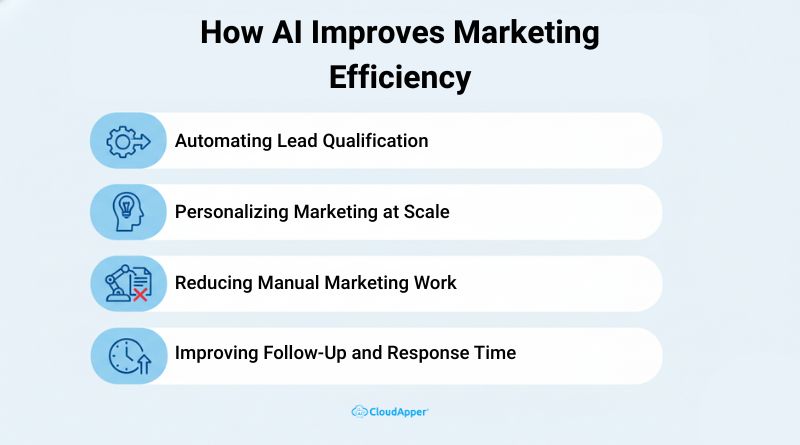
Automating Lead Qualification
Not every lead is ready to buy. AI helps you identify which leads deserve immediate attention and which ones need more nurturing. By analyzing basic signals like behavior, engagement, and responses, AI sorts leads automatically.
This saves time and prevents your team from chasing low-quality leads. You focus your energy on prospects that show real interest. Over time, this improves conversion rates and keeps marketing efforts aligned with sales goals.
Personalizing Marketing at Scale
Personalization is important, but it is difficult to manage manually. AI helps you personalize communication based on customer behavior and preferences. Emails, messages, and follow-ups feel relevant without requiring you to write everything from scratch.
For example, AI can adjust messaging based on past interactions or interests. This makes your outreach feel thoughtful rather than generic. When customers feel understood, engagement improves naturally.
Reducing Manual Marketing Work
AI takes care of repetitive tasks like scheduling messages, distributing content, and tracking responses. This reduces the amount of manual work your team has to handle.
When routine work is automated, you gain time to focus on planning, creativity, and customer relationships. Marketing efficiency improves because effort is spent where it adds the most value.
Improving Follow-Up and Response Time
Fast responses matter. AI helps ensure that leads and customers receive timely replies even outside regular business hours. Automated follow-ups keep conversations moving without delays.
This improves the customer experience and prevents missed opportunities. When response time improves, trust and engagement improve as well.
Most small businesses see the biggest efficiency gains when routine marketing work is handled automatically.
Example: Using AI to Improve Marketing Efficiency
Imagine you run a small online business. You generate leads through your website and social media. Without AI, you manually review leads, send emails, and track responses. This works, but it takes time and leads often go cold.
With AI support, lead data is organized automatically. Interested prospects receive timely messages. Follow-ups happen without reminders. Your team sees which leads are engaged and focuses on closing deals instead of managing inboxes.
CloudApper AI RevOps supports this workflow by automating lead management and engagement. It helps you maintain consistent communication and keep marketing efforts focused. The result is better use of time and improved marketing efficiency.
Benefits of AI Marketing Efficiency for Small Businesses
When AI is applied thoughtfully, it helps small businesses address the exact challenges that reduce marketing efficiency. The benefits show up not only in saved time but also in better outcomes.
Reduced Operational Costs Without Reducing Impact
AI reduces the need for manual effort across marketing tasks. Routine activities like lead sorting, follow-ups, and message scheduling are handled automatically.
This allows small businesses to operate efficiently without expanding headcount. Costs stay under control while marketing output improves.
Better Conversion Through Timely Engagement
Timing matters in marketing. AI helps ensure that leads and customers receive responses when interest is highest. Automated follow-ups keep conversations active without delays.
When engagement is timely and relevant, conversion rates improve. Leads feel valued and are more likely to move forward.
Improved Consistency Across Marketing Channels
Consistency is difficult to maintain manually. AI helps apply the same logic and messaging standards across emails, messages, and outreach.
This creates a smoother experience for prospects and customers. Messaging feels intentional rather than scattered, which strengthens trust over time.
Faster Learning and Smarter Decisions
AI provides insights into customer behavior and campaign performance. You can see what messages resonate and which actions lead to engagement.
This helps you adjust strategies quickly. Instead of guessing, you make decisions based on patterns and outcomes. Marketing efficiency improves because effort is focused where it delivers results.
More Time for Strategy and Relationships
When routine tasks are automated, your team gains time. That time can be spent planning campaigns, improving messaging, and building stronger customer relationships.
This shift from execution to strategy is one of the most valuable benefits of AI-driven marketing efficiency. It allows small businesses to grow without feeling stretched thin.
Final Thoughts
Marketing efficiency is not about working harder. It is about working smarter. AI helps you focus on what matters by removing friction from daily marketing tasks. When routine work is automated, your team can spend more time building relationships and growing the business.
CloudApper AI RevOps supports small businesses by bringing structure and consistency to marketing and revenue operations. By improving follow-up, personalization, and lead management, it helps you make better use of your resources.
Small businesses make the biggest gains when AI supports daily marketing operations.
What is CloudApper AI Platform?
CloudApper AI is an advanced platform that enables organizations to integrate AI into their existing enterprise systems effortlessly, without the need for technical expertise, costly development, or upgrading the underlying infrastructure. By transforming legacy systems into AI-capable solutions, CloudApper allows companies to harness the power of Generative AI quickly and efficiently. This approach has been successfully implemented with leading systems like UKG, Workday, Oracle, Paradox, Amazon AWS Bedrock and can be applied across various industries, helping businesses enhance productivity, automate processes, and gain deeper insights without the usual complexities. With CloudApper AI, you can start experiencing the transformative benefits of AI today. Learn More
- Useful Links:
- Agentic AI
- No-Code/Low-Code
- Custom Software
- HCM Personalization
- iPaaS
- FedRAMP
AI RevOps Agent
Scale Revenue Without Hiring More People
Download Brochure


Amplifier Agent
Keeps Your Brand Visible With Articles & Social Media Content That Connects.
Learn More
Outreach Agent
Launches Email & SMS Campaigns That Reach Out on Time and Actually Convert.
Learn More


- Works with














Similar Posts
The Next Generation of Email Automation Tools: Why the AI…
Speed Up SaaS Queries with Real-Time FAQ Tools for Busy…