AI in revenue operations improves outcomes by unifying workflows, analytics, and automation. This article explains why AI initiatives fail, the challenges RevOps teams face, and how a unified AI-powered strategy enables better alignment, visibility, and measurable revenue impact.

TL;DR
- AI in revenue operations improves outcomes by unifying workflows, analytics, and automation across teams.
- AI fails when deployed as isolated tools without addressing data silos and workflow misalignment.
- Unified RevOps strategies allow AI to act as an orchestration layer rather than a point solution.
- CloudApper AI RevOps enables end-to-end revenue automation without replacing existing systems.
- Successful AI adoption requires alignment across people, processes, and technology.
Table of Contents
- What Is the Role of AI in Revenue Operations Workflows?
- Why AI Alone Doesn’t Fix Revenue Operations
- Challenges of Adopting AI in Revenue Operations
- How CloudApper AI RevOps Automates Revenue Operations Workflows
Revenue operations teams are increasingly turning to AI to streamline workflows, improve forecasting accuracy, and align sales, marketing, and customer success. But how exactly does AI improve revenue operations outcomes—and why do so many AI initiatives fail to deliver meaningful ROI?
This article explains the role of AI in revenue operations workflows, the challenges of adopting AI in RevOps, and how a unified AI-powered revenue operations strategy using tools like CloudApper AI RevOps enables organizations to move from isolated automation to measurable business impact.
What Is the Role of AI in Revenue Operations Workflows?
AI improves revenue operations by acting as an orchestration layer across people, processes, and data. Rather than optimizing a single function in isolation, AI enables revenue teams to operate as a coordinated system.
At a workflow level, AI helps RevOps teams:
-
Automate repetitive operational tasks across marketing, sales, and customer success
-
Prioritize leads and accounts based on predictive signals
-
Surface real-time insights across the revenue pipeline
-
Reduce friction between handoffs and ownership transitions
When applied correctly, AI transforms revenue operations workflows from reactive and manual to proactive and intelligence-driven. However, this transformation only works when AI is embedded within a unified RevOps framework, not deployed as disconnected tools across departments.
Why AI Alone Doesn’t Fix Revenue Operations
Many organizations approach AI as a standalone solution, a tool that can simply be layered on top of existing processes. This is where most AI-driven revenue initiatives fall short.
Revenue operations problems are rarely caused by a lack of automation. They stem from deeper structural issues such as:
-
Data silos across marketing, sales, and customer success
-
Disconnected platforms that prevent insight sharing
-
Inconsistent workflows and handoff rules
-
Lack of visibility across the full customer lifecycle
When AI tools are introduced into this fragmented environment, they operate with incomplete context. Predictive models lose accuracy, automation triggers misfire, and teams continue to work with conflicting data views.
AI improves revenue operations outcomes only when it operates on unified, well-orchestrated workflows.
Challenges of Adopting AI in Revenue Operations
Despite the promise of automation and predictive intelligence, many organizations struggle to realize tangible value from AI in revenue operations. These challenges are not technological shortcomings—they are operational and structural gaps that AI alone cannot resolve.
Fragmented Data Across Revenue Teams
Fragmented data is the most common obstacle to successful AI adoption in RevOps. Customer and revenue data often live in separate systems across marketing automation platforms, CRMs, customer success tools, and financial systems.
When AI models operate on incomplete or inconsistent data, the outputs become unreliable. Lead scoring loses accuracy, forecasts diverge from reality, and revenue insights lack context. Without a unified data foundation, AI-driven analytics cannot reflect the true state of the revenue pipeline.
Disconnected Platforms and Tool Sprawl
Revenue teams frequently operate within a complex ecosystem of disconnected platforms. Marketing, sales, and customer success may each use best-in-class tools, but without orchestration, information flow breaks down.
This disconnection prevents AI insights from traveling across the revenue lifecycle. Signals identified in marketing fail to inform sales outreach, and customer success insights do not loop back into expansion or retention strategies. As a result, revenue opportunities are missed even when AI-generated insights exist.
Misaligned Workflows and Revenue Handoffs
AI adoption often exposes workflow misalignment rather than fixing it. When ownership, handoffs, and operational rules are unclear, automation creates confusion instead of efficiency.
For example, AI may surface high-intent accounts, but without aligned workflows, teams are unsure who should act, when, and how. This leads to delays, duplicated effort, and inconsistent customer experiences—undermining the very outcomes AI is meant to improve.
Limited AI Readiness and Skills Gaps
Another critical challenge is human readiness. Revenue teams may receive AI-driven insights but lack the training or confidence to act on them.
Without proper upskilling, AI outputs are treated as suggestions rather than trusted intelligence. Teams revert to intuition-based decisions, reducing adoption and weakening ROI. Successful AI integration requires ongoing enablement so teams understand not just what AI recommends, but why.
Treating AI as a Tool Rather Than a RevOps Strategy
Perhaps the most fundamental challenge is conceptual. Many organizations adopt AI as a tactical tool rather than a strategic RevOps capability.
When AI is implemented in isolation—within sales, marketing, or support—it reinforces silos instead of eliminating them. AI delivers its greatest impact only when aligned with a unified revenue operations strategy that coordinates people, processes, and data across the entire revenue lifecycle.
How CloudApper AI RevOps Automates Revenue Operations Workflows
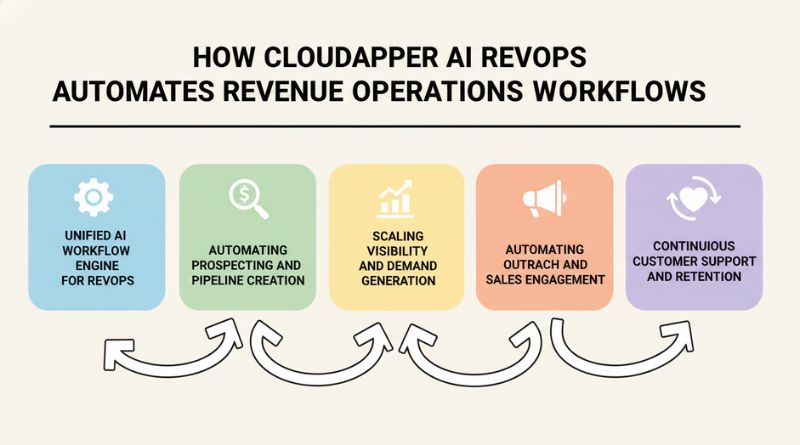
AI delivers real value in revenue operations only when it is applied to execution, not just insights. CloudApper AI RevOps is purpose-built to automate revenue operations workflows end to end—covering prospecting, content, outreach, sales engagement, and customer support—without adding headcount or disrupting existing systems.
A Unified AI Workflow Engine for RevOps
CloudApper AI RevOps functions as a centralized workflow engine that sits above the revenue stack. It connects marketing, sales, and customer success activities into one continuous motion, ensuring that insights, actions, and handoffs remain aligned across the entire revenue lifecycle.
This unified layer eliminates the fragmentation that typically prevents AI from delivering measurable outcomes.
Automating Prospecting and Pipeline Creation
Revenue workflows begin with the Scouting Agent, which defines the Ideal Customer Profile and continuously identifies high-fit prospects across multiple sources. Leads are enriched with verified data in real time, ensuring the pipeline stays relevant, accurate, and ready for engagement.
This removes manual research bottlenecks and keeps revenue teams focused on execution rather than data gathering.
Scaling Visibility and Demand Generation
Once the ICP is established, the Amplifier Agent automates content creation and distribution. It generates SEO-optimized blogs and social content tailored to the target audience, keeping the brand visible across channels without relying on manual content calendars.
This ensures inbound demand generation runs continuously in the background, supporting pipeline growth.
Automating Outreach and Sales Engagement
The Outreach Agent uses enriched lead data to automate personalized email and SMS campaigns aligned to funnel stages. Messaging is timely, relevant, and consistent, allowing outreach to scale without sacrificing personalization.
At the point of active interest, the Sales Agent engages website visitors in real time—answering questions, qualifying intent, and booking meetings instantly. No opportunity waits on human availability, and no hot lead goes cold.
Continuous Customer Support and Retention
Revenue operations do not stop at deal close. The CSR Agent automates customer support workflows by handling FAQs, renewals, follow-ups, and issue routing 24/7. This ensures customers receive consistent, proactive support while reducing operational load on human teams.
Retention and expansion become automated components of the revenue engine, not afterthoughts.
Moving From AI Hype to Revenue Impact
AI has the power to dramatically improve revenue operations outcomes, but only when implemented with intention and structure. Organizations that move beyond fragmented automation and embrace a unified RevOps strategy unlock faster growth, better customer experiences, and more predictable revenue.
The future of revenue operations belongs to teams that treat AI as an enabler of alignment—not a shortcut. By addressing foundational challenges and orchestrating AI across workflows, analytics, and automation, revenue leaders can turn AI investments into measurable business results.
If your revenue teams are investing in AI but still relying on manual handoffs, it’s time to unify execution—not add more tools.
See How CloudApper AI RevOps Automates Your Revenue Workflows
What is CloudApper AI Platform?
CloudApper AI is an advanced platform that enables organizations to integrate AI into their existing enterprise systems effortlessly, without the need for technical expertise, costly development, or upgrading the underlying infrastructure. By transforming legacy systems into AI-capable solutions, CloudApper allows companies to harness the power of Generative AI quickly and efficiently. This approach has been successfully implemented with leading systems like UKG, Workday, Oracle, Paradox, Amazon AWS Bedrock and can be applied across various industries, helping businesses enhance productivity, automate processes, and gain deeper insights without the usual complexities. With CloudApper AI, you can start experiencing the transformative benefits of AI today. Learn More
- Useful Links:
- Agentic AI
- No-Code/Low-Code
- Custom Software
- HCM Personalization
- iPaaS
- FedRAMP
AI RevOps Agent
Scale Revenue Without Hiring More People
Download Brochure


Amplifier Agent
Keeps Your Brand Visible With Articles & Social Media Content That Connects.
Learn More
Outreach Agent
Launches Email & SMS Campaigns That Reach Out on Time and Actually Convert.
Learn More


- Works with














Similar Posts
The Next Generation of Email Automation Tools: Why the AI…
Speed Up SaaS Queries with Real-Time FAQ Tools for Busy…