High-volume hiring overwhelms traditional recruitment fast. This article explains how enterprise teams use AI to screen, engage, and move candidates faster while maintaining quality, reducing recruiter overload, and keeping hiring processes stable at scale.


TL;DR
- High-volume hiring fails when manual screening and scheduling cannot keep up with application volume.
- AI helps stabilize hiring by automating early screening, engagement, and interview scheduling.
- Recruiters regain time to focus on evaluating candidates instead of managing logistics.
- Candidate experience improves through faster responses and clearer next steps.
- CloudApper AI Recruiter helps enterprise teams scale hiring without sacrificing quality.
Table of Contents
- What High-Volume Hiring Really Looks Like in Practice
- Why Traditional Hiring Methods Struggle at Scale
- Manual Hiring vs AI-Assisted High-Volume Hiring
- Where High-Volume Hiring Breaks Down Without Automation
- What High-Volume Hiring Looks Like with CloudApper AI Recruiter
- A Practical Way to Approach High-volume Hiring with AI
- Final Thoughts
High-volume hiring breaks traditional recruitment processes fast. When hundreds or even thousands of applications arrive within days, recruiters fall behind almost immediately. Candidates wait too long for updates. Good applicants drop off. Hiring managers grow frustrated. You are not struggling to find candidates. You are struggling to process them fast enough without losing quality.
Retail, manufacturing, healthcare, logistics, and seasonal hiring teams feel it the most. To handle this pressure, many teams turn to CloudApper AI Recruiter early in the process. Not as a shortcut, but as a way to bring structure, speed, and consistency to high-volume hiring before things spiral.
What High-Volume Hiring Really Looks Like in Practice
High-volume hiring is not just about filling a lot of roles. It changes how your entire recruitment operation behaves.
In real environments, high-volume hiring usually means you are dealing with hundreds or thousands of applicants per role or campaign. Resume screening becomes the first bottleneck. Recruiters spend most of their day reviewing profiles instead of evaluating fit.

Scheduling becomes the second bottleneck. Coordinating interviews across large candidate pools turns recruiters into full-time schedulers. As delays stack up, candidate experience suffers first. Candidates stop responding. Some accept other offers. Others simply disappear.
If you have lived through this, you know the pressure is constant. Every delay compounds the next one.
Why Traditional Hiring Methods Struggle at Scale
Most recruitment processes work fine at low volume. They fall apart at scale.
Manual resume screening takes too long. Even strong recruiters cannot review hundreds of resumes per day without fatigue. Scheduling interviews manually creates delays that candidates notice right away.
Follow-ups often get missed. Status updates fall behind. Recruiters feel overwhelmed. Hiring managers lose confidence in timelines. Burnout starts to show up on the recruiting team.
None of this happens because your team is weak. It happens because the process was never designed for high-volume hiring.
Manual Hiring vs AI-Assisted High-Volume Hiring
| Area | Manual Hiring | AI-Assisted High-Volume Hiring |
|---|---|---|
| Resume screening | Recruiters spend most of the day reviewing resumes one by one | Resumes are screened consistently using defined criteria |
| Interview scheduling | Scheduling takes hours and often causes delays | Scheduling happens earlier and with less manual effort |
| Candidate response time | Slow responses increase candidate drop-off | Faster movement keeps candidates engaged |
| Recruiter workload | Workload spikes and burnout becomes common | Workload is more balanced and manageable |
| Quality of review | Quality suffers due to volume pressure | Recruiters focus on stronger, qualified candidates |
| Overall control | Teams react to volume as it comes | Teams stay in control of the hiring process |
Where High-Volume Hiring Breaks Down Without Automation
Most breakdowns happen in the same places.
Resume backlogs grow faster than recruiters can handle. Candidates wait days or weeks without updates. Missed follow-ups turn into ghosting. Recruiters work longer hours and still feel behind.
Over time, burnout creeps in. Quality slips. The hiring brand takes a hit. Leaders start asking why time to hire keeps increasing even though applications are high.
These are not people problems. They are process problems.
If this breakdown feels familiar, the issue is not effort. It’s time for you to change how candidates move through the funnel.
What High-Volume Hiring Looks Like with CloudApper AI Recruiter
When CloudApper AI Recruiter is in place, the recruitment process follows a clear, repeatable flow that handles volume without overwhelming your team:
Candidates Apply Instantly Using QR Codes Or Text
Candidates start the process by scanning a QR code or sending a text. There is no long application form or portal login. This removes friction at the very first step and makes it easy for candidates to apply from anywhere, especially in high-volume or frontline hiring scenarios.
A Chatbot Guides Candidates To Submit Their Resumes
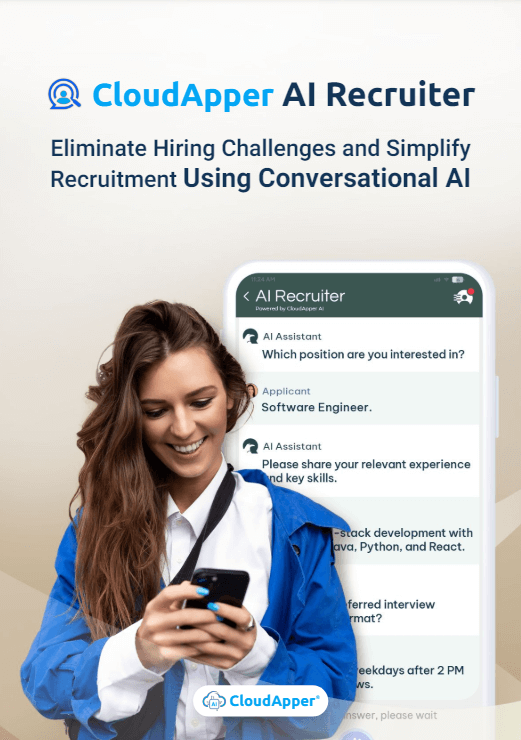
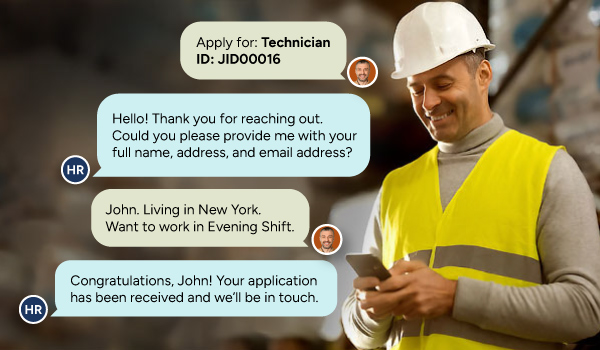
As soon as candidates apply, a chatbot appears and guides them to upload or submit their resume. This happens in real time without recruiter involvement. Candidates know exactly what to do next, and resumes enter the system immediately.
Resumes Are Screened Automatically As They Come In
Once resumes are submitted, they are screened based on role-specific criteria you define. Candidates who do not meet basic requirements are filtered out early. This keeps the funnel clean and prevents recruiters from getting buried in unqualified applications.
Role-Based Pre-Screening Questions Follow Immediately
Candidates who pass resume screening are asked job-specific pre-screening questions. These questions confirm availability, experience, and core role requirements before anyone moves forward. This step adds clarity early and reduces wasted interview time later.
Scenario-Based Questions Verify Real Skills
To validate what candidates claim on their resumes, the chatbot asks real-life, role-related scenario questions. These questions help surface candidates who can apply their skills in practical situations, not just describe them on paper.
Qualified Candidates Receive Interview Scheduling Links
Candidates who pass screening and scenario questions receive a link to schedule their interviews. This removes back-and-forth emails and shortens time to interview. Candidates stay engaged because the next step is clear and immediate.
Recruiters Receive A Ranked And Scored Shortlist
Recruiters see a ranked and scored shortlist based on resume fit, screening answers, and scenario responses. Instead of managing volume, recruiters focus on evaluating strong candidates and making confident hiring decisions.
A Practical Way to Approach High-volume Hiring with AI
If you are feeling overwhelmed by application volume, the goal is not to overhaul everything at once. The most effective teams start by identifying where the process slows down and fixing those pressure points first. This approach keeps changes manageable and delivers faster results.
-
Map where delays actually happen: Look closely at screening time, response time, and interview scheduling to see where candidates get stuck or drop off.
-
Track how recruiters spend their day: If most of their time goes into resume reviews, follow-ups, or coordination, those are the first areas that need support.
-
Focus on the earliest stages first: Resume intake and initial screening feel the pressure of volume before anything else, so improvements here have the biggest impact.
-
Measure improvement by flow, not just speed: A smoother, steadier movement of candidates through the funnel matters more than rushing individual steps.
Final Thoughts
High-volume hiring does not fail because teams lack effort. It fails because traditional processes cannot scale.
When you support recruiters with structured workflows and early-stage automation, hiring becomes manageable again. Speed improves. Candidate experience improves. Recruiters regain focus.
CloudApper AI Recruiter helps enterprise teams bring order to high-volume hiring without sacrificing quality. It gives you a way to move fast, stay consistent, and keep control as volume grows.
If high-volume hiring is becoming your default, the next step is seeing how AI works in your own environment.
What is CloudApper AI Platform?
CloudApper AI is an advanced platform that enables organizations to integrate AI into their existing enterprise systems effortlessly, without the need for technical expertise, costly development, or upgrading the underlying infrastructure. By transforming legacy systems into AI-capable solutions, CloudApper allows companies to harness the power of Generative AI quickly and efficiently. This approach has been successfully implemented with leading systems like UKG, Workday, Oracle, Paradox, Amazon AWS Bedrock and can be applied across various industries, helping businesses enhance productivity, automate processes, and gain deeper insights without the usual complexities. With CloudApper AI, you can start experiencing the transformative benefits of AI today. Learn More
- Useful Links:
- Agentic AI
- No-Code/Low-Code
- Custom Software
- HCM Personalization
- iPaaS
- FedRAMP
CloudApper AI Solutions for HR

- Works with








- and more.
Similar Posts

How to Stop Losing Shortlisted Candidates During a Hiring Surge…

Recording Candidate Video Interviews in Illinois: Consent, Retention, and Deletion…