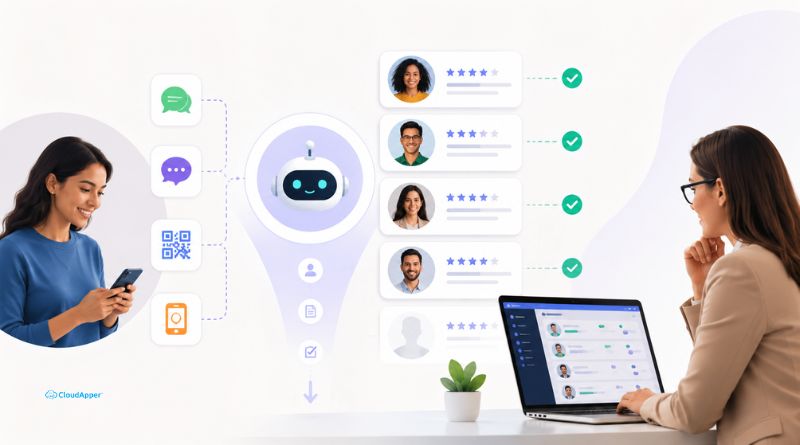
Recruiters lose candidates when applications feel long and frustrating. This article explains how conversational AI simplifies job applications, increases completion rates, and helps hiring teams screen, schedule, and engage candidates faster using a chat-based hiring experience.

TL;DR
- Traditional job applications cause high candidate drop-off and incomplete pipelines.
- Conversational AI replaces long forms with simple, guided chat-based applications.
- Candidates apply faster by scanning a QR code and chatting with an AI recruiter.
- Automated pre-screening and interview scheduling reduce recruiter workload.
- Higher completion rates lead to stronger pipelines and faster hiring decisions.
Table of Contents
If you manage hiring, you have probably seen this happen more times than you can count. A job gets plenty of clicks, but only a fraction of candidates actually finish the application. Your team spends time promoting roles, yet the pipeline feels thinner than it should. High drop-off rates quietly slow down hiring and put extra pressure on recruiters to source more candidates.
This is exactly where CloudApper AI Recruiter and conversational AI come into play. Instead of pushing candidates through long, form-heavy applications, conversational AI turns the process into a simple, guided conversation. Candidates are more likely to finish, and your team gets more complete applications without adding extra work.
Let’s look at how conversational AI works in job applications and why it has such a strong impact on completion rates.
What Is Conversational AI in Job Applications?
Conversational AI in job applications allows candidates to apply by chatting rather than filling out traditional forms. The interaction can happen on a career site, through text messages, or on a mobile device.
Instead of showing dozens of fields at once, the system asks one question at a time. Each question is clear and easy to answer. Based on the response, the next question adjusts naturally.

For candidates, this feels like a normal conversation. For you, it still captures the information you need to evaluate fit. Nothing gets lost, and nothing feels overwhelming.
This approach works especially well for candidates who apply quickly, apply on mobile, or apply to multiple jobs at once.
Why Traditional Job Applications Lose Candidates
Traditional job applications were designed around systems and compliance, not how people actually apply for jobs. That disconnect creates friction at every stage of the hiring funnel and directly impacts how many candidates make it to the finish line.
Long Forms Create Early Drop-Off
Long applications demand too much effort too early. Candidates are asked to upload resumes, re-enter the same information multiple times, and answer questions that often feel repetitive or unclear.
From your side, this may seem necessary. From the candidate’s side, it feels like work before there is any real engagement. Many candidates abandon the application simply because they do not know how much more time it will take. When effort is front-loaded, completion rates suffer.
Mobile Applications Make Friction Worse
Most candidates apply from their phones. What feels manageable on a desktop becomes frustrating on a small screen.
Scrolling through long forms, typing extended answers, and switching between screens all increase the chance that a candidate gives up. Even motivated applicants drop off when the process feels clumsy on mobile. If your application experience is not designed for mobile-first behavior, you are losing candidates before recruiters ever see them.
Timing Works Against Traditional Applications
Candidates rarely apply at ideal times. They apply between shifts, during commutes, or late at night when they finally have a few minutes.
Traditional applications assume uninterrupted time and focus. If the process cannot be completed quickly in one sitting, candidates leave with the intention of coming back later. Many never do. This timing mismatch quietly reduces your applicant pool.
The Impact on Your Hiring Funnel
All of these issues lead to the same outcome. Fewer completed applications and less visibility into real candidate interest.
When applications drop off early, your team spends more time sourcing and less time hiring. You may assume interest is low, when in reality the process is the problem. Fixing this friction is often the fastest way to improve hiring results without increasing spend.
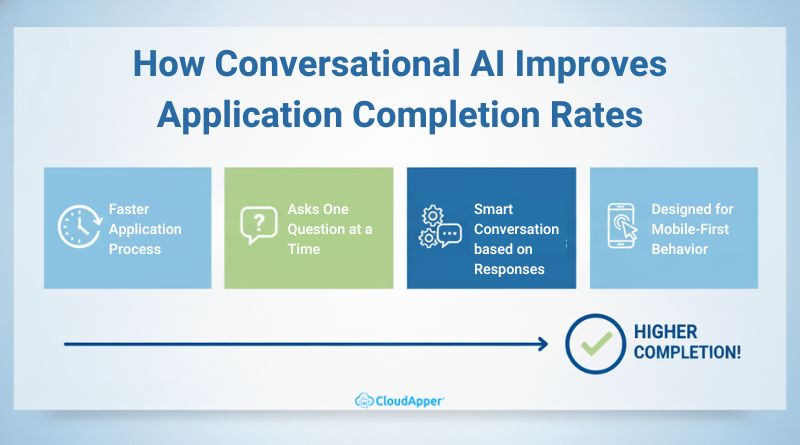
How Conversational AI Improves Application Completion Rates
Conversational AI improves completion rates by removing friction throughout the application process. Instead of asking candidates to commit to a long form, it guides them forward through a series of simple interactions.
A Faster Way for Candidates to Start Applying
Conversational applications lower the effort required to begin. Candidates are not asked to fill out pages of information before they even get started.
A short response or confirmation is enough to enter the process. Once candidates take that first step, they are far more likely to continue and complete the application.
Reducing friction at the start has a direct impact on overall completion rates.
One Question at a Time Keeps Candidates Engaged
Traditional applications show too much at once. Conversational AI does the opposite by focusing on one clear question at a time.
This reduces mental overload and keeps candidates focused. Each answer feels like progress instead of work.
When the process feels manageable, candidates are less likely to abandon it halfway through.
A Smarter Flow Based on Candidate Responses
Conversational AI adjusts the flow based on how candidates respond. If someone does not meet a basic requirement, the conversation can end early without frustration.
Qualified candidates move forward without unnecessary questions. This saves time and makes the experience feel more personal.
From a recruiter’s perspective, this also means cleaner data and fewer irrelevant applications.
Designed for Mobile-First Behavior
Most candidates apply from their phones. Conversational applications are built with this reality in mind.
Short questions and quick responses work naturally on mobile screens. Candidates can apply during short breaks or between tasks without struggling with long forms. A smoother mobile experience leads to higher completion rates, especially for hourly and frontline roles.
The end result is simple. More candidates finish applying, and your pipeline becomes stronger without increasing spend.
If candidates are starting your application but not finishing it, the problem is not interest. It is friction.
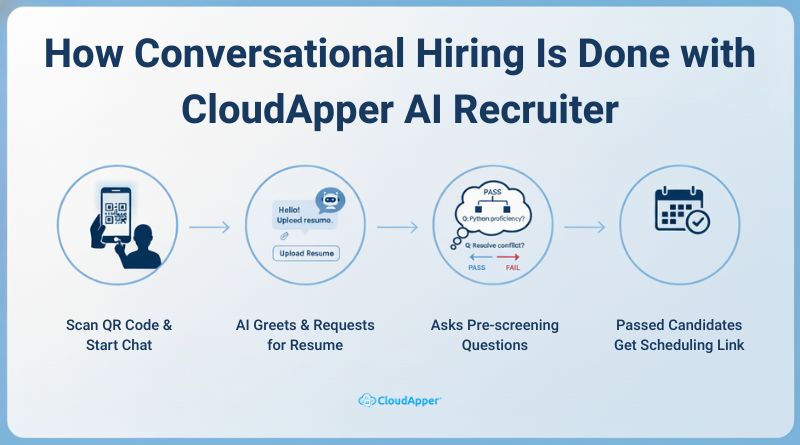
How Conversational Hiring Is Done with CloudApper AI Recruiter
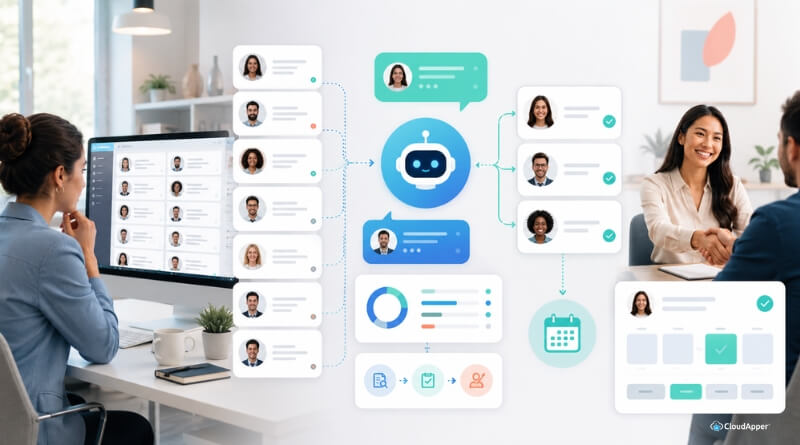
Conversational hiring with CloudApper AI Recruiter is designed to be simple for candidates and efficient for your team. The entire process happens in a guided chat, from the first interaction to interview scheduling.
Starting the Application with a Simple QR Code
The process begins when a candidate scans a QR code. This QR code can be placed on job posters, flyers, career pages, or even at hiring events.
Once scanned, the candidate is instantly redirected to a chat window. There are no accounts to create and no forms to search for. The application starts immediately, which removes hesitation and encourages more candidates to apply.
A Friendly Chat-Based Introduction
As soon as the chat opens, the candidate is greeted by the CloudApper AI Recruiter chatbot. The greeting sets clear expectations and explains what will happen next.
This first interaction feels natural and conversational. Candidates know they are in the right place and understand that the process will be quick and guided.
Resume Upload Without Friction
The chatbot then prompts the candidate to upload their resume. This step is simple and works well on both desktop and mobile devices.
Candidates do not have to manually enter information that already exists on their resume. This reduces effort and speeds up the application.
Once the resume is uploaded, the system uses it to guide the next phase of the conversation.
Skill-Based and Real-Life Pre-Screening Questions
Based on the resume, the chatbot asks relevant pre-screening questions. These questions focus on skills, experience, and real-life job scenarios related to the role.
Because the questions are tailored to each candidate, the conversation stays focused. Candidates are not asked generic or irrelevant questions.
This approach helps you understand how candidates think and respond, not just what titles they have held.
Automatic Decision Based on Pre-Screening Results
After the pre-screening phase, the system evaluates responses against the criteria you set.
Candidates who meet the requirements move forward automatically. Candidates who do not are politely informed that they will not proceed at this time.
This ensures fairness and consistency while saving recruiters from manual follow-ups.
Interview Scheduling Without Back-and-Forth
Qualified candidates receive a calendar link directly in the chat. They can choose an interview slot that works for them without emailing or waiting for confirmation.
This removes scheduling delays and keeps candidates engaged while interest is high. From your side, interviews get booked faster with no extra coordination.
A Real-World Healthcare Hiring Example
Lisa led talent acquisition for a healthcare organization with constant hiring needs. Her team struggled with incomplete applications and slow screening. Recruiters spent hours following up just to collect missing information.
After moving to a conversational application flow, the change was immediate.
Candidates completed applications in one session, often from their phones. Recruiters saw fewer partial applications and more qualified profiles.
Because screening happened automatically, Lisa’s team could focus on interviews and hiring decisions instead of admin work. Time-to-review dropped, and candidate communication improved.
The hiring process became easier to manage without increasing team size.
What This Means for the Future of Job Applications
Job applications are changing because candidate expectations are changing. People expect simple, clear, and respectful experiences.
Conversational AI aligns hiring with how people already communicate. It removes unnecessary steps while keeping important evaluation intact.
For you, this means higher completion rates, faster screening, and stronger pipelines. For candidates, it means less frustration and better engagement.
Improving job applications is not about adding complexity. It is about removing friction where it no longer serves anyone.
Conclusion
High application drop-off is not a candidate problem. It is a process problem. Long forms, poor mobile experiences, and slow screening quietly reduce completion rates and weaken your hiring pipeline. Conversational AI addresses this by turning job applications into simple, guided conversations that candidates can finish in one sitting while giving recruiters more complete and usable information.
With conversational hiring powered by CloudApper AI Recruiter, you can help candidates apply faster, screen them automatically, and schedule interviews without delays. If you want to improve completion rates, reduce recruiter workload, and move qualified candidates forward while interest is high, it is time to rethink how job applications are done.
You do not need more applicants. You need more candidates to actually finish applying and move forward.
What is CloudApper AI Platform?
CloudApper AI is an advanced platform that enables organizations to integrate AI into their existing enterprise systems effortlessly, without the need for technical expertise, costly development, or upgrading the underlying infrastructure. By transforming legacy systems into AI-capable solutions, CloudApper allows companies to harness the power of Generative AI quickly and efficiently. This approach has been successfully implemented with leading systems like UKG, Workday, Oracle, Paradox, Amazon AWS Bedrock and can be applied across various industries, helping businesses enhance productivity, automate processes, and gain deeper insights without the usual complexities. With CloudApper AI, you can start experiencing the transformative benefits of AI today. Learn More
- Useful Links:
- Agentic AI
- No-Code/Low-Code
- Custom Software
- WorkBridge
- iPaaS
- FedRAMP
CloudApper AI Solutions for HR

- Works with


- and more.








Similar Posts
The 7-Second Resume Rule Is Killing High-Volume Hiring in Dayforce:…
How to Automatically Feed Candidate Scores in Greenhouse Scorecards