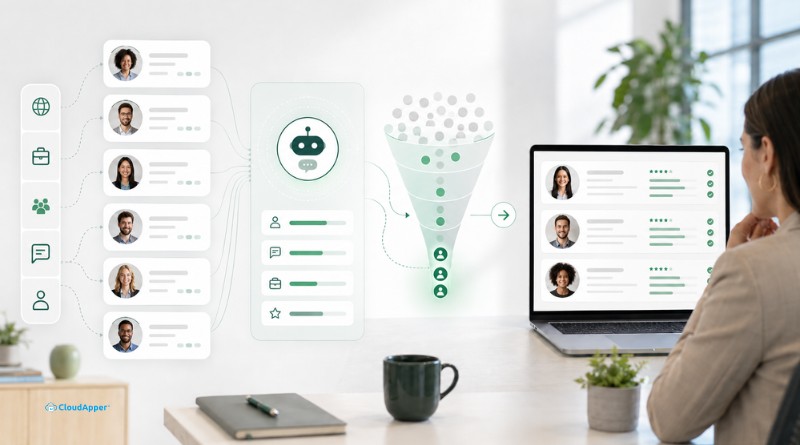
An employee referral program helps frontline teams hire faster and better. This guide explains how referral programs work, why they succeed for frontline roles, where traditional approaches fail, and how AI improves screening, follow-ups, and hiring consistency.


TL;DR
- An employee referral program helps frontline teams hire faster with better-fit candidates
- Referrals work well because employees understand the real demands of frontline roles
- Traditional referral programs struggle with delays, admin work, and inconsistency
- AI improves screening speed, fairness, and communication
- AI-supported referral programs scale easily as hiring volume grows
Table of Contents
- What Is an Employee Referral Program?
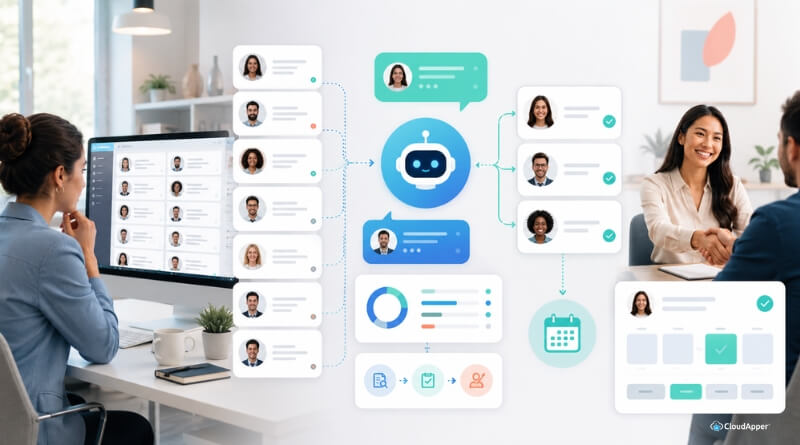
- How an Employee Referral Program Works
- Why Employee Referral Programs Work So Well for Frontline Roles
- Where Traditional Employee Referral Programs Break Down
- How AI Improves Employee Referral Programs
- Traditional Employee Referral Program vs AI-Powered Referral Program
- Final Thoughts
If you are hiring frontline workers, you already know how hard it can be. You need people who show up, do the work well, and stay longer than a few weeks. Job boards often bring in a flood of resumes, but many candidates are not a good fit. Cold applications tell you very little about reliability or attitude.
This is where an employee referral program makes a real difference. It lets your current employees recommend people they already trust. For frontline roles, that trust matters a lot. Tools like CloudApper AI Recruiter help teams run employee referral programs more smoothly by reducing manual work and keeping the process moving. But before you think about tools, it helps to understand the concept clearly.
This article breaks down what an employee referral program is, how it works, why it fits frontline hiring so well, where traditional programs fall short, and how AI improves the process. You will walk away with a clear picture of how to use referrals more effectively without making hiring more complicated.
What Is an Employee Referral Program?
An employee referral program is a hiring approach where your current employees recommend people from their own network for open roles. These recommendations can be friends, former coworkers, or people they know personally. Instead of relying only on job boards, you tap into relationships that already exist.
Companies use employee referral programs because they tend to bring in better candidates. Employees usually think carefully before referring someone. They do not want to damage their own reputation by recommending a poor fit. As a result, referred candidates often match the role better and stay longer.

For frontline roles, this approach works especially well. Frontline work requires reliability, teamwork, and comfort with the job environment. Employees already in those roles understand what the work is really like. They know who would handle it well and who would not.
At a basic level, an employee referral program creates a stronger connection between hiring and culture. Candidates feel more comfortable applying because someone they know already works there. That sense of connection often starts before the first interview.
How an Employee Referral Program Works
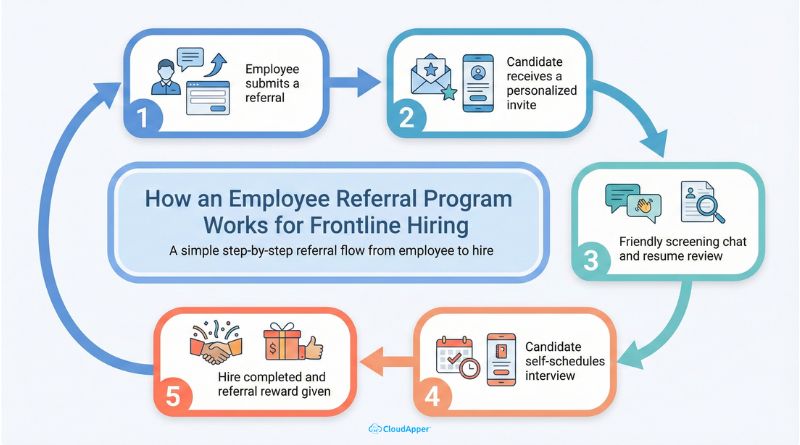
An employee referral program does not need to be complicated. At its core, the process follows a few simple steps.
-
An employee submits a referral
An employee shares the name and contact details of someone they recommend for a role. This step should be quick and easy. The fewer barriers, the more referrals you receive. -
The candidate receives a personalized invite
The referred candidate gets a message explaining the role, who referred them, and how to apply. This message feels more personal than a job board listing. -
Screening takes place
The candidate shares basic details such as experience, skills, and availability. This step helps determine if they meet the role requirements. -
An interview is scheduled
If the candidate qualifies, the interview moves forward. Timing matters here. Faster scheduling keeps interest high. -
Hiring and referral rewards happen
If the candidate is hired, the referring employee may receive a reward. This could be a bonus, recognition, or another incentive.
This process sounds simple, but execution makes the difference. Delays, manual tracking, and inconsistent follow-up can weaken even the best referral program. This is where structure and automation start to matter.
Why Employee Referral Programs Work So Well for Frontline Roles
Employee referral programs fit frontline hiring because they match how frontline work actually operates. The strengths come from context, trust, and speed.
Employees Understand the Reality of the Job
Frontline employees know what the work really feels like. They understand the schedule, the pace, and the physical or emotional demands. When they refer someone, they usually think about whether that person can handle the reality of the role, not just the job title. This leads to candidates who are better prepared and less likely to leave early.
Referrals Create Trust Before the First Interview
Referred candidates do not start as strangers. They already know someone inside the company. That connection builds trust before any formal conversation happens. Candidates feel more comfortable asking questions and moving forward, which often leads to faster decisions and higher offer acceptance rates.
Referrals Improve Team Engagement and Retention
When employees help build their own team, they feel more invested in the outcome. They care about who joins because it affects their daily work. This sense of ownership often leads to stronger teams and better retention, especially in frontline environments where teamwork matters.
When referrals work this well, the real question becomes how to run the program consistently without adding more work for HR.
Where Traditional Employee Referral Programs Break Down
Even strong referral programs can struggle when the process relies too much on manual effort and memory.
-
Manual referral tracking creates confusion
Referrals often arrive through emails, texts, or spreadsheets. HR teams spend time chasing details instead of reviewing candidates. Important information gets missed, and some referrals fall through the cracks. -
Slow response weakens candidate interest
When referred candidates wait days to hear back, momentum fades. Frontline candidates often accept the first offer they receive, so delays directly impact hiring success. -
Inconsistent screening leads to uneven decisions
Without clear criteria, referrals are evaluated differently depending on who reviews them. This creates unfair outcomes and makes it harder to measure program success. -
Administrative work overwhelms HR teams
Scheduling interviews, sending updates, and following up manually takes time. As referral volume increases, HR teams struggle to keep up. -
Lack of visibility reduces trust in the program
When employees do not know what happens after they submit a referral, participation drops. A program that feels opaque quickly loses engagement.
How AI Improves Employee Referral Programs
AI improves employee referral programs by adding structure, speed, and consistency without removing the human connection.
Faster and Friendlier Candidate Screening
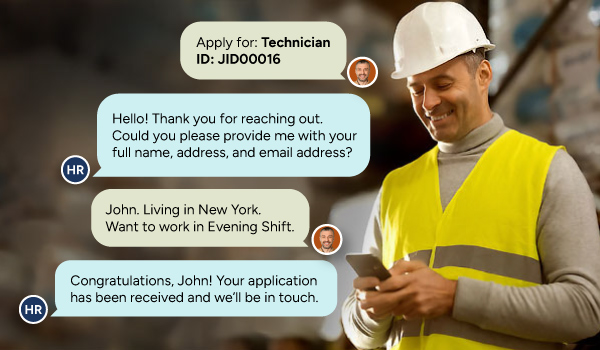
AI enables short, conversational screening instead of long forms. Candidates share experience, skills, and availability in a simple way that feels natural for frontline roles. This lowers drop-off and helps you assess fit earlier.
Consistent and Fair Resume Evaluation
AI extracts key details from resumes and evaluates candidates against role requirements. This keeps screening consistent across referrals and reduces reliance on gut feeling. Every candidate is reviewed using the same criteria.
Self-Scheduling Removes Delays
AI allows shortlisted candidates to schedule interviews themselves. You avoid back-and-forth emails and missed calls. Candidates move forward while interest is still high, and hiring managers stay informed automatically.
Reliable Communication at Every Step
AI keeps candidates informed with timely updates. They know what stage they are in and what comes next. This improves the experience and reduces frustration, especially for frontline workers who value quick responses.
Less Admin Work for HR Teams
By handling routine steps automatically, AI frees HR teams to focus on people instead of paperwork. Referral programs stay organized even as volume grows, without adding extra workload.
Traditional Employee Referral Program vs AI-Powered Referral Program
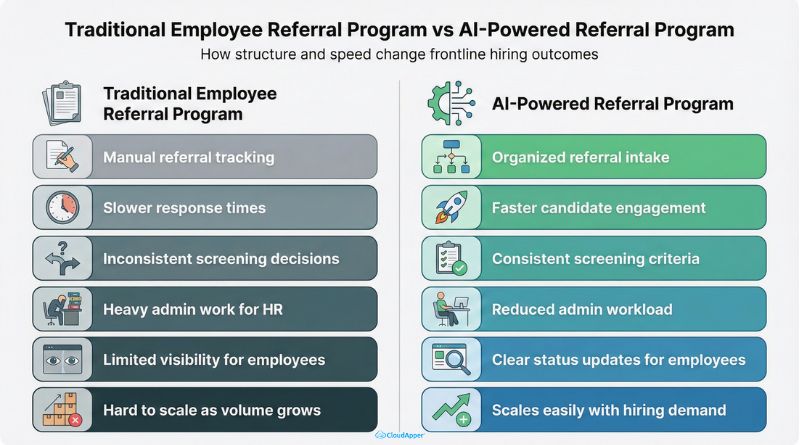
In a traditional referral program, speed depends heavily on people. When teams are busy, responses slow down. Follow-ups get delayed. Admin work piles up. The program still works, but results vary week to week.
An AI-powered referral program keeps execution steady. Referrals trigger immediate outreach. Screening happens consistently. Scheduling moves faster. Admin work stays manageable even as volume grows.
Candidate experience also improves. Instead of waiting days for updates, candidates move through the process smoothly. This matters in frontline hiring, where speed often decides outcomes.
Scalability becomes easier. Traditional programs struggle when referrals increase suddenly. AI-powered programs handle growth without adding pressure to the team.
The difference is not about replacing people. It is about supporting them with systems that do not forget, delay, or stall.
Final Thoughts
An employee referral program is one of the most effective ways to hire frontline workers. It brings trust, speed, and a better fit into the hiring process. The challenge is running it consistently as volume grows.
AI does not replace the human element of referrals. It supports it. It keeps the process fair, fast, and manageable. When you combine employee networks with structured screening and timely communication, hiring becomes less stressful and more predictable.
A strong employee referral program depends less on effort and more on having the right structure.
What is CloudApper AI Platform?
CloudApper AI is an advanced platform that enables organizations to integrate AI into their existing enterprise systems effortlessly, without the need for technical expertise, costly development, or upgrading the underlying infrastructure. By transforming legacy systems into AI-capable solutions, CloudApper allows companies to harness the power of Generative AI quickly and efficiently. This approach has been successfully implemented with leading systems like UKG, Workday, Oracle, Paradox, Amazon AWS Bedrock and can be applied across various industries, helping businesses enhance productivity, automate processes, and gain deeper insights without the usual complexities. With CloudApper AI, you can start experiencing the transformative benefits of AI today. Learn More
- Useful Links:
- Agentic AI
- No-Code/Low-Code
- Custom Software
- HCM Personalization
- iPaaS
- FedRAMP
CloudApper AI Solutions for HR

- Works with







- and more.
Similar Posts
The Hidden Cost of Duplicate Candidate Records Across Your Hiring…
The 7-Second Resume Rule Is Killing High-Volume Hiring in Dayforce:…