SaaS teams lose time and budget on low-quality leads every day. AI-driven multi-channel outreach automation helps focus on the right prospects, improves response rates, and brings structure to follow-ups across email, SMS, and social channels without adding extra workload.

TL;DR
- Multi-channel outreach automation for SaaS coordinates email, SMS, and social touchpoints so leads get timely, structured follow-ups.
- AI improves outreach by analyzing real engagement data and adjusting timing, channel, and messaging instead of relying on guesswork.
- Lead quality improves because the system filters and prioritizes warm, engaged prospects, helping sales focus on the right people.
- A solid setup needs CRM integration, clean lead data, clear journeys, and simple templates, plus ongoing monitoring and optimization.
- Success is measured through reply rates, meetings booked, lead-to-opportunity conversion, and channel performance across opens and clicks.
Table of Contents
- How AI Improves Multi-Channel Outreach Automation for SaaS
- Best Practices for Implementing Multi-Channel Outreach Automation for SaaS
- Benefits of Multi-Channel Outreach Automation for SaaS
- How to Set Up Multi-Channel Outreach Automation for SaaS
- Future Trends in Multi-Channel Outreach Automation for SaaS
- Comparing Multi-Channel Outreach Automation for SaaS Tools
- Final Thoughts
Did you know that SaaS companies waste up to 70% of their marketing budget on low-quality leads? That staggering figure highlights a common pain point in the industry. However, multi-channel outreach automation for SaaS changes the game by using AI tools like the CloudApper AI Outreach Agent to target prospects more effectively. Therefore, teams can boost conversions and cut down on wasted efforts. For example, imagine streamlining emails, SMS, and social touches into one smart system that learns from interactions.
How AI Improves Multi-Channel Outreach Automation for SaaS
Before automation became intelligent, sales teams had to rely on guesswork to decide when to follow up, which channel to use, and how often to reach out. AI removes that uncertainty by watching how prospects actually behave and adjusting outreach in real time. This is how AI truly improves multi-channel outreach automation for SaaS in practical, day-to-day work:
-
Analyzes large volumes of engagement data in real time
AI reviews open rates, click behavior, reply timing, and inactivity across thousands of prospects at once. This allows teams to understand patterns that would be impossible to spot manually. -
Adjusts message timing based on actual prospect behavior
If a lead consistently opens emails in the evening, the system schedules future messages during that time window. This improves open and reply rates without sales reps needing to guess the best timing. -
Refines channel selection automatically
When a prospect ignores email but responds to SMS, AI shifts future outreach toward the channel that performs better. This prevents wasted touches on channels that are not working. -
Continuously improves targeting and sequencing
With every interaction, the system learns which messages and sequences perform best. Campaigns become sharper over time instead of staying static. -
Eliminates guesswork from outreach decisions
Without AI, teams rely on assumptions about audience behavior. With AI, decisions are based on real engagement data, making outreach more precise and reliable. -
Raises automation from basic scheduling to intelligent engagement
Instead of simply sending messages on a fixed timeline, AI turns automation into a responsive system that adapts to how each lead actually behaves.
Best Practices for Implementing Multi-Channel Outreach Automation for SaaS
Start by assessing your current setup before implementing outreach automation. Evaluate how leads flow through your funnel and identify bottlenecks. Next, select a tool that supports multiple channels and AI features. For instance, platforms like CloudApper AI Outreach Agent offer robust options. Then, define your lead scoring criteria, such as industry fit or engagement level. After that, build sequences that branch based on responses. Finally, test everything thoroughly before full rollout.
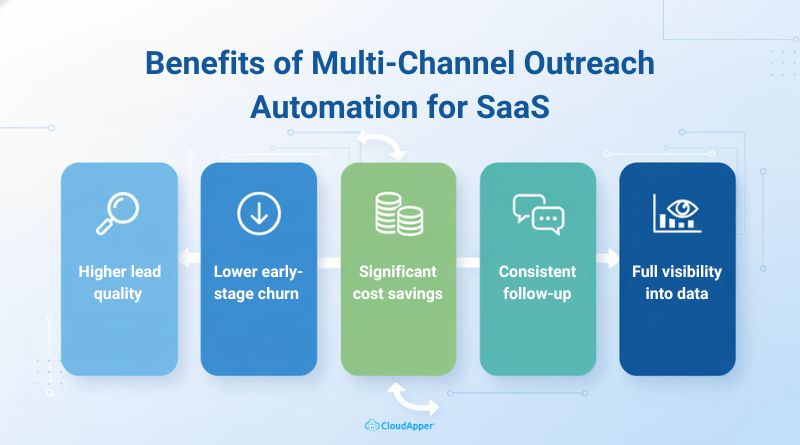
Benefits of Multi-Channel Outreach Automation for SaaS
-
Higher lead quality through real behavior filtering
The system tracks how prospects open, click, and reply, then prioritizes only those who show real interest. Sales reps stop wasting time on cold form fills and focus on leads that are already warm, which often lifts conversion rates by 20 to 30 percent. -
Lower early-stage churn from better engagement alignment
When prospects receive messages on the channels they actually respond to, expectations stay clear from the start. In real cases, teams that focused only on engaged leads saw demo bookings rise and no-show rates fall because conversations stayed active and relevant. -
Significant cost savings from reduced manual workload
Follow-ups, reminders, and status updates run automatically. Sales reps no longer spend hours copying data, setting alerts, or checking who needs a nudge. That saved time shifts directly into calls, demos, and deal work, lowering the cost per lead and per opportunity. -
Consistent follow-up regardless of team workload
Every prospect receives the same level of attention even during peak sales periods. No leads are forgotten in inboxes, and no reps follow wildly different routines. This creates a pipeline that feels steady and predictable instead of rushed and uneven. -
Full visibility into what actually drives responses
You always know which messages performed well, which channels worked best, and where leads dropped off. Decisions are no longer based on guesswork. However, this only works when lead data stays clean and accurate. When inputs remain strong, automation becomes a reliable growth engine instead of just another tool.
How to Set Up Multi-Channel Outreach Automation for SaaS
Setting up multi-channel outreach automation works best when you approach it step by step instead of trying to automate everything at once. A structured setup helps you avoid data issues, message overload, and poor targeting. Here is a practical way to build your system for long-term success:
-
Map your customer journey first
Identify every key touchpoint from first contact to conversion so you know exactly where automation should support the sales process. -
Integrate the automation platform with your CRM
Connect the system to your existing CRM, such as Salesforce, to ensure all lead activity, engagement, and status updates stay in one unified view. -
Create consistent content templates for each channel
Build email, SMS, and follow-up templates that maintain the same message and tone across all channels to avoid confusing prospects. -
Monitor engagement and optimize continuously
Track opens, clicks, replies, and drop-offs. Use this data to refine timing, content, and sequencing for better results over time. -
Ensure compliance with data privacy regulations
Always follow rules such as GDPR and regional data laws to protect prospect information and maintain trust in your outreach process.
Future Trends in Multi-Channel Outreach Automation for SaaS
Future trends in multi-channel outreach automation for SaaS point to more integrations. Expect in-app messaging and voice channels to join the mix. AI will evolve to predict not just channels but content preferences too. For instance, generative AI might craft messages on the fly. However, ethical use remains crucial. Therefore, focus on transparency to build trust with prospects.
Comparing Multi-Channel Outreach Automation for SaaS Tools
| Evaluation Area | What to Look For | Why It Matters for Your Team |
|---|---|---|
| Channel Support | Email, SMS, social, and chat in one platform | Lets you reach prospects where they actually respond instead of relying on a single channel |
| Behavior-Based Triggers | Opens, clicks, replies, inactivity | Ensures follow-ups react to real engagement instead of fixed schedules |
| CRM Integration | Native sync with your existing CRM | Prevents data silos and keeps sales activity, lead status, and reporting aligned |
| Personalization Depth | Dynamic fields based on user behavior | Makes outreach feel human instead of automated |
| Analytics & Reporting | Real-time performance tracking | Shows exactly which messages and channels drive responses |
| Ease of Use | Simple setup and daily operation | Reduces training time and speeds up adoption |
| Automation Control | Ability to pause, edit, or override flows | Keeps human control when needed |
| Scalability | Handles growing lead volume smoothly | Supports expansion without adding manual workload |
| Cost Structure | Transparent pricing based on usage | Helps balance budget with long-term ROI |
| AI Optimization | Predictive timing and channel selection | Increases response rates without manual testing |
Final Thoughts
In wrapping up, multi-channel outreach automation for SaaS transforms lead generation. It empowers teams to focus on quality interactions, driving sustainable growth. By leveraging CloudApper AI Outreach Agent, you stay ahead in a competitive landscape. So, explore these solutions today and watch your metrics improve.
What is CloudApper AI Platform?
CloudApper AI is an advanced platform that enables organizations to integrate AI into their existing enterprise systems effortlessly, without the need for technical expertise, costly development, or upgrading the underlying infrastructure. By transforming legacy systems into AI-capable solutions, CloudApper allows companies to harness the power of Generative AI quickly and efficiently. This approach has been successfully implemented with leading systems like UKG, Workday, Oracle, Paradox, Amazon AWS Bedrock and can be applied across various industries, helping businesses enhance productivity, automate processes, and gain deeper insights without the usual complexities. With CloudApper AI, you can start experiencing the transformative benefits of AI today. Learn More
- Useful Links:
- Agentic AI
- No-Code/Low-Code
- Custom Software
- HCM Personalization
- iPaaS
- FedRAMP
AI RevOps Agent
Scale Revenue Without Hiring More People
Download Brochure


Amplifier Agent
Keeps Your Brand Visible With Articles & Social Media Content That Connects.
Learn More
Outreach Agent
Launches Email & SMS Campaigns That Reach Out on Time and Actually Convert.
Learn More


- Works with














Similar Posts
The Next Generation of Email Automation Tools: Why the AI…
Speed Up SaaS Queries with Real-Time FAQ Tools for Busy…