Recruiting feels stuck between “move faster” pressure and nonstop follow-ups. LLMs are helping teams close that gap by making outreach more personal, responses quicker, and next steps clearer. This piece breaks down what that looks like in real workflows and where CloudApper AI Recruiter fits to keep candidates warm without piling more work on recruiters.

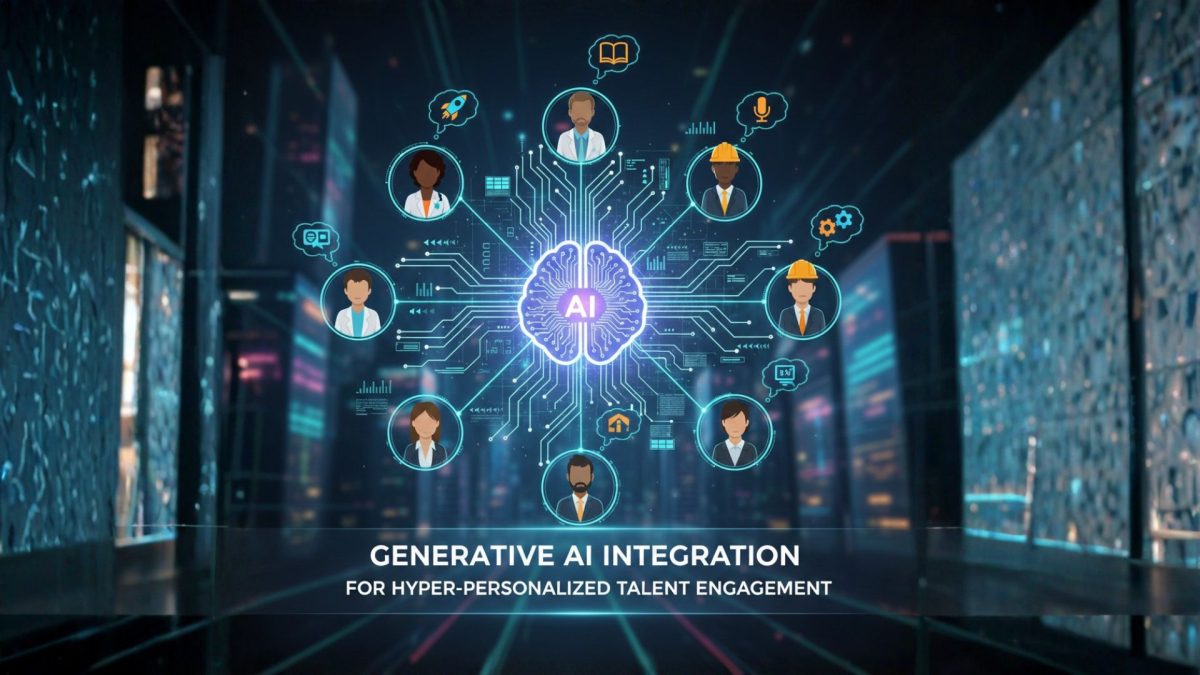
Recruitment is in a weird place right now. Candidates expect fast, relevant communication, but recruiters are staring at inboxes full of resumes, tight hiring manager timelines, and a follow-up workload that never ends. That gap is exactly why Large Language Models (LLMs) are showing up inside modern recruiting stacks—not as “cool features,” but as practical tools that help teams communicate like humans at scale.
And it matters, because the cost of friction is brutal. SHRM has reported a 92% drop-off rate for people who click “Apply” but never complete the application. When you lose that many interested candidates before you even start evaluating fit, “better engagement” stops being a branding goal and becomes a pipeline survival requirement.
Why “personalization at scale” became the baseline
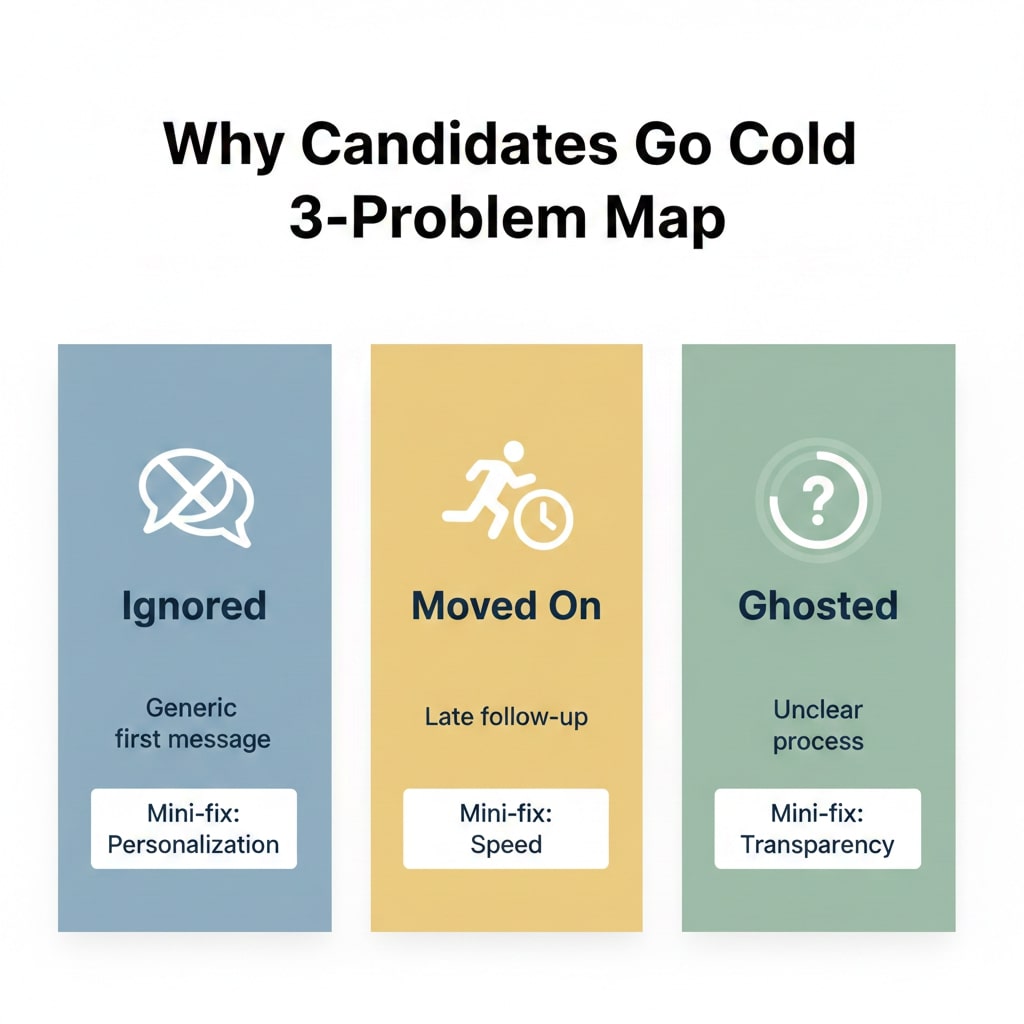
If you’ve ever watched a strong candidate go cold, you already know the pattern:
- The first message feels generic, so it gets ignored.
- The follow-up comes too late, so the candidate moves on.
- The process feels unclear, so they stop responding.
Personalization fixes the first problem, speed fixes the second, and clarity fixes the third.

LinkedIn has shared that personalized InMails perform about 15% better than bulk messages. That’s not a minor lift when you’re hiring at volume or chasing hard-to-reach talent. It’s the difference between “we got a few replies” and “we actually filled the shortlist.”
This is also why recruiters are increasingly becoming what people casually call “AI orchestrators.” The human work is still the point—relationship building, selling the opportunity, reading nuance, aligning stakeholders. But AI takes over the repetitive tasks that eat up time: drafting variants, summarizing profiles, triggering follow-ups, answering FAQs, and keeping the process moving.
SHRM’s 2025 research shows AI use in HR tasks has climbed to 43% in 2025 (up from 26% in 2024)—meaning teams are moving from experiments to real workflows. SHRM
What LLMs actually do in talent engagement (beyond “writing messages”)
Hyper-personalized engagement isn’t just inserting a first name. When LLMs are integrated correctly, they can help with four high-impact jobs:
1) Build a tailored value proposition per candidate
A strong outreach message usually connects three dots:
- what the candidate has done,
- what the role needs,
- why your company is worth the switch.
LLMs can draft that bridge quickly by reading a candidate profile/resume and mapping it to role requirements. That doesn’t replace recruiter judgment—but it makes the first draft faster and more consistent.
2) Adapt outreach across channels and moments
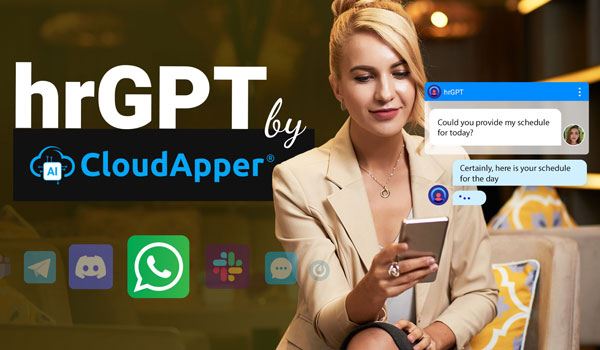
Candidates don’t live in one channel. You might start with email, follow up via SMS, and then confirm interview details through a chat interface. LLMs help keep the tone consistent while adjusting length, format, and call-to-action for each channel.
3) Generate clearer, more candidate-friendly job descriptions
Job descriptions are often overloaded, inconsistent, or written for internal stakeholders rather than humans who are deciding whether to apply. SHRM has noted that among HR professionals using AI in recruiting, job description generation is one of the most common uses.
In practice, LLMs help teams rewrite JDs to be more readable, role-specific, and inclusive—without needing three rounds of edits from five people.
4) Keep candidates warm automatically
Fast, personalized follow-up matters because candidates drop when they feel ignored. Poor communication also directly harms outcomes—research frequently highlights that experience gaps cause candidates to disengage, decline offers, or share negative impressions. (For example, SHL research has been cited showing 42% of candidates decline offers due to a bad interview experience.)
So when AI handles reminders, check-ins, “here’s what happens next,” and reschedule coordination, recruiters get more time for the moments that actually win candidates.
The “AI Orchestrator” recruiter is a real shift—not a slogan
Gartner reported that 38% of HR leaders were already piloting, planning, or implementing generative AI as of early 2024 (up from 19% the prior year). Gartner That jump tells you something important: leaders aren’t adopting GenAI because it’s trendy—they’re adopting it because the workload pressure is structural.
But the smartest teams aren’t using AI to sound more “automated.” They’re using AI to sound more personal, more timely, and more consistent.
Where CloudApper AI Recruiter fits naturally into this shift
This is the exact lane CloudApper AI Recruiter is built for: hyper-personalized engagement without adding recruiter workload.
Instead of a single generic automation layer, CloudApper AI Recruiter uses a multi-agent approach (Screening, Assessment, Communication, Scheduling, Analytics) to support the full engagement cycle:
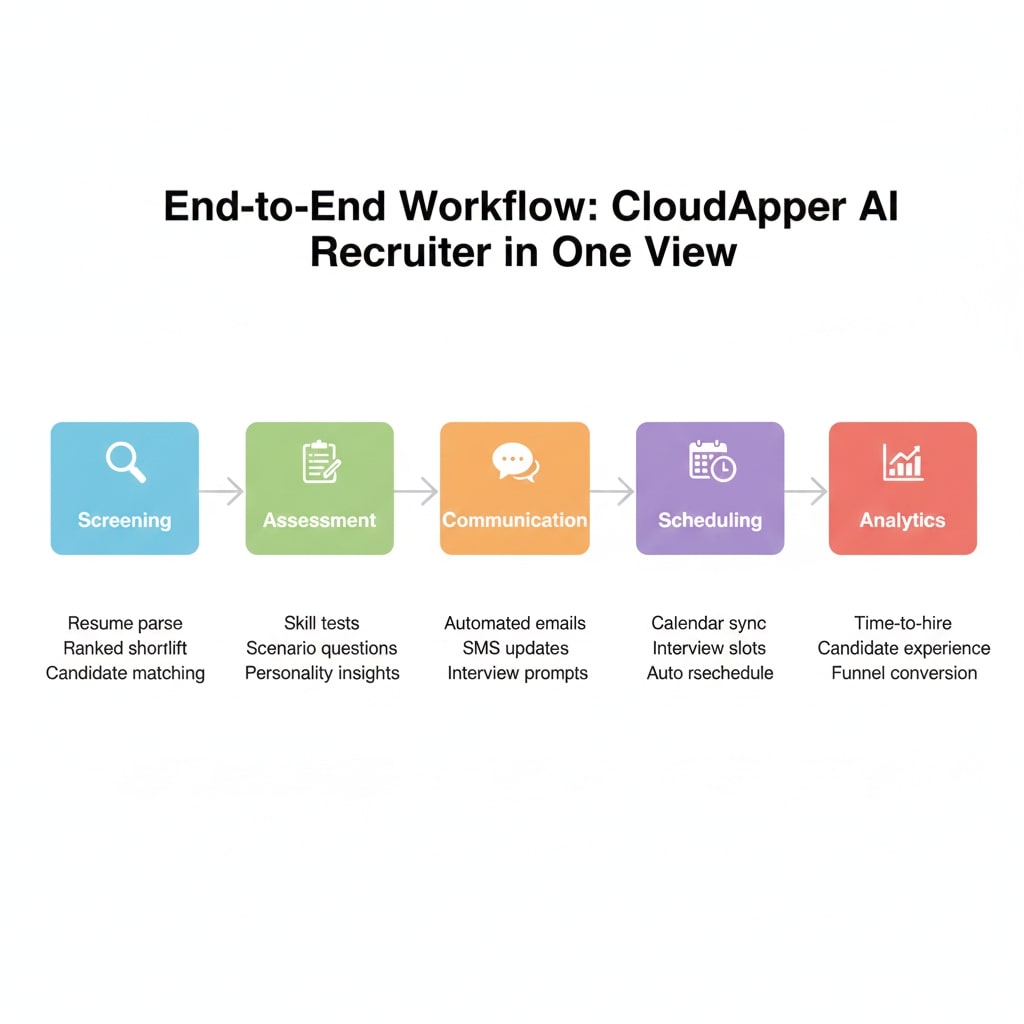
- Screening + scoring + ranking so recruiters aren’t buried under volume.
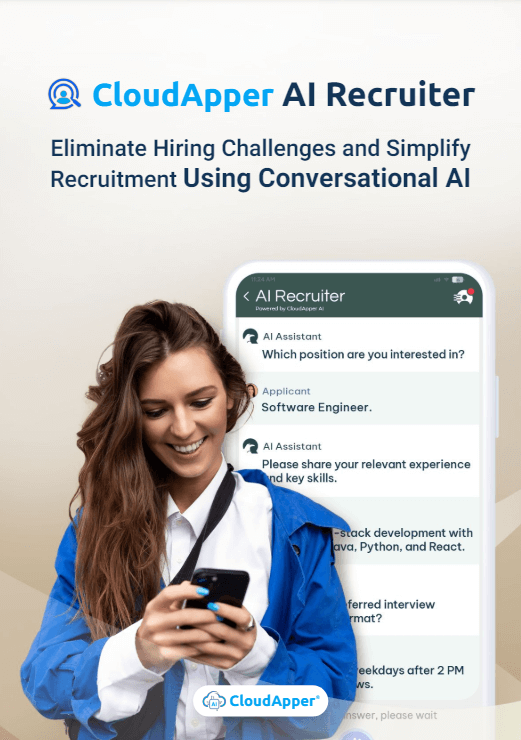
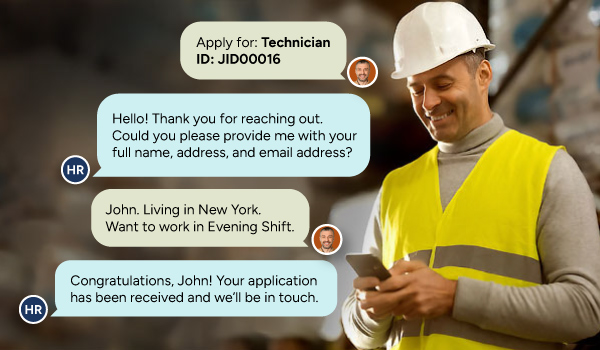
- A recruiting chatbot that guides candidates through the process and answers questions in real time.
- Automated email/SMS communication to keep candidates engaged with updates and follow-ups.
- Scheduling automation that syncs calendars and manages reschedules.
- Analytics to track funnel flow, response behavior, and conversion.
That matters because candidate drop-off often isn’t about “lack of interest.” It’s often about friction and delay. With a 92% abandonment benchmark floating around in the industry, removing steps and keeping momentum is a competitive advantage.
CloudApper’s angle is also practical for real environments: it’s designed to integrate with existing ATS/HRIS/TA systems without messy migrations, and teams can tailor workflows to match how they actually hire.
A practical playbook for hyper-personalized engagement (that doesn’t feel creepy)
Here’s what works in the real world—especially for North America hiring teams where speed and candidate expectations are high:
- Use personalization signals that candidates recognize as “real.”
Examples: a project, certification, domain experience, location constraint, shift preference, or recent role. (Avoid guessing personal traits.) - Keep the “why you” specific.
Mention a team mission, a tech stack, a growth path, schedule stability, or impact. Generic culture lines don’t convert. - Make the next step easy.
One clear action: reply with a time window, answer 2–3 quick questions, or book directly. - Follow up fast, but politely.
If you’re going to follow up, do it with new information: a benefit, a clarifying detail, or an option. - Offer transparency early.
Share timeline, steps, pay range (when possible), and interview format. Clarity builds trust. - Let AI do the drafts—keep humans responsible for judgment.
Recruiters should own the final message strategy and the decision-making.
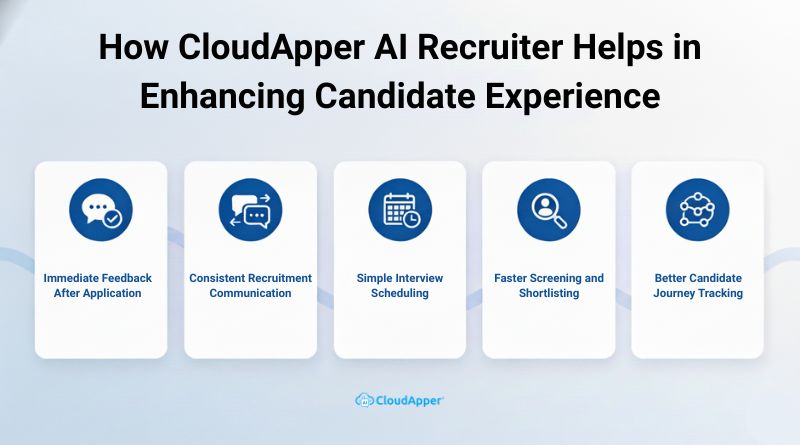
CloudApper AI Recruiter supports this by combining chatbot-led guidance, communication automation, and scheduling coordination, so your engagement isn’t dependent on someone remembering to follow up between meetings.
Don’t ignore governance: bias, privacy, and compliance are part of “quality engagement.”
Personalization has to be responsible. Hiring-related AI is increasingly treated as “high risk” in regulation discussions (especially in the EU), and U.S. states are tightening expectations around employment decision tools. For example, California AI employment regulations took effect in October 2025.
That doesn’t mean “don’t use AI.” It means:
- document what the system does,
- standardize what inputs are used,
- monitor outcomes,
- keep humans accountable for hiring decisions.
CloudApper AI Recruiter’s emphasis on reducing both unconscious human bias and algorithmic bias, along with secure handling of hiring data, fits the direction compliance is moving—while still focusing on what recruiters actually need: better conversions and less manual chasing.
The bottom line
Recruiting is becoming more human, not less—because the admin work is finally getting automated.
When LLMs help you personalize outreach, simplify applications, and maintain momentum, candidates feel seen and supported. Recruiters get time back for real conversations. Hiring managers get clearer shortlists. And your pipeline stops leaking at every stage.
If you want to see what this looks like in a practical, end-to-end workflow (screening → engagement → scheduling → analytics), CloudApper AI Recruiter is built exactly for that:
What is CloudApper AI Platform?
CloudApper AI is an advanced platform that enables organizations to integrate AI into their existing enterprise systems effortlessly, without the need for technical expertise, costly development, or upgrading the underlying infrastructure. By transforming legacy systems into AI-capable solutions, CloudApper allows companies to harness the power of Generative AI quickly and efficiently. This approach has been successfully implemented with leading systems like UKG, Workday, Oracle, Paradox, Amazon AWS Bedrock and can be applied across various industries, helping businesses enhance productivity, automate processes, and gain deeper insights without the usual complexities. With CloudApper AI, you can start experiencing the transformative benefits of AI today. Learn More
- Useful Links:
- Agentic AI
- No-Code/Low-Code
- Custom Software
- HCM Personalization
- iPaaS
- FedRAMP
CloudApper AI Solutions for HR

- Works with







- and more.
Similar Posts

How to Stop Losing Shortlisted Candidates During a Hiring Surge…

Recording Candidate Video Interviews in Illinois: Consent, Retention, and Deletion…