There is no shortage of people holding a Class A — there is a shortage of drivers who pass a Clearinghouse query and make the right call at 2 a.m. Ten CDL interview questions, what a strong answer sounds like, and the disqualifying signal for each, mapped to 2026 FMCSA and CVSA enforcement priorities.
Table of Contents
- Truck Driver Interview Questions About Independent Work: The Short Answer
- The CDL Hiring Problem Is No Longer a Numbers Problem
- Three 2026 Enforcement Changes Your Interview Should Already Reflect
- The 10 Questions
- How to Score the Answers
- Where Driver Hiring Actually Breaks — and It Is Not the Interview
- Frequently Asked Questions
Truck Driver Interview Questions About Independent Work: The Short Answer
To screen a CDL driver for independent work, ask about decisions they made with no one watching: a trip they shut down for weather, an inspection defect they refused to run, a log they corrected themselves. You are testing whether their judgment holds when dispatch pressure, a delivery window, and a paycheck all point the other way.
The CDL Hiring Problem Is No Longer a Numbers Problem
For a decade the industry explained driver hiring with one statistic: the shortage. That framing is now over, and it changed by the admission of the people who invented it. The American Trucking Associations’ chief economist Bob Costello has reframed it plainly — “What we have in the United States is a quality problem around drivers, much more so than an absolute number.” ATA president Chris Spear went further: “What we lack is the number of qualified drivers who meet our high standards of professionalism and safety.”
That distinction is the whole job of a CDL interview. There is no shortage of people holding a Class A. There is a shortage of drivers who will pass a Clearinghouse query, survive a Level 1 inspection, and make the right call at 2 a.m. on an icy grade with a load that is already late. Ten questions cannot verify a record — your queries and your MVR do that. What ten questions can do is tell you how a driver thinks when the rule and the schedule disagree.
Federal median pay for heavy and tractor-trailer drivers is $57,440 (BLS, May 2024) against roughly 237,600 openings a year. You are not competing for scarcity. You are competing on how well you can tell a professional from a liability before they touch your equipment.
Three 2026 Enforcement Changes Your Interview Should Already Reflect
Most CDL interview question lists on the internet were written before any of this. Each of these maps to a specific question below.
| What changed | Status as of August 2026 | Question it should drive |
|---|---|---|
| English language proficiency becomes an out-of-service offense. FMCSA published a proposed rule codifying 49 CFR 391.11(b)(2) and placing non-compliant drivers out of service, with a narrow US–Mexico border-zone exception. | Proposed rule published 10 Aug 2026; comments close 9 Oct 2026 | Q6 — communication with dispatch, customers, and officials |
| CVSA’s 2026 International Roadcheck driver focus is ELD tampering — false or manipulated records of duty status. Falsification of duty status was the second most-cited driver violation last year, at 58,382 violations. | Active enforcement priority | Q1 — ELD experience |
| The 2026 Roadcheck vehicle focus is cargo securement. Nearly 35,000 violations were issued in 2025 for unsecured cargo and vehicle components. | Active enforcement priority | Q5 — cargo securement |
And the baseline you are hiring against, from CVSA’s 2025 Roadcheck (56,178 inspections): 5.9% of drivers were placed out of service. Of those driver out-of-service violations, hours of service was 32.4%, no CDL 24.4%, no medical card 14.9%, and false logs 10.0%. Cargo securement accounted for 11.4% of vehicle out-of-service violations across North America.
Read that list again as a hiring document. Four of the top five reasons a driver gets pulled off the road are paperwork and eligibility — things you can catch before an offer. The interview is for the fifth thing: judgment.
The 10 Questions
Each question below has the same three lines: why it works, what a strong answer sounds like, and the signal that should end the conversation. Use the third line. It is the one most hiring managers skip.
1. Walk me through your experience with ELDs — including a time the device and your actual duty status disagreed.
Why it works: ELD tampering is CVSA’s 2026 driver focus. A driver who has never had to reconcile a device error either has very little seat time or is not paying attention.
Strong answer sounds like: A specific device by name, a specific correction, and an annotation they made themselves — plus who they told.
End the conversation if: They describe editing time to create hours, or call log manipulation something “everybody does.” That is a false-log violation you are being warned about in advance.
2. Describe a critical safety decision you made on the road with nobody available to approve it.
Why it works: This is the independent-judgment question. Every driver will say safety comes first; this asks what it cost them.
Strong answer sounds like: A decision that had a downside they absorbed — a missed appointment, a shut-down, a conversation with an unhappy customer — and no blame shifted to dispatch.
End the conversation if: Every example ends with them being right and someone else being wrong, or they cannot produce one at all.
3. How do you run pre-trip and post-trip inspections, and when did an inspection catch something that mattered?
Why it works: Brake and tire defects drove 41.1% of vehicle out-of-service violations in the 2025 Roadcheck. A driver’s inspection habit is your cheapest insurance against that.
Strong answer sounds like: A repeatable sequence, not a recital of the CDL manual, plus a defect they found and what they did instead of running it.
End the conversation if: They describe post-trips as optional, or the honest answer is “I look it over.”
4. How do you plan a route and manage your clock when the delivery window and your Hours of Service do not both fit?
Why it works: Hours of service is the single largest driver out-of-service category at 32.4%. This question asks whether they solve that conflict legally or quietly.
Strong answer sounds like: Parking planned in advance, dispatch called early, the appointment renegotiated rather than the log.
End the conversation if: The resolution involves personal conveyance used as extra drive time, or “I make it work.”
5. Tell me about the most difficult load you have secured. Walk me through the securement, not the delivery.
Why it works: Cargo securement is CVSA’s 2026 vehicle focus and 11.4% of vehicle out-of-service violations.
Strong answer sounds like: Working load limits, tiedown count for the length and weight, and re-checks in the first 50 miles and at every break.
End the conversation if: They cannot describe how they arrived at a number of straps or chains, or the shipper loaded it and they never looked.
6. Walk me through a call with a dispatcher, a customer, and an officer on the same bad day.
Why it works: FMCSA’s proposed rule would place a driver out of service for inability to respond to official inquiries in English. Separately, communication is what turns a delay into a managed delay.
Strong answer sounds like: Early notification, plain language, no surprises, and clear recall of an interaction with an inspector.
End the conversation if: Every problem in their history was somebody else’s fault, or roadside interactions are described as adversarial by default.
7. What conditions make you stop, and who did you have to tell about it?
Why it works: The stopping decision is where independent judgment and commercial pressure collide most directly.
Strong answer sounds like: Specific thresholds, a specific shutdown, and the phone call they made before they were asked.
End the conversation if: They have never shut down, or they only shut down when told to.
8. How do you work with maintenance when you know something is wrong and the shop disagrees?
Why it works: A driver who will run a truck they doubt because a mechanic signed it off is a future out-of-service violation and a future claim.
Strong answer sounds like: Written defect reports, escalation, and holding the line on anything that touches brakes, tires, steering, or lights.
End the conversation if: They have never pushed back, or they have driven something they described as unsafe.
9. What technology do you use to do this job better, and what was the last new system you had to learn?
Why it works: Telematics, collision mitigation, digital freight matching, and camera systems are now standard. Learning speed is a real cost line.
Strong answer sounds like: Named tools, a specific thing they learned recently, and no defensiveness about in-cab cameras.
End the conversation if: Every safety system is characterized as surveillance or a nuisance.
10. Why are you leaving, and what would make you stay somewhere three years?
Why it works: Turnover is the cost that eats every other efficiency you gain. This is the only question here about your retention, not your risk.
Strong answer sounds like: Concrete, checkable reasons — home time, lane structure, equipment age, pay predictability — that you can honestly match or honestly decline.
End the conversation if: The reasons cannot be verified, or their stated needs are things you know you do not offer. Hiring against that is a resignation you scheduled.
How to Score the Answers
Run every candidate through the same five dimensions and write the number down before you discuss them. Consistency of questioning is also what makes your process defensible if it is ever reviewed.
| Dimension | 1 — Reject | 2 — Concern | 3 — Hire |
|---|---|---|---|
| Compliance instinct | Treats rules as obstacles | Follows rules when observed | Follows rules when it costs them |
| Independent judgment | Waits for permission | Decides, then informs late | Decides, documents, notifies early |
| Inspection discipline | Informal, “looks it over” | Consistent pre-trip only | Repeatable pre- and post-trip, with a real catch |
| Communication | Blames others | Reports problems after the fact | Escalates before it becomes a problem |
| Retention fit | Wants what you cannot offer | Vague about what they want | Specific needs you can genuinely meet |
Anything scoring 1 on compliance instinct or independent judgment is a decline regardless of the total.
Where Driver Hiring Actually Breaks — and It Is Not the Interview
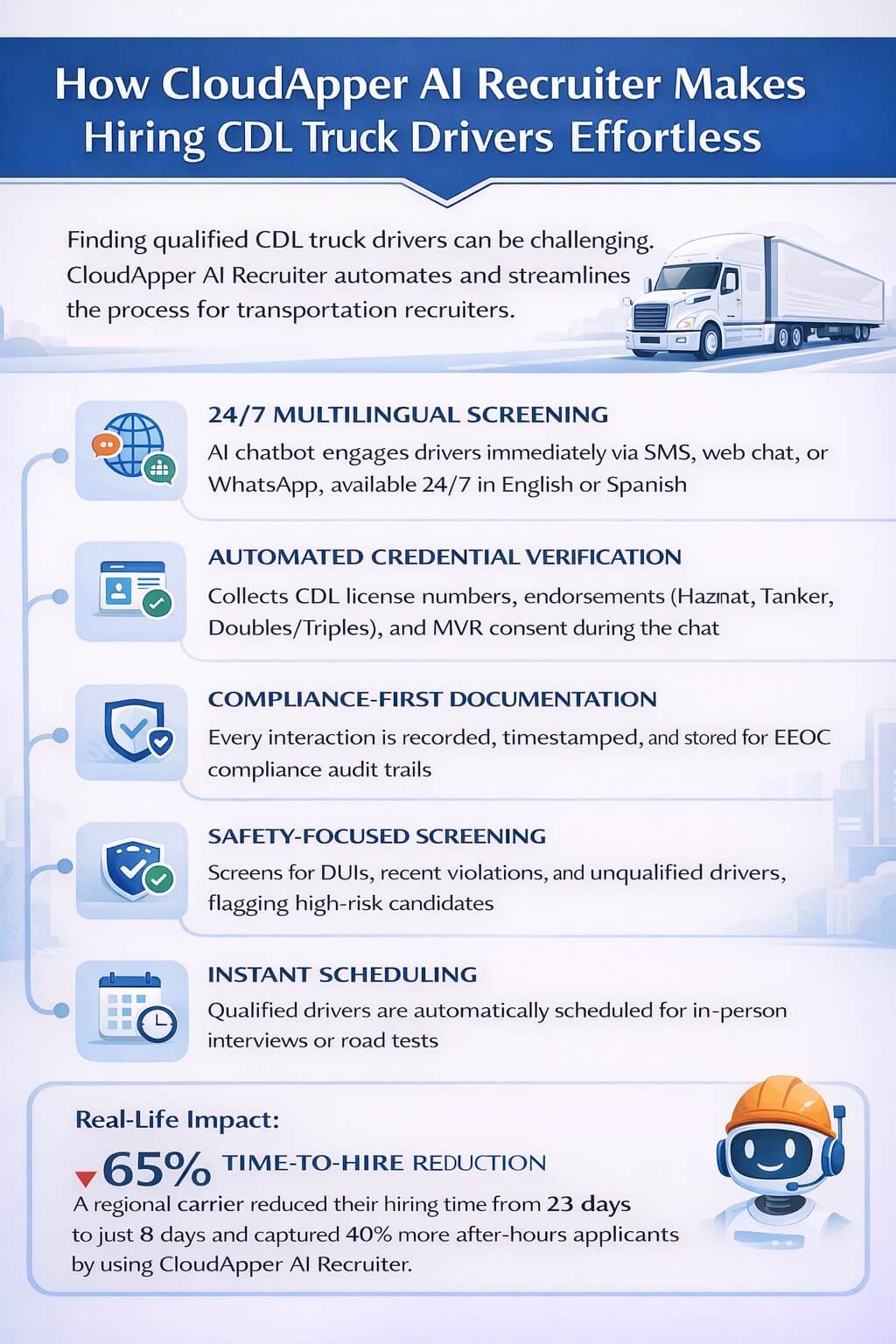
Ten good questions are worthless if the qualified driver never reaches the interview.

Your ATS or HCM was built to store what happened: an application submitted, a stage advanced, an offer accepted. It was never built to do the work in between — query the Clearinghouse, verify a CDL class and endorsements, read an MVR, chase a candidate who abandoned an application at 11 p.m., and get a screening conversation on the calendar before a competitor does. That gap between the system of record and the work is where driver hiring is lost, and it is not a recruiter performance problem. It is an architecture problem.
The cost of that gap is measurable on the candidate side. SHRM has reported that as many as 92% of people never finish an online job application. In driver hiring, where the applicant is holding a phone in a truck stop and has three other carriers open, an application that takes twenty minutes and a callback that takes three days is not a funnel. It is a leak.
CloudApper AI Recruiter closes that gap without replacing the system you already run. It sits on top of your existing ATS or HCM and does the screening work that platform was never designed to do: a conversational apply-and-screen flow candidates finish on a phone, automated credential and eligibility checks, consistent structured questions asked identically of every applicant with a timestamped record, and interview scheduling that happens while the candidate is still engaged. Your ATS stays the system of record. The work moves. The same pattern applies further up the funnel in AI resume screening and downstream in recruitment analytics.
| Metric | Before | After |
|---|---|---|
| Time to hire | 23 days | 8 days |
| Application-to-screen conversion | Baseline | +64% |
| Requisition fill speed | Baseline | 70% faster |
What that changes is not a recruiter’s task list. A carrier that screens in hours instead of days stops losing every qualified driver to whoever called first — and stops filling seats with the candidate who was merely still available. The recruiting team gets its week back from credential chasing. And the driver, who has done nothing wrong except apply on a phone at the end of a shift, gets an answer the same day instead of silence.
That is the difference between a hiring process that stores applications and one that does the work.
See how transportation and logistics teams screen CDL drivers inside the ATS they already use.
Frequently Asked Questions
What interview questions test whether a truck driver can work independently?
Ask about decisions made without supervision: a trip they shut down for weather, a defect they refused to run, a log they corrected on their own initiative. Strong answers include a cost the driver absorbed — a missed appointment or a difficult call with dispatch — rather than a decision that turned out to be free.
What are the most important CDL interview questions to ask in 2026?
Prioritize the four areas that put drivers out of service most often: hours of service management, ELD accuracy, medical and licensing currency, and cargo securement. Then add two judgment questions — the safety decision made alone, and the conditions under which the driver stops — because those are the only ones a background check cannot answer for you.
Why is safety judgment more important than a clean record in a CDL interview?
A clean record tells you what has not happened yet. Safety judgment tells you what a driver will do when a delivery window, dispatch pressure, and a legal limit point in three different directions. Your MVR, CDL verification, and Clearinghouse query establish eligibility; the interview is where you assess the decision-making those checks cannot see.
Does the FMCSA English language proficiency rule affect driver interviews?
It affects what you must be able to observe. FMCSA published a proposed rule on 10 August 2026 codifying the existing requirement in 49 CFR 391.11(b)(2) and placing non-compliant drivers out of service, with a limited exception for drivers operating only within US–Mexico border commercial zones. Comments close 9 October 2026. A structured, spoken interview — rather than a form — is how carriers observe this consistently and record that they did.
Is there still a truck driver shortage in 2026?
The framing has shifted. The American Trucking Associations now describes it as a quality problem rather than a quantity problem — its chief economist has said the United States has “a quality problem around drivers, much more so than an absolute number.” For carriers, that means screening rigor, not recruiting volume, is the constraint.
How does AI screening help carriers hire CDL drivers faster?
It closes the gap between an application arriving and a qualified driver being reached. Conversational screening lets candidates apply and answer qualification questions on a phone, credential and eligibility checks run automatically, every applicant gets the same structured questions with a timestamped record, and interviews are scheduled while the candidate is still engaged — inside the ATS or HCM the carrier already uses.
CloudApper is the process layer that closes the gaps enterprise software can’t — across HR, ERP, CRM, and beyond, on any platform, in weeks not quarters. Because the carriers filling seats fastest are not the ones with the biggest recruiting budgets. They are the ones that stopped waiting for their system of record to do the work.

What is CloudApper AI Platform?
CloudApper AI is an advanced platform that enables organizations to integrate AI into their existing enterprise systems effortlessly, without the need for technical expertise, costly development, or upgrading the underlying infrastructure. By transforming legacy systems into AI-capable solutions, CloudApper allows companies to harness the power of Generative AI quickly and efficiently. This approach has been successfully implemented with leading systems like UKG, Workday, Oracle, Paradox, Amazon AWS Bedrock and can be applied across various industries, helping businesses enhance productivity, automate processes, and gain deeper insights without the usual complexities. With CloudApper AI, you can start experiencing the transformative benefits of AI today. Learn More
- Useful Links:
- Agentic AI
- No-Code/Low-Code
- Custom Software
- HCM Personalization
- iPaaS
- FedRAMP
CloudApper AI Solutions for HR


- Works with








- and more.
Similar Posts

Recording Candidate Video Interviews in Illinois: Consent, Retention, and Deletion…

Replace 30-Minute Phone Screens With 10-Minute Video Reviews: The Recruiter…