Build a talent pool for hourly workers without paid job postings by using organic channels that keep candidates engaged and pre-screened. Techniques like mobile text-to-apply, database mining, employee referrals, and conversational AI keep your hiring pipeline flowing so you’re ready when roles open—without recurring job board costs.
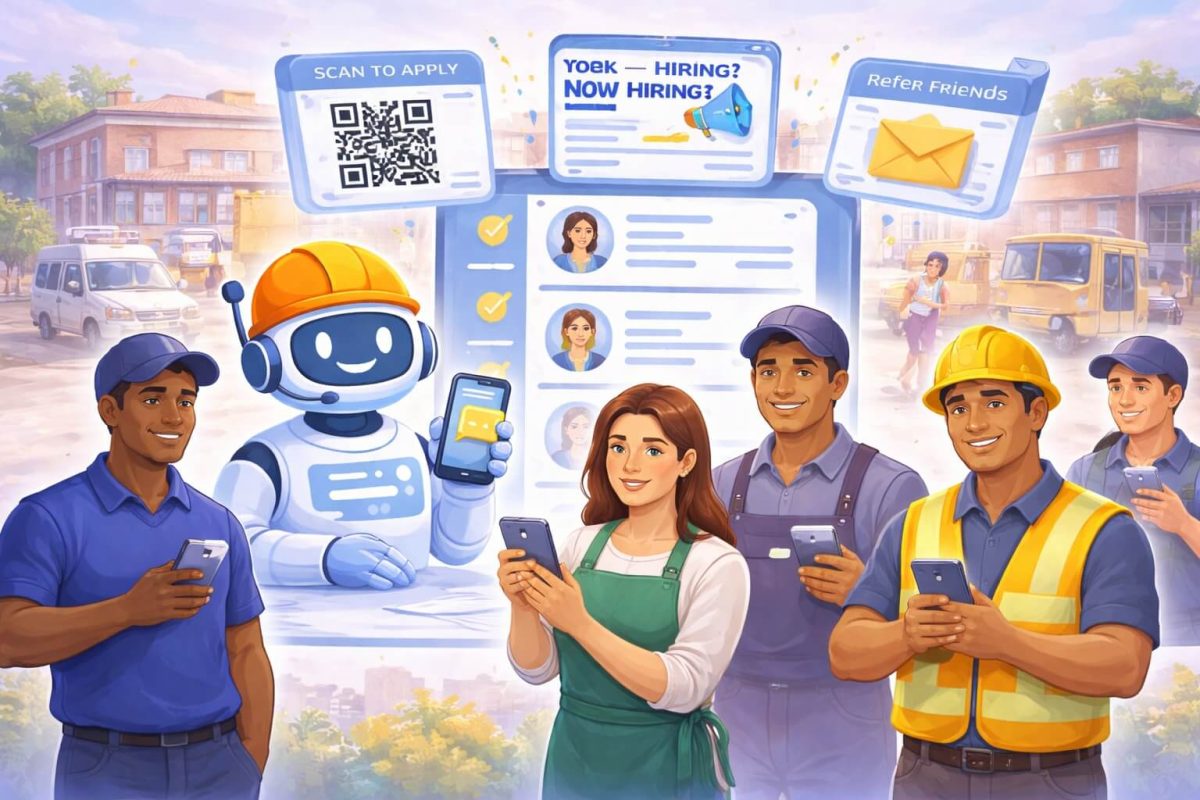
Table of Contents
- The Expensive Problem Costing You Thousands
- TL;DR
- Why Hourly Worker Talent Pools Matter More Than Ever?
- The Problems With Traditional Hourly Recruiting
- Strategy #1: Create Always-On Career Interest Pages
- Strategy #2: Leverage Text-to-Apply Technology
- Strategy #3: Mine Your Existing Database and Re-Engage Past Applicants
- Strategy #4: Build Referral Momentum Through Current Employees
- Strategy #5: Use AI-Powered Conversational Recruitment
- The Complete Benefits Package
- Getting Started: Your 90-Day Roadmap
- Frequently Asked Questions
- The Strategic Imperative
The Expensive Problem Costing You Thousands
Here’s a painful truth: Most healthcare facilities, retail chains, and manufacturing plants are hemorrhaging money on job board fees every single month—often paying $5,000, $10,000, or even $20,000+ annually just to post open positions. And for what? To attract candidates who apply to dozens of similar jobs, half of whom never respond to your emails, and a quarter of whom don’t show up for scheduled interviews.
Meanwhile, there’s a better way that costs nothing in job posting fees: building a continuous talent pool of hourly workers who are already interested in your organization, pre-screened, and ready to interview when positions open.

According to recent industry research, companies that maintain active talent pools reduce time-to-hire by 60% and cut recruiting costs by up to 50%. Yet most organizations still operate reactively—posting jobs when desperate, paying premium rates for emergency visibility, and starting from scratch with every open position.
For talent acquisition professionals managing constant hiring needs in healthcare, retail, and manufacturing, building a talent pool without paid postings isn’t just smart—it’s essential for sustainable, cost-effective recruiting.
TL;DR
Building a continuous talent pool for hourly workers eliminates job posting costs and reactive hiring. By combining always-on career pages, mobile-friendly applications, ATS mining, referrals, and AI-powered engagement, organizations can maintain a ready pipeline of pre-screened candidates.
Why Hourly Worker Talent Pools Matter More Than Ever?
The hourly workforce represents a unique recruiting challenge. High turnover is built into the business model—retail sees 60% annual turnover, healthcare support roles average 40%, and manufacturing hourly positions often exceed 50%. This means you’re constantly hiring, and traditional reactive recruiting can’t keep pace.
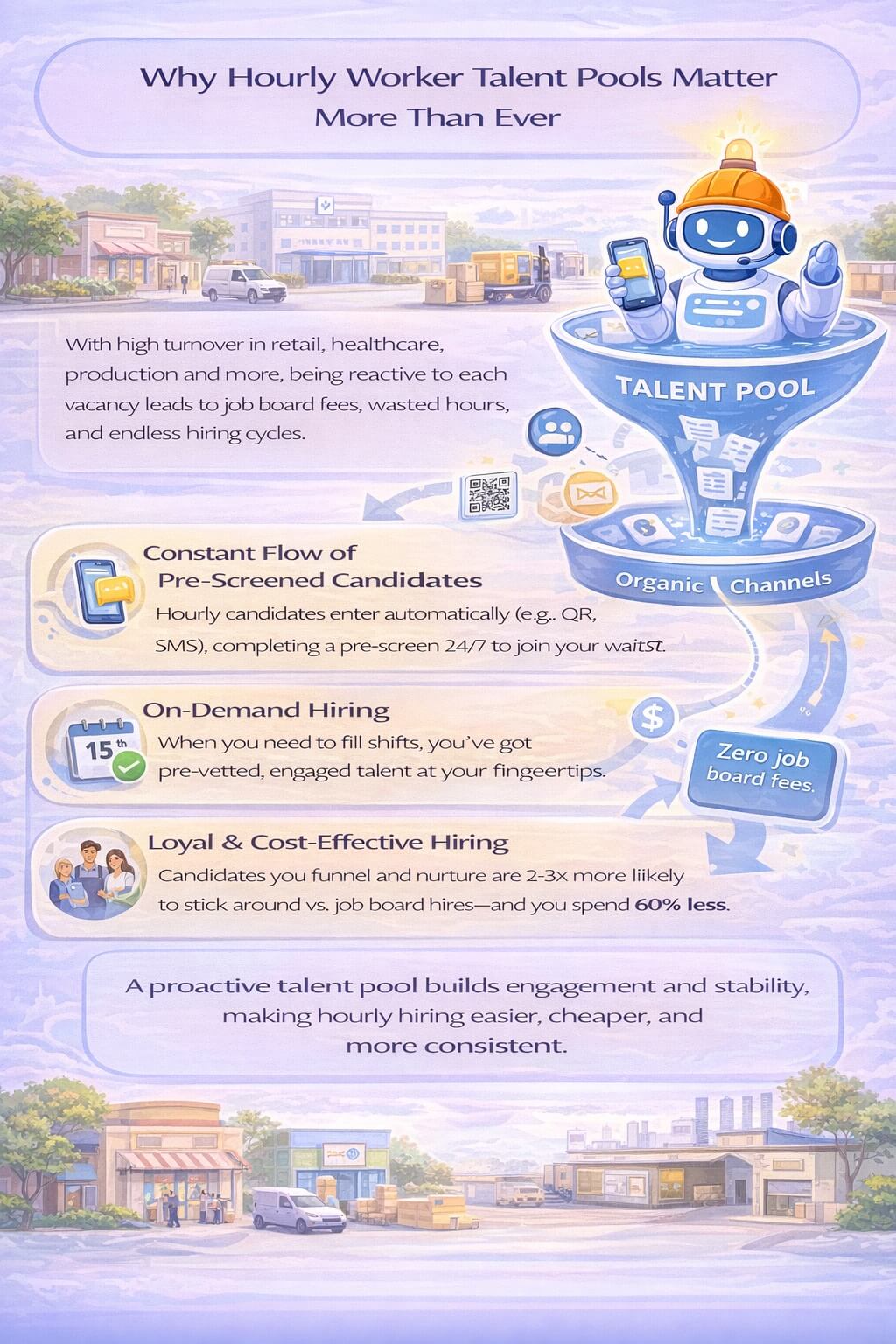
The math is sobering: A retail store needing 20 new associates per year spends hundreds of hours on job postings, screening, and coordination. A hospital hiring 50 CNAs annually might invest $175,000+ in recruiting costs. A manufacturing facility filling 30 production positions could waste months of productivity with positions sitting vacant.
Now consider this alternative: A proactive talent pool where candidates flow in continuously through organic channels, get pre-screened automatically, and remain engaged until you’re ready to hire them. No job board fees. No emergency “sponsored” listings. No starting from zero every time someone quits.
This is what leading organizations are building right now, and it’s changing the economics of hourly hiring completely.
The Problems With Traditional Hourly Recruiting
Before we explore solutions, let’s be honest about why the traditional model is broken for hourly hiring.
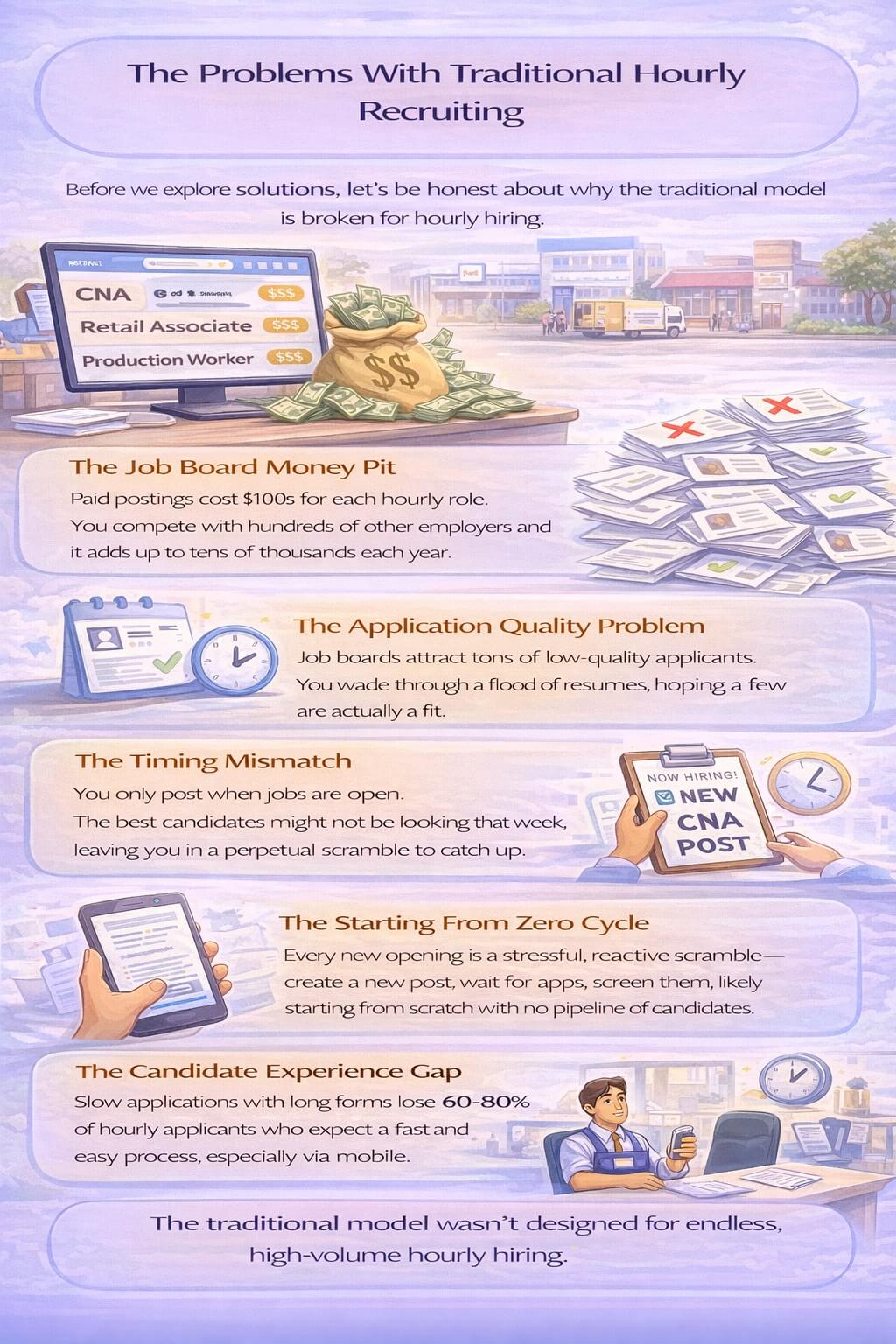
The Job Board Money Pit: Every time you post a CNA job, retail associate position, or manufacturing worker role on Indeed, ZipRecruiter, or other boards, you’re paying $100-500 or more. For high-volume hiring, these fees add up to tens of thousands annually. And you’re competing with hundreds of identical postings from other employers.
The Application Quality Problem: Free job board postings attract massive volumes of unqualified applicants. You get 200 applications, but only 20 are actually qualified, and maybe 10 will respond to interview requests. Paid postings help somewhat but don’t eliminate the quality issue.
The Timing Mismatch: You post jobs when positions are open. But the best candidates aren’t necessarily looking exactly when you have openings. They looked last month, or they’ll look next month. By only recruiting during active openings, you miss great candidates whose timing doesn’t perfectly align with yours.
The Starting From Zero Cycle: Every new opening means creating a new posting, waiting for applications to come in, screening from scratch, and hoping you get enough qualified candidates. This reactive cycle keeps you perpetually behind and stressed.
The Candidate Experience Gap: Hourly workers, especially younger ones, expect modern, convenient application processes. They want to apply from their phones in under five minutes. Traditional job applications with lengthy forms and document uploads lose 60-80% of interested candidates who start but don’t finish.
The Ghosting Phenomenon: Even when you find qualified candidates and schedule interviews, no-show rates for hourly positions commonly hit 30-50%. You’ve invested time in screening and coordination, then candidates simply don’t appear.
The traditional model wasn’t designed for continuous, high-volume hourly hiring. It’s time for something better.
Strategy #1: Create Always-On Career Interest Pages
Instead of posting individual jobs on expensive boards, create a permanent “Join Our Team” or “Career Opportunities” landing page on your website that’s always active, always collecting interested candidates.
How This Works: Your career page isn’t tied to specific open positions. Instead, it invites people to express interest in working for your organization generally. “Interested in nursing at [Hospital Name]? Join our talent community.” “Want to work retail at [Company]? We’re always looking for great people.”
Include a simple form—name, phone, email, and maybe a few qualifying questions. Make it mobile-friendly and completable in under two minutes. No resume upload required at this stage.
Why This Works: You’re capturing interest continuously, not just when you have openings. Someone who visits your website, hears about you from a friend, or sees your business in their community can express interest immediately, even if you’re not actively hiring for their desired role right now.
Implementation Tips:
- Promote this page everywhere: employee badges, store signage, truck graphics, business cards, receipts, social media profiles
- Make the URL simple and memorable: company.com/join or company.com/careers
- Include QR codes that link directly to the form—perfect for physical locations
- Highlight benefits, culture, and employee stories, not just job requirements
- Add testimonials from current employees about what they love about working there
Real-World Example: A regional hospital system created a permanent “Join Our Healthcare Team” page with a simple interest form. They promoted it through social media, employee referrals, and community events. Over 12 months, they collected 400+ interested candidates without spending a dollar on job postings. When positions opened, they contacted relevant candidates from this pool and filled roles in half their previous time.
Strategy #2: Leverage Text-to-Apply Technology
Modern hourly workers are mobile-first. They’re on their phones constantly, but they won’t fill out lengthy applications. Text-to-apply eliminates friction and captures candidates in the moment they’re interested.
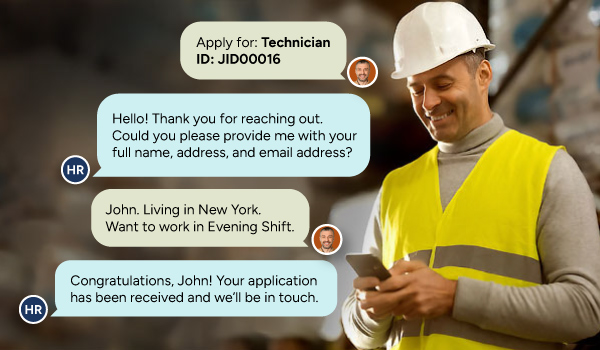
How This Works: Instead of directing candidates to application forms, let them apply by simply texting a number. “Interested in working here? Text JOBS to [number].” That’s it. The system responds with a conversational chat that gathers basic information, asks qualifying questions, and adds them to your talent pool.
Why This Works: It meets hourly candidates where they are—on their phones, using text messaging. Application completion rates jump from 40% to 80%+ when you eliminate the need to visit websites, create accounts, and upload documents.
Implementation Tips:
- Get a dedicated text number for recruiting (or use a platform that provides this)
- Create simple keywords: TEXT “NURSE” to 555-123, TEXT “RETAIL” to 555-123, etc.
- Display these prominently in stores, facilities, on uniforms, and in marketing materials
- Respond instantly with an engaging conversational flow, not robotic forms
- Ask only essential qualifying questions—you can gather more details later
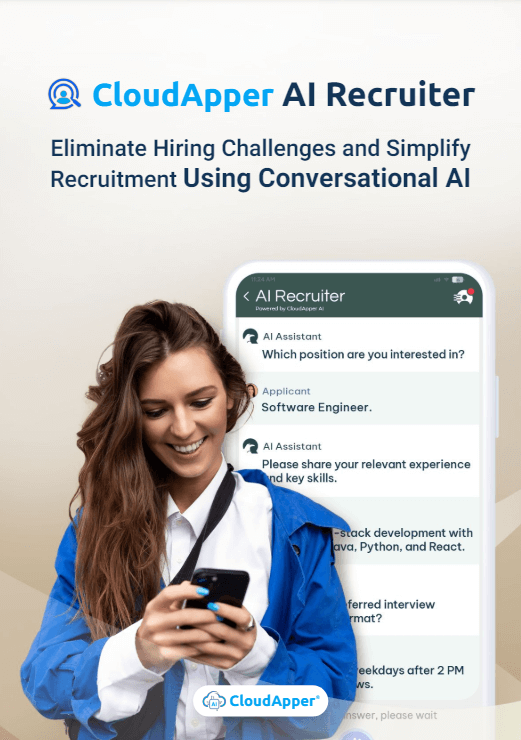
CloudApper AI Recruiter Solution: CloudApper enables text-to-apply functionality that integrates directly with your ATS. Candidates text your number, engage in a natural conversation with AI that asks relevant screening questions, and automatically get added to your talent pool with all their information synced to your system. The AI handles everything—no recruiter time required until candidates are qualified and interested.
Real-World Example: A retail chain with 50 stores implemented text-to-apply promoted through in-store signage and employee referrals. “Want to work here? Text TEAM to [number].” Within 90 days, they built a talent pool of 200+ pre-screened candidates across their locations, eliminating their dependency on paid job boards for seasonal hiring.
Strategy #3: Mine Your Existing Database and Re-Engage Past Applicants
You’ve already invested money attracting candidates in the past. Why not leverage those existing connections before spending more on new job postings?
How This Works: Your ATS contains hundreds or thousands of past applicants—people who applied for previous positions, completed phone screens, maybe even interviewed. Many of these candidates are still interested in working for you, but you never followed up with them after they weren’t selected initially.
Systematically re-engage these past candidates when new positions open. Send personalized messages acknowledging their previous interest and inviting them to consider new opportunities.
Why This Works: Past applicants already understand your organization, they’ve expressed interest before, and many have been at least partially vetted. They’re warm leads versus completely cold candidates from job boards. Plus, reaching out to them costs nothing.
Implementation Tips:
- Segment your database by role type, location, skills, and when they last engaged
- Create re-engagement campaigns: “We know you were interested in working with us previously. We have new opportunities that might be perfect for you.”
- Use multiple channels: email, text, and even phone calls for strong candidates
- Make it easy for them to update their information and express current interest
- Be honest about why they weren’t selected before (if it was timing, specific requirements, etc.)
CloudApper AI Recruiter Solution: CloudApper automatically mines your ATS database whenever new positions open, identifies past candidates who match requirements, and reaches out to them through automated text and email campaigns. The AI re-engages candidates conversationally, confirms their interest and availability, pre-screens them for current requirements, and schedules interviews—all without manual recruiter work.
Real-World Example: A manufacturing facility had 500+ past applicants in their ATS from the previous two years. Before posting a new batch of production positions externally, they used AI automation to reach out to relevant past candidates. 75 responded with interest, 40 were still qualified and available, and they filled 12 positions from this pool—saving approximately $6,000 in job posting and agency fees.
Strategy #4: Build Referral Momentum Through Current Employees
Your current hourly employees know other people with similar skills and work preferences. Employee referrals are your highest-quality, lowest-cost source of candidates—you just need to make referring easy and rewarding.
How This Works: Create a structured referral program specifically designed for hourly workers. Make it simple to refer friends—text a number, forward a link, scan a QR code. Offer meaningful bonuses for successful referrals (candidates who get hired and stay 90 days).
Build this into your culture. Talk about it in team meetings. Recognize employees who make referrals. Make referring feel like helping your friends find good jobs, not just helping your company fill positions.
Why This Works: Referred candidates are more likely to be good fits culturally, they perform better on average, and they stay longer. Your employees self-select friends and contacts who they believe would succeed and who they’d want to work alongside. Plus, referrals cost nothing except the bonus you pay for successful hires—far less than job board fees.
Implementation Tips:
- Offer tiered bonuses: $250 when the referred candidate is hired, another $250 when they stay 90 days
- Make referring dead simple: “Text REFER to [number] and you’ll get a link to share with friends”
- Celebrate successful referrals publicly—recognize employees who bring in great people
- Extend referral bonuses to past employees too—they’re still connected to your network
- Track and report on referrals to show employees this program is real and people are getting rewarded
Real-World Example: A healthcare system launched a referral program for CNAs with $500 total bonuses. They promoted it through employee text messages, break room signage, and team meetings. In six months, employees referred 80+ candidates, resulting in 25 new hires. The cost per hire (including bonuses) was $500 versus $3,500 for traditional recruiting—an 86% savings.
Strategy #5: Use AI-Powered Conversational Recruitment
This is where talent pool building becomes truly scalable and cost-effective. AI-powered conversational recruitment automates the entire process of attracting, screening, engaging, and nurturing hourly candidates without paid job postings.
How This Works: Advanced platforms like CloudApper AI Recruiter create an always-on recruiting assistant that handles everything:
- Continuous Candidate Attraction: Candidates can apply through text, chat, QR codes, or career pages anytime—24/7, even when you’re not actively hiring
- Instant Screening: AI asks relevant qualifying questions conversationally, understands natural responses, and scores candidates automatically
- Automated Engagement: The system keeps candidates warm with updates, job recommendations, and relevant information about your organization
- Smart Matching: When positions open, AI automatically identifies the best matches from your talent pool and reaches out to them
- Interview Scheduling: Qualified candidates self-schedule interviews through integrated calendars—no back-and-forth coordination needed
All of this happens automatically, syncing with your existing ATS (Workday, Dayforce, UKG, SAP SuccessFactors, etc.) so recruiters see organized, pre-screened candidates ready for final interviews.
Why This Works: You’re essentially building a recruiting machine that runs 24/7 without job posting costs or manual recruiter work for initial stages. Candidates can express interest and get screened at midnight on Sunday if that’s when they’re thinking about new jobs. The AI never sleeps, never gets overwhelmed by volume, and consistently applies your screening criteria.
Implementation Tips:
- Choose a platform with proven ATS integration for your specific system
- Configure screening questions and scoring criteria for your most common hourly roles
- Promote your text-to-apply number and QR codes everywhere
- Use the data the system provides to continuously improve messaging and screening
- Start with one role type to prove ROI before expanding
CloudApper AI Recruiter Capabilities:
CloudApper transforms hourly hiring by combining all these strategies into one automated platform:
- Multi-Channel Application: Candidates can apply via text (SMS), chat, QR codes, or web forms
- Conversational AI Screening: Natural language AI asks qualifying questions and understands responses like “Yeah, I can do nights” the same as “Night shift availability: yes”
- Automatic Database Mining: Continuously analyzes your existing ATS for relevant past candidates
- Intelligent Matching: Contextual AI understands that “patient care coordinator” relates to CNA experience
- Automated Nurturing: Keeps candidates engaged with relevant updates until you’re ready to hire
- Interview Scheduling: Candidates pick interview times from your availability automatically
- Complete ATS Integration: Everything syncs back to Workday, Dayforce, UKG, or other systems seamlessly
The result: A continuously growing, pre-screened talent pool of hourly workers built entirely through organic channels—no job posting fees required.
Real-World Example: A retail organization implemented CloudApper AI Recruiter across 30 stores. They promoted text-to-apply through in-store signage, social media, and employee referrals. Over 12 months, they:
- Built a talent pool of 500+ pre-screened candidates
- Eliminated 90% of job board posting expenses (saving $18,000+ annually)
- Reduced time-to-hire from 35 days to 12 days
- Improved candidate quality with automated consistent screening
- Freed their three-person recruiting team to focus on interviews and hiring decisions instead of job posting and initial screening
The Complete Benefits Package
Building a talent pool for hourly workers without paid job postings delivers advantages that compound over time:
Massive Cost Savings: Eliminating job board fees, sponsored listings, and agency usage saves thousands to tens of thousands annually. A mid-sized organization can easily save $15,000-30,000+ per year by shifting from paid postings to talent pool recruiting.
Dramatically Faster Hiring: When positions open, you’re not starting from zero. You already have pre-screened, interested candidates ready to interview. Time-to-hire typically drops from 30-45 days to 10-15 days.
Higher Quality Candidates: Candidates who proactively join your talent pool, come through referrals, or previously applied and stayed engaged tend to be higher quality than random job board applicants. They’re genuinely interested in your organization specifically, not just any job.
Better Candidate Experience: Modern, mobile-friendly application processes (text-to-apply, QR codes, simple forms) make applying easy and convenient. This positive experience strengthens your employer brand and increases offer acceptance rates.
Reduced Recruiter Workload: Automation handles initial attraction, screening, and engagement. Recruiters focus on final interviews and hiring decisions instead of posting jobs, monitoring boards, and manually screening hundreds of unqualified applicants.
Scalability Without Cost Increases: Whether you need to hire 10 people or 100, your talent pool system scales effortlessly. You’re not paying per posting or per applicant—the infrastructure handles any volume at the same cost.
Proactive Instead of Reactive: You’re building relationships with candidates before you desperately need them. This creates hiring agility—when positions open, you can fill them immediately instead of starting a 6-week recruiting process.
Improved Retention: Candidates hired from well-managed talent pools often have higher retention because they’re better matches, they’ve had positive experiences throughout hiring, and they feel valued from day one.
Getting Started: Your 90-Day Roadmap
Transitioning from paid job postings to talent pool recruiting doesn’t happen overnight, but you can make meaningful progress quickly.
Days 1-30: Foundation
- Audit your current recruiting costs: How much are you spending on job boards annually?
- Create or improve your always-on career interest page
- Set up text-to-apply capability (CloudApper can help with this)
- Design QR codes and promote them in physical locations
- Launch or refresh your employee referral program
Days 31-60: Activation
- Implement AI recruiting automation (CloudApper AI Recruiter integrates in 2-3 weeks)
- Mine your ATS database and begin re-engaging past candidates
- Start promoting your talent pool channels: text numbers, QR codes, career page
- Train your recruiting team on the new process
- Hire your first 3-5 people from your emerging talent pool to prove the model
Days 61-90: Optimization
- Reduce or eliminate paid job postings as your talent pool grows
- Analyze which channels bring the best candidates (referrals vs. text-to-apply vs. career page)
- Refine your AI screening questions based on hiring outcomes
- Expand successful strategies across more locations or role types
- Calculate and report cost savings and time-to-hire improvements
Most organizations find they can reduce paid job postings by 50-75% within 90 days and eliminate them almost entirely within 6 months as their talent pool matures.
Frequently Asked Questions
Won’t we miss out on candidates if we stop posting on job boards?
Not if you’re actively building and promoting your talent pool. The candidates on job boards are searching for “nurse jobs” or “retail jobs”—they’re not loyal to specific boards. If you make it easy and appealing to join your talent pool (through text-to-apply, QR codes, referrals, social media), you’ll attract the same candidates without the board fees. In fact, you’ll often get better candidates because your channels select for people specifically interested in your organization.
How long does it take to build a useful talent pool?
You’ll see results within 30-60 days if you’re actively promoting your channels. Text-to-apply and referral programs can generate dozens of candidates within the first month. AI automation accelerates this by automatically re-engaging your existing database. Within 90 days, most organizations have 50-200 pre-screened candidates in their pool, depending on their hiring volume and promotion efforts.
What if we have immediate hiring needs and don’t have time to build a pool?
Start with re-engaging your existing database—that can generate qualified candidates within days. Simultaneously build your talent pool for future needs. Many organizations run hybrid models initially: using talent pools for 50-70% of hires and strategic job postings for urgent needs. As the pool grows, dependency on paid postings decreases.
How do we keep candidates engaged while they’re in our talent pool?
Automated systems like CloudApper AI Recruiter handle this through regular touchpoints: job recommendations when relevant positions open, updates about your organization, simple check-ins to confirm continued interest. The key is consistency without being overwhelming—monthly or quarterly engagement keeps candidates warm without annoying them.
Can small recruiting teams manage a talent pool effectively?
Yes—in fact, small teams benefit most from automation because it gives them capabilities of much larger teams. CloudApper AI Recruiter handles screening, engagement, and matching automatically. Small teams report that talent pools actually reduce their workload compared to constantly posting jobs and screening from scratch.
What about seasonal hiring where we need lots of people quickly?
This is where talent pools shine. Build your pool year-round through low-effort channels (text-to-apply, referrals, career page). When seasonal hiring arrives, you already have hundreds of pre-screened candidates ready to interview. Retail and hospitality organizations use this approach to staff up 10X faster than posting jobs when seasonal demand hits.
How much does AI recruiting automation cost?
CloudApper AI Recruiter pricing is typically $200-1,000 per month depending on hiring volume—far less than monthly job board expenses for high-volume hiring. Most organizations achieve positive ROI within the first 60-90 days through eliminated posting fees and reduced recruiter time. Calculate your current monthly spending on job boards and agency fees to see the comparison.
Will hourly candidates actually text a number or scan QR codes to apply?
Absolutely. Hourly workers—especially younger ones—strongly prefer mobile-friendly, simple application methods. Text-to-apply and QR codes meet them where they are and respect their time. Application completion rates are consistently 2-3X higher with these methods versus traditional online applications.
What if our ATS doesn’t integrate well with automation tools?
CloudApper integrates with all major ATS platforms: Workday, Dayforce, UKG, SAP SuccessFactors, Oracle, and more. The integration is pre-built—no custom development required. Even if you use a less common ATS, most modern platforms have APIs that enable integration within weeks.
How do we measure success?
Track these key metrics:
- Monthly recruiting costs (paid postings vs. talent pool costs)
- Cost-per-hire from talent pool versus traditional sources
- Time-to-hire for talent pool candidates
- Talent pool size growth month-over-month
- Percentage of hires from talent pool versus external sources
- Candidate quality scores and retention rates
Most organizations see 40-60% cost reduction and 50-70% faster time-to-hire within 6 months.
The Strategic Imperative
We’re at an inflection point in hourly worker recruiting. The old model—reactive job postings costing thousands annually—is becoming unsustainable. Rising job board fees, increasing candidate expectations for modern experiences, and the need for continuous hiring in healthcare, retail, and manufacturing demand a better approach.
Organizations building proactive talent pools now gain a compounding advantage. Every month, their pool grows stronger, their costs decrease, and their hiring speed increases. Meanwhile, organizations still depending on paid job postings face rising costs, slower fills, and constant recruiting stress.
The technology to make this transformation is mature and accessible. CloudApper AI Recruiter and similar platforms have proven ROI across hundreds of organizations. The strategies—text-to-apply, database mining, referral programs, conversational AI—are established best practices, not experimental techniques.
Your competitors are making this shift. Forward-thinking healthcare systems, retail chains, and manufacturing facilities are building talent pools and eliminating their dependency on expensive job boards. They’re hiring faster, spending less, and providing better candidate experiences.
The question isn’t whether to build a talent pool for hourly workers—it’s whether you’ll start now and gain competitive advantage, or wait and fall further behind while watching recruiting costs climb and positions stay open longer.
Stop throwing money at job boards every time you need to hire someone. Start building the sustainable, cost-effective recruiting infrastructure that will serve your organization for years to come.
Ready to build your hourly worker talent pool and eliminate expensive job postings? Visit CloudApper AI Recruiter to see how AI-powered conversational recruitment can transform your hiring process.

What is CloudApper AI Platform?
CloudApper AI is an advanced platform that enables organizations to integrate AI into their existing enterprise systems effortlessly, without the need for technical expertise, costly development, or upgrading the underlying infrastructure. By transforming legacy systems into AI-capable solutions, CloudApper allows companies to harness the power of Generative AI quickly and efficiently. This approach has been successfully implemented with leading systems like UKG, Workday, Oracle, Paradox, Amazon AWS Bedrock and can be applied across various industries, helping businesses enhance productivity, automate processes, and gain deeper insights without the usual complexities. With CloudApper AI, you can start experiencing the transformative benefits of AI today. Learn More
- Useful Links:
- Agentic AI
- No-Code/Low-Code
- Custom Software
- HCM Personalization
- iPaaS
- FedRAMP
CloudApper AI Solutions for HR

- Works with







- and more.
Similar Posts

Hourly Candidates Can’t Take Calls on Shift. Here’s How to…

How to Assess Candidate Communication Skills Before the First Interview