Silver medalist candidates—strong runners-up from past hires—are a goldmine for recruiters. Re-engaging them with AI automation delivers personalized messages, instant responses, and seamless scheduling. Fill roles faster, cut sourcing costs, and improve hire quality by tapping into pre-vetted talent already familiar with your company.
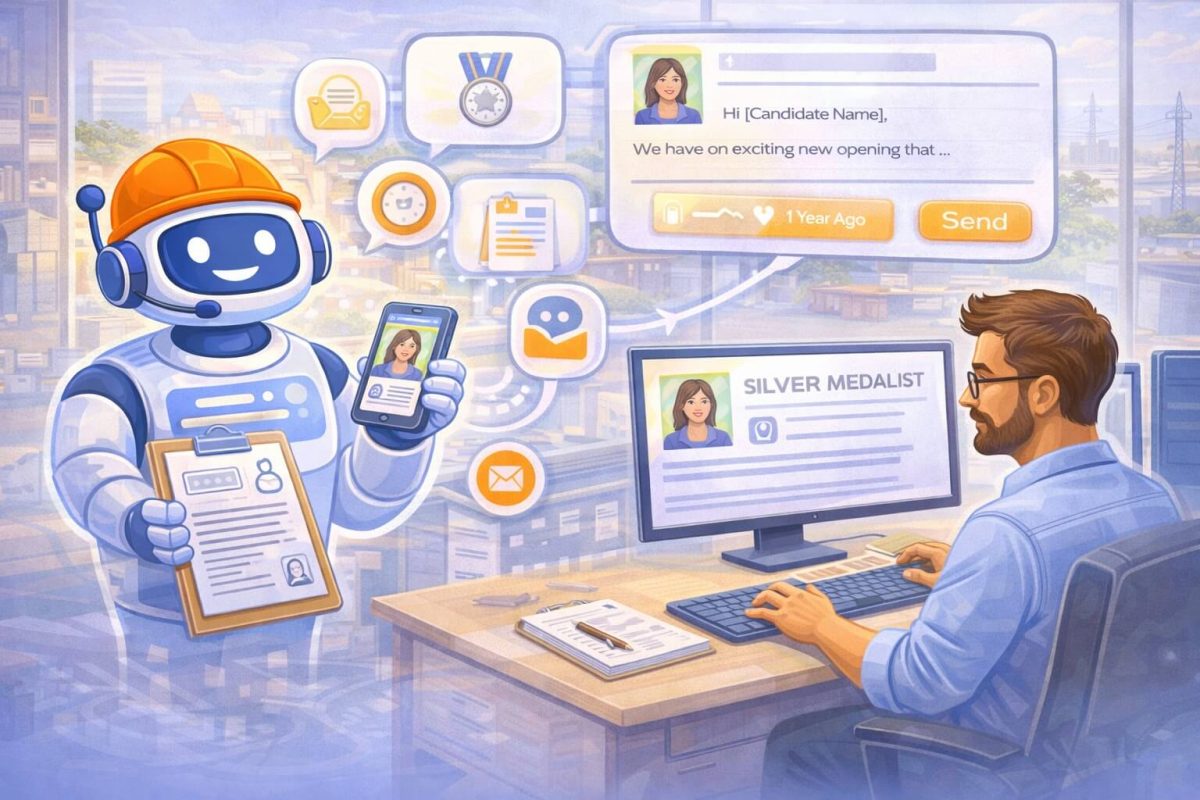
Table of Contents
- The Talent You’ve Already Vetted Is Slipping Away
- TL;DR
- Why Silver Medalists Matter More Than Ever
- The Problems With Manual Silver Medalist Tracking
- How AI Automation Solves Silver Medalist Re-Engagement
- Real-World Results: Silver Medalists + AI Automation
- The Complete Benefits of AI-Powered Silver Medalist Re-Engagement
- Implementation: Making This Real in Your Organization
- Frequently Asked Questions
- The Strategic Imperative: Why This Matters Now
The Talent You’ve Already Vetted Is Slipping Away
Picture this scenario: Six months ago, you interviewed five exceptional nurses for a critical care position. The interviews were rigorous, the candidates were impressive, and the final decision was agonizing. You hired one person—your “gold medalist.” But what happened to the other four highly qualified candidates who made it to the final round?
They disappeared into your applicant tracking system, forgotten. Meanwhile, you’re posting new job openings, screening hundreds of resumes, and starting the expensive, time-consuming hiring process from scratch—even though you already have pre-vetted, interested, qualified candidates sitting in your database.
These runner-up candidates—known as “silver medalists” in recruiting—represent one of the most valuable yet underutilized assets in your talent acquisition strategy. Silver medalists are candidates who made it to the final round of a hiring process but weren’t selected, often losing by a very small margin. They’ve been thoroughly screened, they’ve met your team, they understand your organization, and they’ve demonstrated they’re genuinely interested in working for you.
For talent acquisition professionals in healthcare, retail, and manufacturing—industries with continuous, high-volume hiring needs—silver medalists represent your fastest path to quality hires. And with AI automation, re-engaging them has never been easier or more effective.
TL;DR
Turn past “almost-hired” applicants into your fastest hires. AI automation re-engages silver medalist candidates with personalized, timely outreach while you sleep. Build an evergreen talent pipeline, slash time-to-hire, reduce recruiting costs, and boost retention—all without purchasing new leads.
Why Silver Medalists Matter More Than Ever
The recruiting landscape has fundamentally changed. There are more open jobs than unemployed people, and 61% of U.S. business leaders say it’s challenging to attract top talent. In this environment, spending weeks sourcing and screening new candidates when you already have qualified people in your database makes no financial or strategic sense.
Consider the investment you’ve already made in silver medalists: resume screening time, phone interviews, in-person meetings, reference checks, skills assessments, and hiring manager evaluations. For a candidate who reached final rounds, you might have invested 5-10 hours of recruiter time and 3-5 hours of hiring manager time. That’s a significant investment to simply abandon.
Recruiting silver medalists can be a cost-effective strategy, allowing you to avoid expensive job board or agency fees while securing high-quality candidates at lower cost. When you factor in that the average cost-per-hire now exceeds $4,500, and time-to-hire averages 42 days, the ROI of silver medalist recruiting becomes compelling.
But here’s the challenge: manually tracking, remembering, and reaching out to silver medalists doesn’t scale. When you’re hiring 50, 100, or 200 people annually across multiple roles and locations, you can’t rely on spreadsheets and calendar reminders. This is where AI automation transforms silver medalist recruiting from a nice idea into a systematic competitive advantage.
The Problems With Manual Silver Medalist Tracking
Most organizations recognize the value of silver medalists in theory but fail to leverage them in practice. Here’s why manual approaches don’t work:
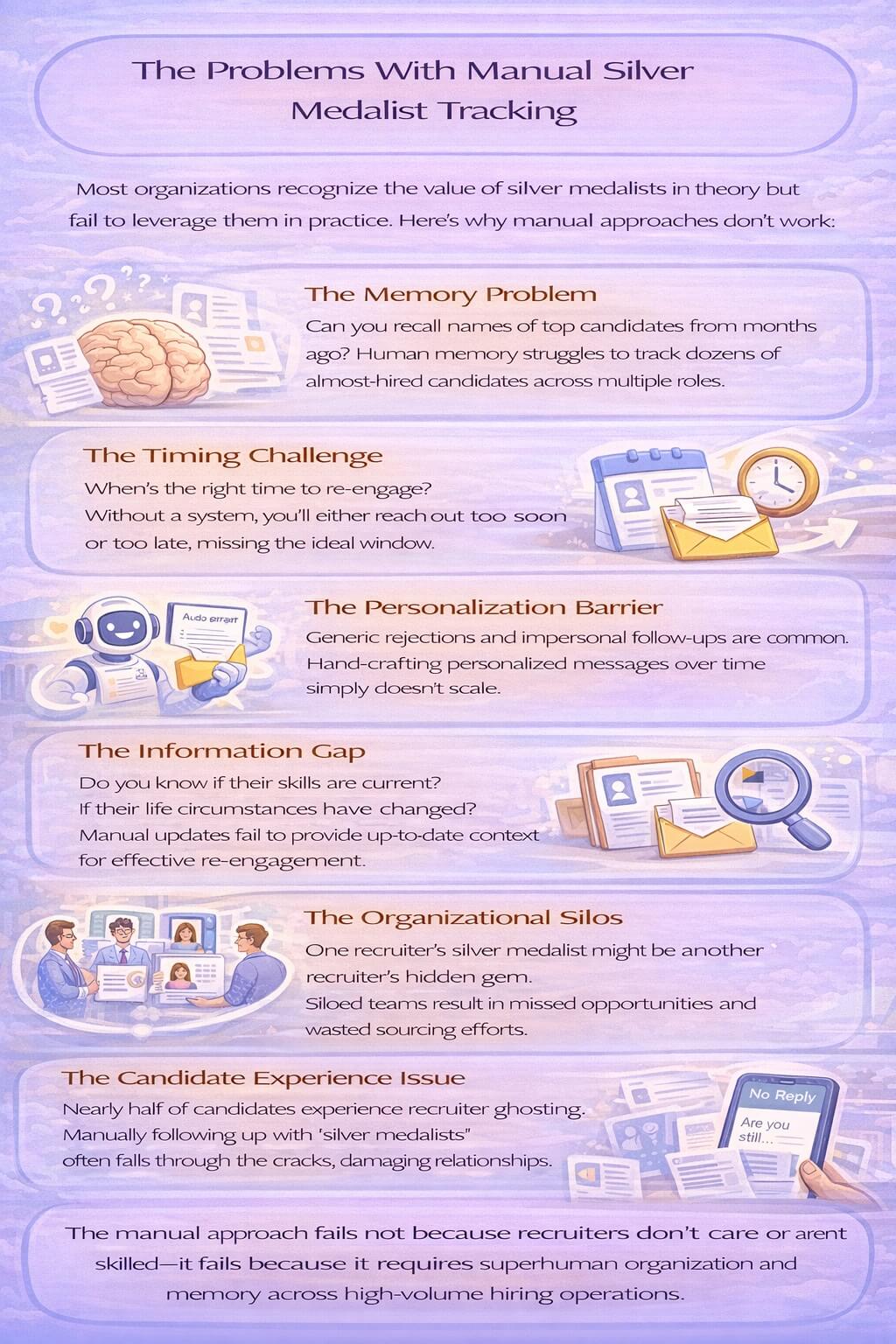
The Memory Problem: Three months after hiring for a nursing position, can you remember the names of the candidates who came in second and third? What about for the retail manager role you filled last quarter? Or the manufacturing technician position from six months ago? Human memory isn’t designed to track dozens of almost-hired candidates across multiple roles and timeframes.
The Timing Challenge: When is the right time to reach back out to a silver medalist? Too soon, and they might feel like you’re desperate or that you made a mistake with your first choice. Too late, and they’ve moved on to other opportunities. Without a system, this timing decision becomes inconsistent guesswork.
The Personalization Barrier: Silver medalists who’ve invested significant time in your recruitment process deserve more than auto-generated touchpoints. Generic rejection emails feel disrespectful. But writing personalized follow-up messages to every finalist, then checking in quarterly, then reaching out when relevant roles open—this level of personalization doesn’t scale manually.
The Information Gap: When you do remember to contact a silver medalist months later, what do you say? Are their skills still current? Have their circumstances changed? Are they even still looking? Without updated information, re-engagement feels awkward and uncertain.
The Organizational Silos: One recruiter’s silver medalist might be another recruiter’s perfect candidate, but if they’re not sharing this information systematically, great candidates get overlooked while teams duplicate sourcing efforts.
The Candidate Experience Issue: Half of all candidates have been ghosted by recruiters after personal conversations. When you don’t follow up with silver medalists, you’re contributing to this negative pattern. But manually maintaining relationships with dozens of past candidates while juggling current openings is nearly impossible.
The manual approach fails not because recruiters don’t care or aren’t skilled—it fails because it requires superhuman organization and memory across high-volume hiring operations.
How AI Automation Solves Silver Medalist Re-Engagement
Artificial intelligence and automation transform silver medalist recruiting from an aspirational best practice into a systematic, scalable process that works in the background without overwhelming your team.
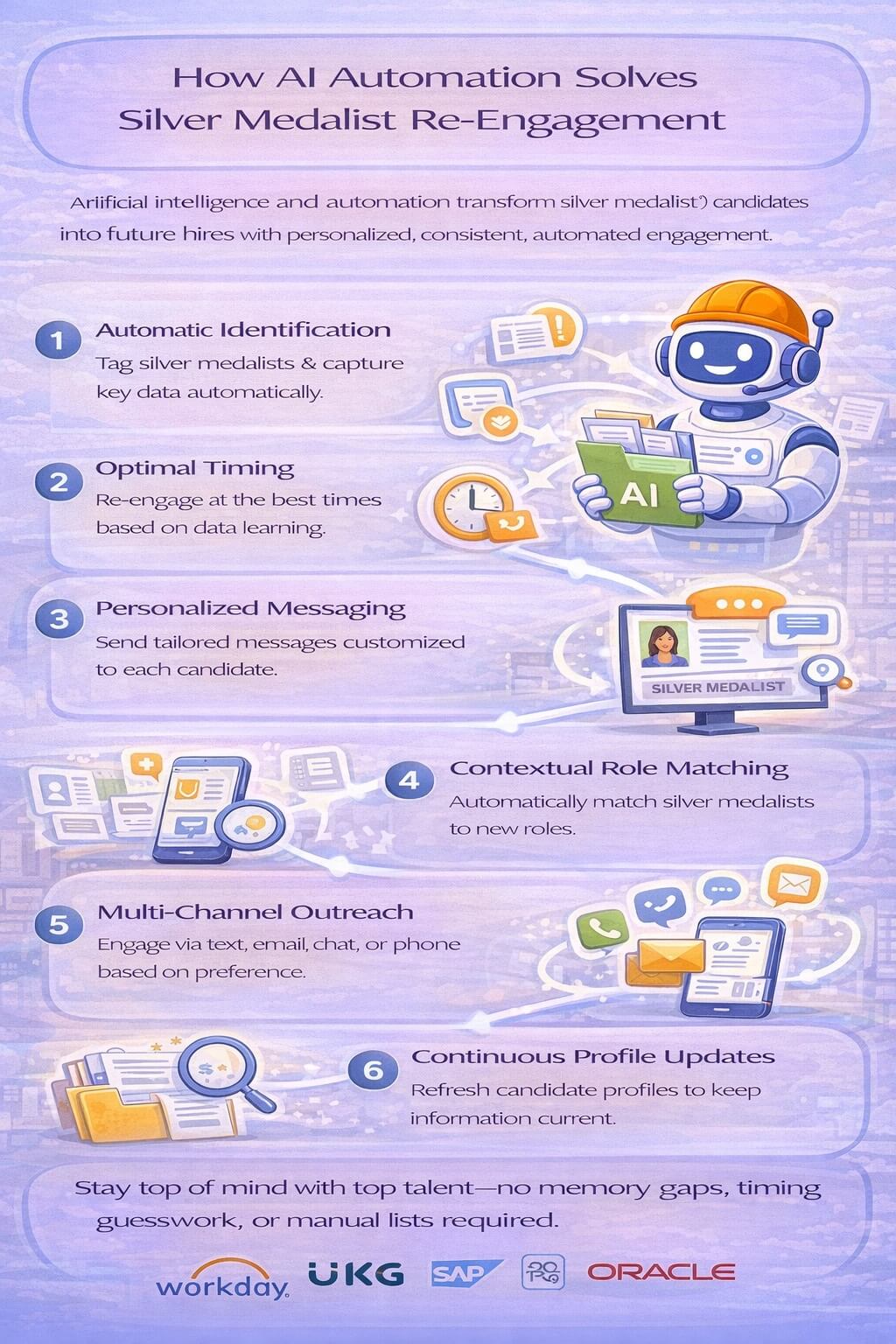
Automatic Identification and Tagging
AI-powered systems automatically identify silver medalists as candidates move through your hiring process. When someone reaches final interview rounds but isn’t selected, the system tags them as a silver medalist, captures relevant information about their skills and qualifications, and adds them to a nurture pool.
This happens automatically in your ATS without recruiters needing to remember to manually tag people or create lists. Every silver medalist gets captured and categorized for future engagement.
Intelligent Timing and Cadence
AI determines optimal re-engagement timing based on multiple factors: how recently they interviewed, what role they applied for, industry norms for job searching timelines, and patterns from successful re-engagements. The system automatically reaches out at the right intervals—perhaps 30 days after initial rejection, then quarterly check-ins, with accelerated outreach when relevant roles open.
This removes the guesswork and ensures consistent follow-up without recruiters needing to manually track timing for dozens of candidates.
Personalized Communication at Scale
Modern AI systems can generate personalized messages that reference specific details about each candidate’s interview experience, the role they applied for, what impressed the hiring team, and why you’re reaching out now. These messages feel personal because they are—the AI incorporates actual data from the candidate’s interactions with your organization.
For example: “Hi Sarah, we were really impressed when you interviewed for our ICU nursing position last spring, particularly your experience with trauma cases. I wanted to reach out because we now have an opening in our Emergency Department that I think would be an even better match for your background.”
This level of personalization happens automatically for every silver medalist, creating authentic engagement at scale.
Contextual Matching to New Roles
AI doesn’t just remember that someone was a silver medalist—it understands their full profile and automatically matches them to new opportunities. When you post a new position, the system scans your database of silver medalists, identifies those whose skills and experience match the new role (even if it’s different from what they originally applied for), and reaches out automatically.
A nurse who interviewed for day shift six months ago gets automatically contacted when evening shift positions open. A retail candidate who was great but not quite right for store manager gets flagged for assistant manager roles. A manufacturing candidate with forklift certification gets matched to warehouse positions even though they originally applied for production line work.
Multi-Channel Engagement
AI platforms engage silver medalists through their preferred channels—email, text message, phone, or chat—and track which methods get the best response rates for different candidate segments. The system learns that nurses respond better to text messages, retail workers prefer email, and manufacturing candidates engage more through phone calls, then optimizes accordingly.
Continuous Profile Enrichment
AI systems can automatically update silver medalist profiles with new information gathered from public sources, professional networks, and ongoing interactions. If a candidate mentioned they were working toward a certification during their interview, the system can check months later to see if they’ve completed it, making re-engagement more relevant and timely.
Automated Screening and Qualification
When silver medalists express interest in new opportunities, AI automatically conducts updated screening to confirm they still meet requirements, checks availability, and assesses whether circumstances that prevented them from accepting the original role have changed. By the time a candidate reaches your desk, they’ve already been re-qualified for the current opportunity.
Seamless ATS Integration
All of this happens in the background, syncing with your existing ATS—Workday, Dayforce, UKG, SAP SuccessFactors, Oracle, or others. When you log into your recruiting system, you see silver medalists surfaced alongside new applicants, with complete context about their previous interactions and current fit for open roles.
Real-World Results: Silver Medalists + AI Automation
Let’s examine actual outcomes when organizations implement AI-powered silver medalist re-engagement:
Healthcare System: Regional Hospital Network
Challenge: Hiring 60+ nurses annually with 45-day average time-to-hire and $5,200 cost-per-hire. Silver medalists were tracked in spreadsheets but rarely contacted systematically.
Solution: Implemented AI automation that automatically identified nursing silver medalists, maintained quarterly engagement, and matched them to new openings.
Results:
- 40% of nursing hires came from re-engaged silver medalists within 12 months
- Time-to-hire for silver medalist nurses: 12 days versus 45 days for new candidates
- Cost-per-hire reduced by 65% for silver medalist hires
- Candidate quality scores identical or higher than original gold medalists
- Saved approximately $125,000 annually in recruiting costs
Retail Chain: 50-Store Regional Operator
Challenge: High turnover requiring 200+ hires annually. Silver medalists from store manager and assistant manager searches were never systematically re-engaged.
Solution: AI system automatically captured management candidates who reached final rounds, kept them engaged with company updates, and matched them to openings across all locations.
Results:
- Built a pool of 80+ pre-vetted management candidates across regions
- Filled 35% of management positions from silver medalists in first year
- Reduced time-to-hire from 38 days to 14 days for silver medalist hires
- Eliminated $15,000+ in agency fees for management recruiting
- Improved retention by 22% for silver medalist hires versus new hires
Manufacturing Facility: Large Production Plant
Challenge: Continuous hiring for skilled production, maintenance, and quality control roles. Previous candidates were rarely reconsidered for new openings.
Solution: Implemented AI that tracked silver medalists by skill type, automatically re-engaged them when relevant roles opened, and maintained engagement through periodic touchpoints.
Results:
- 28% of production hires came from silver medalist pool within 18 months
- Time-to-hire decreased from 42 days to 16 days for silver medalist candidates
- Saved 25+ hours per week of recruiter screening time
- Cost-per-hire reduced by $1,800 for silver medalist hires
- Silver medalists showed 18% better 90-day retention than new hires
The Complete Benefits of AI-Powered Silver Medalist Re-Engagement
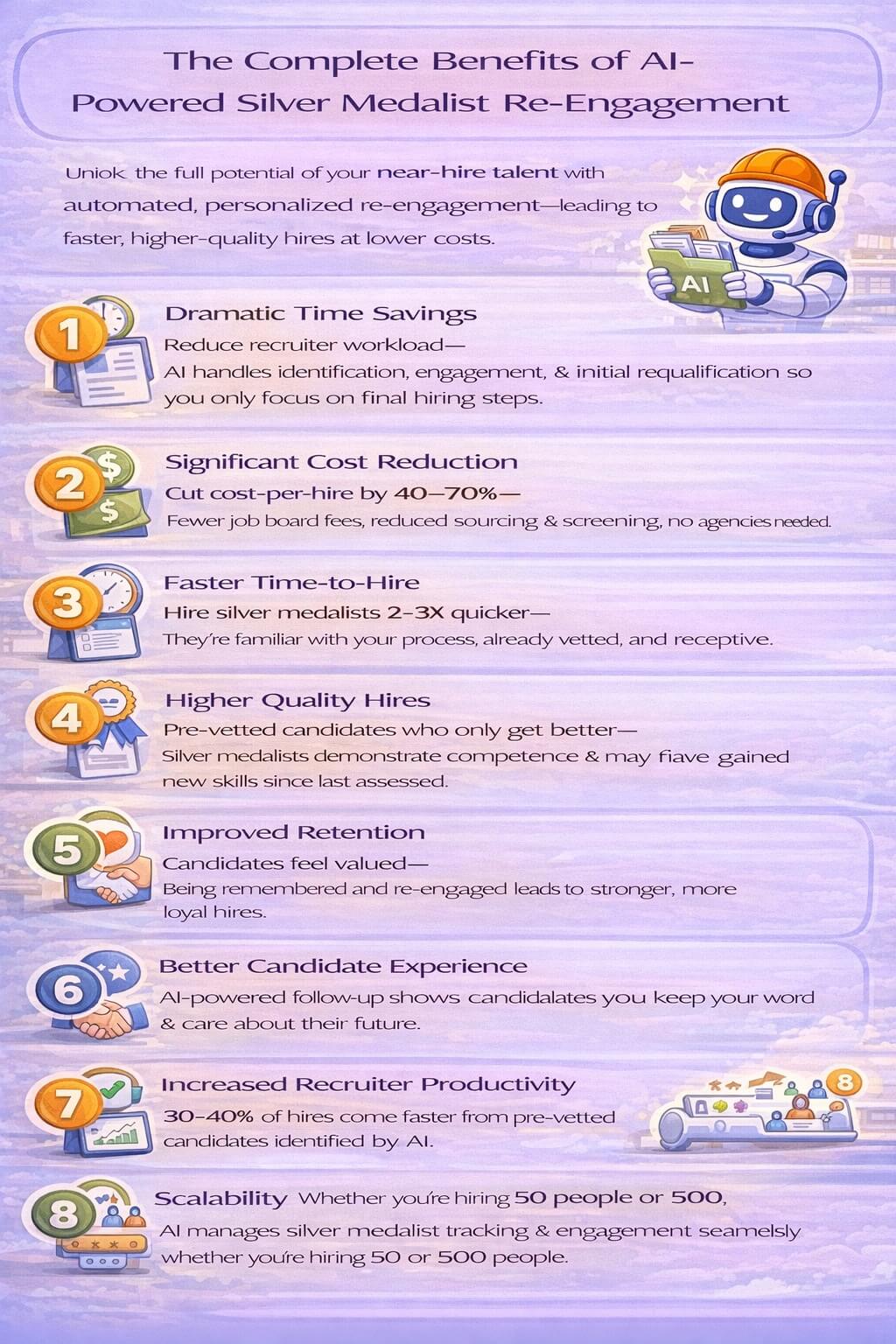
Dramatic Time Savings: Silver medalists have already been through your recruitment process and may require less time to source, screen, and hire. When automation handles identification, engagement, and initial requalification, recruiters focus only on final interviews and decisions.
Significant Cost Reduction: Eliminating duplicate sourcing, screening, and initial assessment work reduces cost-per-hire by 40-70% for silver medalist hires. No job board fees, no agency costs, minimal screening time.
Faster Time-to-Hire: Silver medalists move through hiring processes 2-3X faster than new candidates because they’re already familiar with your organization, they’ve already been partially vetted, and they’re warm leads rather than cold prospects.
Higher Quality Hires: Silver medalists have already demonstrated high levels of competence by making it to final stages, and they may have gained additional skills and experience since you last spoke. They’re proven quality candidates who’ve only gotten stronger.
Improved Retention: Silver medalists often show better retention because they feel valued (you remembered them and reached back out), they’re genuinely interested in your organization specifically, and the mutual assessment was thorough during the original process.
Better Candidate Experience: Candidates are accustomed to hearing they’ll be considered for future roles but usually don’t hear back. Your organization stands out by actually following up. This relatively simple act dramatically improves employer branding.
Increased Recruiter Productivity: When 30-40% of hires come from silver medalists who are automatically identified, engaged, and requalified by AI, recruiters handle significantly higher hiring volume without proportional workload increases.
Scalability: Whether you’re hiring 50 people or 500, AI handles silver medalist tracking and engagement with identical efficiency. The system scales infinitely without additional labor costs.
Competitive Advantage: While competitors start from scratch with every opening, you’re hiring from a continuously growing pool of pre-vetted, engaged candidates. This speed and efficiency advantage compounds over time.
Implementation: Making This Real in Your Organization
Implementing AI-powered silver medalist re-engagement is straightforward, but success requires thoughtful planning and execution.
Phase 1: Assessment (Week 1-2)
Audit your current state: How many candidates reach final rounds annually? What happens to them after you select someone else? How are they currently tracked? What information do you have about them?
Calculate the potential: If you filled 30% of future roles from silver medalists, what would that save in time and costs? Use this to build your business case.
Phase 2: Technology Selection (Week 2-3)
Choose an AI recruiting automation platform with proven ATS integration and silver medalist engagement capabilities. CloudApper AI Recruiter, for example, connects to major ATS platforms (Workday, Dayforce, UKG, SAP SuccessFactors) and automatically handles the entire silver medalist lifecycle.
Key capabilities to look for:
- Automatic silver medalist identification and tagging
- Intelligent matching to new opportunities
- Multi-channel automated engagement (email, text, chat)
- Personalization at scale
- Seamless ATS integration
- Analytics and reporting
Phase 3: Integration and Configuration (Week 3-5)
Connect the AI platform to your ATS. This typically takes a few hours to a few days with vendor support. Configure your engagement strategy:
- Define what constitutes a silver medalist (reached final interview? Top 3 candidates? Hiring manager recommended?)
- Set engagement cadence (30 days, 90 days, when relevant roles open?)
- Create message templates with personalization variables
- Configure matching rules for different role types
- Set up reporting to track silver medalist hire rates
Phase 4: Historical Data Migration (Week 4-6)
Don’t start from zero—mine your historical data. Identify candidates from the past 12-24 months who reached final rounds but weren’t hired. Import them into your silver medalist pool with the AI platform’s help.
Many organizations discover they have 50-200 silver medalists from recent hiring who can be immediately re-engaged, creating instant value.
Phase 5: Launch and Monitor (Week 6-8)
Begin actively using the system for new hiring processes. Every candidate who reaches final rounds but isn’t selected automatically enters the silver medalist pool and begins receiving automated engagement.
Monitor closely: Are response rates meeting expectations? Is messaging resonating? Are matches accurate? Refine based on early feedback.
Phase 6: Optimization and Scale (Month 3+)
Use analytics from the platform to continuously improve:
- Which messaging gets best response rates?
- What timing produces optimal engagement?
- Which candidate segments are most likely to be interested in re-engagement?
- How does hire quality compare between silver medalists and new candidates?
Expand the program across more roles, locations, and candidate types as you prove ROI.
Phase 7: Cultural Integration (Ongoing)
Train hiring managers to think of every finalist as a potential future hire, not a rejection. Change the team mindset from “we’re filling this one position” to “we’re building relationships with multiple strong candidates.”
Ensure respectful, thoughtful communication when candidates aren’t selected initially. Avoid auto-generated touchpoints for later-stage candidates—if they’ve invested time in multiple interviews and assessments, they deserve personalized rejection messages.
Most organizations are fully operational with AI-powered silver medalist re-engagement within 60-90 days and see measurable results—silver medalist hires, reduced time-to-fill, cost savings—within the first quarter.
Frequently Asked Questions
Won’t candidates be offended if we rejected them before and now want to hire them?
Not if you handle it respectfully. Your organization can stand out by following up when past candidates are good fits for open positions, helping candidates feel valued. Frame the outreach as “we were impressed with you then, we stayed impressed, and now we have an opportunity that might be an even better match.” Most candidates appreciate being remembered and reconsidered—it shows you valued them even though timing or fit wasn’t perfect initially.
How long after the initial interview should we wait before re-engaging?
This varies by industry and role, but generally 30-90 days is appropriate for initial follow-up, then quarterly touchpoints. AI systems optimize this timing based on response patterns. The key is staying connected without being pushy—you’re maintaining a relationship, not desperately filling a position.
What if silver medalists have moved on to other jobs?
Many will have, and that’s fine. You’re playing a probability game—if 30-40% of silver medalists are interested and available when you reach out, that’s a win. The ones who’ve moved on simply decline politely, and you maintain a positive relationship for potential future opportunities. The cost of reaching out is minimal, while the benefit of re-engaging available candidates is substantial.
How do we prevent accidentally contacting people we’ve already hired?
AI systems automatically cross-reference your silver medalist database with current employee records. Anyone who’s been hired (by you or through other means) gets flagged and excluded from outreach. This happens automatically—recruiters don’t need to manually check.
Should we offer the same role they originally applied for, or can we suggest different positions?
Both. AI matching identifies when silver medalists fit new roles, even if different from their original application. A candidate who wasn’t quite right for one nursing specialty might be perfect for another. Someone who applied for retail store manager might be ideal for district coordinator. The system understands transferable skills and makes intelligent suggestions.
How much does AI automation for silver medalist re-engagement cost?
Platforms like CloudApper AI Recruiter typically cost $200-1,000 per month depending on hiring volume and features. When you consider that re-engaging just 2-3 silver medalists per month eliminates several thousand dollars in recruiting costs, ROI is usually positive within 60-90 days. Calculate your current cost-per-hire and multiply by the percentage of hires that could come from silver medalists to see your potential savings.
Can small recruiting teams manage this, or is it only for large organizations?
Small teams benefit even more from automation because it gives them capabilities of much larger departments. If you’re a 1-2 person recruiting team struggling to keep up with volume, AI-powered silver medalist re-engagement can make you as productive as a team of 5-6. The automation handles what you don’t have time for manually.
What if our ATS doesn’t support advanced tagging or candidate relationship management?
Modern AI platforms like CloudApper work alongside your existing ATS, not as a replacement. They connect through APIs, pull candidate data, handle all the silver medalist engagement, then sync everything back to your ATS. You don’t need sophisticated ATS features—the AI platform provides that layer.
How do we measure success of our silver medalist program?
Track these key metrics:
- Percentage of hires from silver medalist pool
- Time-to-hire for silver medalists versus new candidates
- Cost-per-hire comparison
- Response rates to re-engagement outreach
- Retention rates at 90 days and 1 year
- Candidate quality scores
Most platforms provide these analytics automatically in dashboard form.
What about candidates who didn’t reach final rounds but were still strong?
The silver medalist concept can expand beyond just finalists. Some organizations use AI to re-engage any candidate who passed initial screening, with different engagement strategies based on how far they progressed. The further they went in your process, the more personalized and frequent the engagement. AI handles these tiered approaches automatically.
The Strategic Imperative: Why This Matters Now
We’re in an era where recruiting speed and efficiency separate winning organizations from struggling ones. Organizations leveraging silver medalists reduce time-to-fill and cost-per-hire significantly. The companies that systematically re-engage pre-vetted candidates fill positions in 12 days instead of 42 days and spend $2,000 per hire instead of $5,000.
Meanwhile, organizations that ignore their silver medalists continue starting from scratch with every opening, paying premium rates for sourcing and screening work they’ve already done once before.
The technology to make silver medalist re-engagement scalable and effective now exists. AI automation handles the identification, tracking, engagement, matching, and qualification work that’s impossible to do manually at scale. The ROI is immediate and measurable.
Your competitors are already doing this. Forward-thinking healthcare systems, retail chains, and manufacturing facilities are building systematic silver medalist programs powered by AI. They’re hiring faster, spending less, and providing better candidate experiences.
For talent acquisition professionals in high-volume hiring environments, the question isn’t whether to implement AI-powered silver medalist re-engagement. It’s whether you’ll start now and gain competitive advantage, or wait and watch positions stay open longer while competitors snap up candidates you’ve already vetted.
Stop letting your best almost-hired candidates disappear into your database. Start systematically re-engaging them with AI automation that makes this best practice scalable, sustainable, and profitable.
Ready to transform your silver medalist candidates into your most valuable talent source? Visit CloudApper AI Recruiter to see how AI-powered automation can help you systematically identify, engage, and hire the pre-vetted candidates already in your system.

What is CloudApper AI Platform?
CloudApper AI is an advanced platform that enables organizations to integrate AI into their existing enterprise systems effortlessly, without the need for technical expertise, costly development, or upgrading the underlying infrastructure. By transforming legacy systems into AI-capable solutions, CloudApper allows companies to harness the power of Generative AI quickly and efficiently. This approach has been successfully implemented with leading systems like UKG, Workday, Oracle, Paradox, Amazon AWS Bedrock and can be applied across various industries, helping businesses enhance productivity, automate processes, and gain deeper insights without the usual complexities. With CloudApper AI, you can start experiencing the transformative benefits of AI today. Learn More
- Useful Links:
- Agentic AI
- No-Code/Low-Code
- Custom Software
- HCM Personalization
- iPaaS
- FedRAMP
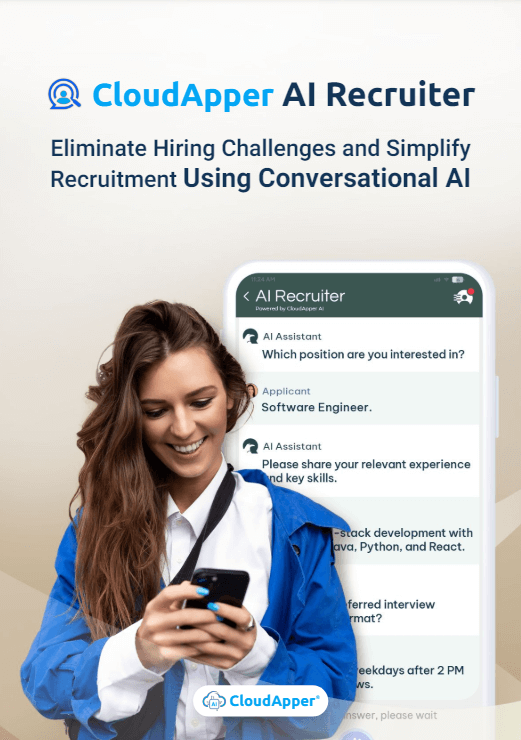
CloudApper AI Solutions for HR

- Works with







- and more.
Similar Posts

Hourly Candidates Can’t Take Calls on Shift. Here’s How to…

How to Assess Candidate Communication Skills Before the First Interview