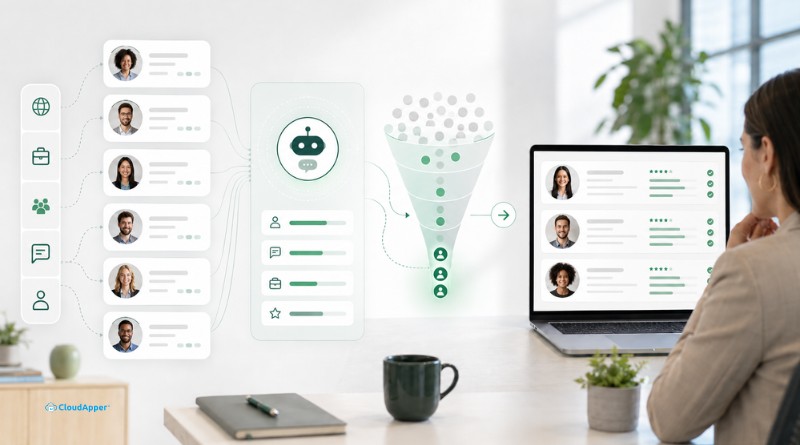
School districts face severe cafeteria worker shortages—98% affected, operating 15% understaffed. These 10 crucial interview questions evaluate food safety, allergy protocols, empathy, and student focus. CloudApper AI Recruiter automates 24/7 SMS screening, verifies certifications, reduces bias, and cuts time-to-hire by 70-90%.
Table of Contents
- Why These Questions Matter for Cafeteria Workers
- Top 10 Essential Cafeteria Worker / Food Service Interview Questions (Plus How AI Recruiter Can Automate The Entire Hiring Process)
- How CloudApper AI Recruiter Makes Hiring Cafeteria Workers Effortless
- Real-World Success Story
School cafeteria staffing has become one of the most challenging operational issues facing districts nationwide. According to the School Nutrition Association’s 2024 workforce report, 98% of school districts are experiencing food service staff shortages, with the average district operating 15% below needed staffing levels. These shortages force menu simplifications, longer lunch lines, reduced meal quality, and in extreme cases, schools reverting to pre-packaged meals or canceling hot lunch programs entirely—directly impacting student nutrition and learning readiness.
The hiring challenges are compounding rapidly. Average time-to-hire for cafeteria positions has stretched to 41 days while breakfast and lunch services can’t wait. Candidate drop-off rates exceed 65% between application and first day of work, largely because applicants juggling multiple hourly jobs can’t afford lengthy hiring processes. Meanwhile, compliance requirements around food safety certifications (ServSafe, allergen training), background checks for working with minors, and health department regulations add administrative complexity. Rising labor competition from retail and fast food offering $15-18/hour with more flexible schedules makes school food service recruitment even more difficult.

CloudApper AI Recruiter transforms this entire landscape. This conversational AI chatbot conducts screening interviews 24/7 via SMS or web chat, processes candidates 90% faster than traditional phone screening, eliminates unconscious bias in initial evaluation, and automatically assesses food safety knowledge and customer service aptitude before human hiring managers invest their limited time. Districts using AI-powered recruiting report filling cafeteria positions in under 11 days—even during peak hiring periods when schools compete with restaurants ramping up for summer tourism.
We’ll give you the exact interview questions that identify reliable, food-safety-conscious, student-focused cafeteria workers, then show you how CloudApper AI Recruiter handles the heavy lifting automatically—so you can serve nutritious meals consistently.
TL;DR
School districts face severe cafeteria worker shortages (98% affected, 15% understaffed, 41-day average time-to-hire, 65%+ drop-off). This article provides 10 essential interview questions assessing food allergy protocols, food safety, empathy for food-insecure students, sanitation, pressure handling, tech skills, integrity, cultural sensitivity, and mission alignment. CloudApper AI Recruiter automates screening via SMS/chat with these questions, verifies ServSafe/certifications, schedules interviews/compliance, eliminates bias, and accelerates hiring by 70-90%—as shown in a case reducing time-to-hire to 12 days and boosting conversions to 69%.
Why These Questions Matter for Cafeteria Workers
The school cafeteria worker role has evolved dramatically beyond simply serving food. Today’s food service professionals manage complex dietary restrictions and life-threatening allergies, operate sophisticated point-of-sale and meal tracking systems, implement USDA nutritional guidelines with precision, handle cash and digital payments, communicate sensitively with students from food-insecure households, maintain rigorous food safety protocols under health department scrutiny, and often serve as caring adult presences for vulnerable students who may depend on school meals as their primary nutrition source.
Old interview questions like “Can you work early mornings?” or “Have you worked in food service before?” barely scratch the surface of what predicts success. The cafeteria workers who stay long-term and maintain excellent food safety records demonstrate empathy with students, meticulous attention to safety protocols, grace under pressure during lunch rushes, technological adaptability, and genuine understanding of their role in student wellbeing—not just feeding bodies, but nourishing futures. Modern cafeteria worker interviews must assess food safety knowledge, customer service mindset with children, multitasking capabilities, and cultural sensitivity around food and economic diversity, all while processing high volumes of candidates efficiently to keep meal programs fully staffed.
Top 10 Essential Cafeteria Worker / Food Service Interview Questions (Plus How AI Recruiter Can Automate The Entire Hiring Process)
1. “Walk me through the proper steps for preventing cross-contamination when preparing meals for students with severe food allergies.”
Why ask this? Food allergies can be life-threatening, and cafeteria workers must demonstrate serious knowledge of contamination prevention protocols.
Sample Strong Answer: “Cross-contamination prevention is absolutely critical and requires constant vigilance. First, I’d review the student’s allergy information in our meal tracking system to know exactly what allergens to avoid—most commonly peanuts, tree nuts, dairy, eggs, soy, wheat, fish, and shellfish. I’d use completely separate preparation surfaces, utensils, and cutting boards that are clearly labeled for allergen-free prep. I’d wash my hands thoroughly and change gloves between handling different foods. For example, if I’m preparing regular sandwiches with peanut butter and then need to prepare an allergen-free meal, I’d completely clean the workspace, use different equipment, and prepare the allergen-free meal first before working with allergens. I’d store allergen-free ingredients separately and cover prepared allergen-free meals to prevent airborne contamination. I’d also communicate clearly with the student and any supervising staff that this is their special meal. In my previous cafeteria role, we had color-coded cutting boards and utensils for allergen-free prep, which made it easier to maintain protocols during busy service.”
1. “Describe how you would handle a situation where a student approaches the lunch line but doesn’t have money and appears embarrassed.”
Why ask this? This tests empathy, discretion, and understanding of food insecurity—critical soft skills when working with children in economically diverse schools.
Sample Strong Answer: “I’d treat the student with the same respect and dignity as every other student—no child should ever be embarrassed about food access. I’d quietly say something like, ‘No problem, let me check your account,’ and serve them their meal just as I would any other student, maintaining their privacy. Many districts have policies allowing students to charge meals or providing emergency meals, and I’d follow that protocol without drawing attention. I’d never announce their account status in front of peers or make them feel singled out. After service, I’d discreetly notify the cafeteria manager or office staff about the account status so they can follow up appropriately with the family about free/reduced lunch applications or payment. I understand that for some students, school breakfast and lunch are their only reliable meals, and my job is to nourish them, not judge their circumstances. Every student deserves to eat with dignity.”
3. “You notice the refrigerator temperature gauge reading 45°F during your shift. What’s your immediate course of action?”
Why ask this? Food safety knowledge is non-negotiable, and this tests understanding of temperature danger zones and proper reporting protocols.
Sample Strong Answer: “That’s above the safe refrigeration temperature of 41°F or below, which puts us in the danger zone where bacteria can multiply rapidly. I’d immediately stop using any food from that refrigerator and alert my supervisor right away. I’d check if it’s a thermometer malfunction or an actual equipment failure by verifying with a separate thermometer probe. If it’s genuinely at 45°F, we’d need to assess how long the temperature has been elevated and determine what food needs to be discarded according to health department guidelines—generally, if perishable food has been in the danger zone (above 41°F, below 135°F) for more than two hours, it must be thrown out. I’d document the temperature, time discovered, and all food affected. We’d never serve potentially unsafe food—we’d adjust the menu to items from properly functioning refrigeration or shelf-stable options. Student safety always comes first, even if it means additional work or food waste. I’d also help with the cleanup and restocking once the issue was resolved.”
4. “The lunch line is backing up significantly because we’re understaffed today and students are getting restless. How do you handle the pressure?”
Why ask this? Lunch rushes are daily reality, and this assesses multitasking, composure under pressure, and customer service mindset.
Sample Strong Answer: “I’d stay calm and focus on efficient service without sacrificing food safety or accuracy. First, I’d quickly communicate with my team to streamline—maybe one person focuses solely on serving hot entrees while another handles sides and drinks, creating an assembly line flow. I’d keep my workspace organized so I’m not wasting movements. While serving, I’d maintain a friendly demeanor with students even though I’m moving quickly—a smile and ‘here you go!’ takes one second and keeps the atmosphere positive rather than stressful. If students are getting rowdy in line, I’d politely but firmly remind them to keep moving and stay orderly. I might also communicate with supervising staff that we need help managing the line. In my previous role, we developed hand signals to communicate when we needed backup or when items were running low so we could problem-solve without leaving our stations. The key is staying focused, working as a team, and remembering that students are hungry and have limited lunch time—getting them fed efficiently is our primary job during that rush.”
5. “Tell me about your experience with point-of-sale systems, meal tracking software, or other technology used in modern school cafeterias.”
Why ask this? Technology integration is now standard in school nutrition programs for tracking free/reduced meals, nutritional compliance, and payment processing.
Sample Strong Answer: “In my last position, I used the PrimeroEdge system daily for meal tracking and payment processing. I’d scan student IDs or enter PIN codes, which automatically recorded their meal selection and deducted payment or tracked their free/reduced meal status. The system flagged students with dietary restrictions or allergies, which helped us serve them safely. I’m comfortable with touchscreen interfaces and learned to troubleshoot common issues like barcode scanner malfunctions or system freezes. I’ve also used basic cash registers and can accurately make change and balance a drawer at the end of shifts. When our district switched to a new system mid-year, I attended the training and practiced during slow times until I was proficient. I understand these systems aren’t just about payment—they’re accountability tools that ensure we’re meeting USDA requirements and tracking student nutrition. I’m always willing to learn new technology because it ultimately helps us serve students more efficiently and accurately.”
6. “How would you respond if a student made a negative comment about the food you’re serving or refused to eat what’s being offered?”
Why ask this? This tests resilience, professionalism, and understanding that students’ food preferences/reactions shouldn’t be taken personally.
Sample Strong Answer: “I wouldn’t take it personally—kids are honest and not all foods appeal to everyone. I’d respond positively, something like, ‘That’s okay, not everyone likes everything. Make sure you get some fruit and milk so you have energy for class.’ I’d serve them the components they will eat from the meal options available. If a student flat-out refuses everything, I’d encourage them to take at least something nutritious and let them know they might get hungry later. I’d never force or shame a student about food—that creates negative relationships with eating. If multiple students are consistently rejecting certain menu items, I’d mention that feedback to my supervisor because it might indicate we need recipe adjustments or different offerings. I also understand that some students have sensory issues, cultural food preferences, or are navigating food insecurity in complex ways. My job is to provide nourishing options with kindness, not to police what or how much they eat. Building positive rapport with students matters more than any single meal acceptance.”
7. “Describe your approach to maintaining cleanliness and sanitation in a high-volume food service environment.”
Why ask this? Sanitation directly impacts health department ratings and student safety—this reveals conscientiousness and understanding of cleaning protocols.
Sample Strong Answer: “Sanitation is continuous, not just an end-of-shift task. Throughout service, I’m constantly wiping down surfaces, keeping my work area organized, and preventing buildup. I follow the ‘clean as you go’ method—if I spill something, I clean it immediately before it becomes a contamination or safety hazard. I understand proper sanitizer concentrations and contact time requirements—typically 200 ppm quaternary ammonium with at least 10 seconds contact time, or whatever our health department requires. I use color-coded cleaning cloths to prevent cross-contamination between food prep surfaces and non-food surfaces. After each meal service, I do thorough cleaning of all equipment, steam tables, serving lines, and floors, following our cleaning checklist. I properly store cleaning chemicals away from food and ensure proper labeling. I’ve worked in kitchens with excellent health inspection scores and understand that the daily discipline of sanitation is what maintains that—it’s not about a deep clean once a week, it’s about maintaining standards every single shift. I take pride in working in a clean, safe environment.”
8. “What would you do if you witnessed a coworker not following proper food safety procedures, such as not wearing gloves or not washing hands?”
Why ask this? This assesses integrity, understanding of accountability in food safety, and willingness to address problems professionally.
Sample Strong Answer: “Food safety is non-negotiable because we’re responsible for children’s health, so I’d address it directly but professionally. If it was a minor oversight in the moment—like a coworker forgot to put gloves on—I’d give them a friendly reminder: ‘Hey, don’t forget your gloves before handling that food.’ Most times people appreciate the catch because we’re all human and occasionally forget a step when busy. If it was a pattern or something more serious, I’d speak with them privately first if appropriate, or bring it to a supervisor’s attention if it continued or if it was something immediately dangerous. I wouldn’t gossip about it or ignore it—ignoring food safety violations puts students at risk and could jeopardize our whole program if there was an outbreak or health inspection issue. I’d want my coworkers to hold me accountable too. We’re a team responsible for serving safe food to hundreds of children daily, and that requires everyone maintaining standards consistently.”
9. “School cafeterias serve students from diverse cultural and economic backgrounds. How do you ensure you’re treating all students with respect and sensitivity?”
Why ask this? Cultural competence and equity-mindedness are essential when serving diverse student populations with varying relationships to food and resources.
Sample Strong Answer: “Every student deserves to be treated with dignity and respect, regardless of their background or circumstances. I make an effort to learn and correctly pronounce students’ names, which shows I see them as individuals. I’m mindful that students have different cultural relationships with food—some may be fasting for religious reasons, some may find certain menu items unfamiliar, and some may be navigating food insecurity. I never make assumptions or judgments. I treat the student receiving free meals exactly the same as the student paying cash—there should be zero difference in how they’re greeted or served. I’m also aware that commenting on how much or how little a student eats can be harmful, so I avoid that. If students want to share about their cultural foods or traditions, I listen with genuine interest. I’ve worked in diverse schools where we celebrated different heritages through special menu items, and I loved learning about new foods and traditions. Ultimately, my role is to provide nourishing food in a welcoming environment where every single student feels valued and cared for.”
10. “Why do you want to work as a cafeteria worker in a school specifically, rather than in a restaurant or other food service setting?”
Why ask this? Mission alignment predicts retention—workers motivated by working with children and community impact stay longer than those just seeking any food service job.
Sample Strong Answer: “I specifically want to work in a school cafeteria because I value being part of students’ education and wellbeing. In restaurants, you serve people once and rarely see them again, but in schools, I get to build relationships with students over time. I love when kindergarteners light up seeing me, or when a shy student gradually starts saying ‘thank you,’ or when I can make a positive interaction for a student who might be having a hard day. I also deeply believe in the mission of school nutrition—for many students, school meals are their most reliable nutrition, and knowing I’m directly contributing to their ability to learn and grow is incredibly meaningful. The schedule works well for my family too—mornings and early afternoons with weekends, holidays, and summers off let me be present for my own children. The school environment feels more community-focused and purposeful than commercial food service. I’m not just serving food; I’m nourishing the next generation and being a caring adult presence in students’ lives. That matters to me more than slightly higher wages elsewhere.”
How CloudApper AI Recruiter Makes Hiring Cafeteria Workers Effortless
Picture this scenario: Your cafeteria manager reports two workers gave notice before the start of a new school year. Instead of panicking, you simply activate CloudApper AI Recruiter. Within 48 hours, it has screened 18 candidates via SMS, asked all ten questions above plus your district’s custom requirements, assessed their food safety knowledge, evaluated their empathy and student focus, verified their availability for split shifts, ranked them by qualification match, and scheduled your top five candidates for in-person working interviews—all without you spending a single minute on phone tag. This isn’t aspirational. It’s exactly how CloudApper AI Recruiter works for school districts right now.
Here’s how it revolutionizes cafeteria worker hiring specifically:
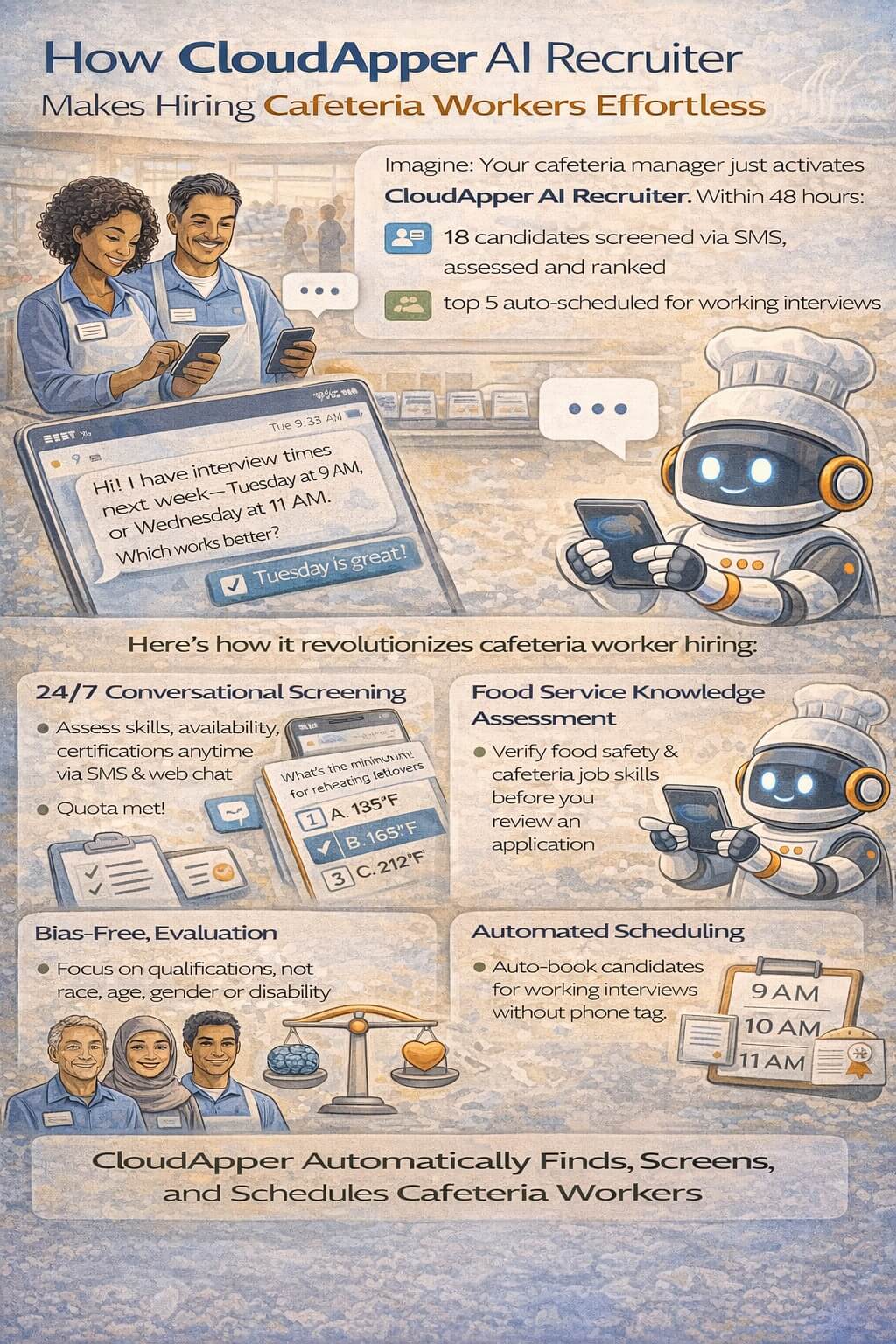
24/7 Conversational Screening via SMS & Web Chat
Food service candidates are often working multiple hourly jobs or have caregiving responsibilities that make traditional business-hours phone screening impossible. CloudApper meets them in their reality—they can complete screening interviews via text message during their break at their current job, after putting kids to bed, or on weekends. The AI conducts warm, conversational exchanges that assess both hard skills (food safety knowledge) and soft skills (empathy with students, patience under pressure). For cafeteria recruitment specifically, it can immediately verify food handler certifications, assess previous food service experience, confirm split-shift availability (typically 6-9 AM and 11 AM-2 PM), and evaluate mission alignment with serving students—all before your nutrition director reviews a single application.
Food Service-Specific Knowledge Assessment
CloudApper AI Recruiter can include customized questions that test actual food safety knowledge: “What’s the minimum internal temperature for reheating leftovers?” or “How long can prepared food safely sit in the temperature danger zone?” The AI evaluates responses against correct answers and flags candidates with strong food safety knowledge. You can configure it to assess ServSafe certification status, allergen awareness, sanitation protocols, and even customer service scenarios specific to school settings. Candidates who don’t demonstrate baseline food safety competence are automatically screened out, saving your team from interviewing unqualified applicants.
Bias-Free, Equity-Focused Evaluation
Every candidate answers identical questions evaluated against the same criteria. The AI doesn’t make assumptions based on age, accent, employment gaps, or unconventional work histories. This is especially important in food service where immigrant workers, older adults re-entering the workforce, individuals with disabilities, and people transitioning from other industries often bring exceptional work ethic and reliability but may face unconscious bias in traditional screening. CloudApper evaluates what matters: Do they understand food safety? Do they show empathy for students? Can they handle the physical and interpersonal demands? That’s what determines ranking.
Automated Scheduling & Compliance Coordination
After initial screening, CloudApper can automatically trigger your hiring workflow—sending candidates links to complete food handler certification courses if they don’t have current credentials, scheduling tuberculosis tests, initiating fingerprinting appointments, and coordinating first-day paperwork. For qualified candidates, it schedules working interviews or trial shifts directly on your cafeteria manager’s calendar. The system maintains a live pipeline of pre-screened, compliance-progressing candidates so you’re never caught short-staffed at the start of a new semester.
Real-World Success Story
A mid-sized urban district with 28 school cafeterias was chronically understaffed by 22 positions, forcing managers to work serving lines and causing meal service delays. After implementing CloudApper AI Recruiter, they reduced time-to-hire from 41 days to 12 days, increased their qualified applicant pool by 94%, and filled all vacant positions within 60 days. Most remarkably, their candidate-to-hire conversion rate jumped from 28% to 69% because the instant SMS screening process captured candidates’ interest before they accepted other food service jobs. The nutrition director reported: “We went from constantly scrambling to adequately staffed with a waiting list. CloudApper eliminated the administrative burden that was drowning us.”
Mobile-Optimized for Hourly Workers
Cafeteria candidates aren’t sitting at computers—they’re working other jobs, managing households, and navigating busy lives. CloudApper’s SMS-first design requires no app downloads, no account creation, just natural text conversation. Candidates can complete screening in 10-15 minutes during any free moment. Completion rates are 5x higher than traditional applications requiring desktop access and lengthy form-filling.
Ready to build your reliable food service team? Discover how CloudApper AI Recruiter keeps cafeterias fully staffed: Explore CloudApper AI Recruiter for School Nutrition
FAQ
Q: Why are school districts struggling to hire cafeteria workers? A: 98% of districts report food service staff shortages, operating 15% below needed levels, with average time-to-hire at 41 days and candidate drop-off exceeding 65% due to lengthy processes and compliance requirements.
Q: What makes a strong interview question for school cafeteria workers? A: Effective questions evaluate critical areas like food allergy cross-contamination prevention, food safety (e.g., temperature danger zones), empathy for students facing food insecurity, sanitation protocols, composure during rushes, tech familiarity (POS systems), integrity in reporting violations, cultural sensitivity, and genuine motivation for child-focused roles over higher-paying alternatives.
Q: How can AI improve hiring for school food service positions? A: CloudApper AI Recruiter provides 24/7 conversational screening via SMS/chat, asks targeted questions on safety/empathy, verifies certifications (e.g., ServSafe), auto-schedules interviews/trial shifts/compliance tasks, ranks candidates objectively, reduces bias, and cuts time-to-hire by 70-90% while building larger qualified pools.
Q: How should cafeteria workers handle students with food allergies? A: Use separate labeled equipment/surfaces, prepare allergen-free meals first, change gloves/wash hands, store ingredients separately, cover meals, review allergy info in tracking systems, and communicate clearly—prioritizing vigilance to prevent life-threatening cross-contamination.
Q: What is the proper response to a refrigerator reading 45°F? A: Immediately stop using it (danger zone above 41°F), alert supervisor, verify temperature, assess duration, discard affected food per guidelines (e.g., >2 hours in danger zone), document everything, and adjust menu—never compromising student safety.
Q: How important is empathy in school cafeteria roles? A: Extremely—workers must handle food insecurity discreetly (e.g., serve embarrassed students without announcement), respond positively to food complaints without shaming, and treat all students with dignity regardless of economic/cultural background.
Q: What real-world results have districts seen with AI recruiting for cafeteria staff? A: A mid-sized urban district reduced time-to-hire from 41 to 12 days, grew qualified applicants by 94%, filled all vacancies in 60 days, and improved candidate-to-hire conversion from 28% to 69%.
Stop Scrambling for Cafeteria Staff—Start Hiring Smarter Today
The school food service staffing crisis won’t resolve itself through job postings alone. Your hiring process must evolve to compete for hourly workers who have countless options. By asking the right interview questions and leveraging CloudApper AI Recruiter’s conversational intelligence, you can build a stable, qualified, student-focused cafeteria team that shows up reliably—not 41 days from now, but within two weeks.
Districts using CloudApper AI Recruiter consistently report:
- 90% faster initial screening processes
- 71% reduction in time-to-hire for food service roles
- 5x larger qualified candidate pools
- 69% decrease in candidate drop-off rates
- Elimination of evening phone screening for managers
The interview questions we’ve shared reveal whether candidates have the food safety knowledge, student empathy, reliability, and mission alignment to succeed long-term in school cafeterias. But manually asking them to dozens of candidates while also managing meal service, USDA compliance, and operational challenges? That’s where most nutrition departments fail.
Don’t let outdated hiring processes compromise your meal programs and student nutrition.
Book your personalized demo of CloudApper AI Recruiter and see how it screens, evaluates, and schedules cafeteria workers automatically—while your team focuses on feeding students.
What’s your biggest challenge in recruiting and retaining school cafeteria staff? Share in the comments below. Our team actively monitors these conversations and often provides customized strategies for specific food service hiring challenges.
You might also like to read:

What is CloudApper AI Platform?
CloudApper AI is an advanced platform that enables organizations to integrate AI into their existing enterprise systems effortlessly, without the need for technical expertise, costly development, or upgrading the underlying infrastructure. By transforming legacy systems into AI-capable solutions, CloudApper allows companies to harness the power of Generative AI quickly and efficiently. This approach has been successfully implemented with leading systems like UKG, Workday, Oracle, Paradox, Amazon AWS Bedrock and can be applied across various industries, helping businesses enhance productivity, automate processes, and gain deeper insights without the usual complexities. With CloudApper AI, you can start experiencing the transformative benefits of AI today. Learn More
- Useful Links:
- Agentic AI
- No-Code/Low-Code
- Custom Software
- HCM Personalization
- iPaaS
- FedRAMP
CloudApper AI Solutions for HR

- Works with








- and more.
Similar Posts

The Hidden Cost of Duplicate Candidate Records Across Your Hiring…
The 7-Second Resume Rule Is Killing High-Volume Hiring in Dayforce:…