High-volume hourly recruiting faces 30-50% interview no-show rates, costing $500 each and delaying hires. CloudApper AI Recruiter eliminates them via instant SMS engagement, self-scheduling, automated multi-touch reminders, and easy rescheduling—cutting no-shows to 8-12% and time-to-hire dramatically.
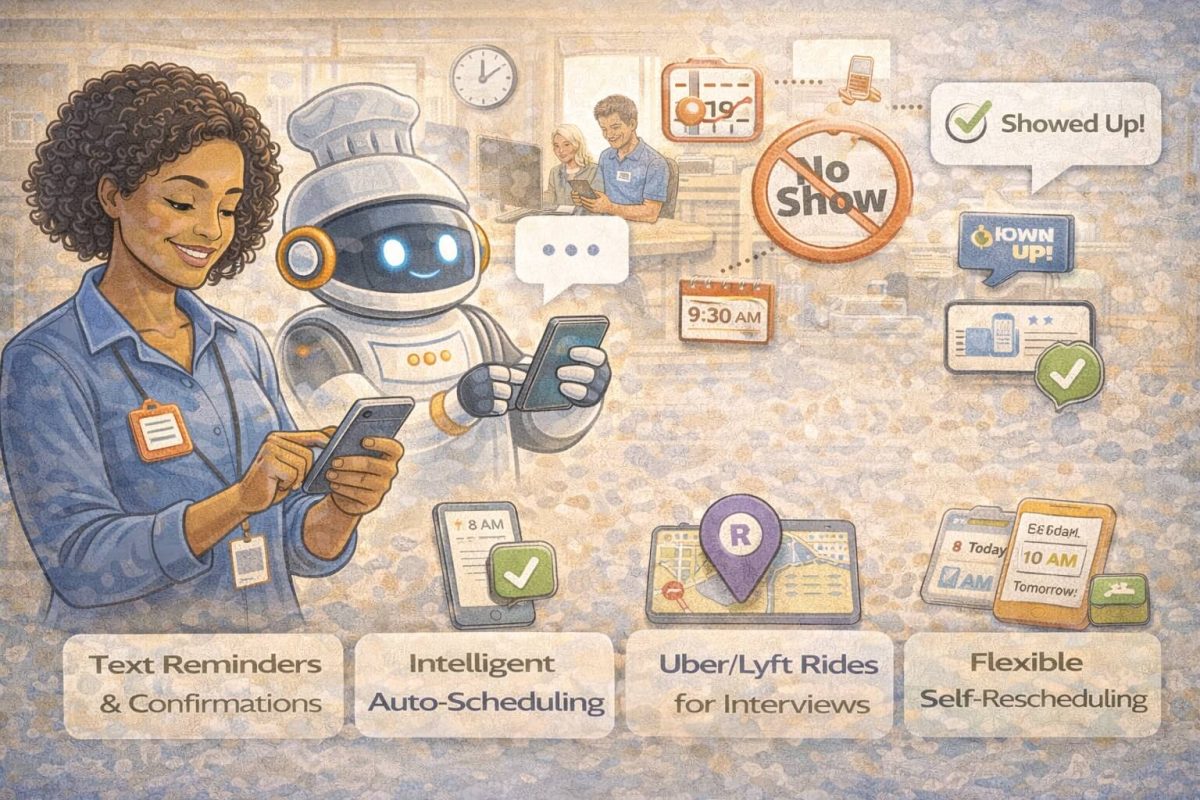
Table of Contents
- The Silent Crisis Costing You Time, Money, and Great Candidates
- TL;DR
- Why Hourly Candidates Don’t Show Up
- The CloudApper AI Recruiter Solution
- Real-World Results: Organizations Eliminating No-Shows
- Additional Strategies to Reduce No-Shows
- Complete Benefits of Eliminating No-Shows
- Frequently Asked Questions
- FAQ
- The Strategic Imperative: Why This Matters Now
The Silent Crisis Costing You Time, Money, and Great Candidates
Your hiring manager blocks off three hours Tuesday afternoon. You’ve scheduled five interviews for a CNA position. Only two candidates show up. The other three simply don’t appear—no call, no text, no explanation. Those three hours are gone forever, your hiring manager is frustrated, and your critical position remains unfilled.
This scenario plays out thousands of times daily across healthcare facilities, retail stores, and manufacturing plants throughout the United States. Interview no-shows aren’t occasional inconveniences—they’re a systemic crisis in hourly recruiting that’s wasting countless hours and preventing organizations from hiring the frontline workers they desperately need.

Recent data reveals the scope of the problem: 41% of employers report an increase in candidate ghosting, and for hourly positions specifically, the rates are even higher. Some organizations report no-show rates exceeding 50% for entry-level and hourly interviews. Meanwhile, 42% of candidates have left the recruitment process when it took too long to schedule an interview, creating a vicious cycle where slow scheduling leads to no-shows, which leads to more interview rounds, which slows scheduling further.
The financial impact is staggering. Each interview no-show costs approximately $500 when you factor in recruiter time, hiring manager time, lost productivity, and extended time-to-fill. For an organization conducting 500 hourly interviews annually with a 40% no-show rate, that’s $100,000 wasted on candidates who never appear.
But the problem goes deeper than money. No-shows extend time-to-hire, burn out hiring managers, damage team morale when positions stay unfilled, and force you to schedule far more interviews than necessary just to account for expected no-shows. This reactive approach creates scheduling nightmares and makes high-volume recruiting feel impossible.
The good news? With the right strategies and automation technology, interview no-shows can be reduced by 60-80%, transforming your hiring efficiency and results.
TL;DR
High-volume hourly recruiting faces 30-50% interview no-show rates (up to 52% in cases), wasting $500 per no-show and extending time-to-hire. Causes include scheduling delays, competition, lack of reminders, conflicts, and poor experiences. CloudApper AI Recruiter eliminates them via instant SMS engagement, pre-screening, candidate self-scheduling (including after-hours), multi-touch text reminders, easy rescheduling, and continuous communication—reducing no-shows to 8-12%, slashing time-to-hire (e.g., 52 to 19 days), and delivering real results in healthcare, retail, and manufacturing.
Why Hourly Candidates Don’t Show Up
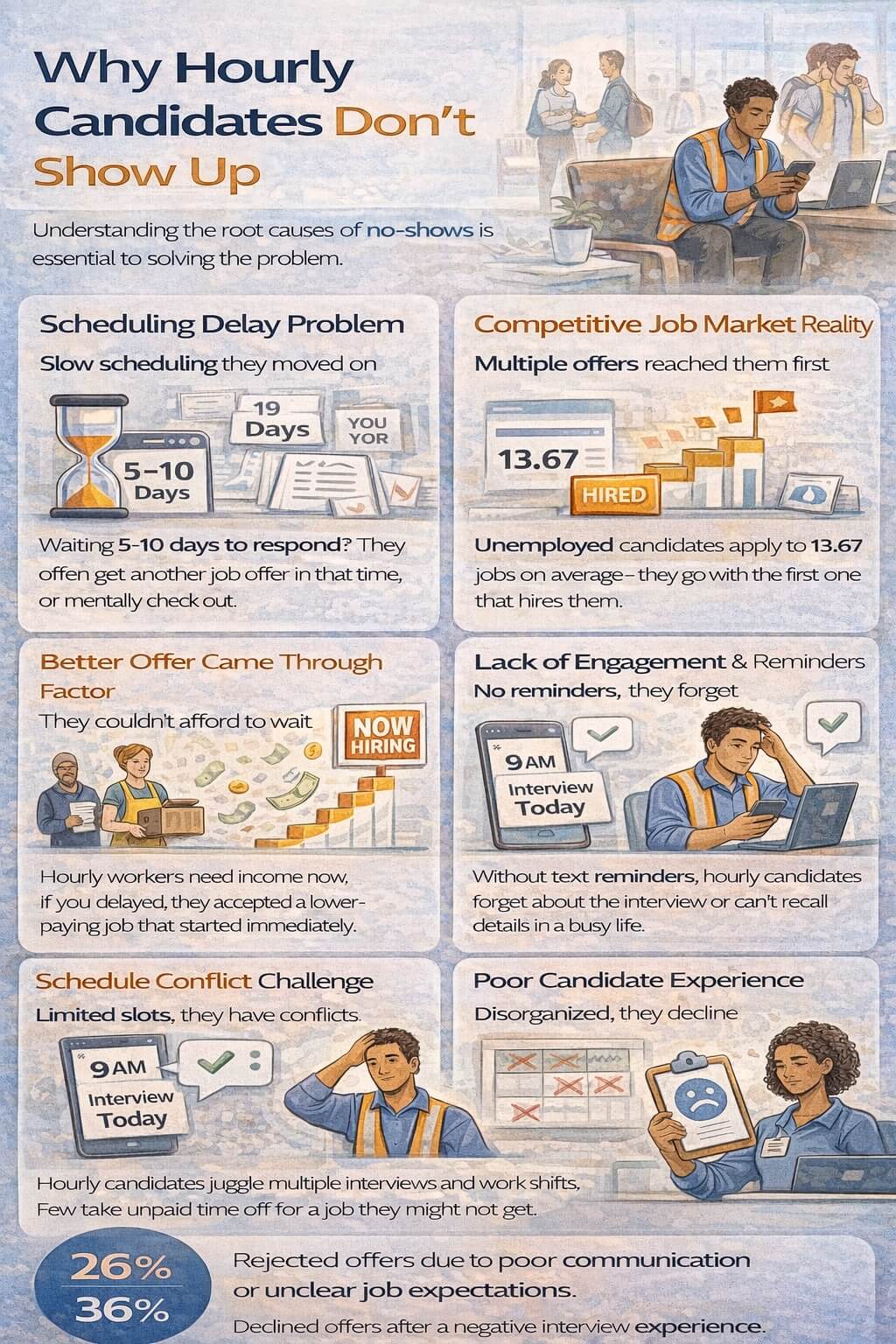
Understanding the root causes of no-shows is essential to solving the problem. Hourly candidates ghost interviews for fundamentally different reasons than professional candidates.
The Scheduling Delay Problem
Job seekers are more likely to go through with an interview if they hear back within 48 hours of applying. However, in traditional recruiting workflows, it often takes 5-10 days to review applications, select candidates, send interview invitations, and coordinate schedules.
By the time you contact candidates a week or two after they applied, their situation has changed. They’ve accepted another offer, lost interest, or simply moved on emotionally from your opportunity. When they ghost your interview, it’s not personal—they’ve mentally checked out of your process before you even engaged them.
The Competitive Job Market Reality
According to the U.S. Bureau of Labor Statistics, job seekers who are currently unemployed submit an average of 13.67 job applications. Your CNA candidate is simultaneously interviewing with four other hospitals. Your retail applicant is talking to six different chains. Your production worker candidate has interviews at three manufacturing plants.
Whoever moves fastest wins. If competitors schedule interviews immediately while you’re still processing applications, candidates show up for their interviews—not yours.
The “Better Offer Came Through” Factor
Hourly workers often can’t afford to wait. They need income now. When they applied to your position two weeks ago, they were desperate. Today, they’ve accepted a job that started immediately—even if your opportunity was ultimately better. They don’t show up for your interview because they’re already working somewhere else.
The Lack of Engagement and Reminders
Without regular touchpoints between application and interview, candidates forget about scheduled interviews or lose track of timing. Life gets busy. Without automated reminders via text (their preferred communication channel), interviews slip through the cracks.
Research shows text-based communication resonates with hourly workers, improving engagement and reducing no-show rates for interviews and orientations. Yet most organizations still rely primarily on email communication that hourly candidates rarely check.
The Schedule Conflict Challenge
Highly qualified candidates often have multiple interviews and may have to fit an interview around their work schedule. When you offer limited interview times during standard business hours, hourly candidates who are currently employed can’t attend without taking time off work—something they’re reluctant to do for a job they might not get.
The Poor Candidate Experience
When your application process is cumbersome, communication is slow, or the interview scheduling experience is unprofessional, candidates assume your organization is disorganized. Why would they prioritize an interview with a company that seems disorganized when other opportunities feel more professional?
26% of job seekers rejected offers due to poor communication or unclear job expectations, and 36% declined offers after a negative interview experience. This candidate experience problem starts long before the interview—it begins with how quickly you respond and how smooth your scheduling process feels.
The CloudApper AI Recruiter Solution
CloudApper AI Recruiter attacks the no-show problem systematically through automation that addresses every root cause.
Instant Engagement (Minutes, Not Days)
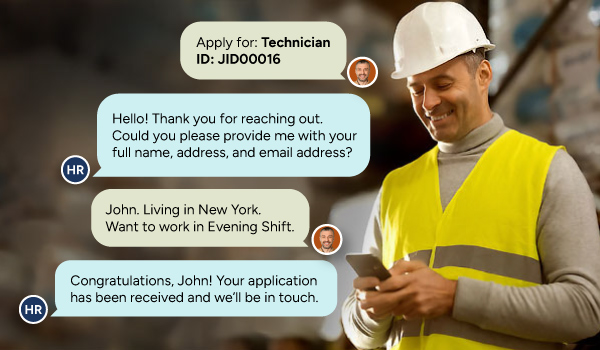
The moment candidates apply through text-to-apply, QR code, or your careers page, CloudApper’s AI responds instantly with conversational screening. There’s no multi-day gap between application and engagement.
Traditional Process: Candidate applies Monday → recruiter reviews Wednesday → phone screen scheduled for following Monday (10 days elapsed)
CloudApper Process: Candidate applies Monday 2pm → AI responds Monday 2:01pm with screening questions → qualified candidates receive interview offers by Monday 3pm
This speed eliminates the engagement gap that causes candidates to lose interest or accept other offers.
Automated Pre-Screening Before Scheduling
CloudApper conducts intelligent pre-screening through conversational AI before interview scheduling even begins. The system asks qualifying questions via text, email, or chat:
“Do you have reliable transportation to our facility?” “Are you available to start within 2 weeks?” “Can you work our required shifts?”
Only candidates who pass pre-screening and confirm availability move to interview scheduling. This eliminates wasted interviews with unqualified or unavailable candidates who were likely to no-show anyway.
Self-Service Interview Scheduling
Instead of email tennis to find mutually available times, CloudApper lets candidates schedule their own interviews through conversational AI:
AI: “Great! You’re pre-qualified for our CNA position. I have interview times available Tuesday at 2pm, Wednesday at 10am, or Thursday at 4pm. Which works best for you?”
Candidate: “Thursday at 4”
AI: “Perfect! Interview scheduled for Thursday, January 16th at 4pm at [location]. You’ll receive reminder texts. See you then!”
This self-scheduling approach gives candidates control over timing, making them more likely to attend times they personally selected. It also accommodates their current work schedules by offering varied times including evenings and weekends.
Multi-Channel Automated Reminders
CloudApper sends automated reminders through candidates’ preferred channels—primarily text messages for hourly workers:
- Confirmation immediately after scheduling
- Reminder 48 hours before interview
- Reminder morning of interview
- Reminder 2 hours before interview (optional)
Each reminder includes interview details, location/link, interviewer name, and easy rescheduling option. Text-based communication resonates with hourly workers, improving engagement and reducing no-show rates, and CloudApper leverages this insight systematically.
Easy Rescheduling Options
Life happens. Instead of candidates simply not showing up when conflicts arise, CloudApper makes rescheduling effortless. Reminders include “Need to reschedule? Reply RESCHEDULE and I’ll show you new times.”
When candidates can easily reschedule rather than ghost, your no-show rate plummets. CloudApper handles rescheduling automatically—showing available times, updating calendars, and notifying everyone involved.
Continuous Engagement Throughout Process
CloudApper keeps candidates engaged between scheduling and interview with relevant information:
- Details about the role and your organization
- What to expect during the interview
- Directions and parking information
- Answers to common candidate questions
This ongoing engagement maintains interest and reduces the likelihood candidates forget about or deprioritize your interview.
Interview Preparation Support
The AI can share interview preparation tips, suggest questions candidates might want to ask, and provide insights about your company culture. This preparation makes candidates feel more confident and invested, increasing attendance rates.
Flexible Interview Options
CloudApper supports multiple interview formats—phone, video, or in-person—making it easier for candidates to attend even with scheduling constraints. Virtual interviews are a great way to reduce interview no-shows. In fact, job seekers are 20% more likely to accept video interview invitations than in-person or phone interviews.
For candidates who can’t travel during business hours or have transportation challenges, offering video interviews as an option significantly improves attendance.
Seamless ATS Integration
All scheduling, rescheduling, reminders, and attendance tracking sync automatically with your ATS—Workday, Dayforce, UKG, SAP SuccessFactors, Oracle, and others. Your recruiting team sees complete visibility into scheduled interviews, attendance patterns, and no-show trends without manually tracking anything.
Real-World Results: Organizations Eliminating No-Shows
Healthcare System: Multi-Facility Network
Challenge: 45% no-show rate for CNA and medical assistant interviews. Hiring managers frustrated, positions chronically unfilled, recruitment process seemed broken.
Solution: Implemented CloudApper AI Recruiter with instant engagement, automated pre-screening, self-scheduling, and text-based reminders.
Results:
- Interview no-show rate reduced from 45% to 8%
- Time from application to scheduled interview: under 24 hours
- Hiring manager satisfaction increased dramatically (less wasted time)
- Time-to-hire decreased from 52 days to 19 days
- Filled 40% more positions with same recruiting team size
- Saved approximately 15 hours per week of wasted interview time
Retail Chain: 50-Store Regional Operator
Challenge: 52% no-show rate for store associate interviews during seasonal hiring. Had to schedule 3X more interviews than needed to account for no-shows, creating scheduling nightmares.
Solution: CloudApper text-to-apply with instant screening, self-scheduling, and automated text reminders focused on hourly workers’ communication preferences.
Results:
- No-show rate dropped from 52% to 11%
- Eliminated need to “over-schedule” interviews
- Hiring manager time saved: 12 hours per week across all stores
- Seasonal hiring completed 40% faster
- Candidate feedback: 89% rated scheduling experience “excellent”
- Reduced total interviews needed by 60% (better pre-screening + fewer no-shows)
Manufacturing Facility: Large Production Plant
Challenge: 38% no-show rate for production worker interviews. Scheduling complexity across three shifts made traditional coordination impossible.
Solution: CloudApper with 24/7 automated scheduling, shift-specific interview times, video interview options, and persistent text reminders.
Results:
- No-show rate reduced from 38% to 9%
- Offered evening and weekend interview times (automated system made this feasible)
- 70% of candidates chose self-scheduled times outside traditional business hours
- Production hiring stayed on schedule (no delays due to unfilled positions)
- Recruiter workload decreased by 25 hours per month
- Worker quality improved (better engagement indicated higher candidate seriousness)
Additional Strategies to Reduce No-Shows
Beyond automation, several strategic approaches further minimize interview no-shows:
Competitive Urgency Messaging: When scheduling, the AI can mention “We’re interviewing several candidates this week and expect to make decisions quickly.” This creates appropriate urgency without desperation.
Salary Transparency Upfront: Job seekers value pay transparency, with almost half (47%) preferring to see salary information before applying for an open position. When candidates know the pay range before interviewing, they’re more likely to attend.
Streamline to Single Interview When Possible: For many hourly positions, multiple interview rounds aren’t necessary. CloudApper’s thorough AI pre-screening allows you to move qualified candidates directly to hiring manager interviews, reducing total process time and dropout risk.
Offer Interview Flexibility: Try offering after-hours or weekend interviews to reduce the chances of a scheduling conflict. CloudApper’s automation makes this operationally feasible without burdening your recruiting team.
Personalized Communication: Even though automated, CloudApper’s messages reference specific details about each candidate’s situation, making communication feel personal rather than generic.
Build Genuine Connection: During pre-screening, the AI can gather candidate questions and interests, which hiring managers can reference during interviews. This prep work makes interviews feel more personalized.
Complete Benefits of Eliminating No-Shows
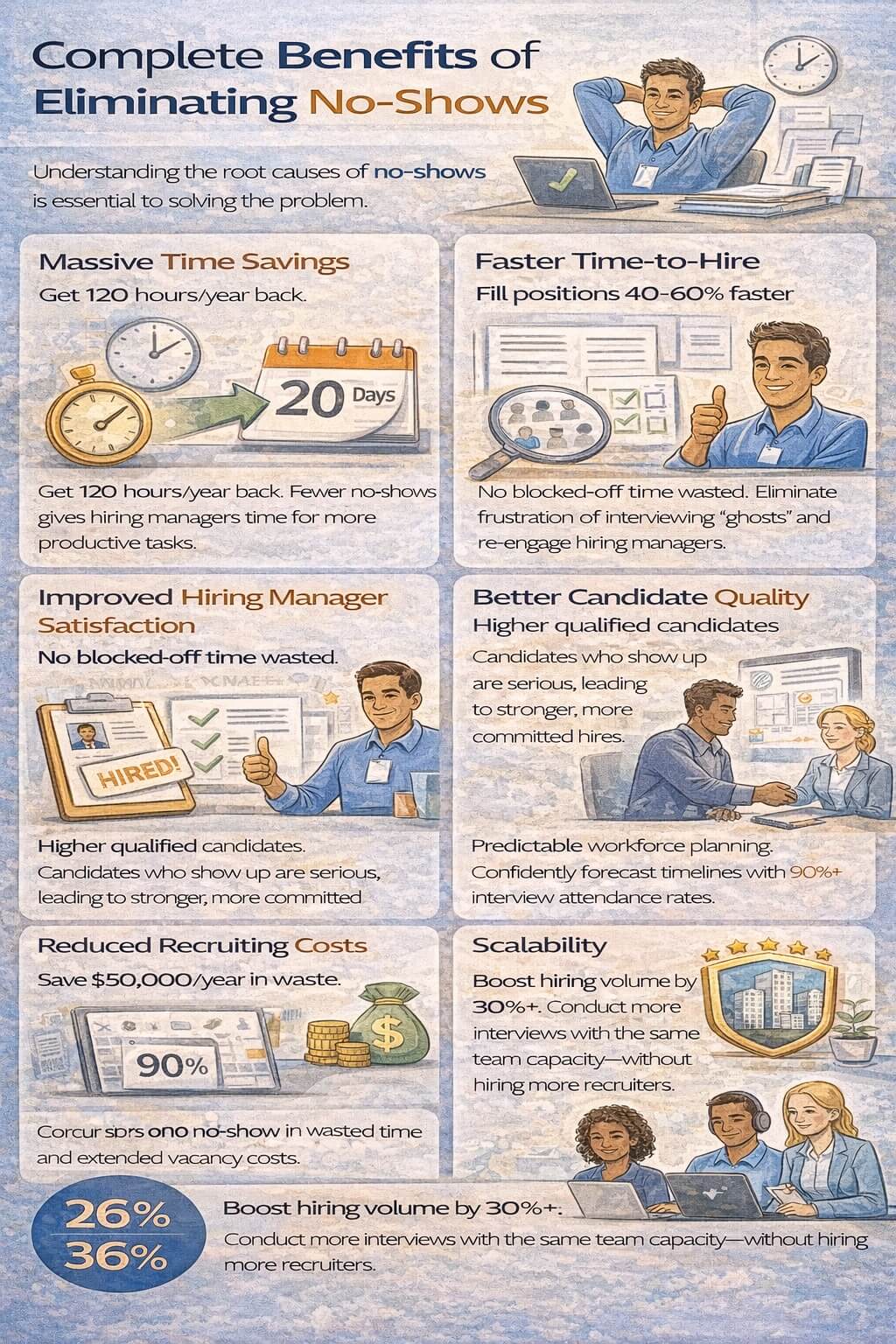
Massive Time Savings: When no-show rates drop from 40-50% to under 10%, hiring managers get their time back. A hiring manager conducting 100 interviews annually saves approximately 120 hours that were previously wasted on no-shows.
Faster Time-to-Hire: Fewer no-shows means fewer replacement interview rounds. Positions fill in one round instead of three, cutting time-to-hire by 40-60%.
Improved Hiring Manager Satisfaction: Nothing frustrates hiring managers more than blocked-off time wasted on no-shows. Eliminating this frustration improves their engagement with the recruiting process.
Better Candidate Quality: Candidates who show up for interviews tend to be more serious and committed than those who ghost. Lower no-show rates correlate with better hire quality.
More Accurate Hiring Forecasting: When you can trust that 90% of scheduled interviews will actually happen, workforce planning becomes more predictable. You can forecast hiring timelines accurately instead of guessing.
Reduced Recruiting Costs: Every no-show costs approximately $500 in wasted time and extended vacancy costs. Cutting 100 no-shows annually saves $50,000.
Scalability: Lower no-show rates mean you can conduct more productive interviews with the same team capacity, enabling higher hiring volume without proportional recruiter increases.
Improved Employer Brand: When your process is fast, professional, and communicates effectively, candidates who do interview share positive experiences—strengthening your reputation and making future recruiting easier.
Frequently Asked Questions
What’s a “normal” no-show rate for hourly positions?
Industry averages for hourly positions range from 30-50% depending on the role and region. However, organizations implementing best practices with automation typically achieve no-show rates of 8-12%. Anything above 25% indicates significant room for improvement and likely represents tens of thousands in wasted costs annually.
Will automated reminders annoy candidates?
Not when done correctly. Candidates appreciate reminders that help them remember important commitments. The key is appropriate frequency (not daily reminders) and helpful content. CloudApper’s reminders provide value—interview details, directions, what to expect—not just “don’t forget.” Research shows text reminders dramatically reduce no-shows without negative candidate feedback.
Should we penalize candidates who no-show?
Penalizing doesn’t solve the problem—preventing no-shows through better processes does. However, you can implement reasonable policies like “we allow one reschedule, but repeated no-shows without notice remove candidates from consideration.” CloudApper tracks attendance patterns automatically, flagging repeat offenders.
What about candidates without reliable phones or text access?
While text is optimal for hourly workers, CloudApper supports multiple communication channels. Candidates can receive reminders via email as backup, and the system adapts to whatever channel each candidate responds to best. Phone penetration in the U.S. working population exceeds 90%, so this affects minimal candidates.
How quickly can we implement no-show reduction strategies?
CloudApper AI Recruiter typically goes live within 2-3 weeks from kickoff. You’ll see no-show reduction immediately—the first week of automated reminders and instant scheduling produces measurable improvements. Full optimization usually takes 30-60 days as you refine messaging and scheduling options based on data.
Won’t offering evening and weekend interviews burden our team?
Not with automation. CloudApper handles all scheduling coordination, reminders, and communication without recruiter involvement. Hiring managers simply include evening/weekend availability in their calendars, and the system offers those times to candidates. Many managers find that offering a few evening slots dramatically improves attendance without significant burden.
What if we’re already using an ATS—do we need to replace it?
No. CloudApper integrates with your existing ATS (Workday, Dayforce, UKG, SAP SuccessFactors, Oracle, etc.) and works as an enhancement layer. All scheduling, attendance, and candidate information syncs automatically to your current system. You keep your ATS and add CloudApper’s automation capabilities on top.
How much does CloudApper AI Recruiter cost?
Pricing typically ranges from $200-1,000 monthly depending on hiring volume and features. When you calculate that each prevented no-show saves approximately $500, eliminating just 2-3 no-shows per month delivers positive ROI. Most organizations save tens of thousands annually through reduced wasted time and faster hiring.
Can we customize reminder timing and messages?
Absolutely. CloudApper lets you configure reminder timing (48 hours before, morning of, 2 hours before, etc.), message content, and communication channels for different role types. You can test different approaches and use data to optimize what works best for your candidates.
What about high-volume hiring like seasonal retail?
This is where CloudApper excels. The system scales infinitely—whether scheduling 10 interviews or 1,000. During high-volume periods, the automation becomes even more valuable because manually tracking reminders for hundreds of candidates is impossible. Organizations report CloudApper enabling 3-5X more interviews during peak periods with the same team.
FAQ
Q: What is a typical interview no-show rate for hourly positions?
A: Industry averages range from 30-50%, with some organizations experiencing over 50%. Best-in-class automation reduces this to 8-12%.
Q: Why do candidates no-show for interviews in high-volume hourly recruiting?
A: Key reasons include long scheduling delays (5-10 days), accepting faster offers from competitors, lack of reminders (especially text), schedule conflicts with current jobs, immediate income needs, and poor candidate experiences from slow or impersonal communication.
Q: How much do interview no-shows cost employers?
A: Each no-show costs about $500 in recruiter/hiring manager time, lost productivity, and extended vacancies. For 500 annual interviews at 40% no-shows, that’s $100,000 wasted yearly.
Q: How does CloudApper AI Recruiter prevent interview no-shows?
A: It provides instant text-based engagement, automated pre-screening, candidate-driven self-scheduling (including evenings/weekends), multi-channel reminders (confirmation + 48h/ morning/ 2h before), one-reply rescheduling, continuous role info sharing, and flexible formats—reducing no-shows by 60-80%.
Q: What key features in CloudApper AI help eliminate no-shows?
A: Instant conversational SMS screening, qualifying questions on availability/shifts, self-service slot selection, automated text reminders with details/reschedule options, easy “RESCHEDULE” replies, ongoing engagement (directions/tips), video/phone options, and seamless ATS integration.
Q: What real-world results have companies achieved?
A: Healthcare: 45% to 8% no-shows, time-to-hire 52 to 19 days. Retail: 52% to 11%, 60% fewer interviews needed. Manufacturing: 38% to 9%, 70% non-business hour slots used, recruiter time saved 25 hours/month.
Q: How quickly can organizations see ROI from reducing no-shows?
A: Implementation in 2-3 weeks; ROI often from preventing just 2-3 no-shows per month per recruiter, plus faster fills, time savings (12-15 hours/week), and 40%+ more positions filled.
The Strategic Imperative: Why This Matters Now
Interview no-shows aren’t just an operational annoyance—they’re a strategic barrier to effective hiring. When 40-50% of your interviews result in no-shows, you’re not competing effectively for hourly talent. Your time-to-hire is too slow, your hiring managers are frustrated, and your frontline positions stay chronically understaffed.
Organizations that eliminate no-shows through automation gain compound advantages: They hire faster, operate more efficiently, build stronger teams, and provide candidate experiences that strengthen their employer brand. Meanwhile, organizations accepting high no-show rates as “normal” continue wasting hundreds of hours and tens of thousands of dollars annually.
The technology to solve this problem exists today. CloudApper AI Recruiter has proven results across healthcare, retail, and manufacturing—reducing no-show rates from 40-50% to under 10% consistently. The implementation is fast, integration is seamless, and ROI appears within weeks.
Your competitors are already doing this. Forward-thinking organizations have embraced recruitment automation and are winning the hourly hiring war. They’re scheduling faster, communicating better, and showing candidates that their organization is professional and efficient—all while their recruiting teams are less stressed and more productive.
For talent acquisition professionals managing constant, high-volume hourly hiring, the question isn’t whether to address interview no-shows. It’s whether you’ll implement proven solutions now and gain competitive advantage, or continue accepting wasted time and frustrated hiring managers as the cost of doing business.
Stop wasting hundreds of hours on interview no-shows. Start implementing automated engagement, scheduling, and reminders that eliminate this costly problem.
Ready to reduce your no-show rate by 60-80% and transform your hourly hiring efficiency? Visit CloudApper AI Recruiter to see how AI-powered automation eliminates interview no-shows while making your entire recruiting process faster and more effective.

What is CloudApper AI Platform?
CloudApper AI is an advanced platform that enables organizations to integrate AI into their existing enterprise systems effortlessly, without the need for technical expertise, costly development, or upgrading the underlying infrastructure. By transforming legacy systems into AI-capable solutions, CloudApper allows companies to harness the power of Generative AI quickly and efficiently. This approach has been successfully implemented with leading systems like UKG, Workday, Oracle, Paradox, Amazon AWS Bedrock and can be applied across various industries, helping businesses enhance productivity, automate processes, and gain deeper insights without the usual complexities. With CloudApper AI, you can start experiencing the transformative benefits of AI today. Learn More
- Useful Links:
- Agentic AI
- No-Code/Low-Code
- Custom Software
- HCM Personalization
- iPaaS
- FedRAMP
CloudApper AI Solutions for HR

- Works with







- and more.
Similar Posts

Hourly Candidates Can’t Take Calls on Shift. Here’s How to…

How to Assess Candidate Communication Skills Before the First Interview