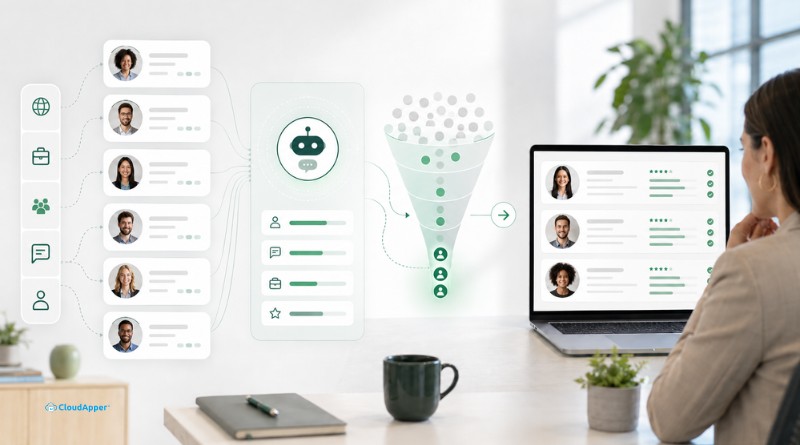
Speed to lead matters most in hourly recruiting because frontline candidates apply outside business hours, juggle multiple offers, and choose the fastest responder — often within minutes. CloudApper AI Recruiter enables instant text responses, conversational screening for qualifications/availability, auto-interview scheduling, and continuous engagement to secure premium talent quickly, cut time-to-fill by 10x, and lower hiring costs significantly.
Table of Contents
- TL;DR
- What Speed to Lead Means in Frontline Hiring
- Why Traditional Recruiting Speeds Fail for Frontline Roles
- The Brutal Math of Speed to Lead
- How Technology Enables Competitive Speed to Lead
- Strategic Benefits of Optimized Speed to Lead
- How CloudApper AI Recruiter Delivers Competitive Speed to Lead
- Implementation Strategies for Speed Optimization
- Frequently Asked Questions
- Speed as Competitive Strategy
Your perfect warehouse worker applied at 2:17 PM on Tuesday. Five years of forklift experience, spotless safety record, excellent references, available immediately. Your recruiting team reviewed her application Wednesday morning at 9 AM—a respectable 18-hour response time by traditional standards. They sent an email requesting a phone screen. She never responded. By Wednesday afternoon, she’d already completed two interviews with competitors who engaged her within minutes of application, and accepted an offer Thursday morning. You never had a chance.
This isn’t an exceptional case—it’s the new normal in hourly recruiting. Research shows that candidates contacted within five minutes of applying are 21 times more likely to convert than those contacted after 30 minutes. In frontline hiring where top candidates receive multiple offers within 48 hours, speed to lead isn’t just important—it’s the single most decisive factor separating organizations that fill positions quickly with quality talent from those perpetually struggling with vacancies.
For talent acquisition professionals managing continuous hiring in healthcare, retail, and manufacturing, understanding why speed to lead matters is easy. Achieving it at scale across hundreds of weekly applications is where most organizations fail spectacularly. While they’re still designing perfect recruiting processes optimized for deliberation and thoroughness, competitors with ruthless speed-to-lead focus are capturing all the best talent before the careful planners even make first contact.
TL;DR
In hourly and frontline recruiting, speed to lead is the #1 factor for winning top talent — candidates apply impulsively, ghost slow responders, and accept the first fast offer. CloudApper AI Recruiter delivers 5-minute (or seconds) response via instant text engagement, automated conversational screening, qualification, and interview scheduling — slashing time-to-fill from weeks to days, reducing vacancy costs by up to 85%, improving hire quality, and building a competitive edge in high-turnover industries like retail, healthcare, and manufacturing.
What Speed to Lead Means in Frontline Hiring
Speed to lead measures the time between when a candidate expresses interest (submits application, texts recruiting number, clicks “apply now”) and when your organization makes meaningful contact—not an automated confirmation email, but actual engagement that moves the candidate forward. In professional recruiting, acceptable speed to lead might be measured in days. In hourly hiring, it’s measured in minutes.
The dramatic difference stems from fundamental distinctions between professional and frontline candidate behavior. Professional candidates often take weeks to evaluate opportunities, submit applications thoughtfully to select companies, and wait patiently for responses while maintaining current employment. They’re conducting careful career moves with significant consequences.

Hourly candidates operate completely differently. They’re typically employed while searching, looking for immediate improvement in pay, schedule, location, or working conditions. They apply to multiple opportunities simultaneously—often 5-10 positions in a single evening—and move forward with whoever responds first. The job search isn’t a contemplative career decision; it’s a practical transaction where speed signals seriousness and professionalism.
This behavioral pattern creates winner-take-all dynamics. The organization that engages candidates first captures their attention and commitment. Everyone else is fighting for candidates who’ve already mentally moved on, even if they haven’t formally accepted offers yet. It’s not unusual for candidates to ghost scheduled interviews with slower-responding employers because they’ve already started work elsewhere.
Why Traditional Recruiting Speeds Fail for Frontline Roles
Most recruiting operations were designed for professional hiring rhythms that emphasize thoroughness over speed. Applications are reviewed in batches, screening calls are scheduled during business hours, and recruiters manage reasonable daily volumes through systematic processes. These approaches fail catastrophically for hourly hiring:
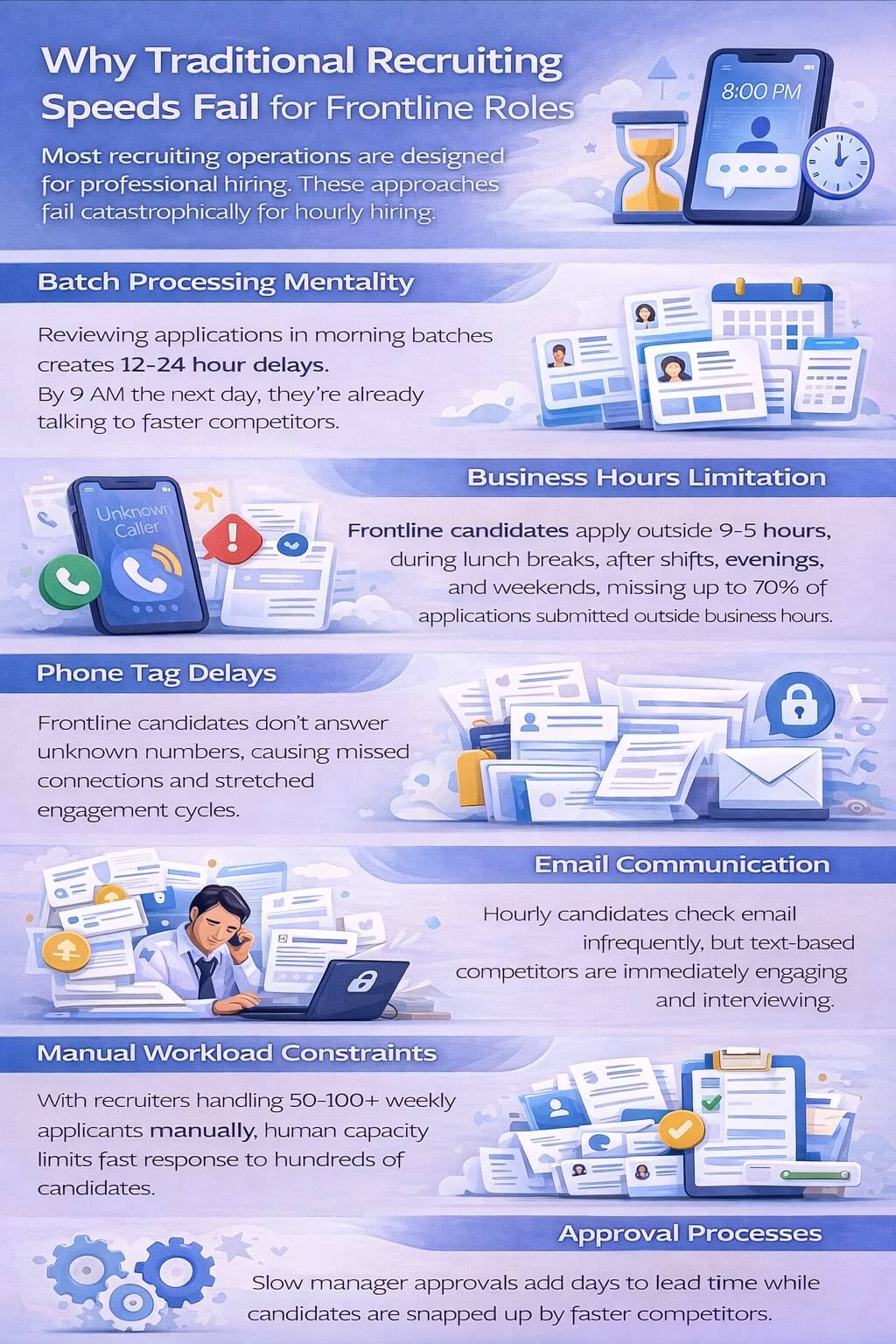
Batch Processing Mentality: Recruiters trained to review applications in morning batches create artificial 12-24 hour delays. A candidate applying at 3 PM won’t hear anything until 9 AM the next day—by which time they’ve had four conversations with faster competitors.
Business Hours Limitation: Frontline candidates apply primarily outside 9-5 hours—during lunch breaks, after current shifts, late evenings, and weekends. Organizations only engaging during business hours miss 70% of application volume in real-time, creating massive speed disadvantages.
Phone Tag Delays: Traditional recruiting relies on phone calls for initial screening. But hourly candidates don’t answer unknown numbers, creating phone tag cycles that stretch engagement to days. By the time you finally connect, they’re no longer interested.
Email Communication: Professional candidates check email regularly. Hourly workers might check once daily or less, making email-based engagement hopelessly slow. Your carefully crafted screening invitation sits unread while text-based competitors have already scheduled interviews.
Manual Workload Constraints: With recruiters handling 50-100 applications weekly manually, response time is physically limited by human processing capacity. Even dedicated recruiters can’t respond to hundreds of candidates within minutes.
Approval Processes: Organizations requiring manager approval before contacting candidates add days to speed to lead. The candidate doesn’t care about your internal approvals—they care that competitor hospitals are already interviewing them.
Quality-Over-Speed Prioritization: Many recruiting teams pride themselves on thorough evaluation and careful consideration. But in hourly markets, perfect candidate assessment delivered too late is worthless—someone else already hired them.
The Brutal Math of Speed to Lead
The competitive dynamics of speed to lead aren’t subtle—they’re mathematical and decisive:
The Five-Minute Rule: Studies consistently show that candidates contacted within five minutes of applying convert at 21x the rate of those contacted after 30 minutes. This isn’t marginal improvement; it’s order-of-magnitude advantage. Organizations achieving five-minute speed to lead simply operate in a different competitive universe than those stuck at 24-hour response times.
The 48-Hour Window: Research indicates that top hourly candidates—those currently employed and selective about opportunities—typically receive multiple offers within 48 hours of beginning their job search. Your window to engage, screen, interview, and extend offers is two days. Organizations with week-long hiring processes never even compete for premium talent.
The Compound Effect: Speed advantages compound throughout the process. Fast initial engagement leads to faster screening completion, which enables faster interview scheduling, which produces faster offer decisions. Organizations optimized for speed fill positions in 3-5 days while slower competitors take 3-5 weeks—a 10x difference.
The Availability Penalty: Every hour of delay increases the probability that candidates become unavailable. They accept other offers, lose interest, encounter schedule conflicts, or simply forget they applied. Your effective candidate pool shrinks continuously based on how long you take to engage.
The Quality Inversion: Conventional wisdom suggests that slower, more deliberate processes produce better quality hires. In hourly recruiting, the opposite is true—the best candidates (experienced, currently employed, reliable) move fastest through job searches. Slow processes systematically select for desperate or unemployed candidates willing to wait.
How Technology Enables Competitive Speed to Lead
Achieving five-minute speed to lead across hundreds of weekly applications requires technology that automates initial engagement and screening. Human recruiters simply cannot respond to every application within minutes while maintaining quality evaluation—the math doesn’t work.
AI-powered conversational systems solve this impossible equation by engaging candidates instantly upon application, conducting meaningful screening conversations automatically, and presenting qualified candidates to recruiters for final evaluation. The technology handles speed; humans handle judgment.
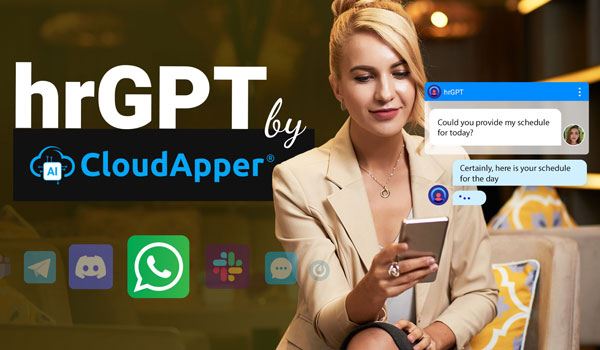
When a nursing assistant applies at 11 PM, AI responds within seconds: “Thanks for applying! I can answer questions and get you screened for the position right now. What would you like to know?” The candidate receives immediate engagement instead of silence, dramatically increasing the probability they’ll continue with your process instead of moving to competitors.
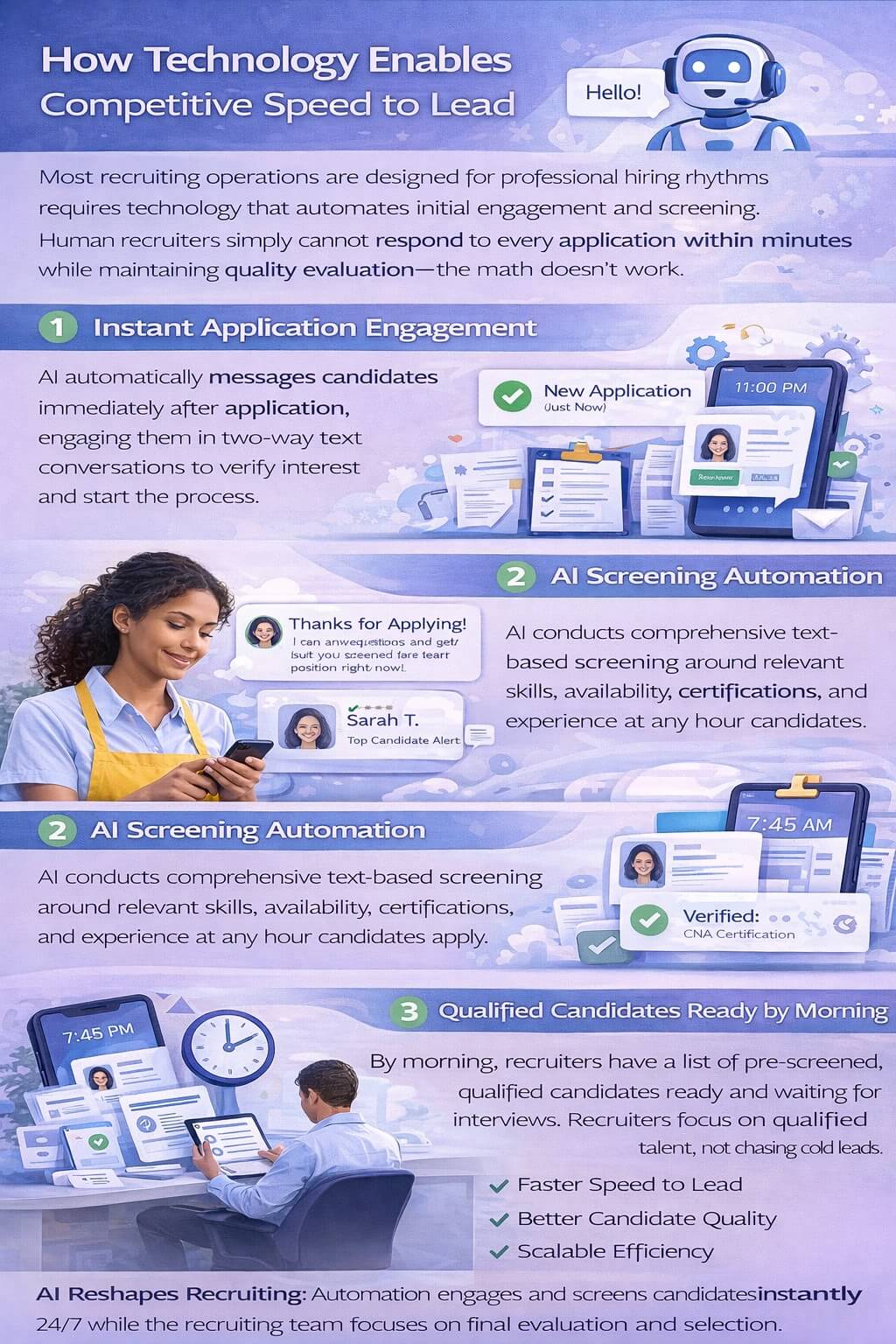
The AI then conducts comprehensive screening through conversational text exchanges—verifying certifications, assessing experience, confirming availability, evaluating relevant skills. This happens at whatever hour candidates apply, regardless of recruiting team schedules or capacity. The technology scales infinitely without speed degradation.
By morning, recruiters arrive to a list of qualified, screened candidates ready for interviews—not raw applications requiring hours of manual review. The AI has already captured candidate attention, completed initial assessment, and maintained engagement. Recruiters focus on interviewing rather than chasing leads that have gone cold overnight.
This technology-enabled speed doesn’t sacrifice quality. The screening is often more thorough than rushed human reviews, more consistent across candidates, and better documented for compliance. You’re not trading speed for quality—you’re achieving both simultaneously through intelligent automation.
Strategic Benefits of Optimized Speed to Lead
Organizations that master speed to lead in hourly recruiting realize transformative competitive advantages:
Access to Premium Talent: The best hourly workers—experienced, reliable, currently employed—move quickly through job searches. Fast speed to lead ensures you engage them before competitors, giving you first opportunity to hire top performers who would otherwise be unavailable.
Dramatically Reduced Time-to-Fill: When you engage candidates within minutes rather than days, your entire hiring cycle compresses. Positions that took four weeks to fill with slow processes might fill in four days with optimized speed to lead, reducing vacancy costs by 85%.
Higher Conversion Rates: Speed signals professionalism, organization, and genuine interest. Candidates perceive fast-responding employers as more desirable, increasing the probability they’ll accept your offers even when pay is comparable to competitors.
Lower Cost-Per-Hire: Faster fills mean lower recruiting costs—less advertising spend, fewer recruiter hours per hire, reduced agency fees, and minimal overtime covering vacancies. The efficiency gains are substantial and measurable.
Improved Candidate Experience: Candidates universally prefer immediate engagement over waiting in uncertainty. Fast speed to lead improves satisfaction scores, NPS, and employer brand—creating positive word-of-mouth that drives future application volume.
Competitive Moat: While most organizations struggle to achieve even 24-hour speed to lead, those mastering five-minute engagement create competitive advantages that are difficult to overcome. You’re consistently capturing talent before slower competitors even know they applied.
Better Quality of Hire: Despite conventional wisdom, faster processes produce better hires in hourly recruiting because you access more selective, higher-quality candidates. Quality improves while speed increases—the ultimate recruiting win.
Operational Stability: Consistent ability to fill positions quickly means better staffing predictability, reduced operational disruption, lower burnout from covering gaps, and improved customer/patient service. Speed to lead impacts operational performance, not just recruiting metrics.
How CloudApper AI Recruiter Delivers Competitive Speed to Lead
CloudApper AI Recruiter was purpose-built to solve the speed-to-lead challenge in high-volume hourly hiring, enabling instant engagement at scale without overwhelming recruiting teams.
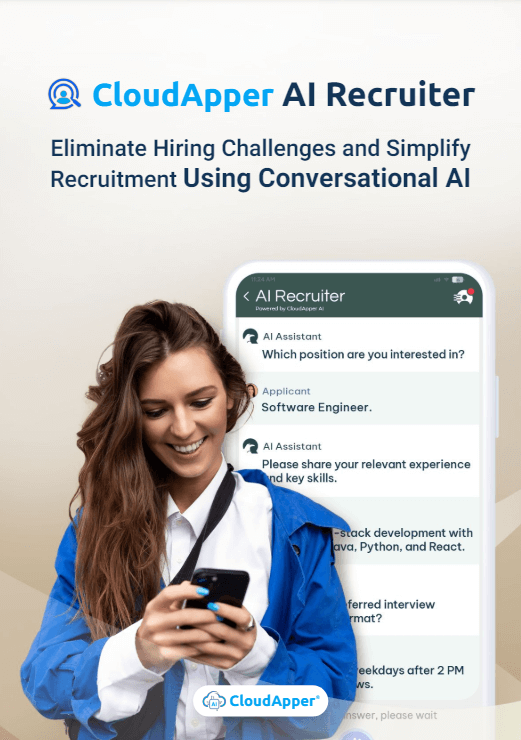
The platform responds to candidates within seconds of application, regardless of time or day. When someone applies to your retail position at 9 PM Saturday, CloudApper immediately sends a text: “Hi! Thanks for applying to our sales associate position. I can answer questions and get you screened right now. What would you like to know?”
This instant engagement captures candidate attention before they continue applying elsewhere. Rather than waiting until Monday morning for your recruiting team to review applications in batch, candidates receive immediate, meaningful interaction that moves them forward in your process.
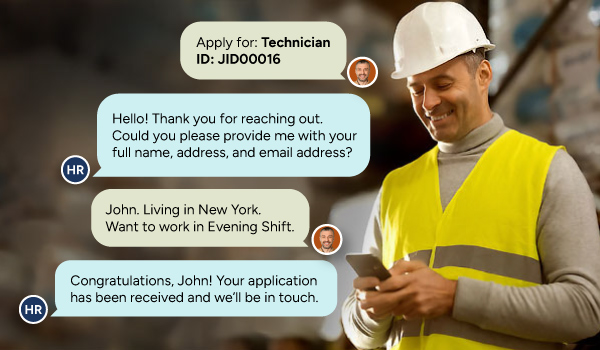
CloudApper conducts comprehensive screening through conversational exchanges. For healthcare roles, it verifies certifications, assesses experience levels, confirms shift availability, and evaluates patient care skills. For warehouse positions, it determines forklift certification, confirms physical capabilities, evaluates safety awareness, and assesses schedule flexibility. For retail roles, it explores customer service experience, communication skills, and availability.
These screening conversations happen instantly and continuously. Whether you receive 5 applications or 50 in an evening, every candidate gets the same immediate, thorough engagement. The technology scales without speed degradation—your 100th applicant of the day receives the same five-minute speed to lead as your first.
When candidates qualify based on screening, CloudApper immediately offers interview scheduling integrated with your team’s calendars: “Great! Based on your experience, you’re a strong candidate. I can schedule you for an interview tomorrow at 2 PM, Wednesday at 10 AM, or Thursday at 3 PM. Which works best?” Qualified candidates move from application to scheduled interview in minutes, not days.
For recruiting teams, CloudApper presents candidates who’ve already been engaged, screened, and scheduled—ready for interviews. Instead of spending hours chasing applications from two days ago, recruiters focus on interviewing candidates whose interest is fresh and commitment is high.
The platform also maintains engagement speed throughout the hiring journey. Interview reminders are sent automatically and instantly. Follow-up questions are answered within seconds. Status updates are provided proactively. This consistent speed prevents candidate drop-off that occurs when communication slows after initial engagement.
CloudApper’s speed advantage compounds across your entire operation. With hundreds or thousands of candidates monthly, achieving five-minute speed to lead manually is impossible. The platform delivers this speed automatically, creating competitive advantages that directly impact your ability to fill positions with quality talent.
Implementation Strategies for Speed Optimization
Maximizing speed to lead requires both technology deployment and process redesign:
Eliminate Approval Bottlenecks: Remove unnecessary approval steps before candidate contact. Empower recruiters or technology to engage immediately based on basic qualification criteria. Speed requires decisiveness.
Shift to Text Communication: Phone calls and emails are inherently slow for hourly recruiting. Text messaging enables instant engagement and real-time conversation that matches how candidates actually communicate.
Automate Initial Screening: Don’t wait for human review before engaging candidates. AI can conduct initial assessment immediately, escalating qualified candidates to humans for final evaluation.
Enable 24/7 Operations: Candidates don’t apply on your schedule. Technology enabling round-the-clock engagement ensures you capture everyone regardless of when they express interest.
Measure and Monitor: Track speed to lead meticulously—average time from application to first engagement, percentage of candidates contacted within 5 minutes, and conversion rates by speed tier. What gets measured gets managed.
Prioritize Speed in Team Culture: Train recruiting teams that speed is the primary competitive weapon in hourly hiring. Thoroughness matters, but speed matters more. Cultural emphasis on velocity drives behavioral change.
Simplify Processes: Every step in your hiring process is an opportunity for delay. Streamline ruthlessly—combine steps, eliminate redundancy, reduce complexity. Faster processes produce better results.
Frequently Asked Questions
Q: Doesn’t optimizing for speed sacrifice quality evaluation and lead to bad hires?
A: This concern assumes speed and quality are opposing forces, but in hourly recruiting they’re aligned. Fast initial engagement captures better candidates who move quickly. AI screening can be more thorough and consistent than rushed human reviews. The quality risk is in slow processes that systematically select for desperate candidates willing to wait—not in fast processes that attract and assess premium talent efficiently.
Q: How can we possibly achieve five-minute speed to lead when our recruiting team is already overwhelmed?
A: That’s precisely the point—humans can’t achieve five-minute speed to lead at scale, which is why technology is essential. AI handles instant engagement and initial screening automatically. Your team’s workload decreases because they’re only interviewing pre-screened, qualified candidates instead of manually processing every raw application. Technology enables speed while reducing recruiter burden.
Q: What if we respond immediately but candidates still don’t engage with us?
A: Fast response dramatically increases engagement probability, but isn’t magic. Some candidates will remain non-responsive regardless of speed. However, your conversion rates will be dramatically higher with five-minute engagement than 24-hour delays. You won’t win every candidate, but you’ll win far more than slower competitors.
Q: How do we balance speed with the need to carefully evaluate cultural fit and soft skills?
A: Speed to lead focuses on initial engagement and screening—not final hiring decisions. AI can quickly assess basic qualifications and interest, but human recruiters still conduct interviews to evaluate cultural fit, communication skills, and judgment. You’re accelerating early stages while preserving careful evaluation where it matters most.
Q: Won’t instant AI engagement feel impersonal and damage candidate experience?
A: Research shows the opposite—candidates strongly prefer instant AI responses over waiting days for human contact. The immediacy demonstrates professionalism and respect. As long as AI transitions smoothly to human recruiters for interviews and decisions, candidate experience improves dramatically with faster engagement.
Q: Our hiring managers want time to review candidates carefully before we interview. How do we balance speed with their preferences?
A: This requires education about hourly recruiting realities. Show managers data on how speed impacts candidate availability. Help them understand that careful review of candidates who’ve already accepted other offers is pointless. Build trust in AI screening quality so they’re comfortable with pre-qualified candidates. Cultural change enabling speed must include manager buy-in.
Speed as Competitive Strategy
In professional recruiting, many factors determine success—employer brand, compensation, career development, company reputation. In hourly recruiting, one factor dominates all others: speed to lead. The organization that engages candidates first, moves them through screening fastest, and extends offers soonest wins—regardless of other considerations.
This isn’t because hourly candidates are unsophisticated or impulsive. It’s because they’re practical people making rational decisions in tight labor markets where opportunities are plentiful and differentiation between employers is minimal. When three hospitals, four retailers, or five warehouses all offer similar pay for similar work, candidates choose whoever respects their time by responding immediately and moving efficiently.
For talent acquisition professionals and HR leaders managing frontline hiring, optimizing speed to lead isn’t one priority among many—it’s the foundational requirement that determines whether all other recruiting efforts succeed or fail. Perfect employer branding, compelling value propositions, and excellent benefits packages are worthless if candidates never engage because your speed to lead is too slow.
The competitive reality is unforgiving: achieve five-minute speed to lead or accept that competitors who do will consistently capture the best talent while you struggle with whoever’s left. Technology makes this possible. The question is whether you’ll deploy it before your competition does.
To learn more about how CloudApper AI Recruiter delivers the instant engagement speed required for competitive frontline recruiting, contact us.

What is CloudApper AI Platform?
CloudApper AI is an advanced platform that enables organizations to integrate AI into their existing enterprise systems effortlessly, without the need for technical expertise, costly development, or upgrading the underlying infrastructure. By transforming legacy systems into AI-capable solutions, CloudApper allows companies to harness the power of Generative AI quickly and efficiently. This approach has been successfully implemented with leading systems like UKG, Workday, Oracle, Paradox, Amazon AWS Bedrock and can be applied across various industries, helping businesses enhance productivity, automate processes, and gain deeper insights without the usual complexities. With CloudApper AI, you can start experiencing the transformative benefits of AI today. Learn More
- Useful Links:
- Agentic AI
- No-Code/Low-Code
- Custom Software
- HCM Personalization
- iPaaS
- FedRAMP
CloudApper AI Solutions for HR

- Works with







- and more.
Similar Posts

The Hidden Cost of Duplicate Candidate Records Across Your Hiring…
The 7-Second Resume Rule Is Killing High-Volume Hiring in Dayforce:…