Screening at scale breaks first when hiring volume increases, exposing process limits that slow recruiting and increase compliance and experience risks.
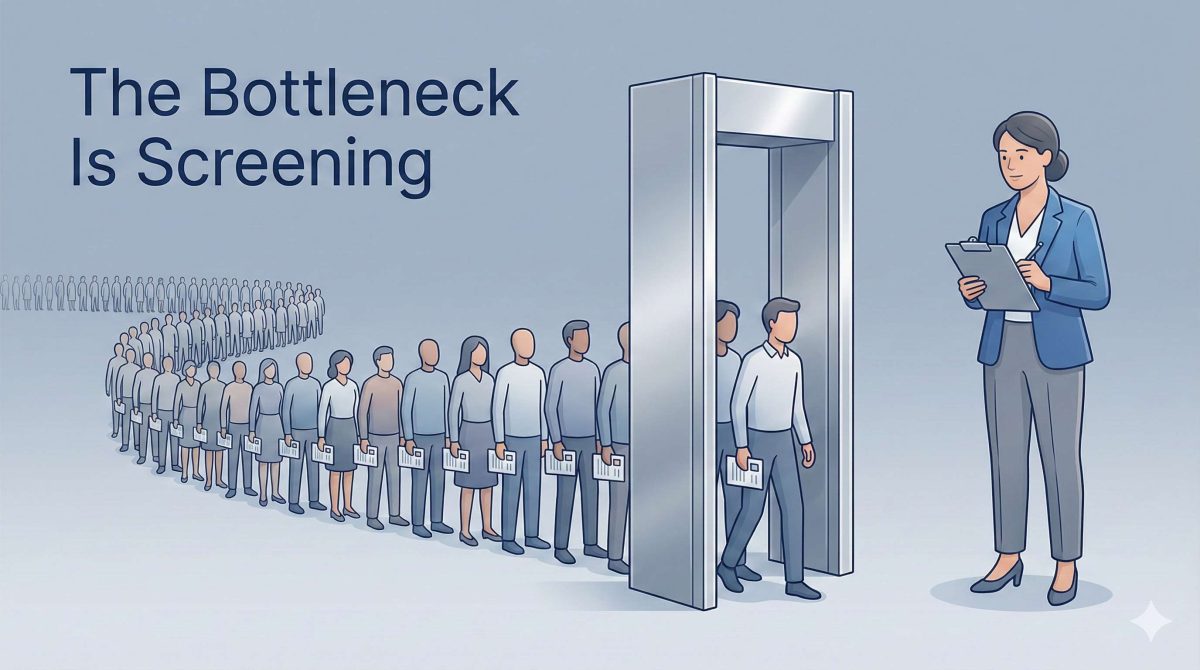
Table of Contents
- Screening at Scale Was Never Designed for Modern Hiring Conditions
- Why Manual Screening Collapses Under Volume Pressure
- Where Screening at Scale Creates the Greatest Risk
- Screening at Scale Fails Quietly, Then All at Once
- Why Screening at Scale Hurts Candidate Experience First
- The Compliance Implications of Screening at Scale
- Why Screening at Scale Is the First System to Break
- How This Connects to High Volume Hiring More Broadly
- Explore more
Screening at scale is one of the earliest pressure points to fail when hiring volume increases. Long before teams run out of budget or job demand softens, recruiters find themselves overwhelmed by applicant flow they cannot process consistently, quickly, or defensibly.
This breakdown is not caused by a lack of effort or intent. It is caused by screening models that were never designed to operate under sustained volume, tight labor supply, and heightened compliance expectations at the same time.
Across industries that rely on frontline and hourly labor, screening is where hiring stress becomes visible first.
Screening at Scale Was Never Designed for Modern Hiring Conditions
Most screening workflows still assume moderate applicant volume, stable timelines, and recruiter availability. Resumes are reviewed manually. Criteria are applied sequentially. Documentation is created after decisions are made.
That approach can work when applicant supply is abundant and time pressure is low. It breaks down quickly when volume spikes or when hiring teams must move faster to compete for fewer candidates.

According to the U.S. Bureau of Labor Statistics, industries such as retail, accommodation and food services, and transportation consistently experience high churn and elevated job openings relative to available workers. In those conditions, screening volume does not just increase—it becomes volatile.
Screening systems built for steady flow are not resilient to volatility.
Why Manual Screening Collapses Under Volume Pressure
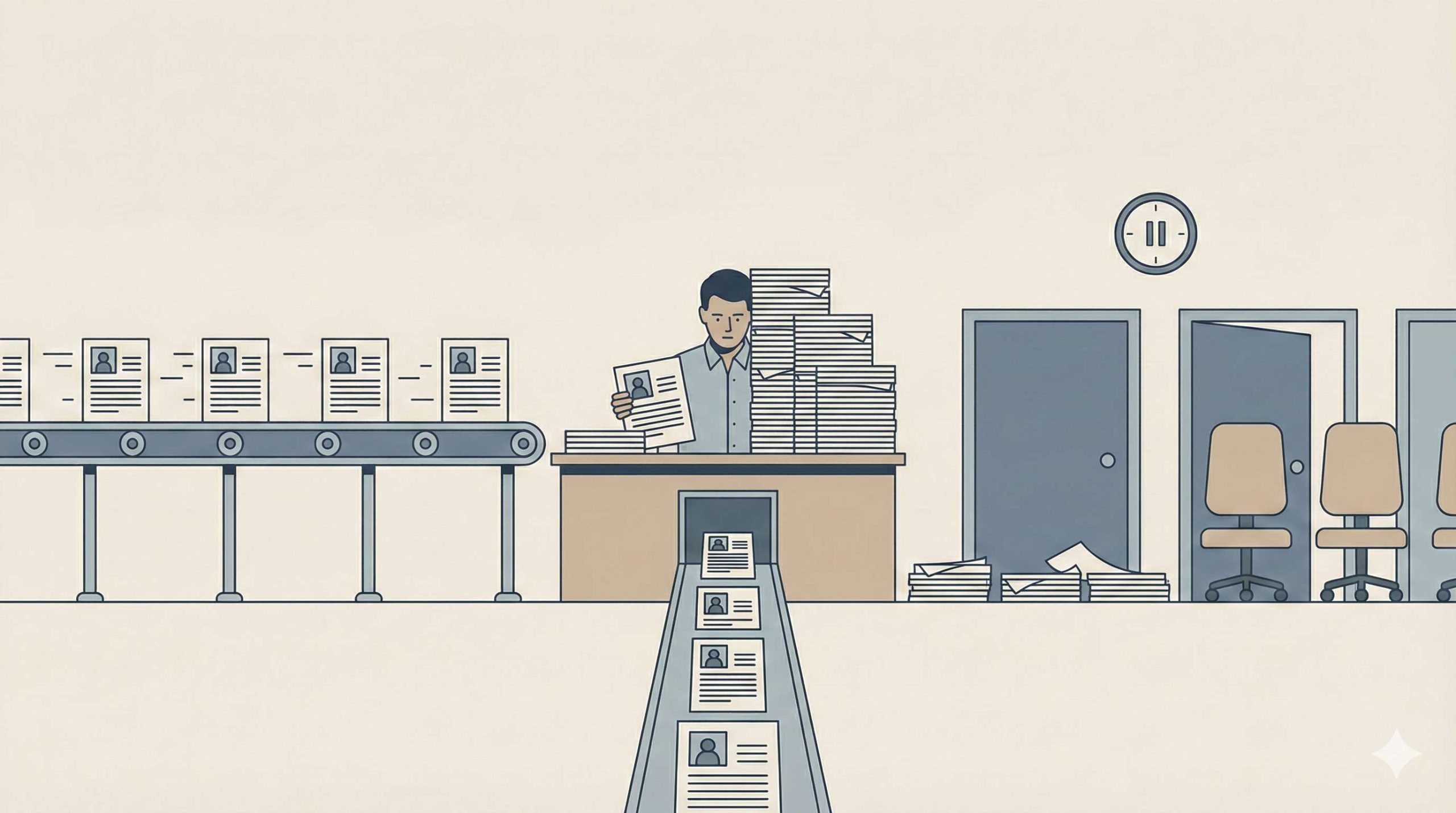
When recruiters are asked to screen hundreds or thousands of applications in compressed timeframes, manual processes begin to fail in predictable ways.
First, response times slow. Candidates wait longer to hear back and disengage. Second, criteria are applied inconsistently as recruiters rush to keep up. Third, documentation becomes incomplete, increasing downstream compliance risk.
Research and reporting from the U.S. Department of Labor makes clear that compliance obligations do not decrease during labor shortages or hiring surges. Fair and consistent screening remains a requirement, regardless of volume amidst hourly labor shortages in the USA.
This creates a structural conflict. The more pressure recruiters face, the harder it becomes to maintain the very consistency screening requires.
Screening doesn’t fail because recruiters stop caring
it fails because systems weren’t built to absorb pressure..
Screening doesn’t fail because recruiters stop caring
it fails because systems weren’t built to absorb pressure..
Where Screening at Scale Creates the Greatest Risk
The most significant risk in screening at scale is not speed—it is explainability.
When hiring decisions are made quickly without standardized early screening, recruiters often struggle to reconstruct why certain candidates advanced and others did not. Over time, this lack of clarity erodes audit readiness and exposes organizations to risk, even when intent is sound.
This is the point at which many hiring teams begin reassessing how screening work is distributed.
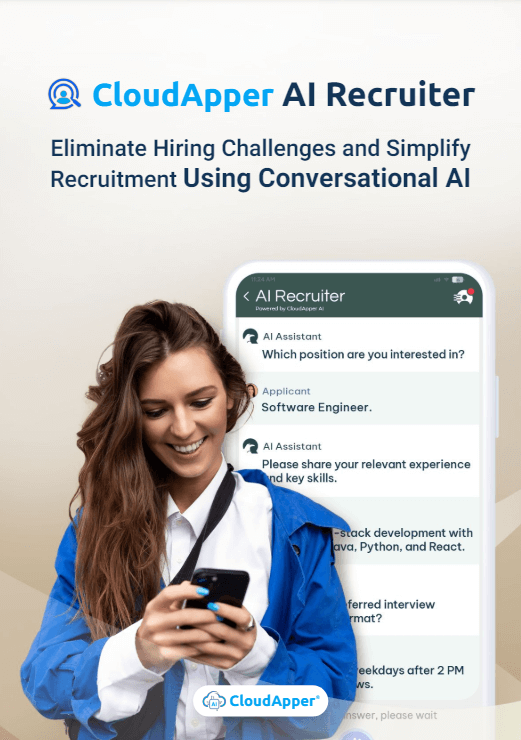
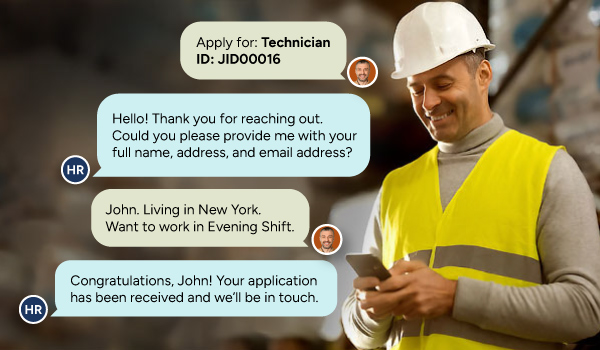
Rather than asking recruiters to manually process every application, some organizations introduce structured, AI-assisted screening layers to handle volume consistently while preserving human oversight. Platforms such as CloudApper AI Recruiter are often adopted at this stage—not to replace recruiter judgment, but to standardize early qualification, accelerate candidate engagement, and maintain clear screening logic when volume spikes.
Used this way, AI functions as a stabilizer, not a decision-maker.
Screening at Scale Fails Quietly, Then All at Once
One reason screening at scale is so dangerous is that it rarely fails dramatically at first.
Instead, small issues accumulate. Candidates drop out. Recruiters rely on shortcuts. Criteria drift. Communication gaps widen. By the time leadership recognizes the problem, the hiring funnel is already leaking.
Major newspapers such as The Wall Street Journal and The New York Times have repeatedly reported on employers struggling not just to find workers, but to move applicants through hiring processes fast enough to secure them.
In many cases, the bottleneck is not demand or compensation. It is screening capacity.
Why Screening at Scale Hurts Candidate Experience First
For candidates—especially deskless and hourly workers—screening delays are experienced as silence.
Applicants who do not receive timely responses assume they have been rejected or ignored. They move on quickly, often accepting the first offer that materializes. In tight labor markets, slow screening is effectively self-selection out of the talent pool.
This dynamic disproportionately affects hourly and frontline roles, where candidates apply from mobile devices and expect fast feedback. Screening systems that cannot operate at scale inadvertently reduce the already-limited supply of available workers.
The Compliance Implications of Screening at Scale
As screening volume increases, so does compliance exposure.
Inconsistent application of criteria, undocumented decisions, and ad hoc screening shortcuts create risk that may not surface until audits or disputes occur. Regulatory guidance makes clear that hiring fairness expectations apply regardless of market conditions.
This is why organizations facing sustained volume pressure increasingly look for screening approaches that are consistent by design. Standardized early screening, transparent qualification logic, and traceable decision paths reduce reliance on after-the-fact justification.
AI-assisted screening, when implemented with human oversight and clear guardrails, can help enforce this consistency at scale rather than undermine it.
Why Screening at Scale Is the First System to Break
Screening sits at the intersection of volume, speed, compliance, and candidate experience. When any one of those variables shifts, screening absorbs the impact.
When all of them shift at once—as they do in high volume hiring environments—screening is the first system to fracture.
This is not a reflection of recruiter capability. It is a reflection of process design. Systems built for lower volume cannot simply be pushed harder. They must be redesigned to absorb pressure without collapsing.
How This Connects to High Volume Hiring More Broadly
Screening at scale does not fail in isolation. It is one of the clearest signals explaining why high volume hiring systems break under stress.
Labor shortages tighten the funnel. Volume exposes inefficiencies. Screening becomes the choke point where all constraints converge.
Organizations that address screening resilience early—before downstream failures compound—are better positioned to compete for talent without sacrificing compliance or experience.
Explore more
Explore how scalable, transparent screening models can support high volume hiring without removing human judgment.

What is CloudApper AI Platform?
CloudApper AI is an advanced platform that enables organizations to integrate AI into their existing enterprise systems effortlessly, without the need for technical expertise, costly development, or upgrading the underlying infrastructure. By transforming legacy systems into AI-capable solutions, CloudApper allows companies to harness the power of Generative AI quickly and efficiently. This approach has been successfully implemented with leading systems like UKG, Workday, Oracle, Paradox, Amazon AWS Bedrock and can be applied across various industries, helping businesses enhance productivity, automate processes, and gain deeper insights without the usual complexities. With CloudApper AI, you can start experiencing the transformative benefits of AI today. Learn More
- Useful Links:
- Agentic AI
- No-Code/Low-Code
- Custom Software
- HCM Personalization
- iPaaS
- FedRAMP
CloudApper AI Solutions for HR


- Works with







- and more.
Similar Posts

How to Stop Losing Shortlisted Candidates During a Hiring Surge…

Recording Candidate Video Interviews in Illinois: Consent, Retention, and Deletion…