Generative AI has made it easy to mass-produce “perfect” resumes, overwhelming ATS systems and hiding real talent. This piece explores why keyword matching is failing—and how HR teams can shift to proof-of-skill hiring in the age of AI.


Table of Contents
- The “sand in the gears” problem: when authentic talent becomes invisible
- Why keyword-matching is dead (or at least dangerously insufficient)
- The new model: move from “document review” to “proof of capability”
- The rise of “agent-to-agent” hiring
In 2026, the resume is having an identity crisis.
Not because candidates suddenly got more qualified, but because Generative AI makes it effortless to produce a polished, keyword-rich profile that looks “perfect” for nearly any role. The result is resume inflation: a flood of highly optimized documents that read well, match the job description, and still tell you very little about whether the person can actually do the work.

And the volume is not theoretical. LinkedIn has reported an average of 11,000 applications per minute, alongside a more than 45% year-over-year surge in applications, with AI tools contributing to the deluge.
If your hiring process still depends on keyword filters and static resume screening, you’re not just behind. You’re operating a system that AI can game at scale.
The “sand in the gears” problem: when authentic talent becomes invisible
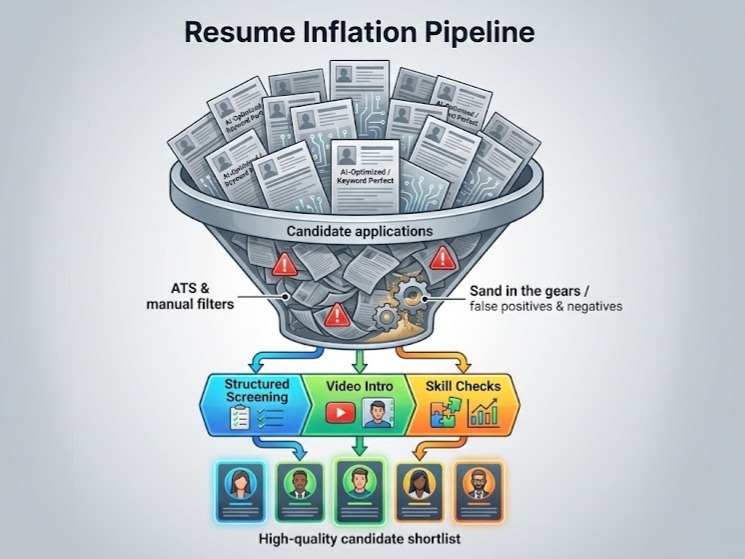
When application volume spikes, most teams respond the same way: tighten filters, add more knockout questions, increase keyword thresholds, or lean harder on automated scoring. But that approach often creates “sand in the gears.”
Here’s why: AI helps candidates generate resumes that hit the right phrases and formatting conventions, which means your ATS becomes better at selecting “resume skill” rather than job skill. Meanwhile, truly strong candidates who write like humans, use different phrasing, or don’t optimize for the algorithm get buried.
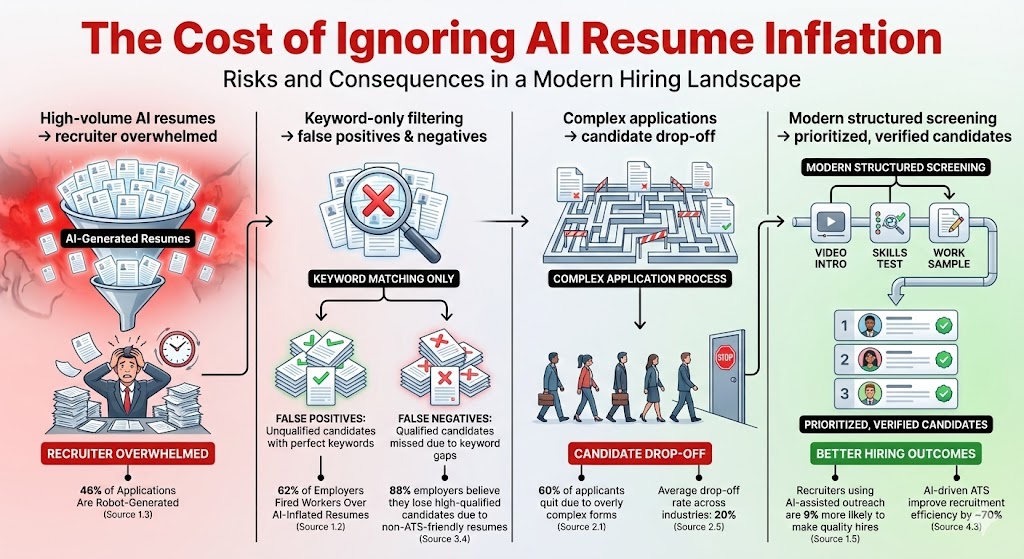
This isn’t just a gut feeling. In a recent wave of reporting on the AI job search arms race, Greenhouse data cited in the press shows the number of applications an average candidate sends is up 239% since ChatGPT’s release in 2022. That’s what “sand in the gears” looks like in real terms: more submissions, more noise, and more opportunity for false positives and false negatives.
It’s also increasingly normal for candidates to use AI inside the application itself. A Gartner survey of job candidates found 39% used AI during the application process, including 54% using it to generate resume/CV text and 50% for cover letters.
So yes, the resume is inflating. But the bigger issue is what that inflation does to your decision model: it turns the top of funnel into an AI-optimized content contest.
Why keyword-matching is dead (or at least dangerously insufficient)
Keyword matching was always a crude proxy for fit. In a world where resumes were “harder” to produce, it was tolerable because effort naturally limited volume and forced tradeoffs.
AI removes that friction.
Now, anyone can tailor a resume in seconds. Tools can rewrite experience bullets to mirror your job description, add the right tool names, and produce a clean, ATS-friendly format on demand. When everyone can speak “ATS language,” keyword matching stops being a filter for relevance and becomes a filter for prompt quality.
Even the platforms that support automated screening acknowledge the tradeoff: automated resume screening can miss high-quality candidates due to settings, formatting, or how the algorithm interprets content, creating false negatives.
So what replaces keyword matching?
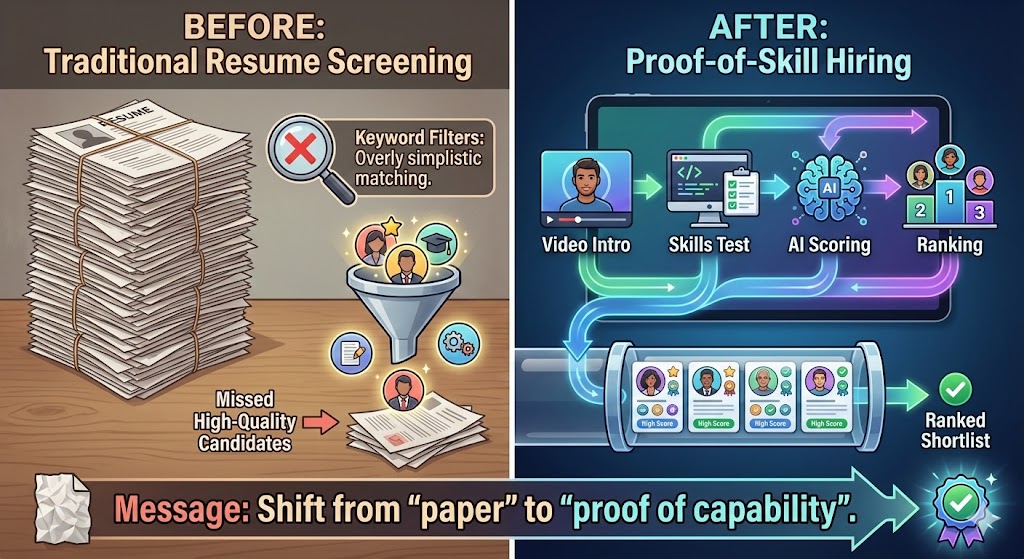
Not “more AI” in the same old workflow. You need a shift from static documents to proof-of-skill signals that are harder to fabricate and easier to compare.
The new model: move from “document review” to “proof of capability”
The fastest way out of resume inflation is to reduce how much a resume alone can decide.
In practice, modern teams are adding 3 types of “AI-resistant” signals early:
1) Structured, skills-based screening that produces comparable data
Instead of scanning for buzzwords, you want structured questions, role-specific scoring, and consistent comparison. This is one reason hiring teams are changing how they interview. Willo’s 2026 hiring research reports that 76.6% of hiring teams encounter AI-generated or AI-assisted applications, and many are adapting their process in response.
2) Short video or audio introductions tied to the job
Not because “video is magical,” but because it can reveal clarity of thought, communication, and authenticity quickly. It also discourages mass-apply behavior when used thoughtfully (short, simple prompts, and mobile-friendly).
3) Work-sample tasks and live skill checks
The goal is not to torture candidates. It’s to verify ability in a lightweight way that mirrors the job. Even a 15-minute scenario can outperform an over-polished resume.
This shift also protects candidate experience. Remember, complexity kills completion: SHRM has cited that the drop-off rate for candidates who click “Apply” but never complete the application can be as high as 92%. If you respond to AI volume by making applications longer and more painful, you lose real people.
The rise of “agent-to-agent” hiring
The next phase is already visible: candidates will increasingly use career agents to find jobs, tailor materials, submit applications, and coordinate scheduling. Employers are doing the same with recruiting automation.
That creates “agent-to-agent” negotiation: candidate AI talking to recruiter AI.
This can be a good thing if you design it correctly. Your recruiting system can:
- enforce structured intake (consistent questions, consistent scoring)
- verify identity and reduce fraud risk
- provide fast, human-sounding communication
- schedule interviews instantly without back-and-forth
Or it can become a spam battlefield where bots endlessly generate and reject content.
The difference is whether your system optimizes for proof or for paper.
Where CloudApper AI Recruiter fits in this new reality
This is exactly the problem CloudApper AI Recruiter is built to solve: high-volume pipelines filled with polished applications that require faster validation, clearer ranking, and more human time spent where it matters.
CloudApper AI Recruiter uses a multi-agent approach (screening, assessment, communication, scheduling, and analytics) to move hiring away from manual resume triage and toward structured, auditable decisioning.
A few capabilities map directly to “resume inflation” defenses:
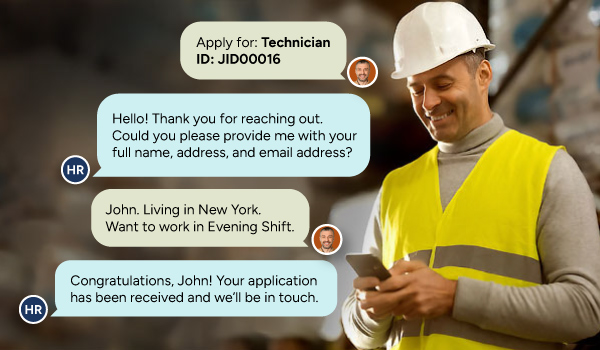
Conversational applications (text to apply and chatbot intake). Candidates can apply by scanning a QR code or texting a shortcode, and the recruiting chatbot guides them through a structured flow. This creates cleaner inputs than a PDF resume alone and reduces drop-off by making the process mobile-friendly.
Skills-aware scoring and ranked shortlists. Instead of drowning recruiters in hundreds of “perfect” resumes, AI Recruiter screens, scores, and ranks candidates so the recruiter sees a prioritized shortlist with notes and comparisons.
Automated communication and scheduling. When the best candidates are still employed, speed matters. CloudApper automates outreach, updates, reminders, and self-scheduling by syncing calendars and handling reschedules, helping reduce candidate drop-off in the middle of the funnel.
Transparency and bias controls. In an era when trust is fragile, transparency is a competitive advantage. Gartner has reported that only 26% of job applicants trust AI will fairly evaluate them. Tools that provide clear scoring logic, consistent workflows, and human oversight are how you keep both speed and credibility.
What HR leaders should do next
If your pipeline feels noisier than ever, it’s probably not your imagination. The market is changing because the economics of applying changed.
The practical move is not to ban AI. That’s unrealistic. The practical move is to redesign the funnel so AI-generated polish cannot substitute for real capability.
Start by reducing how much “resume perfection” can influence early-stage decisions. Add structured signals, lightweight skill checks, and faster engagement. Then use automation that’s built for this era, where volume is high, attention is limited, and trust must be earned.
CloudApper AI Recruiter is one path to doing that without ripping and replacing your current stack, because it’s designed to work with existing TA systems while modernizing screening, communication, and scheduling.
If you want to stop drowning in AI-optimized applications and start surfacing real talent again, the goal is simple: shift from keyword matching to proof of skill, and from manual chaos to structured, transparent automation.
What is CloudApper AI Platform?
CloudApper AI is an advanced platform that enables organizations to integrate AI into their existing enterprise systems effortlessly, without the need for technical expertise, costly development, or upgrading the underlying infrastructure. By transforming legacy systems into AI-capable solutions, CloudApper allows companies to harness the power of Generative AI quickly and efficiently. This approach has been successfully implemented with leading systems like UKG, Workday, Oracle, Paradox, Amazon AWS Bedrock and can be applied across various industries, helping businesses enhance productivity, automate processes, and gain deeper insights without the usual complexities. With CloudApper AI, you can start experiencing the transformative benefits of AI today. Learn More
- Useful Links:
- Agentic AI
- No-Code/Low-Code
- Custom Software
- HCM Personalization
- iPaaS
- FedRAMP
CloudApper AI Solutions for HR


- Works with








- and more.
Similar Posts

The Real Cost of Interview No-Shows, and How Automated Reminders…

Verify Required Certifications and Licenses Without Slowing Down Screening