Blind resume screening automation embeds anonymization into the hiring workflow, ensuring resumes are evaluated on qualifications before identity cues influence decisions.
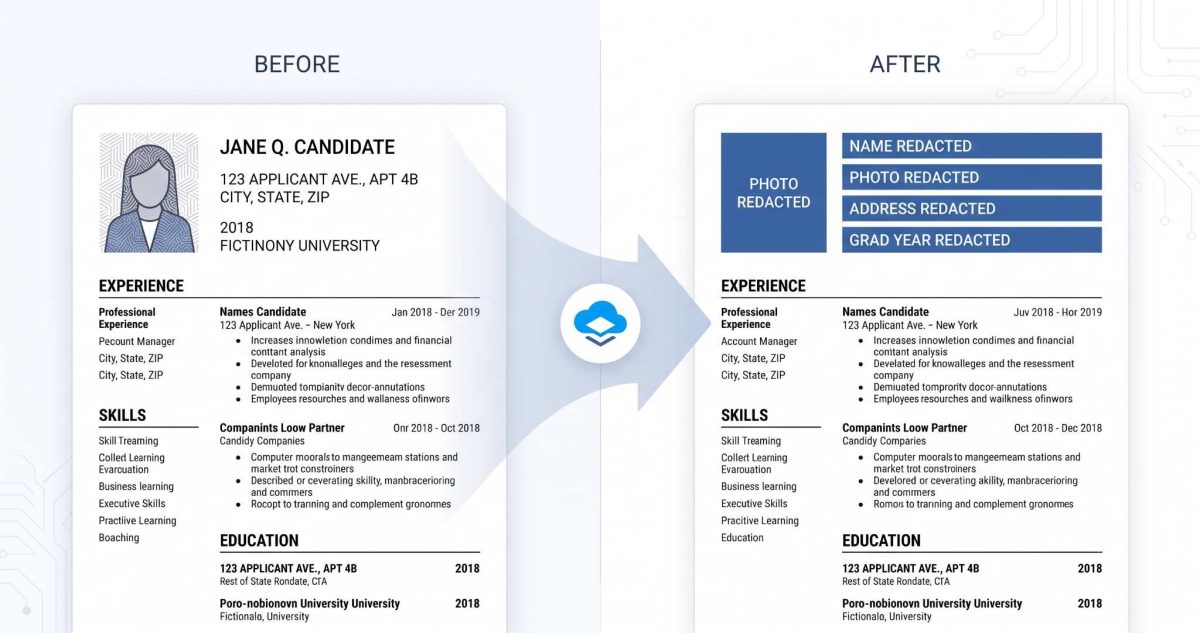
Table of Contents
- What Is Blind Resume Screening Software?
- Why Manual Blind Screening Fails at Scale
- What the Software Removes, and What It Preserves
- How Blind Resume Screening Software Works: The 6-Step Workflow
- What to Look For When Evaluating Blind Screening Software
- The Compliance Reality in 2026
- How CloudApper AI Recruiter Enforces Blind Screening Inside Your ATS
- Fair Hiring Is a Workflow Property, Not a Policy
- Frequently Asked Questions
A blind resume is an application with identifying details removed — name, photo, address, graduation dates and other demographic signals — so reviewers judge skills and experience alone. Blind resume screening software applies that removal automatically to every applicant and records an audit trail proving it happened.
Most hiring teams do not have a bias intention problem. They have a bias enforcement problem. The evidence on why blind screening matters is unambiguous: in the landmark field experiment by Bertrand and Mullainathan, identical resumes with white-sounding names received 50% more interview callbacks than the same resumes with Black-sounding names (NBER). The trigger was not qualifications. It was identity cues with no bearing on the job.
What Is Blind Resume Screening Software?
Blind resume screening software automatically detects and removes personal identifiers from resumes before recruiters or hiring managers review them, including names, photos, pronouns, addresses, and graduation dates. Candidates are evaluated on skills, experience, and qualifications alone, while the system maintains an audit trail proving anonymization was applied consistently to every applicant.
That last clause matters more than it looks. Manual blind screening can’t prove consistency. Software can, and in 2026, provability is becoming a legal requirement, not a nice-to-have.
Why Manual Blind Screening Fails at Scale
Manual anonymization breaks down for predictable, structural reasons, and none of them are about bad intent.
Redaction is forgotten under time pressure. Anonymization quality varies by person and by day. Original files circulate “temporarily” and never stop. And when a candidate or regulator asks whether screening was fair, there is no audit trail to answer with.

In high-volume hiring environments, whether a skilled nursing operator filling hundreds of CNA roles or a field-services company staffing seasonal surges, these small failures compound fast. Bias doesn’t re-enter hiring through intent. It re-enters through process gaps. Closing those gaps by hand doesn’t survive volume; closing them at the workflow level does.
| Manual blind screening | Blind screening software | |
|---|---|---|
| Who removes identifiers | A recruiter or coordinator, by hand | The system, before anyone sees the file |
| Applied to every applicant | In principle; in practice it slips under volume | Every file, every time, without exception |
| Who has already seen the name | The person doing the redacting | Nobody |
| Consistency across reviewers | Varies by person and by workload | Identical by construction |
| Audit trail | None, or a spreadsheet someone maintains | Per-applicant record of what was removed and when |
| Provable to a regulator | Not really — you can state the policy, not evidence it | Yes, that is the point of the trail |
| Cost at 500 applicants | Hours of coordinator time per requisition | No incremental time |
The second-to-last row is the one that decides it. A policy says what should happen; an audit trail shows what did.
What the Software Removes, and What It Preserves
Effective blind screening is selective, not destructive. The software redacts identity signals while preserving every qualification signal a reviewer legitimately needs.
Typically removed: name, photo, email address and phone number, home address or neighborhood, graduation years and other age indicators, pronouns and gendered language, affiliations that signal ethnicity, religion, or national origin.
Always preserved: skills, certifications and licenses, work history and tenure, measurable accomplishments, education content (institution names optionally masked), and job-relevant assessments.
The candidate’s identity isn’t deleted. It’s sequenced. Identity information becomes available only after the shortlisting decision has been made on merit.
How Blind Resume Screening Software Works: The 6-Step Workflow
Step 1: Resume ingestion before human review. Resumes flow from your ATS or career site directly into the anonymization layer. No human sees the original first, which is the point: the workflow, not a person’s discipline, guarantees the blind review.
Step 2: AI-based PII detection. Natural-language models identify personal identifiers in context, catching not just the name field but the “as a recent 2019 graduate…” phrasing a keyword filter would miss.
Step 3: Automated redaction and anonymization. Identified elements are stripped or masked uniformly. Every resume gets the same treatment, whether it’s the first application of the morning or the four-hundredth of the week.
Step 4: Anonymized routing to reviewers. Recruiters and hiring managers receive only the blind version, inside the ATS workflow they already use. Reviews happen on qualifications alone.
Step 5: Controlled re-identification. Once a candidate is shortlisted on merit, identity is restored for scheduling and interviews. Every re-identification is logged, permissioned, and happens only after the screening decision is recorded.
Step 6: Audit trail and compliance logging. Every anonymization, review, and re-identification event is time-stamped. When someone asks “can you prove your screening was fair?”, the answer is a report, not a shrug.
What to Look For When Evaluating Blind Screening Software
Because most demand in this category comes from teams comparing tools, here is the evaluation checklist that actually separates vendors.
Does it work inside your existing ATS? A blind screening tool that requires recruiters to leave UKG Pro Recruiting, Dayforce, or whatever system they live in will be bypassed within a month. Enforcement only works when it’s invisible.
Does it train on your past hiring decisions? This is the question most buyers don’t know to ask. A system that learns from historical hires learns historical bias, the exact mechanism at the center of ongoing AI-hiring litigation. Scoring criteria should come from the job requisition, not from who was hired or passed over before.
Are the criteria transparent and editable? If the vendor can’t show you exactly why a candidate ranked where they did, and let you change the criteria, you’re buying a black box. Black boxes are what regulators audit.
Does a human make the decision? Software should enforce anonymization and surface a ranked overview; a recruiter should decide. Tools that auto-reject candidates create both ethical and legal exposure.
Is there an audit trail? Consistency you can’t prove is consistency you don’t have.
Blind screening is one control among several. It pairs with AI resume screening for consistent evaluation, a wider programme for reducing hiring bias, objective candidate ranking, and better pre-screening so that fewer decisions rest on a human first impression at all.
The Compliance Reality in 2026
Blind screening has moved from DEI initiative to regulatory posture. New York City’s Local Law 144 requires annual independent bias audits of automated employment decision tools, with results published. Illinois’ HB 3773, effective January 1, 2026, makes it a civil rights violation to use AI that discriminates in recruitment and requires notice to candidates. Colorado’s AI Act reaches high-risk employment systems as well, and federal disparate-impact principles under Title VII apply to algorithmic screening exactly as they do to human screening. Meanwhile, ongoing federal litigation over AI resume screening has put every TA leader on notice that “the vendor’s algorithm did it” is not a defense.
Blind screening software built the right way answers this environment directly: it doesn’t train on past hiring decisions, its criteria are transparent and editable by the employer, and it documents every step. Fairness stops being an aspiration and becomes an artifact you can produce on request.
How CloudApper AI Recruiter Enforces Blind Screening Inside Your ATS
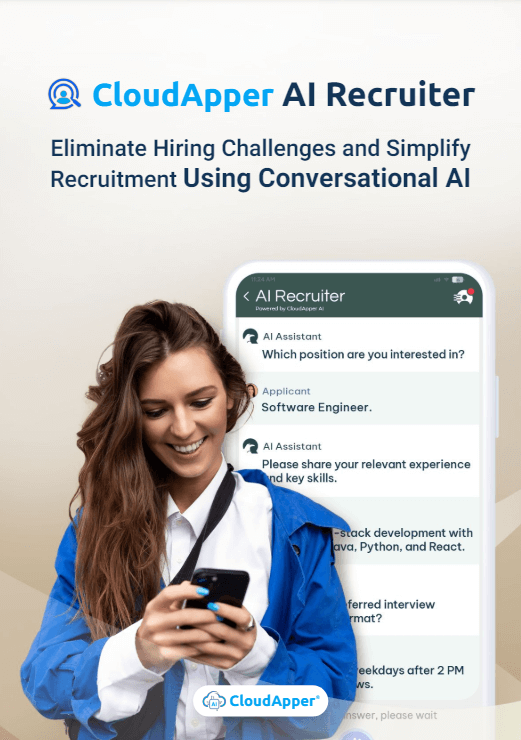
CloudApper AI Recruiter applies this entire model as a process layer on top of the ATS you already run, including UKG Pro Recruiting, Dayforce, and other major systems, rather than as another tool recruiters have to remember to use.
Candidates are ranked blind: names and identifiers are stripped before scoring, and the scoring criteria come from the job requisition, not from your past hiring decisions. That design breaks the bias-learning mechanism at the heart of recent litigation. The criteria are fully transparent and editable by your team; there is no black box. And the output is a candidate overview a recruiter reviews. It informs a human decision, it never replaces one.
For high-volume hiring teams, the enforcement layer also collapses time-to-decision: organizations using AI Recruiter have cut application-to-interview time from 12 days to 72 hours while screening every candidate through the same blind, criteria-based process. Fair screening and fast screening stop being a trade-off.
Fair Hiring Is a Workflow Property, Not a Policy
The organizations getting this right in 2026 share one belief: fairness that depends on individual discipline will fail exactly when it matters most, under volume, under deadline, under pressure. Fairness that lives in the workflow holds.
Blind resume screening software is how that belief becomes operational. Identity cues never reach the reviewer. Every candidate gets identical treatment. Every step leaves evidence. And recruiters keep full authority over the decisions that should always be human.
CloudApper is the process layer that closes the gaps enterprise software can’t: in this case, the gap between a fair-hiring policy and a fair-hiring process. The organizations that move fastest on this aren’t waiting for their ATS vendor’s roadmap. They’re enforcing fairness now, in weeks not quarters.
Frequently Asked Questions
What is blind resume screening software?
Blind resume screening software automatically removes personal identifiers from resumes before human review, including names, photos, addresses, graduation dates, and demographic signals, so recruiters evaluate candidates on qualifications alone. It also keeps an audit trail that proves the system anonymized every applicant’s resume the same way.
What platforms support fair, blind screening for early-stage applications?
Platforms like CloudApper AI Recruiter apply blind screening at the workflow level inside existing ATS systems such as UKG Pro Recruiting and Dayforce. The software anonymizes resumes automatically at ingestion, before any recruiter or hiring manager sees them, rather than relying on manual redaction.
Does blind resume screening software make hiring decisions?
No. Properly designed blind screening software enforces anonymization and presents a ranked candidate overview, while recruiters and hiring managers keep full decision-making authority. Systems that automatically reject candidates create legal exposure under laws like NYC Local Law 144 and Illinois HB 3773.
How does blind screening reduce bias if AI can also be biased?
The bias risk in AI hiring tools comes primarily from training on historical hiring decisions. Blind screening software that scores candidates only against job-requisition criteria, without learning from past hires, removes both the human bias trigger (identity cues) and the algorithmic one (biased training data).
What information is removed during blind resume screening?
The software removes names, photos, contact details, addresses, graduation years and other age indicators, pronouns, and affiliations that signal ethnicity, religion, or national origin. It always preserves skills, certifications, work history, accomplishments, and job-relevant education content.
Can blind resume screening work with our existing ATS?
Yes. Workflow-level tools operate as an enhancement layer on top of your current ATS rather than replacing it. CloudApper AI Recruiter, for example, runs inside UKG and Dayforce environments and typically goes live in six to eight weeks.
Is blind resume screening required by law?
Not directly, but the regulatory direction is clear: NYC Local Law 144 requires bias audits of automated hiring tools, Illinois HB 3773 (effective January 2026) prohibits discriminatory AI in recruitment, and Title VII disparate-impact liability covers screening outcomes whether a human or an algorithm produces them. Blind screening with audit logging gives employers one of the strongest defensive postures available.
Is blind resume screening suitable for high-volume hiring?
It delivers the most value there. Manual anonymization fails precisely when application volume spikes, while automated blind screening treats the tenth and the ten-thousandth resume identically. That consistency explains why high-volume hourly employers in healthcare, senior care, and field services adopt it first.

What is CloudApper AI Platform?
CloudApper AI is an advanced platform that enables organizations to integrate AI into their existing enterprise systems effortlessly, without the need for technical expertise, costly development, or upgrading the underlying infrastructure. By transforming legacy systems into AI-capable solutions, CloudApper allows companies to harness the power of Generative AI quickly and efficiently. This approach has been successfully implemented with leading systems like UKG, Workday, Oracle, Paradox, Amazon AWS Bedrock and can be applied across various industries, helping businesses enhance productivity, automate processes, and gain deeper insights without the usual complexities. With CloudApper AI, you can start experiencing the transformative benefits of AI today. Learn More
- Useful Links:
- Agentic AI
- No-Code/Low-Code
- Custom Software
- HCM Personalization
- iPaaS
- FedRAMP
CloudApper AI Solutions for HR

- Works with








- and more.
Similar Posts
Recording Candidate Video Interviews in Illinois: Consent, Retention, and Deletion…

Replace 30-Minute Phone Screens With 10-Minute Video Reviews: The Recruiter…