Rigid return-to-office tracking is backfiring. As badge swipes and desk-time dashboards replace trust with surveillance, HR leaders are seeing rising resistance, lower engagement, and quiet attrition. Here’s why the RTO-tracking trap is fueling the “Great Resistance”—and how to restore accountability without breaking culture.

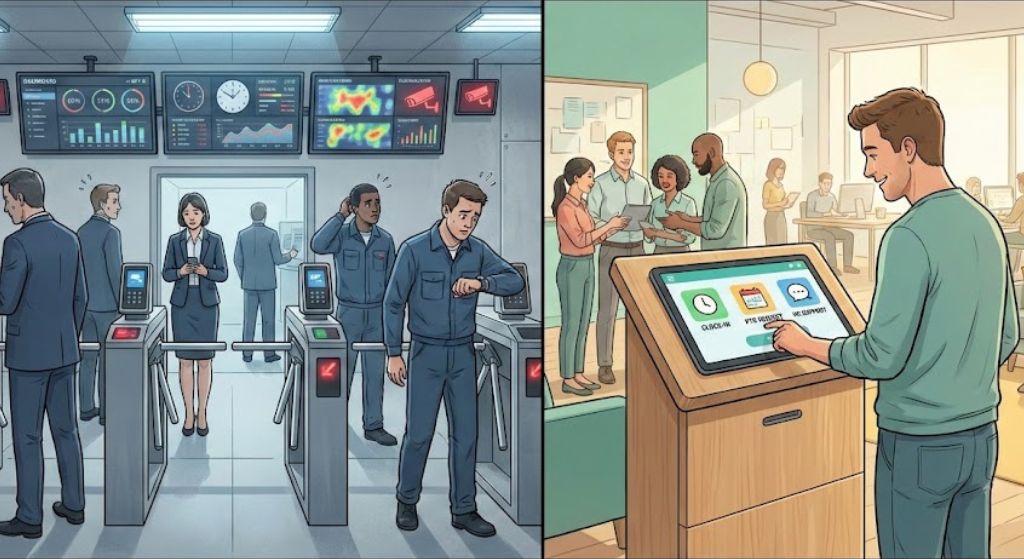
Table of Contents
- What is the RTO-tracking trap?
- Why rigid monitoring triggers backlash (especially among technical and deskless teams)
- The real cost: you don’t lose hours—you lose goodwill
- What HR leaders should do instead: move from surveillance to enablement
- Where hrPad fits: accountability without the “surveillance vibe”
- A practical HR operating model for 2026
- FAQs
If you’ve been in HR long enough, you can feel when an employee sentiment shifts from “grumbling” to “collective resolve.”
That’s where many organizations are right now with Return-to-Office (RTO) mandates—especially when those mandates are paired with rigid badge swipes, desk-time rules, or minute-by-minute time tracking that feels less like operations and more like surveillance.

Economists have already named the broader phenomenon: the “Great Resistance”—the quiet, persistent ways employees and managers push back against full-time office returns. What’s new in early 2026 is how quickly tracking has become the lightning rod. We’re not just debating where work happens. We’re debating whether the workplace is still built on trust.
And trust, once lost, is expensive to buy back.
What is the RTO-tracking trap?
The RTO-tracking trap is when leaders try to “fix” attendance and productivity anxiety by adding more monitoring—badge dashboards, hours-in-office thresholds, stricter timekeeping rules—only to create the very resistance they’re trying to eliminate.
Recent examples show how this plays out. Amazon has reportedly rolled out a manager dashboard that tracks time spent in the office and flags employees who don’t meet in-office expectations, reinforcing how measurable presence is becoming a management proxy for performance. Meanwhile, workplace coverage has described the rise of subtle enforcement tactics and tighter surveillance designed to close loopholes like “coffee badging.”
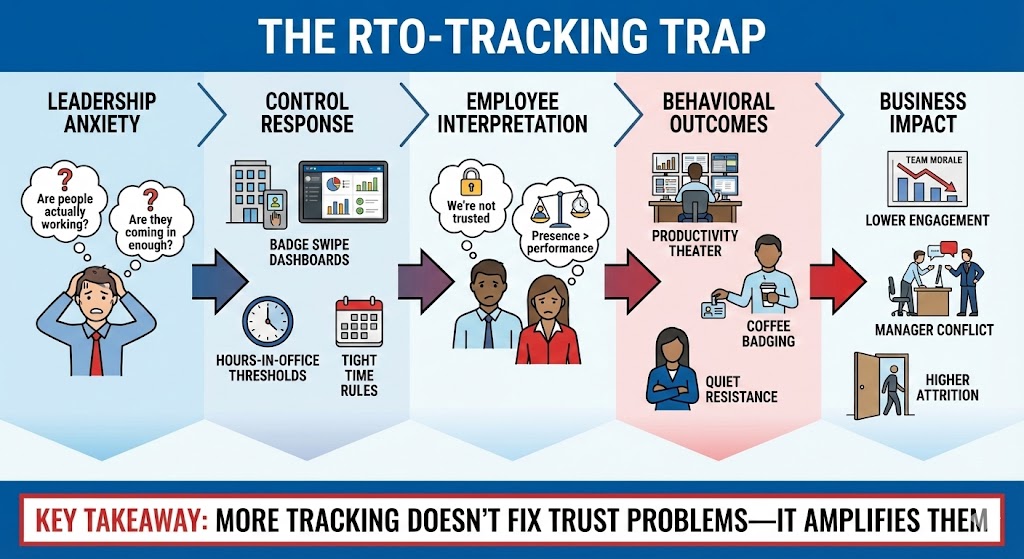
From an HR leader’s perspective, here’s the hard truth: tracking creates data—but not necessarily clarity. It’s very easy to measure “hours present.” It’s far harder to measure collaboration, problem-solving, customer impact, or safe staffing coverage. When the easiest metric becomes the main metric, you get “productivity theater,” not productivity.
Why rigid monitoring triggers backlash (especially among technical and deskless teams)
Employees don’t hate accountability. What they hate is being treated like a risk to be controlled instead of a workforce to be enabled.
That shows up differently depending on the workforce:
Technical staff and knowledge workers
For technical teams, surveillance-style monitoring is read as a leadership confession: “We don’t know how to manage outcomes, so we’re managing visibility.” It shifts the psychological contract from “we trust you to deliver” to “prove you’re working.” That trade—especially in roles where deep work matters—usually reduces engagement, not increases it.
It also creates a weird second-order effect: high performers find ways to opt out (informal exceptions, manager-by-manager deals), while everyone else absorbs the rigidity. Business coverage in early 2026 has highlighted how off-the-record flexibility continues even under mandates, because managers don’t want to lose talent. That inconsistency fuels resentment faster than the policy itself.
Deskless workers
For deskless and frontline teams, the issue isn’t abstract. Time systems determine pay, overtime eligibility, scheduling fairness, and whether HR is accessible during real working hours.
These employees often want accurate time capture—but they don’t want humiliating friction, confusing rules, or a system designed to catch them doing something wrong. When tracking is framed as suspicion, employees interpret every control as a signal: “You think we’re cheating.” That’s the moment attendance, overtime volunteering, and extra effort start to disappear.
You can see hints of this sentiment in active discussions in public forums where employees describe RTO requirements and the need to track hours closely again—often tied to comp time, overtime, or staffing cuts.
The real cost: you don’t lose hours—you lose goodwill
Most HR teams are not trying to micromanage. They’re trying to solve real problems: compliance, cost allocation, client billing, capacity planning, and payroll accuracy.
But employee perception matters as much as HR intent.
Surveillance-style monitoring tends to create three damaging outcomes:
- Withholding discretionary effort.
Employees stop volunteering. They do what’s required, nothing more. If your operations rely on “above and beyond” behaviors—staying late during peak weeks, picking up shifts, covering emergencies—you feel this immediately.
- Manager-employee conflict.
Managers become policy enforcers instead of coaches. Employees don’t argue with HR; they argue with their direct supervisor, because that’s where enforcement happens.
- Attrition and hiring drag.
RTO policies can already raise turnover risk. Layer in tracking that feels invasive, and you don’t just lose people—you lose the people who have options.
The finance and governance world has been warning about this broader surveillance backlash: even well-intentioned monitoring can trigger intense employee concerns around privacy, trust, and fairness.
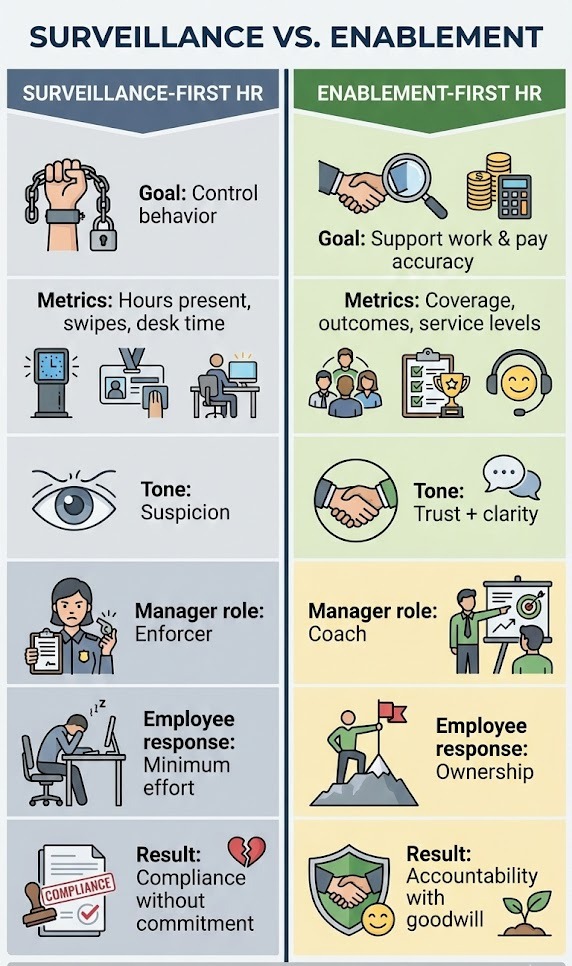
What HR leaders should do instead: move from surveillance to enablement
This is where HR earns its seat at the table—not by “softening” the policy, but by making it operationally effective without breaking trust.
Start with transparency (and be specific)
Transparency is not “we track time for business reasons.” Transparency is:
- What data is collected (badge swipe, geofence, clock-in photo, etc.)
- What it is used for (payroll accuracy, safety coverage, client billing, capacity planning)
- What it is not used for (punishing bathroom breaks, ranking employees by mouse movement, etc.)
- Who can see it (HR only, managers, finance)
- How long it’s retained and how disputes are handled
When employees understand the “why,” time tracking stops feeling like micromanagement and starts feeling like a shared operational system.
Measure outcomes, not presence, wherever possible
If a role can be managed through deliverables, manage it through deliverables. If a role requires on-site coverage, measure coverage. If a role requires customer response times, measure response times.
In other words: tie measurement to the purpose of the work, not to the anxiety of leadership.
Use tools that reduce friction—and increase access
One of the biggest missed opportunities in the RTO debate is that many companies are trying to solve workforce trust issues using tools that were built for policing, not service delivery.
For deskless workforces, the better play is often to implement self-service enablement: make it easier for employees to clock in and clock out accurately, get HR answers instantly, request PTO correctly, and manage shifts without chasing a manager or waiting days for an HR response.
That’s where an employee self-service kiosk approach fits naturally.
Where hrPad fits: accountability without the “surveillance vibe”
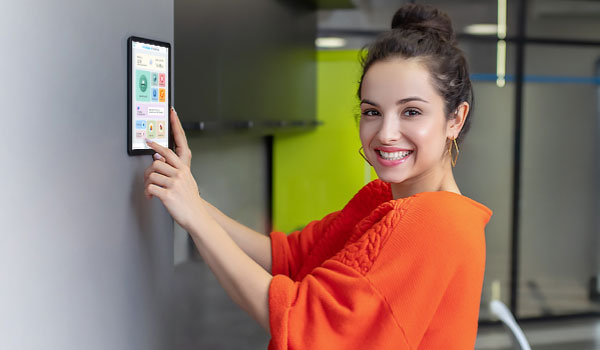
CloudApper hrPad is positioned as an employee self-service kiosk with AI Agents for HR service delivery (HRSD)—not just a time clock. It supports day-to-day workflows like timekeeping, PTO requests, overtime calculations, shift actions, and a 24/7 HR assistant that can answer repetitive questions based on company policy—using standard iPad/tablet devices.
From a trust lens, this matters because hrPad is fundamentally service-oriented:
- The employee experience is “I can do what I need to do quickly,” not “I’m being watched.”
- Time capture can be paired with identity verification like touchless Face ID check-in to reduce buddy punching while keeping the interaction simple.
- HR can reduce repetitive tickets by offering self-service answers and workflows that don’t require an employee to find a supervisor mid-shift.
In other words: you still get accurate time and operational data—but the employee feels enabled, not hunted.
That’s the difference between compliance and culture.
A practical HR operating model for 2026
If you’re reconsidering your RTO + time tracking approach right now, here’s the model I recommend:
1) Separate compliance tracking from productivity judgment.
Time systems should protect pay accuracy and legal compliance. Performance management should be based on outcomes and role expectations.
2) Standardize exceptions instead of hiding them.
If managers are already making informal flexibility deals (and many are), formalize an exception framework. Shadow policies create resentment.
3) Invest in HR service delivery for deskless teams.
If you want frontline trust, start by making HR accessible on their schedule—through self-service kiosks, policy-aware HR assistants, and fast workflows that remove friction.
4) Communicate like a leader, not a compliance memo.
Employees don’t want slogans. They want clarity: what’s changing, why it’s changing, what will be measured, and how fairness is ensured.
FAQs
Is employee monitoring legal?
In many jurisdictions, some monitoring is allowed—but legal doesn’t mean wise. The bigger risk is trust erosion, morale decline, and higher attrition—especially if monitoring isn’t transparent or role-appropriate.
Why are RTO mandates still facing resistance in 2026?
Because the conflict isn’t only about location—it’s about autonomy and trust. Research and reporting continue to show persistent “under-the-radar” flexibility even under mandates, which signals ongoing resistance and negotiation.
What’s a better alternative to surveillance-style time tracking for deskless teams?
Use systems that prioritize accurate pay and employee enablement: simple clock-in experiences, self-service PTO and shift workflows, and policy-based HR answers—so time tracking feels like operational support, not suspicion.
What is CloudApper AI Platform?
CloudApper AI is an advanced platform that enables organizations to integrate AI into their existing enterprise systems effortlessly, without the need for technical expertise, costly development, or upgrading the underlying infrastructure. By transforming legacy systems into AI-capable solutions, CloudApper allows companies to harness the power of Generative AI quickly and efficiently. This approach has been successfully implemented with leading systems like UKG, Workday, Oracle, Paradox, Amazon AWS Bedrock and can be applied across various industries, helping businesses enhance productivity, automate processes, and gain deeper insights without the usual complexities. With CloudApper AI, you can start experiencing the transformative benefits of AI today. Learn More
- Useful Links:
- Agentic AI
- No-Code/Low-Code
- Custom Software
- HCM Personalization
- iPaaS
- FedRAMP
Brochure
CloudApper hrPad
Empower Frontline Employees with an AI-Powered Tablet/iPad Solution
Download Brochure
CloudApper AI Solutions for HR
- Works with







- and more.
Similar Posts

How to Notify Frontline Employees About Unpaid Leave Before They…
Why UKG Pro Employee Self Service Adoption Struggles and How…