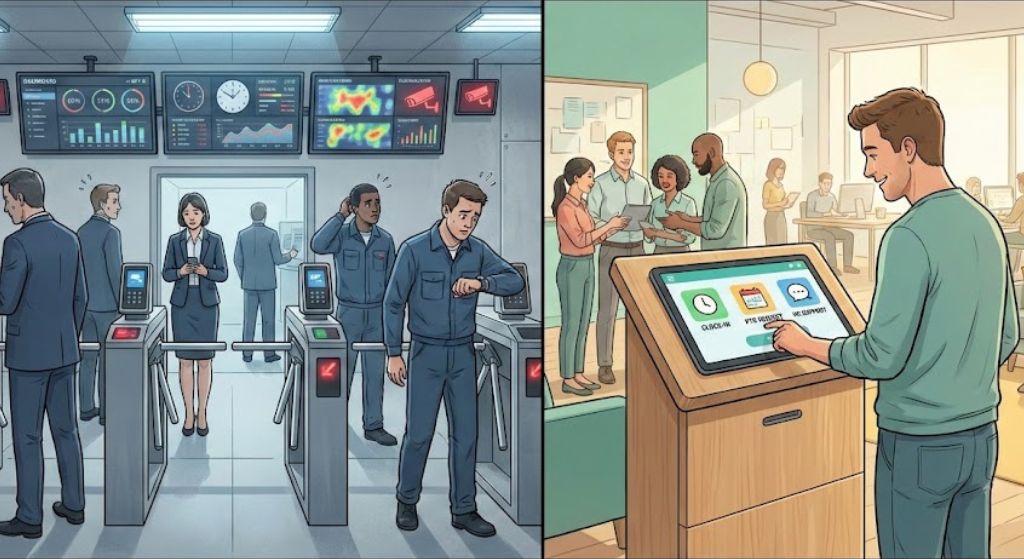
Low attrition can feel like a win, but it may be hiding a deeper risk. As employees “job hug” in uncertain markets, stagnation risk rises—quietly eroding productivity, skills, and engagement. Here’s why HR leaders need to shift from flight-risk thinking to a new retention model built for the AI era.

Table of Contents
- What job-hugging looks like on the ground
- Why low attrition can signal a productivity problem
- The new twist: employees are using AI as a reassurance tool
- Shift your model: from flight risk to stagnation risk
- The retention lever most companies underuse
- HR service delivery that prevents the slow drift
- The external threat: a more fluid talent market powered by AI platforms
- What to do next
- FAQ
For the last few years, many of us have built our retention playbooks around “flight risk.” Who’s about to leave? Who’s quietly quitting? Who’s disengaging in ways that show up in exit interviews later?
Now, the more dangerous pattern often appears to be the opposite.

Employees are staying. They are “job hugging” because the market feels uncertain, layoffs feel random, and switching roles feels riskier than it did during the Great Resignation. LinkedIn career experts have used the term to describe people clinging to roles for security, even when they’ve outgrown them.
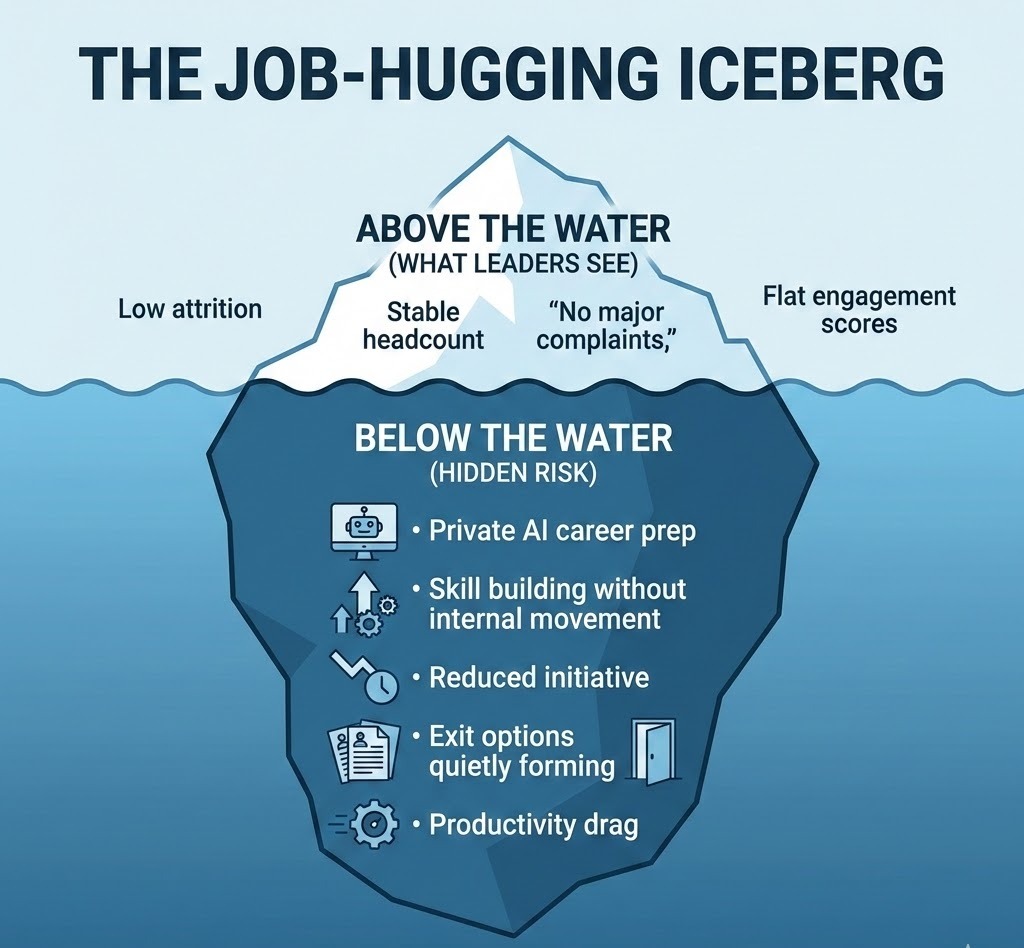
On paper, this can look like a win: low attrition, stable headcount, fewer backfills. But as an HR tech writer, I’ve learned to distrust “calm” metrics when the environment is noisy. Low attrition can also mask a productivity slump, a morale stall, and a skills plateau.
That’s why I think 2026 requires a pivot in how we model risk. We still need flight-risk models, but we also need something many organizations don’t measure well yet: stagnation risk.
Stagnation risk occurs when employees remain in their jobs but stop growing, stop contributing at their highest level, and quietly redirect their ambition elsewhere. Often, that “somewhere else” is AI-assisted.
What job-hugging looks like on the ground
Job-hugging is not the same as loyalty. It’s often self-protection. People stay because they don’t feel confident in the market, they worry about AI disruption, or they simply don’t trust that external moves will be worth the risk right now.
Here’s how it shows up operationally:
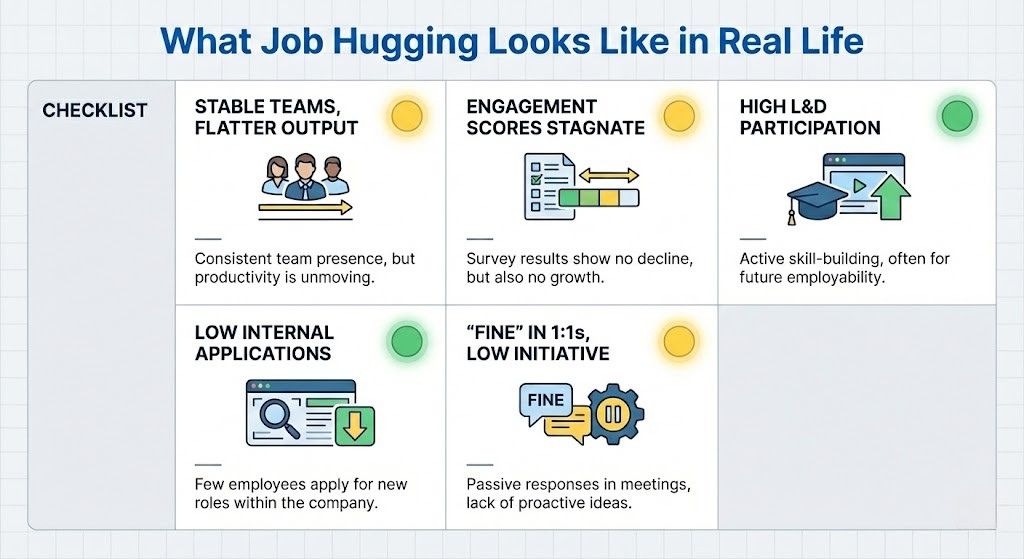
Managers report “stable teams,” but output feels flatter than last year.
Engagement survey scores stop declining, but they also stop improving.
Internal mobility slows, not because people are satisfied, but because they don’t want to rock the boat.
Learning and development participation rises, yet internal applications don’t.
That last point matters. People are absolutely learning. They’re just learning privately, strategically, and sometimes silently.
Why low attrition can signal a productivity problem
Attrition is a lagging indicator. It tells you what already happened. Stagnation is a leading indicator. It tells you what is about to happen.
When employees hug jobs they’ve outgrown, the risk is not immediate resignation. The risk is that your workforce becomes less adaptive right when you need agility the most.
The economic logic is simple: if fewer people leave, you have fewer opportunities to “refresh” skills through hiring. Meanwhile, job requirements keep shifting, especially as AI becomes embedded in day-to-day work. HR trend forecasts for 2026 consistently point toward skills-based workforce planning and internal mobility as central to resilience.
So if you’re not actively moving people across roles, building skills pathways, and creating internal opportunities, “low attrition” can quietly become “low renewal.”
The new twist: employees are using AI as a reassurance tool
This is the part many leaders underestimate. AI isn’t only being used to do work faster. It’s being used to reduce fear.
Employees now use AI to simulate interviews, rewrite resumes, explore career pivots, map salary ranges, and practice negotiating. In at least one LinkedIn survey referenced in coverage of “job hugging,” a significant share of respondents said AI tools could help them prepare for interviews.
When employees can privately “test the market” with AI, they don’t need to talk to recruiters to feel momentum. They can build confidence quietly.
This creates a new kind of retention blind spot: the employee isn’t actively applying today, but they’re building the option to leave tomorrow.
In other words, the modern “job hugger” may look compliant, but they are often planning.
Shift your model: from flight risk to stagnation risk
Flight risk = probability someone will leave soon.
Stagnation risk = probability someone will stay but disengage, stop growing, and eventually exit with upgraded skills.
Stagnation risk is what turns stable headcount into fragile performance.
You can spot it by watching for patterns like:
A role that hasn’t changed in scope in 18–24 months
High AI tool usage for “career prep” behaviors (where you can ethically observe it through approved internal systems)
Low internal job applications despite high learning activity
Repeated “fine” check-ins paired with dropping initiative
Rising internal ticket volume for basic questions, because people stop trying to figure things out
That last one sounds small, but it’s not. When people are mentally checked out, they stop navigating complexity. They ask the system. Or they avoid the system. Either way, productivity dips.
The retention lever most companies underuse
The smartest response to job hugging isn’t to pressure people into “being grateful.” It’s to capture their ambition internally.
This is where internal AI career pathing becomes practical, not theoretical. When employees can see realistic internal moves, required skills, short learning sprints, and manager-approved pathways, they’re less likely to build an exit plan.
Career mobility research and 2026 HR trend reporting increasingly emphasize formal internal mobility processes and skills-based planning as differentiators for leading organizations.
If you want to keep “job huggers” from migrating to competitors, you have to give them a future they can reach without leaving.
HR service delivery that prevents the slow drift
Here’s what most retention strategies forget: people don’t disengage only because of comp or career ladders. They disengage because daily friction wears them down.
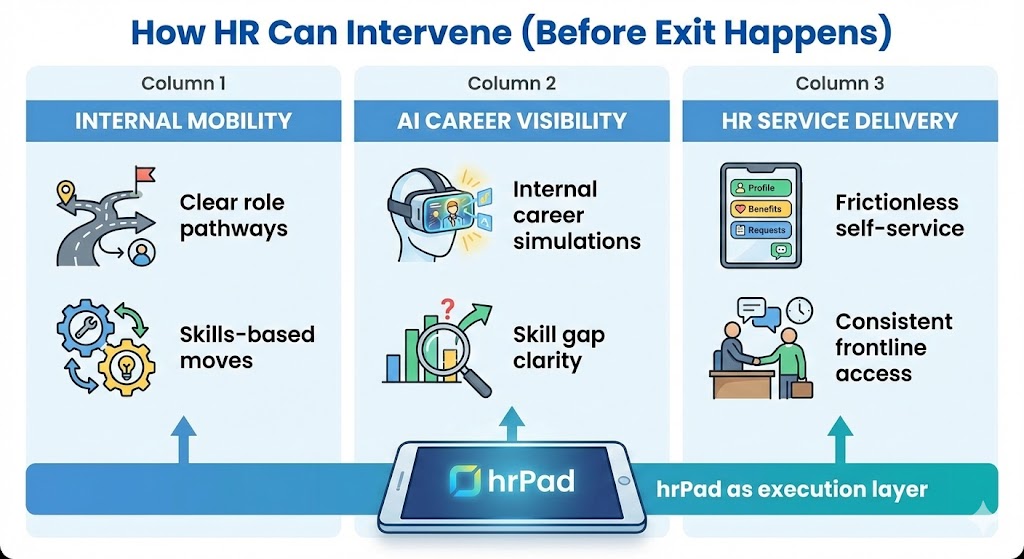
When basic HR tasks feel hard, slow, or inconsistent, employees stop asking, stop trusting, and stop caring. Then they start planning their exit. That’s why HR service delivery matters in a “job hugging” cycle. And it’s where CloudApper hrPad can pull more weight than many leaders expect.
hrPad is an employee self-service kiosk that runs on standard iPad/tablet devices and is designed to streamline frontline workforce experiences. It supports timekeeping and self-service workflows, plus a 24/7 AI assistant that can answer repetitive HR questions based on company policies.
In stagnation-risk terms, hrPad helps in three ways:
First, it reduces daily friction. When employees can quickly get answers, check PTO balances, submit requests, and complete simple HR actions without waiting on a human queue, they stay more connected to the organization.
Second, it creates structured touchpoints. Because the kiosk can run prompts, surveys, and confirmations as part of clock-in/clock-out flows, it becomes a natural channel to measure sentiment and detect disengagement early, before it becomes a resignation.
Third, it supports consistency for frontline teams. In environments where not everyone has a personal device or reliable access to desktop tools, a shared kiosk standardizes the employee experience. That consistency protects trust, and trust protects performance.
The point is not “a kiosk solves retention.” The point is that retention fails when HR delivery fails, and hrPad gives you a scalable way to keep the basics strong while you build bigger internal mobility systems.
The external threat: a more fluid talent market powered by AI platforms
Even if your internal programs are strong, the external market is getting easier to navigate.
Multiple outlets reported that OpenAI announced plans for an AI-powered hiring platform, often referred to as the “OpenAI Jobs Platform,” with reporting indicating a projected launch around mid-2026.
Whether that specific platform dominates or not, the direction is clear: AI-driven matching, AI-driven skill verification, and AI-driven career movement will reduce the friction of switching employers.
So HR should plan for a world where “passive” talent becomes “movable” talent faster than before.
The practical preparation is not panic. It’s readiness:
Make internal opportunities visible and easy to apply for
Build skills pathways that feel real, not aspirational
Strengthen HR service delivery so day-to-day experience doesn’t push people away
Create an internal narrative that growth is expected, supported, and measurable
What to do next
If I were advising an HR team starting this tomorrow, I’d focus on three moves:
Start measuring stagnation signals alongside attrition. Low attrition is not enough.
Launch or refresh internal mobility pathways for your highest-stagnation roles.
Fix HR friction at the frontline level, because that’s where disengagement spreads quietly.
If you want one fast, tangible action: deploy a consistent employee self-service layer where your workforce actually works. For many organizations, hrPad becomes that layer because it puts time, HR actions, and policy-based answers in one shared place employees can use without jumping between tools.
FAQ
What is job-hugging?
Job hugging is when employees stay in their current roles mainly for security, even if they feel disengaged or have outgrown the job.
Why is job-hugging risky for companies?
It can hide stagnation. Employees may stay but contribute less, stop developing, and eventually leave with upgraded skills, which turns “low attrition” into a delayed productivity problem.
What is stagnation risk in HR?
Stagnation risk is the likelihood that employees remain employed but stop growing and disengage over time, creating a future performance and retention gap.
How can HR reduce job hugging without losing employees?
By expanding internal mobility, offering clear career pathing and skill development, and reducing day-to-day HR friction, employers can help employees feel supported.
How does hrPad support HR service delivery?
hrPad is an AI-powered employee self-service kiosk that supports timekeeping, self-service HR actions, and a 24/7 AI assistant for policy-based HR questions, improving accessibility for frontline teams.
What is CloudApper AI Platform?
CloudApper AI is an advanced platform that enables organizations to integrate AI into their existing enterprise systems effortlessly, without the need for technical expertise, costly development, or upgrading the underlying infrastructure. By transforming legacy systems into AI-capable solutions, CloudApper allows companies to harness the power of Generative AI quickly and efficiently. This approach has been successfully implemented with leading systems like UKG, Workday, Oracle, Paradox, Amazon AWS Bedrock and can be applied across various industries, helping businesses enhance productivity, automate processes, and gain deeper insights without the usual complexities. With CloudApper AI, you can start experiencing the transformative benefits of AI today. Learn More
- Useful Links:
- Agentic AI
- No-Code/Low-Code
- Custom Software
- HCM Personalization
- iPaaS
- FedRAMP
Brochure
CloudApper hrPad
Empower Frontline Employees with an AI-Powered Tablet/iPad Solution
Download Brochure
CloudApper AI Solutions for HR

- Works with







- and more.
Similar Posts

How to Notify Frontline Employees About Unpaid Leave Before They…
Why UKG Pro Employee Self Service Adoption Struggles and How…