Most restaurant payroll failures aren’t caused by payroll systems. They start on the floor, where employees move across locations and roles, creating data gaps that lead to overtime leakage and compliance risk. This article explains why multi-entity payroll breaks down and how a frontline layer restores data integrity before payroll ever runs.

Table of Contents
- What Is the Data Integrity Gap in Multi-Entity Restaurants?
- Why Multi-Entity Workforces Break Traditional Payroll Assumptions
- Overtime Leakage: The Invisible Cost of Fragmented Time Data
- Compliance Errors Start at the Clock-In, Not Payroll Processing
- Why Traditional HCMs Struggle in Multi-Entity Restaurant Setups
- The Frontline Layer: Closing the Data Integrity Gap
- How CloudApper hrPad Acts as the Frontline Layer
- From Clean Inputs to Confident Payroll Runs
- Payroll Accuracy Starts on the Restaurant Floor
Restaurant payroll platforms are more capable than ever. Modern HCMs and payroll systems can handle complex pay rules, multiple legal entities, and detailed reporting. Yet payroll errors, overtime leakage, and compliance issues continue to surface in multi-restaurant operations.

The root cause is rarely payroll processing itself. The real failure happens earlier, at the point where time, labor, and compliance data are captured. When employees work across multiple locations or entities, the data feeding payroll systems becomes fragmented, delayed, or inconsistent. This breakdown is known as the Data Integrity Gap, and it is one of the most expensive operational blind spots in restaurant groups.
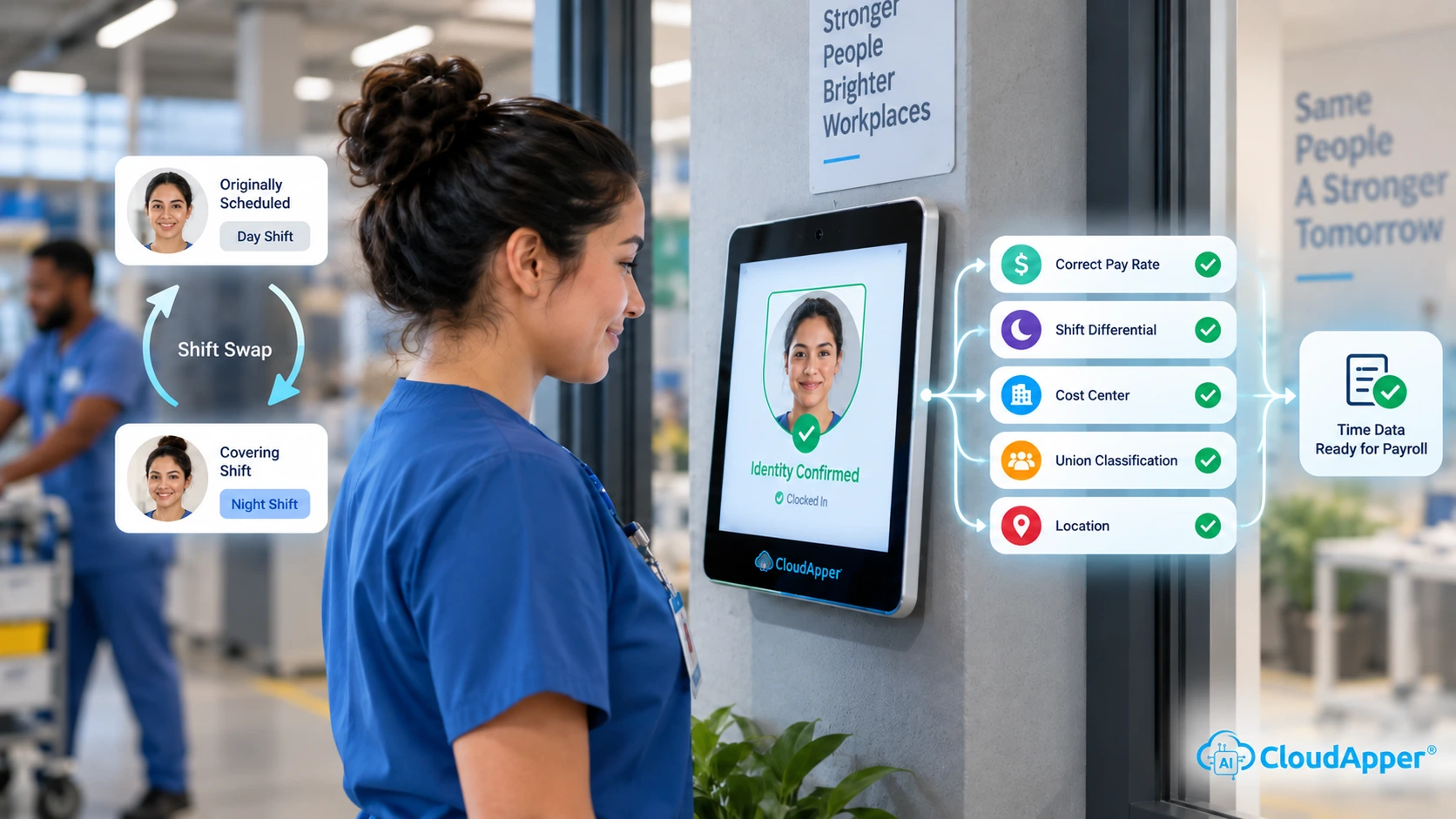
This is where CloudApper hrPad plays a critical role. hrPad functions as a Frontline Layer, standardizing how time, labor transfers, and compliance data are captured across locations before that data ever reaches payroll. Instead of relying on fragmented inputs from apps, managers, or after-the-fact corrections, hrPad centralizes frontline data capture at the source of work.
What Is the Data Integrity Gap in Multi-Entity Restaurants?
The Data Integrity Gap emerges when payroll systems receive data that appears valid but does not accurately reflect how work actually occurred.
In multi-entity restaurant environments, employees frequently:
- Cover shifts at different locations
- Switch roles during the same shift
- Work under multiple cost centers in a single pay period
When time capture tools are inconsistent across locations, these transitions are often recorded incorrectly or corrected manually later. Even small discrepancies accumulate, creating payroll errors that are difficult to trace and even harder to prevent.
Payroll systems depend on accurate inputs. When the inputs are compromised, payroll outcomes are compromised as well.
Why Multi-Entity Workforces Break Traditional Payroll Assumptions
Most payroll and HCM platforms are designed around stable organizational structures. They assume:
- Employees are tied to a single location
- Job roles are consistent within a shift
- Managers can easily validate time data before payroll runs
Restaurant operations rarely function this way. Coverage needs change in real time. Managers make decisions during peak hours, not in controlled administrative settings. Employees move where demand exists, not where systems are cleanest.
This operational reality exposes a gap between how payroll systems are designed and how restaurants actually operate.
Overtime Leakage: The Invisible Cost of Fragmented Time Data
Overtime leakage is rarely caused by intentional mismanagement. It is usually the result of inaccurate or delayed data capture.
When hours are logged under the wrong entity or role, overtime thresholds can be triggered unintentionally. Managers often catch these issues only after payroll previews are generated, forcing last-minute adjustments that mask the root problem rather than solving it.
Over time, these small inefficiencies compound into significant labor cost overruns that are difficult to audit or explain.
Compliance Errors Start at the Clock-In, Not Payroll Processing
Compliance risks in restaurants often originate at the moment of clock-in or clock-out.
Missed attestations, incorrect labor transfers, and inconsistent enforcement across locations introduce compliance gaps that payroll systems cannot fix retroactively. By the time payroll runs, the risk is already embedded in the data.
Manual corrections may resolve short-term issues, but they increase audit exposure and reduce confidence in reported labor data.
Why Traditional HCMs Struggle in Multi-Entity Restaurant Setups
Enterprise platforms like Workday and UKG are powerful systems built to manage complex organizations. However, they are optimized for centralized configuration and downstream processing.
They are not designed to enforce consistency at the frontline across dozens of fast-moving restaurant environments. Without a dedicated operational layer at the point of work, these systems depend on managers and employees to bridge the gap manually.
The limitation is not capability. It is context.
The Frontline Layer: Closing the Data Integrity Gap
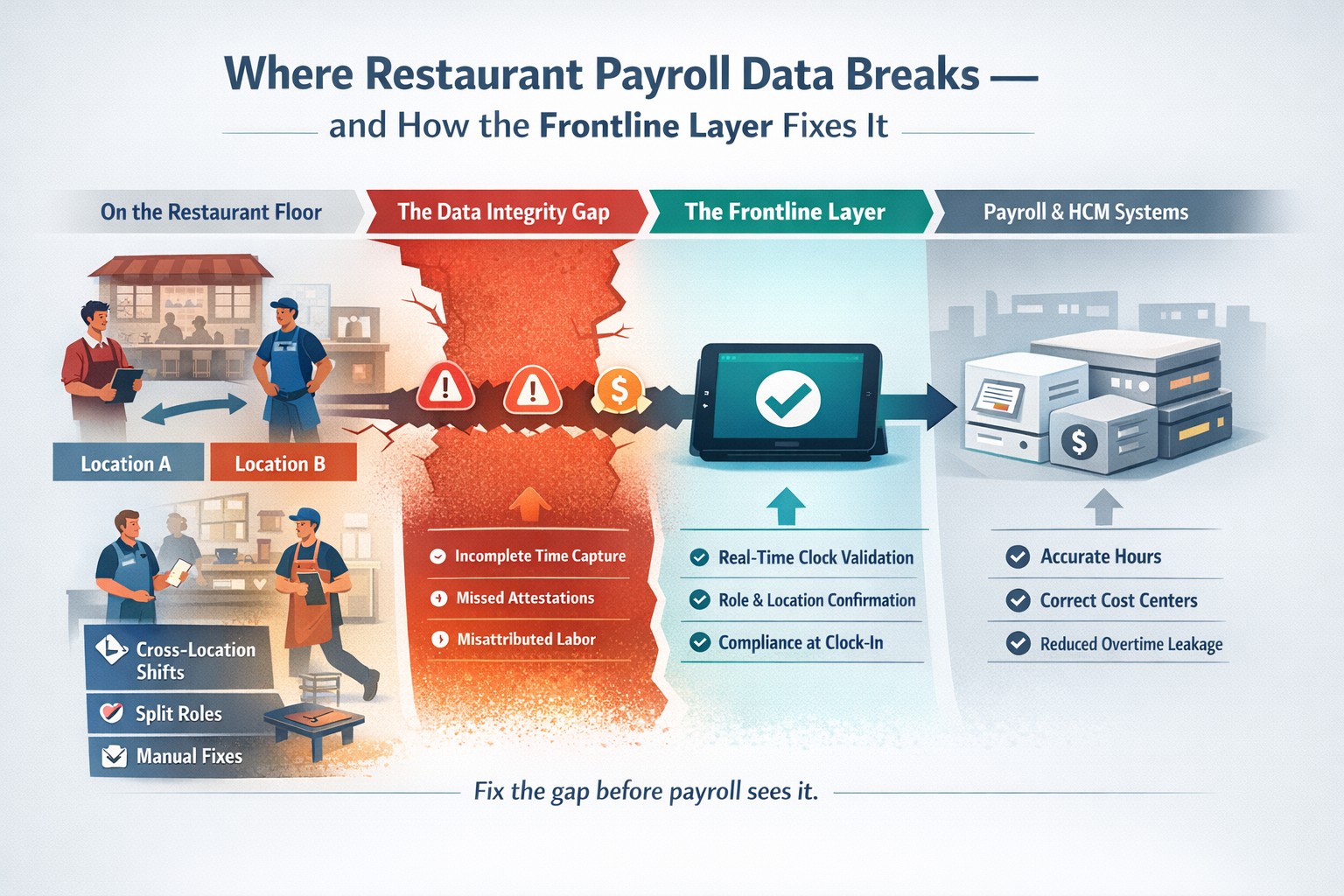
A Frontline Layer sits between daily operations and payroll systems. Its role is to ensure that data is captured correctly, consistently, and in real time before it enters downstream systems.
Instead of correcting errors after the fact, a Frontline Layer prevents them by:
- Validating location and role at clock-in
- Capturing labor transfers as they happen
- Enforcing compliance steps consistently across sites
This approach shifts payroll accuracy upstream, where it belongs.
How CloudApper hrPad Acts as the Frontline Layer
CloudApper hrPad transforms a shared tablet into a centralized frontline interface used across all restaurant locations.
With hrPad:
- Employees clock in and out through a single, consistent experience
- Labor transfers are captured in real time for multi-role shifts
- Compliance attestations are enforced before data reaches payroll
- All validated data flows directly into existing HCM and payroll systems
hrPad does not replace payroll platforms. It strengthens them by ensuring the data they receive is accurate, complete, and operationally aligned.
From Clean Inputs to Confident Payroll Runs
When frontline data integrity improves, payroll outcomes improve naturally.
Restaurants experience:
- Reduced overtime leakage
- Fewer payroll corrections
- Lower compliance risk
- Greater employee trust in pay accuracy
Most importantly, HR teams gain visibility into labor data that reflects reality, not retroactive fixes.
Payroll Accuracy Starts on the Restaurant Floor
Multi-entity restaurant payroll failures are rarely system failures. They are frontline data failures.
By closing the Data Integrity Gap at the point of work, restaurant groups can scale operations without scaling payroll risk. A dedicated Frontline Layer makes it possible to align fast-moving restaurant realities with the systems responsible for pay, compliance, and reporting.
If multi-location payroll accuracy is becoming harder to manage, it may be time to address the problem where it starts.
What is CloudApper AI Platform?
CloudApper AI is an advanced platform that enables organizations to integrate AI into their existing enterprise systems effortlessly, without the need for technical expertise, costly development, or upgrading the underlying infrastructure. By transforming legacy systems into AI-capable solutions, CloudApper allows companies to harness the power of Generative AI quickly and efficiently. This approach has been successfully implemented with leading systems like UKG, Workday, Oracle, Paradox, Amazon AWS Bedrock and can be applied across various industries, helping businesses enhance productivity, automate processes, and gain deeper insights without the usual complexities. With CloudApper AI, you can start experiencing the transformative benefits of AI today. Learn More
- Useful Links:
- Agentic AI
- No-Code/Low-Code
- Custom Software
- HCM Personalization
- iPaaS
- FedRAMP
Brochure
CloudApper hrPad
Empower Frontline Employees with an AI-Powered Tablet/iPad Solution
Download Brochure
CloudApper AI Solutions for HR

- Works with







- and more.
Similar Posts
Certified Payroll Compliance: Why Davis-Bacon Failures Start at the Time…
Shift Swap Pay Rate Accuracy: Confirming Who Actually Worked Before…