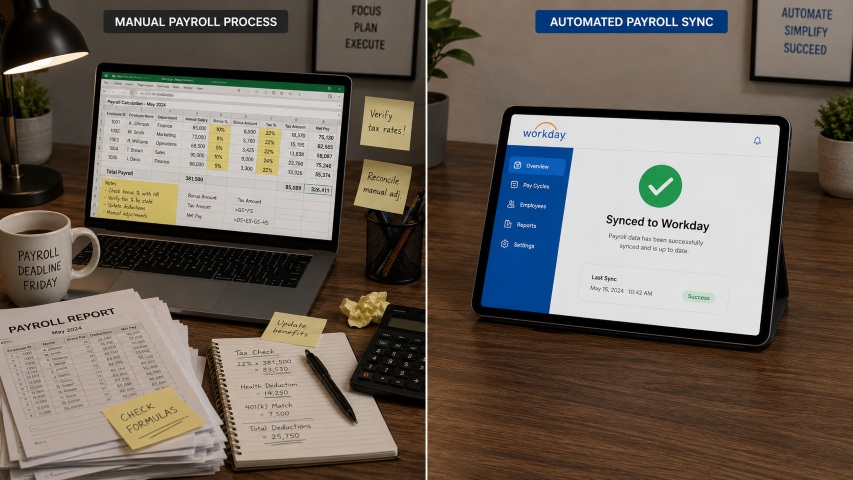
Unscheduled shifts and department transfers happen every day, but most time clocks aren’t built to capture them. When frontline work lacks context, payroll accuracy breaks down. This article explores where the gap starts and how HR teams prevent errors before payroll runs.

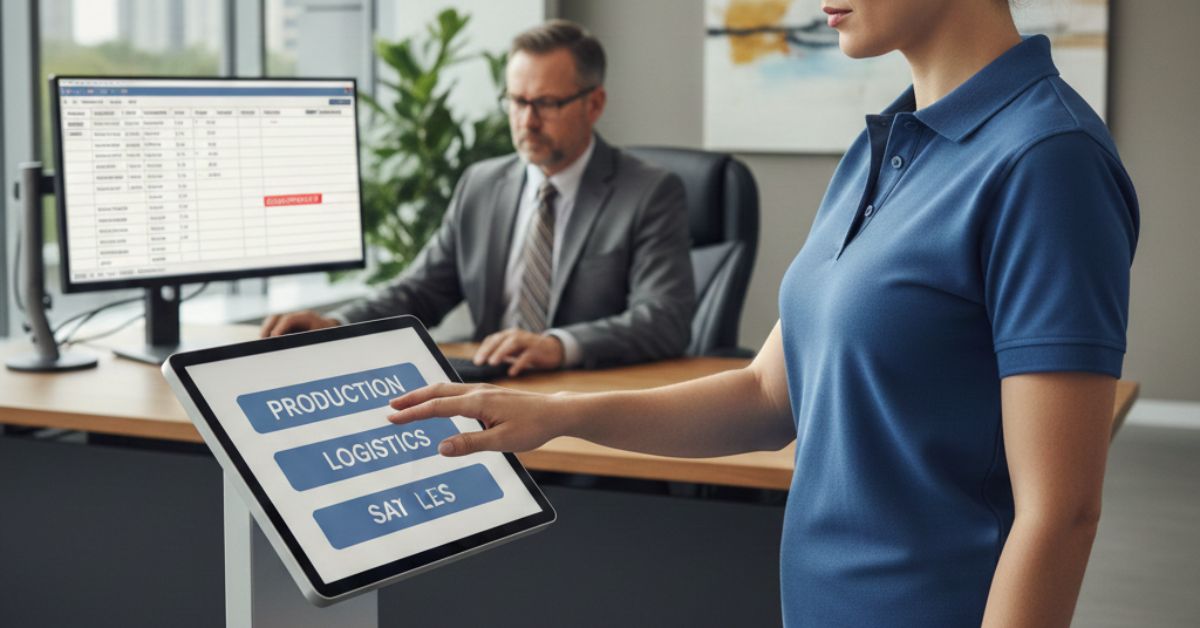
Table of Contents
- Why Unscheduled Shifts and Department Transfers Create Payroll Problems
- When Work Happens Outside the Schedule
- Department Transfers That Never Make It to Payroll
- A Real Conversation That Exposed the Gap
- Why Traditional Time Clocks Miss These Scenarios
- How Modern Time Capture Prevents Payroll Corrections
- What HR Teams Should Reevaluate in Their Time Capture Setup
- Payroll Accuracy Starts at the Clock
Frontline work does not follow clean schedules. Employees step in early, stay late, cover for short-staffed teams, or move between departments when demand spikes. This flexibility keeps operations running — but it quietly creates payroll and labor allocation problems that many HR teams only notice after errors appear.

The issue is not payroll processing itself. In most cases, payroll errors begin at the time clock, when unscheduled shifts and department transfers are captured without enough context.
Why Unscheduled Shifts and Department Transfers Create Payroll Problems
Most time capture systems are designed around predictable assumptions: an employee has a scheduled shift, works in one department, and clocks in and out without deviation. In real-world operations, those assumptions break down every day.
When unscheduled shifts occur, the system still needs to know where the employee actually worked and how their time should be allocated. Without that information, payroll inherits incomplete data, leading to misallocated labor costs, reporting inaccuracies, and avoidable corrections.
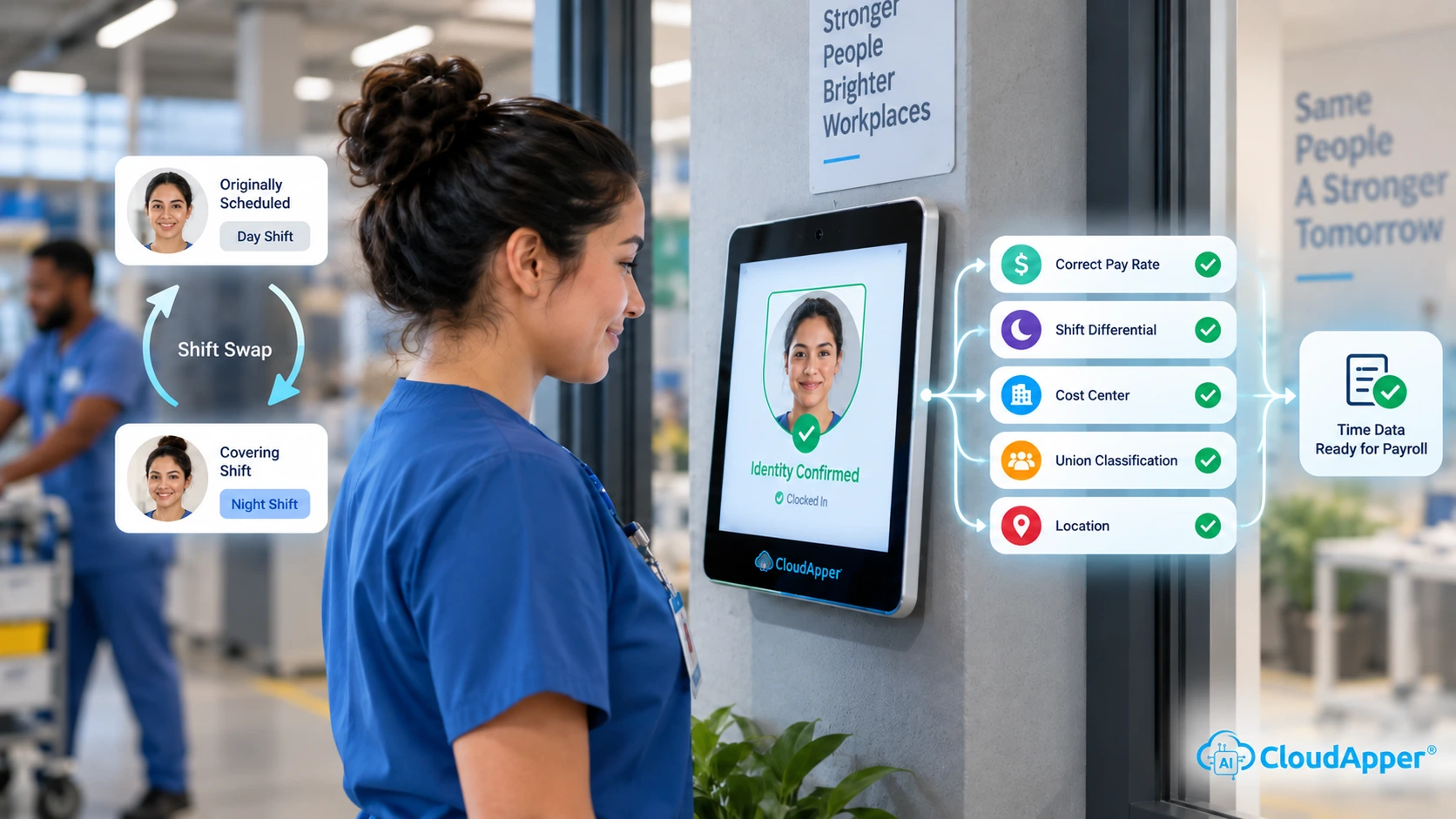
This is exactly where CloudApper hrPad changes the conversation. Designed as a frontline time capture layer, hrPad allows employees to clock in even when no shift is scheduled, select the department they are actually working in, and respond to custom prompts tied to the work they performed — ensuring time data reflects reality before it ever reaches payroll.
When Work Happens Outside the Schedule
Unscheduled shifts are not edge cases. They are routine in environments where staffing needs change quickly.
Employees may:
- Arrive early to prepare for peak demand
- Stay late to complete unfinished work
- Step into another department to support short-term gaps
When time clocks simply record a punch without capturing this context, the hours still get paid — but often to the wrong department or cost center. Over time, this distorts labor reporting and creates friction between HR, payroll, and operations.
Department Transfers That Never Make It to Payroll
Department transfers are another common source of hidden payroll risk.
An employee may clock in under their home department, spend most of the shift supporting another team, and clock out without ever confirming where the work actually happened. If the time capture system does not ask the right question at the right moment, payroll has no way of knowing the difference.
The result is familiar to many HR teams: incorrect labor allocation, frustrated department leaders, and manual adjustments that could have been prevented at the clock.
A Real Conversation That Exposed the Gap
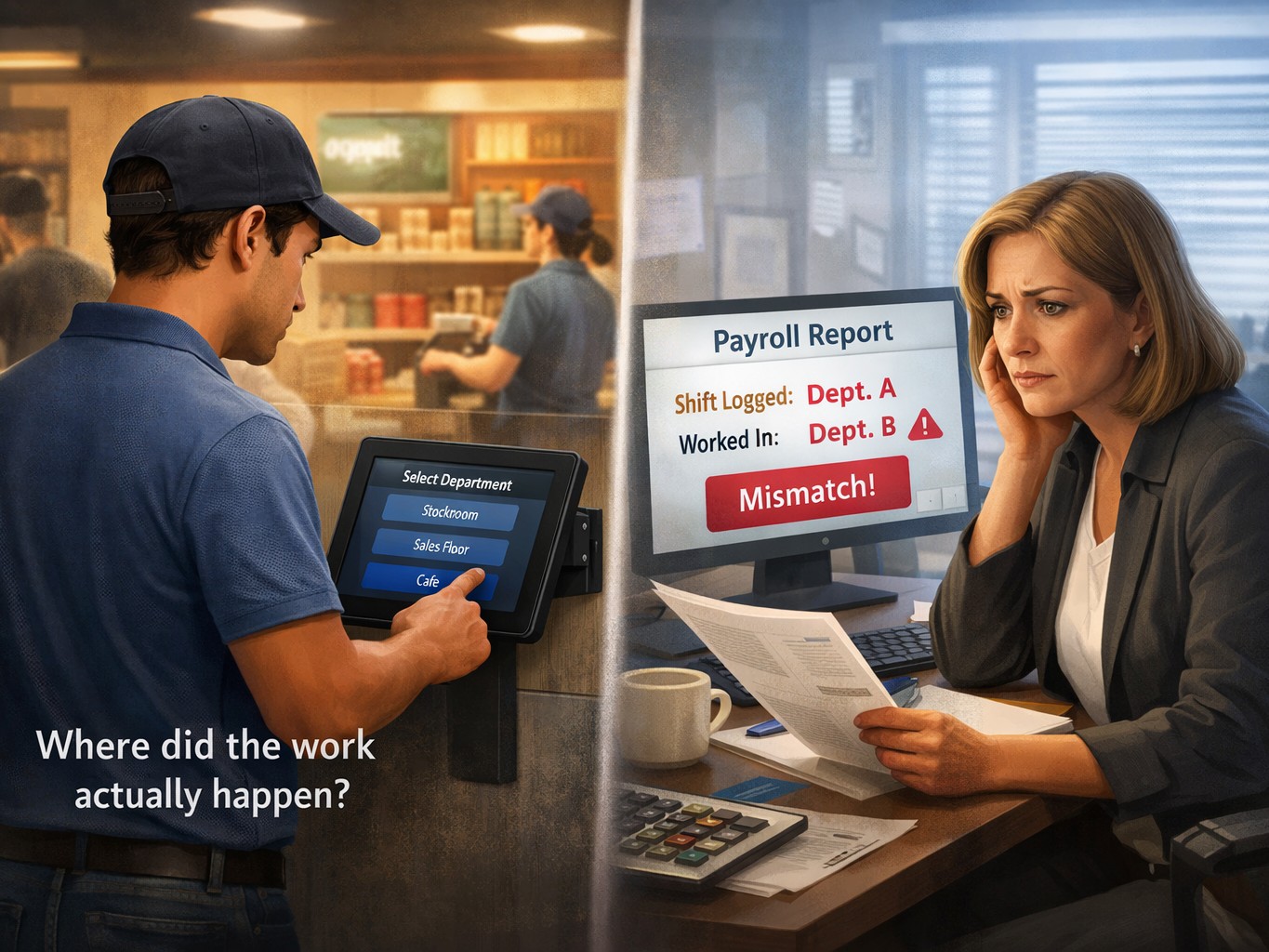
This issue surfaced clearly during a recent discussion with HR and operations leaders reviewing their time capture setup.
One leader asked how employees could select the correct department when working an unscheduled shift. Another asked how confirmations — such as charge-related details — could be captured at clock-out.
These were not feature-driven questions. They reflected day-to-day operational reality. The conversation made one thing clear: traditional time clocks record when someone worked, but often fail to capture what work they actually performed.
That gap is where payroll accuracy starts to break down.
Why Traditional Time Clocks Miss These Scenarios
Traditional time clocks are optimized for consistency, not flexibility. Their workflows are fixed, prompts are minimal, and context is rarely captured unless it was predefined in advance.
When employees clock out, there is often no opportunity to confirm department worked, acknowledge compliance requirements, or provide details that affect how labor should be categorized. Once the punch is saved, payroll systems simply process what they receive — even if the data is incomplete.
How Modern Time Capture Prevents Payroll Corrections
Modern time capture focuses on context as much as timestamps.
By enabling department selection at clock-in or clock-out, presenting custom questions tied to the work performed, and synchronizing data automatically, HR teams can ensure payroll reflects reality instead of assumptions. Errors are prevented at the source, rather than corrected after the fact.
This approach reduces payroll rework, improves labor reporting accuracy, and gives HR teams confidence that frontline activity is being captured correctly.
What HR Teams Should Reevaluate in Their Time Capture Setup
If unscheduled shifts and department transfers are common, HR leaders should ask:
- Can employees clock in without a predefined schedule?
- Can they indicate where they actually worked?
- Are confirmations or attestations required before clock-out?
- Does the system reduce payroll corrections instead of creating them?
The answers determine whether payroll data represents how work truly happens — or just how systems expect it to happen.
Payroll Accuracy Starts at the Clock
Payroll errors rarely originate in payroll. They begin when frontline work is captured without enough context.
Unscheduled shifts and department transfers are not anomalies — they are normal operating conditions. Treating them as exceptions guarantees ongoing payroll corrections and reporting issues.
If these challenges sound familiar, it may be time to rethink how frontline time is captured. Book a quick call to walk through your scenario and explore a cleaner, more accurate approach.
What is CloudApper AI Platform?
CloudApper AI is an advanced platform that enables organizations to integrate AI into their existing enterprise systems effortlessly, without the need for technical expertise, costly development, or upgrading the underlying infrastructure. By transforming legacy systems into AI-capable solutions, CloudApper allows companies to harness the power of Generative AI quickly and efficiently. This approach has been successfully implemented with leading systems like UKG, Workday, Oracle, Paradox, Amazon AWS Bedrock and can be applied across various industries, helping businesses enhance productivity, automate processes, and gain deeper insights without the usual complexities. With CloudApper AI, you can start experiencing the transformative benefits of AI today. Learn More
- Useful Links:
- Agentic AI
- No-Code/Low-Code
- Custom Software
- HCM Personalization
- iPaaS
- FedRAMP
Brochure
CloudApper hrPad
Empower Frontline Employees with an AI-Powered Tablet/iPad Solution
Download Brochure
CloudApper AI Solutions for HR

- Works with







- and more.
Similar Posts
Certified Payroll Compliance: Why Davis-Bacon Failures Start at the Time…
Shift Swap Pay Rate Accuracy: Confirming Who Actually Worked Before…