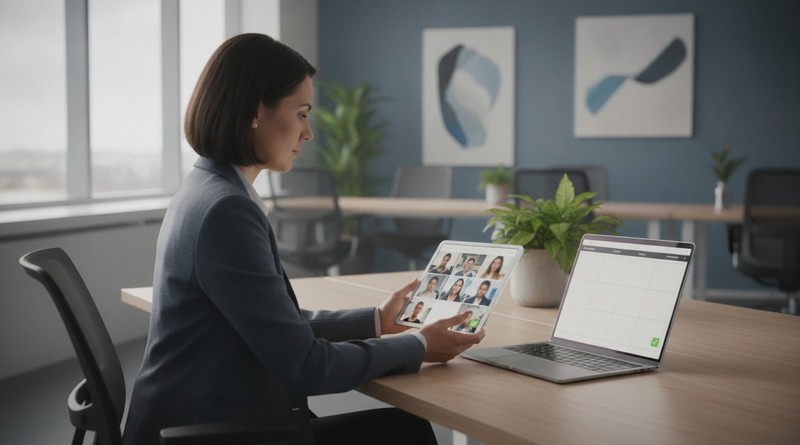
A one-way video interview, also called an asynchronous video interview, lets candidates record answers to set questions on their own time so hiring teams can review them later. The modern version sends the step only to shortlisted candidates, draws questions from each resume, and writes ratings back to your ATS.
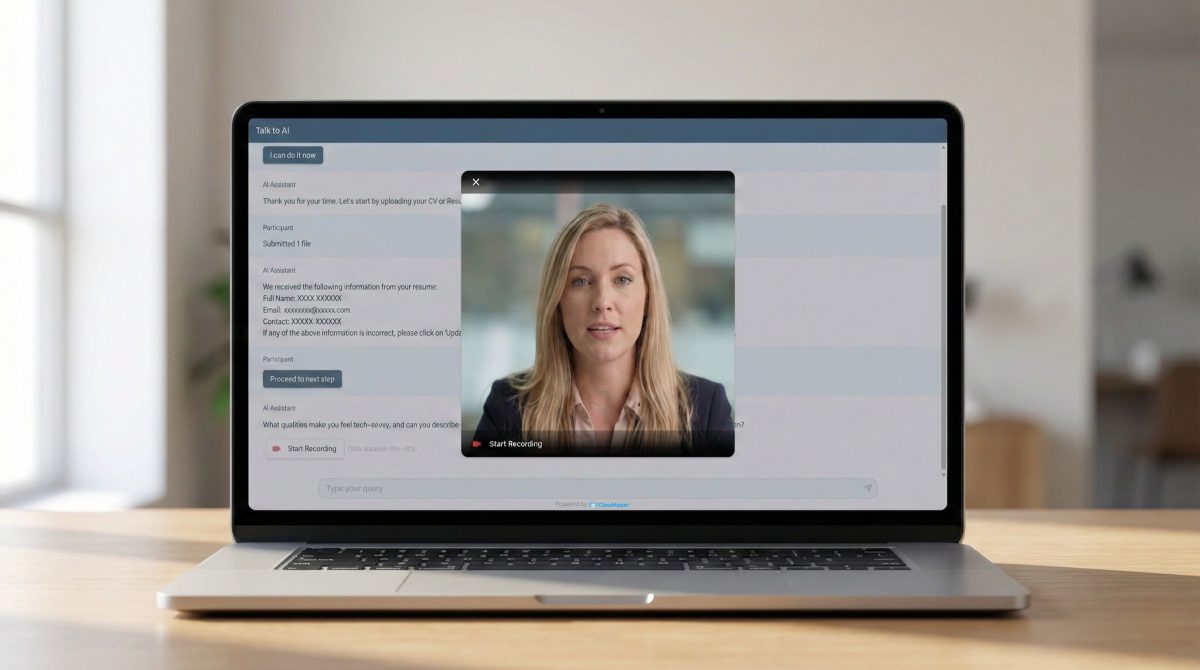
Table of Contents
- What is a one-way video interview?
- One-way or asynchronous video interview: is there a difference?
- Why asynchronous video interviews became standard
- Live versus asynchronous video interviews
- Where traditional one-way video interviews break down
- Candidate experience issues in one-way video interviews
- Why pool-wide screening backfires, and what shortlist-first changes
- Employer-side risk: interview fraud and AI cheating
- How AI evaluates video interview responses, with humans in control
- Conversational and chatbot-led video interviews
- Detecting cheating and discrepancies
- Trigger-based interview workflows
- One-way video interview software: what to look for
- One-way video interviews in your ATS
- How to run one-way video interviews the right way
- Are one-way video interviews fair to candidates?
- What changes when hiring teams close this gap
- Frequently asked questions
One-way video interviews were introduced to solve a scheduling problem. Recruiters posted a fixed set of questions, candidates answered on their own time, and hiring teams reviewed the responses whenever it suited them. No calendars to negotiate, no time zones to reconcile, no phone tag.
That worked. It also created a second problem nobody planned for, because most platforms sent the recording request to everyone who applied.

Meanwhile the thing you screen from has quietly stopped working. For thirty years hiring ran on an unspoken agreement that the resume is evidence. It was never great evidence, but the person applying wrote it, and that made it worth something. Roughly 65% of job seekers now use AI to write their applications. Applications per opening have climbed well past the 115 that was normal three years ago. The documents arriving in your requisition are better written, more closely matched to the job description, and less informative than anything recruiters have dealt with before.
So asynchronous hiring is not the thing that needs fixing. What needs fixing is who gets asked to record, what they get asked, and what happens to the answers afterward. This guide covers how one-way video interviews work, where they fail, how the software differs, and what shortlist-first video pre-screening changes.
What is a one-way video interview?
A one-way video interview is a recorded screening step. The employer sets the questions in advance, the candidate records video answers with no interviewer present, and the hiring team reviews the responses asynchronously.
It replaces the phone screen, not the interview. A typical format runs two to six questions at thirty to ninety seconds each, and candidates record on a phone or laptop.
One-way or asynchronous video interview: is there a difference?
No. The terms describe the same thing from different angles.
- One-way video interview describes the format. Only one side is present.
- Asynchronous video interview describes the timing. The two sides participate at different moments.
- On-demand interview, async video interview, and recorded interview are also used interchangeably.
- Video pre-screening is narrower. It means an asynchronous video step placed deliberately after shortlisting rather than in front of the whole applicant pool. That distinction turns out to matter more than the label.
Why asynchronous video interviews became standard
Three pressures pushed them into the mainstream, and all three are still increasing.
Volume. Hourly, frontline, seasonal, and high-turnover roles pull hundreds of applications per requisition. Resumes for these roles look nearly identical, so resume review sorts poorly. Something with more signal has to sit between application and interview.
Scheduling cost. The phone screen is the most expensive low-value step in hiring. Thirty minutes of recruiter time per candidate, multiplied by a pipeline, spent largely on information a recorded answer conveys in ninety seconds.
Drop-off. The stretch between “we like your resume” and “you are on the calendar” is the longest silence in most hiring processes, and it is where candidates disappear. Every scheduling round you remove is a drop-off point you remove.
Adoption estimates vary by source and by industry, and figures in the range of 70% of mid-to-large organizations using some form of asynchronous interviewing are commonly cited. Treat that as directional rather than precise.
Live versus asynchronous video interviews
Both have a place. The mistake is using one where the other belongs.
| Live video interview | Asynchronous video interview | |
|---|---|---|
| Scheduling required | Yes | No |
| Recruiter time per candidate | 30 to 60 minutes | 2 to 4 minutes of review |
| Candidate can ask questions | Yes | No |
| Reviewable afterward | Notes only | Full recording and transcript |
| Multiple reviewers | Panel, or repeated calls | Same recording, shared scorecard |
| Consistency across candidates | Varies with interviewer | Identical questions, identical conditions |
| Right stage | Interview and final rounds | Screening, replacing the phone screen |
Asynchronous is a screening tool. Live is an interviewing tool. Trying to make asynchronous carry the whole decision is the root of most complaints about it.
Where traditional one-way video interviews break down
The format has a reputation problem, and it is earned. Three failures account for most of it.
Everyone gets invited. Post a role, collect 240 applications, and 240 people receive a recording assignment. The invitation reads as a filter rather than as interest.
The questions are generic. One template per requisition means every candidate answers the same five questions, none of which touch what their specific resume claims.
The answers go nowhere useful. Recordings pile up in a separate tool, nobody watches them all, and the outcome never makes it cleanly back to the applicant record.
Candidate experience issues in one-way video interviews
Candidates dislike the format for reasons worth taking seriously rather than dismissing.
Recording into a camera with no human response is genuinely uncomfortable, and discomfort is not a hiring signal. There is no chance to ask a clarifying question. A single take with no retake punishes nerves rather than measuring ability. And when the whole pool gets invited, candidates correctly read the step as a mass filter and behave accordingly.
The evidence backs them up. Gartner found that only 26% of candidates trust AI to evaluate them fairly, and 62% said they are more likely to apply when a role involves real human interaction. Those numbers are not an argument against recorded interviews. They are an argument against sending them to everyone.
Why pool-wide screening backfires, and what shortlist-first changes
Almost every complaint above traces back to one design decision: who gets asked.
Video pre-screening inverts the sequence. You shortlist first, using resume review, knockout questions, and whatever criteria the requisition already applies. Only the qualified candidates you selected get the video step.
That single change fixes most of the format’s problems at once.
The invitation signals interest. Candidates who receive it have already cleared your review. Telling them so changes how they approach the recording, and completion rates rise accordingly.
Questions can be specific. When the list is short, questions can come from each candidate’s own resume and the role rather than from a global template. If a resume claims six years running a crew of thirty, the question asks about that. A generic template cannot verify a specific claim. A resume-derived question can.
Reviewers see a curated set. Twenty considered responses get watched properly. Two hundred do not.
Verification moves earlier and gets cheaper. A meaningful share of HR teams have responded to AI-written applications by adding an interview round whose only purpose is confirming what the resume says. That spends the most expensive resource in hiring on verification work. Doing it at the screening stage costs minutes instead of hours.
The four steps in practice:
- Shortlist first. Work from your applicant list and advance the people worth hearing from. The whole pool never sees the video step.
- Ask what matters. Questions are drafted from each candidate’s resume and the role, so the answers speak to their actual claims.
- Candidates record on their phone. They get an SMS and an email with a link, open it, and record when it suits them. No app, no account, no scheduling.
- Your team watches and decides. Reviewers watch, rate on a shared scorecard, and interview only the people worth meeting. Every answer comes with a transcript and a summary.
See who’s worth interviewing, before the interview
Watch the walkthrough: how candidates get shortlisted, how questions are drawn from each resume, how candidates record on their phone, and how ratings land back on the applicant record.
Employer-side risk: interview fraud and AI cheating
Candidates are not the only ones with a trust problem. The employer side has grown sharply.
Gartner projects that by 2028, one in four candidate profiles worldwide could be fake. In a Gartner survey of 3,000 candidates, 6% admitted to interview fraud by impersonating someone or having another person pose as them, and 13% reported using generative AI during interviews, rising to 18% in Asia-Pacific. Checkr found in 2025 that 35% of hiring managers had a virtual interview in which someone other than the listed applicant took part, and 31% had interviewed candidates later revealed to be using fake identities. Jamie Kohn, senior research director at Gartner, described the situation plainly: employers are finding it harder to evaluate candidates’ true abilities and, in some cases, their identities.
This is where asynchronous video earns its place rather than merely saving time. A recorded answer to a resume-derived question, tied to a specific applicant record, is a reviewable artifact you can compare against a later live conversation. Inconsistencies surface fast.
What it is not is formal identity verification. For roles where the risk justifies it, pair it with background checks and identity verification.
How AI evaluates video interview responses, with humans in control
The useful division of labor is narrow and worth stating precisely.
What automation should do: transcribe every answer, summarize it, surface the parts that address the question asked, flag inconsistencies against the resume, and organize responses so a reviewer moves through twenty candidates in the time one phone screen takes.
What automation should not do: decide. Not who advances, not who is rejected, not a score that functions as a decision by another name.
The reason is partly ethical and partly practical. Candidates already distrust automated evaluation, and a documented human decision is what makes a hiring process defensible when someone asks how a candidate was assessed. Automation that organizes evidence makes recruiters faster. Automation that replaces judgment makes them liable.
This is the same line that separates a useful AI recruiter from an automated gatekeeper.
A shared scorecard is the mechanism that keeps this honest. Multiple reviewers rate against the same criteria, disagreement surfaces instead of hiding, and you end up with a consistent, documented basis for advancing someone.
Conversational and chatbot-led video interviews
A static recording form is the first generation. A conversational interface is the second.
Instead of presenting five fixed questions and a record button, a chatbot-led interview greets the candidate, explains what is coming, asks one question at a time, and follows up based on what the candidate actually said. A vague answer about team size gets a follow-up about team size. A strong answer moves on.
This matters for two reasons. Candidates report it feeling markedly less cold than recording into a void, which lifts completion. And adaptive follow-up produces better evidence, because the interesting information in any screening conversation usually lives in the second question, not the first.
Detecting cheating and discrepancies
Practical signals worth having, none of which should auto-reject anyone:
- Resume-to-answer mismatch. The candidate’s spoken account of a role differs materially from the written one.
- Answer-pattern anomalies. Responses that read as scripted or recited rather than spoken.
- Environment and session irregularities. Multiple abandoned sessions, or a recording environment inconsistent with the stated situation.
- Cross-stage inconsistency. The recorded answers and the live interview tell different stories.
Every one of these is a prompt for a human to look more closely. None is a verdict.
Trigger-based interview workflows
Asynchronous hiring becomes genuinely intelligent when the video step fires from a status change rather than from a recruiter remembering to send it.
A candidate reaches “screened” and the invitation goes out automatically. A candidate completes the recording and the record advances, with the transcript, summary, and ratings attached. A candidate who has not recorded after three days gets one reminder, then the requisition owner gets a nudge. A candidate who clears review lands in the scheduling queue already qualified.
The payoff is not the automation itself. It is that nothing waits on someone noticing.
One-way video interview software: what to look for
Most one-way video interview platforms differ less in features than in the assumption they are built on. Three models dominate, and the one you pick determines your completion rate before you configure anything.
| Approach | Who gets invited | Question design | Best fit |
|---|---|---|---|
| Pool-wide static recording | Every applicant | One fixed template per requisition | Low applicant volume, or roles with little competition for talent |
| Shortlist-first video pre-screening | Only candidates you advance | Drawn from each candidate’s resume and the role | High-volume hourly and frontline hiring, and any role where resume claims need checking |
| Conversational or chatbot-led | Configurable, often status-triggered | Adaptive, follows up based on answers | Teams that want follow-up probing without a live interviewer |
Whichever model you evaluate, these questions separate software that saves time from software that relocates it:
- Does it shortlist first, or invite the whole pool?
- Are questions generated per candidate, or is there one global template?
- Do candidates record in a browser on a phone, with no app and no account?
- Do results, ratings, and recordings write back to your ATS or HCM applicant record, or do they live in a second system you have to reconcile?
- Is there a shared scorecard, so reviewers rate against the same criteria?
- Is blind review available, so hiring managers can rate answers without seeing names and photos?
- Does every answer arrive with a transcript and summary, so review is genuinely batched?
- Are candidate consent capture, access control, and audit logging on by default?
- Is a retake allowed, and is an alternative format available on request?
- Does it work across the systems you actually run?
That fourth question is the one most evaluations skip and most regret. A video tool that does not close the loop back into the applicant record creates a reconciliation job that consumes the time the tool saved.
One-way video interviews in your ATS
Your ATS is the system of record. It holds the requisition, the applicant record, the status history, the approvals, and the offer. That is what it is built for and it does it reliably.
What no system of record is built to do is judge. Forming a confident opinion about a stranger before spending an hour with them has always been human work, performed with whatever evidence was available. When the evidence degrades, the record cannot compensate. It will faithfully store a thousand AI-polished applications and tell you nothing about which twenty are real.
So the video step sits alongside the ATS rather than inside it, and the result returns to the record.
| What it holds | Where it lives |
|---|---|
| Requisition, applicant record, status history, approvals, offer | Your ATS or HCM |
| Questions, recordings, scorecards, transcripts, ratings | The video pre-screening layer alongside it |
| Final outcome and audit trail | Written back to the ATS |
CloudApper’s video pre-screening connects to UKG, Workday, Dayforce, Oracle, SAP, iCIMS, Infor, BambooHR, PayCore, and Greenhouse. If your ATS is not on that list, the pattern still applies, and the question to ask any vendor is whether they can write outcomes back at the API level rather than exporting a CSV you re-import by hand.
How to run one-way video interviews the right way
- Shortlist before you invite. This is the single highest-impact decision.
- Keep it under eight minutes. Two to four questions. Longer formats raise abandonment without adding signal.
- Tell candidates what to expect. Number of questions, time per answer, whether retakes are allowed, and who will watch. Surprise is what makes the format feel adversarial.
- Draw questions from the resume. Generic questions produce generic answers.
- Allow one retake. Nerves are not a hiring signal.
- Use a shared scorecard. Same criteria, multiple reviewers, documented basis.
- Turn on blind review for manager review. Rate the answer, not the applicant.
- Keep a human on the decision, and say so.
- Offer an alternative on request. A candidate without reliable video access, or with a disability that makes recording difficult, should be able to ask for a phone screen.
- Close the loop into the applicant record. One system, one history, one audit trail.
Are one-way video interviews fair to candidates?
They can be, and fairness is a set of design decisions rather than a disclaimer.
Ask every candidate for a given requisition the same core questions. Keep a documented human decision. Capture consent, control access, and log who reviewed what and when. Offer an alternative format. And invite only the people you have already advanced, which is the factor that most changes how the step is received.
There is also a compliance dimension that is easy to miss. Recorded interviews are hiring records, and several jurisdictions regulate AI-assisted video interviews specifically. Illinois passed the Artificial Intelligence Video Interview Act, which requires notice, an explanation of how the system evaluates candidates, and consent before use. Maryland restricts facial recognition in interviews. New York City regulates automated employment decision tools. Confirm the rules where you hire and check with your own counsel before rollout.
Hear the real person before you book the interview
Shortlist first. Questions drawn from each resume. Candidates record on their phone. Ratings and transcripts land back on the applicant record.
What changes when hiring teams close this gap
The measurable part is straightforward. Interview calendars fill with people someone has already heard from. The verification round disappears because verification happened earlier and cheaper. Time to fill compresses at the stage where it was leaking.
The part that matters more is harder to tabulate. Recruiters stop performing triage on documents they cannot trust and go back to recruiting, which is the work they were hired for and the work they are good at. Hiring managers stop screening and start interviewing. And candidates who are real and qualified and currently getting lost behind better-optimized applications get heard by a person instead of filtered by a keyword match.
That last group is who this is ultimately for. Every hourly worker hired faster is a household that stops waiting. Every school district, hospital, plant, and hotel that fills roles in days instead of weeks is an institution serving the people who depend on it better. Hiring speed is not an HR metric. It is the rate at which organizations can do what they exist to do.
CloudApper is the process layer that closes the gaps enterprise software cannot, across HR, ERP, CRM, and beyond, on any platform, in weeks not quarters. Because the organizations that move fastest aren’t the ones with the biggest budgets or the best vendors. They’re the ones that stopped waiting for permission to close the gap.
Frequently asked questions
What is a one-way video interview?
A one-way video interview is a recorded screening step. The employer sets the questions, the candidate records answers with no interviewer present, and the hiring team reviews the responses on their own schedule. It replaces the phone screen rather than the interview.
What is an asynchronous video interview?
It is the same thing. “One-way” describes the format and “asynchronous” describes the timing. On-demand interview, async video interview, and recorded interview all refer to the same step.
What is the difference between a one-way video interview and video pre-screening?
Video pre-screening is a one-way video interview sent only to candidates you have already shortlisted. The recording mechanics are identical. The difference is sequence, and it drives most of the difference in completion rate and candidate reception.
How long should a one-way video interview be?
Keep the whole exercise under eight minutes. Two to four questions at thirty to ninety seconds each works well for hourly and frontline roles.
Which one-way video interview software should high-volume employers choose?
Prioritize four things: it invites only shortlisted candidates, it generates questions from each candidate’s resume rather than one template, candidates record in a browser with no app or account, and results write back to your existing ATS or HCM record. Tools that miss the last one create a second system to reconcile.
Do one-way video interview platforms integrate with my ATS?
Many do, and the depth varies widely. Ask specifically whether outcomes, ratings, and recordings write back to the applicant record through an API, or whether you export and re-import by hand. CloudApper connects to UKG, Workday, Dayforce, Oracle, SAP, iCIMS, Infor, BambooHR, PayCore, and Greenhouse.
Do candidates abandon one-way video interviews?
Some do, and setup drives the rate. Inviting only shortlisted candidates, explaining what to expect, keeping the question set short, recording in a browser with no install, and allowing one retake all raise completion. Pool-wide, app-gated, no-retake formats drive the highest abandonment.
Are one-way video interviews bad for candidate experience?
Pool-wide ones often are. Candidates read a mass recording request as a filter, and only 26% trust AI to evaluate them fairly. Shortlist-first changes the read, because the invitation follows a decision to advance them.
Can AI score video interview responses?
AI can transcribe, summarize, surface the parts that answer the question, and flag inconsistencies against the resume. Keep the advance-or-reject decision with a person. That is both more defensible and, in practice, more accurate.
Can one-way video interviews detect cheating or fake candidates?
They surface useful signals: resume-to-answer mismatches, scripted-sounding responses, session irregularities, and inconsistencies between the recording and a later live interview. Treat each as a prompt to look closer, not as a verdict, and pair the step with background checks and identity verification for higher-risk roles.
Do one-way video interviews create legal risk?
Recorded interviews are hiring records. Ask every candidate for a requisition the same core questions, keep a human in the decision, document retention and access controls, offer an alternative format on request, and confirm notice and consent rules where you hire. Illinois, Maryland, and New York City all regulate aspects of AI-assisted interviewing.
When should you use a live interview instead?
Once the field is narrow. Asynchronous video is a screening tool that replaces the phone screen. Live interviews are for the decision, where the candidate needs to ask questions too.
Do one-way video interviews work for hourly and frontline hiring?
They work best there. Hourly applicants are hard to reach by phone during a shift and their resumes look nearly identical, so the phone screen is both the bottleneck and the weakest signal.
Can hiring managers review candidates without seeing names or photos?
Yes. Blind review hides names and photos during review, so managers rate the substance of the answers rather than the applicant.
How many questions should a one-way video interview include?
Two to four for screening. Draw them from the candidate’s resume and the role rather than reusing one global set, since specific questions produce answers you can actually verify.

What is CloudApper AI Platform?
CloudApper AI is an advanced platform that enables organizations to integrate AI into their existing enterprise systems effortlessly, without the need for technical expertise, costly development, or upgrading the underlying infrastructure. By transforming legacy systems into AI-capable solutions, CloudApper allows companies to harness the power of Generative AI quickly and efficiently. This approach has been successfully implemented with leading systems like UKG, Workday, Oracle, Paradox, Amazon AWS Bedrock and can be applied across various industries, helping businesses enhance productivity, automate processes, and gain deeper insights without the usual complexities. With CloudApper AI, you can start experiencing the transformative benefits of AI today. Learn More
- Useful Links:
- Agentic AI
- No-Code/Low-Code
- Custom Software
- HCM Personalization
- iPaaS
- FedRAMP
CloudApper AI Solutions for HR
- Works with








- and more.
Similar Posts
Recording Candidate Video Interviews in Illinois: Consent, Retention, and Deletion…

Replace 30-Minute Phone Screens With 10-Minute Video Reviews: The Recruiter…