Project margins are only as accurate as the labor data behind them. When hours land against the right task, work order, and project as work happens, Oracle project cost tracking reflects reality instead of estimates — and finance and operations leaders can protect margin before it erodes.

Table of Contents
- Why accurate project cost tracking has become a margin issue
- How Oracle Project Costing tracks labor today
- Where the accuracy gap opens
- Extending Oracle to capture the work as it happens
The organizations that consistently protect project margin have one thing in common: the numbers they act on match the work that actually happened. Their project P&L isn’t a best guess reconciled weeks later — it’s a live reflection of where labor went, task by task, as the work unfolded. For finance and operations leaders, that accuracy isn’t a reporting nicety. It’s the difference between steering a project while there’s still time to correct course and discovering the margin damage after it’s done.

Featured answer: Oracle project cost tracking is the process of capturing, costing, and allocating project labor and expenses to the correct project and task in Oracle Project Costing. Its accuracy depends on hours landing against the right task, work order, and expenditure type at the source. When capture happens in real time at the point of work, margins reflect reality rather than after-the-fact estimates.
Why accurate project cost tracking has become a margin issue
Project-based organizations — in construction, professional services, manufacturing, and field operations — increasingly compete on margin discipline rather than volume. Labor is usually the largest and most variable cost on any project, which makes labor allocation the single biggest lever on project profitability. When that allocation is precise, leaders can see which tasks are running hot, reprice change orders with confidence, and forecast the rest of the portfolio on solid ground.
The pressure to get this right has intensified. Buyers expect tighter bids, finance teams are asked to forecast with less slack, and operations leaders are accountable for margin at the task level, not just the project level. In that environment, the quality of the labor data flowing into your project cost tracking becomes a strategic asset — because every decision downstream inherits its accuracy or its errors.
How Oracle Project Costing tracks labor today
Oracle Fusion Project Costing provides a robust, well-structured foundation for capturing project cost. Employees and contingent workers report project-related time in Oracle Time and Labor, selecting the project, task, and expenditure type their hours apply to. Project accountants and project managers then import those time cards into Project Costing, where each entry becomes an expenditure item carrying a unit quantity and cost amounts.
From there, Oracle applies the organization’s labor costing rules and rate schedules — maintained by job or by employee — to calculate raw and burden cost for every expenditure item. All labor costs, including overtime premiums, are charged to the project and task indicated on the time card. Project accountants and managers can review and adjust time cards in Project Costing after import, and the integration keeps Time and Labor and Project Costing aligned so that revised entries flow through to costing, accounting, and billing.
It’s a capable model. The accuracy of everything it produces, however, rests on one upstream assumption: that the project, task, and expenditure type recorded against each hour were correct at the moment the work happened.
Where the accuracy gap opens
In practice, that upstream assumption is where many organizations lose ground. Frontline and field workers often record time at the end of a shift, a day, or a week — reconstructing from memory which project and task each hour belonged to. On a job where crews move between work orders, tasks split and merge, and scope shifts mid-shift, that reconstruction drifts from what actually occurred.
The result is labor that lands against the wrong task, gets bucketed into a catch-all, or arrives too late to inform a decision. None of it is visible as an error. It flows cleanly through costing rules into a polished project P&L. And that is precisely why it’s so costly: the margin erosion is quiet. By the time a variance surfaces in a month-end review, the work is finished, the change order is unbilled, and the opportunity to act has passed. The system did exactly what it was told — it was simply told the wrong thing at the source.
Extending Oracle to capture the work as it happens
This is where organizations add an operational layer between the work and the system of record. hrPad AI Powered Tablet/iPad For Oracle , CloudApper’s frontline capture platform, is a tablet-based kiosk and mobile experience that captures job, work-order, and project changes at the point of work — the moment they happen, from the people doing the work.
Instead of asking employees to reconstruct their week, hrPad lets them clock into the correct project, task, or work order in real time, switch assignments as the job changes, and confirm allocation with a tap on a shared kiosk or their own device. Because the capture happens at the source, the labor data flowing into Oracle Time and Labor and Project Costing already reflects reality — so the costing rules Oracle applies are working from accurate inputs rather than approximations.
hrPad is designed to work alongside your existing Oracle investment, not replace any part of it. Oracle remains the system of record for costing, accounting, and billing. hrPad adds the frontline layer that makes sure the hours arriving there are attributed correctly the first time, through capabilities organizations commonly rely on:
- Real-time clock-in against the correct project, task, or work order
- Fast reassignment when crews or scope shift mid-shift
- Kiosk and mobile capture that meets frontline and field workers where they are
- Validation at the point of entry to reduce miscoded time before it’s submitted
- Clean, structured labor data that flows into Oracle Time and Labor and Project Costing
What accurate capture makes possible
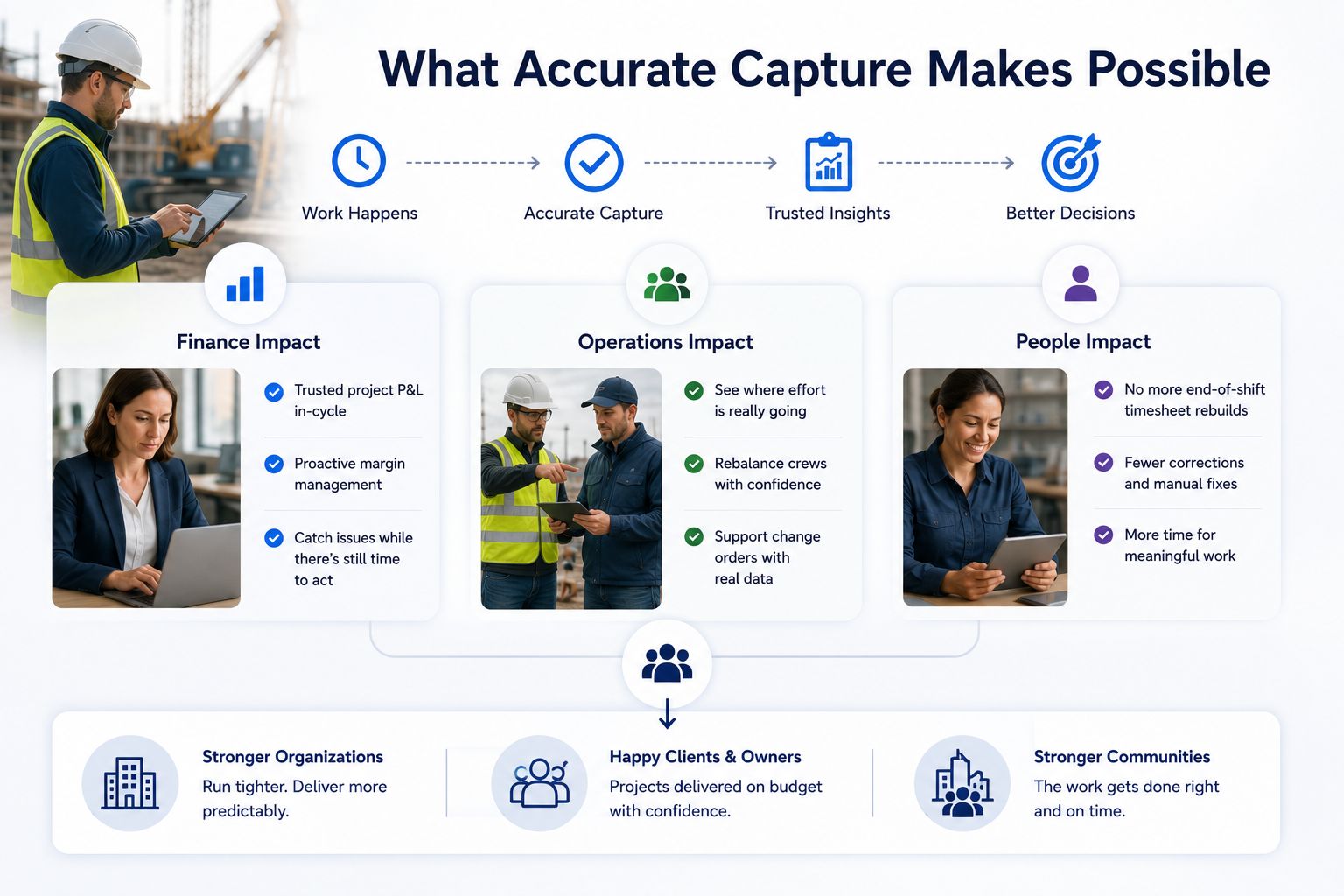
When labor lands against the right task as the work happens, the impact reaches well beyond cleaner reports. Finance leaders gain a project P&L they can trust in-cycle, which means margin conversations move from forensic to proactive — catching a task running over while there’s still room to respond. Operations leaders get visibility into where effort is actually going, so they can rebalance crews, defend change orders with real data, and forecast the rest of the portfolio with confidence.
The teams doing the work feel it too. Frontline and field employees stop spending the end of every shift reconstructing timesheets, and project accountants stop chasing corrections after import. Hours that once went into cleanup go back into the work that matters. And the organizations served by these projects — the clients, the owners, the communities relying on the work getting delivered on budget — benefit from institutions that run tighter and deliver more predictably.
Frequently asked questions
What is Oracle project cost tracking?
Oracle project cost tracking is the process of capturing, costing, and allocating project labor and expenses to the correct project and task within Oracle Project Costing. Labor typically originates as time cards in Oracle Time and Labor, which are imported into Project Costing and costed using labor costing rules and rate schedules to produce raw and burden cost.
Why are my Oracle project margins inaccurate even though the system is configured correctly?
Oracle applies costing rules faithfully to whatever data it receives. If hours are recorded against the wrong project, task, or expenditure type at the source — often because time is entered from memory after the fact — those errors flow cleanly into an accurate-looking P&L. The gap is usually in how labor is captured upstream, not in the costing configuration itself.
How does Oracle Time and Labor connect to Project Costing?
Employees select a project, task, and expenditure type when reporting time in Oracle Time and Labor. Project accountants and managers import those time cards into Project Costing, where each becomes an expenditure item. Costing rules and rate schedules then calculate the labor cost, and revised time cards flow through the integration to keep the two systems aligned.
Does hrPad replace Oracle Project Costing or Oracle Time and Labor?
No. hrPad works alongside Oracle as an additional operational layer. Oracle remains the system of record for costing, accounting, and billing. hrPad captures accurate job, work-order, and project data at the point of work so the labor arriving in Oracle is attributed correctly from the start.
How does capturing labor at the point of work improve cost accuracy?
Point-of-work capture records the correct project, task, or work order as the work happens, rather than relying on end-of-week reconstruction. This reduces miscoded and misallocated hours before they enter the system, so Oracle’s costing rules operate on accurate inputs and the resulting project P&L reflects reality.
Which teams benefit most from real-time project cost tracking?
Finance leaders gain a project P&L they can trust in-cycle for margin management and forecasting. Operations leaders get task-level visibility to rebalance labor and defend change orders. Frontline and field workers spend less time reconstructing timesheets, and project accountants spend less time correcting entries after import.
Conclusion
Project margin isn’t lost in a single dramatic moment. It erodes quietly, one misattributed hour at a time, hidden inside reports that look correct. Oracle Project Costing gives finance and operations leaders a powerful engine for turning labor into cost — and that engine performs best when the data feeding it reflects the work as it actually happened.
Capturing job, work-order, and project changes at the point of work closes the gap between what teams do and what the system records. It’s the difference between managing margin in real time and explaining it after the fact. This is workforce automation working the way it should: the system of record holds the numbers, the frontline layer makes sure those numbers are true, and the organizations that connect the two stop waiting for month-end to find out where their margin went.
Want to see how hrPad captures frontline labor at the source and feeds accurate data into your Oracle project cost tracking? Explore hrPad for Oracle.
What is CloudApper AI Platform?
CloudApper AI is an advanced platform that enables organizations to integrate AI into their existing enterprise systems effortlessly, without the need for technical expertise, costly development, or upgrading the underlying infrastructure. By transforming legacy systems into AI-capable solutions, CloudApper allows companies to harness the power of Generative AI quickly and efficiently. This approach has been successfully implemented with leading systems like UKG, Workday, Oracle, Paradox, Amazon AWS Bedrock and can be applied across various industries, helping businesses enhance productivity, automate processes, and gain deeper insights without the usual complexities. With CloudApper AI, you can start experiencing the transformative benefits of AI today. Learn More
- Useful Links:
- Agentic AI
- No-Code/Low-Code
- Custom Software
- HCM Personalization
- iPaaS
- FedRAMP

Brochure
CloudApper hrPad
Empower Frontline Employees with an AI-Powered Tablet/iPad Solution
Download Brochure
CloudApper AI Solutions for HR



- Works with








- and more.
Similar Posts

FAQs: Preventing Time Theft in Oracle PeopleSoft with CloudApper’s AI…

How Oracle Users in the Logistics Industry Can Avoid Compliance…