A 30-minute phone screen costs the same 30 minutes whether the candidate is a fit or not. This piece walks through the math behind reducing phone screening hours with a 10-minute video review instead, and where those recovered hours actually go.

Table of Contents
Your recruiter can’t tell in advance which phone screens will wrap in five minutes and which will run the full half hour. So every screen still gets booked as a 30-minute block, just in case. Even when a call ends in ten minutes, that block stays locked on the calendar, since the next call isn’t scheduled to start until it’s over. Multiply that across a high-volume hiring week, and reducing phone screening hours stops being a nice-to-have. It becomes the difference between a manageable calendar and one that’s booked solid with 30-minute blocks that didn’t need to be that long. Swap the call for a 10-minute video review instead, and the same batch of screens costs your recruiter a fraction of that time, without cutting a single question from the evaluation. CloudApper’s Candidate Video Pre-Screening solution is built around exactly that swap.
TL;DR
- Every phone screen gets booked as a fixed 30-minute block, whether the call itself needs that long or not.
- A 10-minute video review covers the same evaluation without locking in the full block.
- Recorded answers, transcripts, and summaries replace the live call, not your recruiter’s judgment.
- Reviewing a recording instead of sitting through a call lets your recruiter move through candidates faster.
- The hours your recruiter gets back go toward sourcing, follow-up, and closing, not more screening.
Why Phone Screens Cost More Time Than They Look Like They Do
A phone screen’s actual length varies. Some candidates are an obvious no within a few minutes. Others are worth digging into for the full half hour. The problem is your recruiter can’t know which is which before the call starts, so every screen gets booked at the same 30-minute default. If your team books phone screens in advance, often through self-scheduling tools tied to the ATS, that default block comes with its own coordination overhead too: finding a time that works for both sides, sending the confirmation, and handling the reschedules that come with any calendar-based process. A phone screen alternative that skips the call itself skips that coordination as well.
The Math on Reducing Phone Screening Hours: 30-Minute Calls vs 10-Minute Reviews
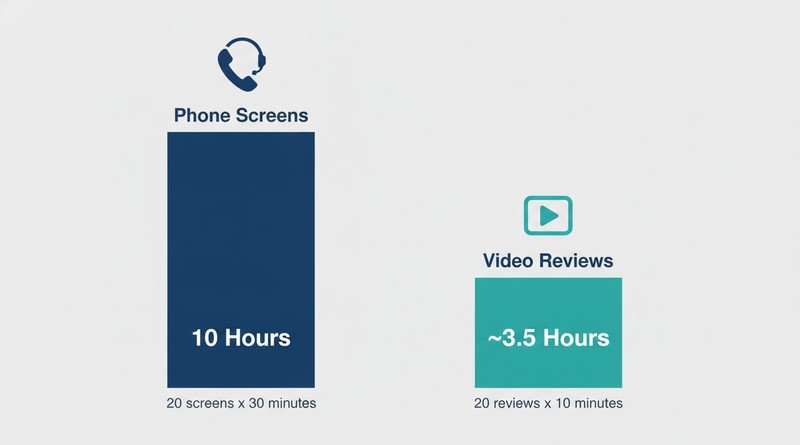
Here’s a simple way to see it. Say your team books 20 phone screens in a week, each scheduled as a 30-minute block. That’s 10 hours committed on the calendar before a single candidate reaches a hiring manager, whether individual calls run short or long. Now run the same 20 candidates through a 10-minute video review instead, since your recruiter is scanning a recorded answer, a transcript, or a summary rather than sitting through a scheduled call. That’s a little over 3 hours of candidate video review time for the same 20 candidates, freeing up close to 7 hours in a single week. If your team also books phone screens in advance, add back whatever time goes into scheduling and rescheduling those calls, since video pre-screening removes that step too. That’s the video pre-screening ROI in plain hours, not just a percentage on a slide.

What Changes When Recruiters Review Instead of Call
Candidates record their answers on their own phone, on their own time, instead of your recruiter conducting a live call. Your recruiter gets the recording along with a transcript and a summary, so they’re scanning for the answer that actually matters instead of sitting through a full conversation start to finish. CloudApper’s Candidate Video Pre-Screening solution runs this review on your recruiter’s own schedule, not on a booked call slot, which is a meaningful part of cutting phone screening time down in the first place. Reviewing a recording takes a fraction of the time a live call would, so your recruiter gets through the full list faster and reaches the candidates worth a real conversation sooner, the same problem the piece on wasted interview slots covers at the next stage of the funnel.
What Happens After You Start Reducing Phone Screening Hours
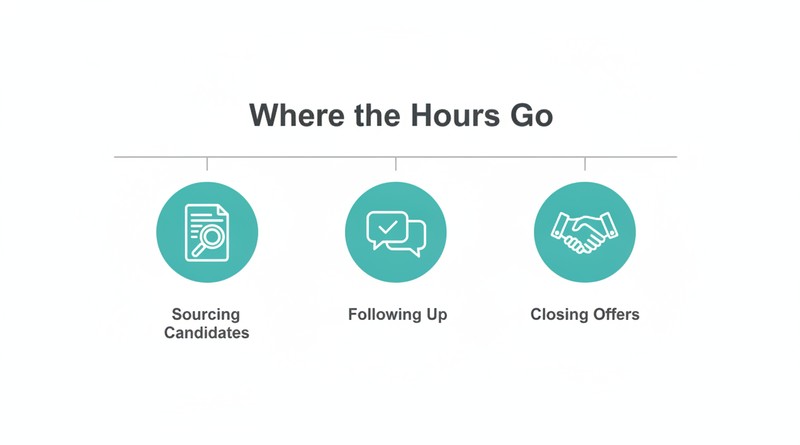
Those recruiter hours don’t just disappear, they go somewhere. Recruiters get more time to source candidates, follow up with people already in the pipeline before they go cold, or actually close offers instead of letting them sit. Those are exactly the tasks that get squeezed out when phone screens eat the calendar first. Reducing phone screening hours doesn’t lower the bar on who gets hired, it just moves the same evaluation into less time.
This isn’t about screening less, it’s about not spending a full 30-minute slot to learn what a 10-minute review would have told you just as clearly. CloudApper’s Candidate Video Pre-Screening solution moves that evaluation into a format your recruiters can review on their own time, without adding a new system to manage. It runs alongside the same ATS your recruiters already log into every day.
Contact us to see what reducing phone screening hours would look like for your team.

What is CloudApper AI Platform?
CloudApper AI is an advanced platform that enables organizations to integrate AI into their existing enterprise systems effortlessly, without the need for technical expertise, costly development, or upgrading the underlying infrastructure. By transforming legacy systems into AI-capable solutions, CloudApper allows companies to harness the power of Generative AI quickly and efficiently. This approach has been successfully implemented with leading systems like UKG, Workday, Oracle, Paradox, Amazon AWS Bedrock and can be applied across various industries, helping businesses enhance productivity, automate processes, and gain deeper insights without the usual complexities. With CloudApper AI, you can start experiencing the transformative benefits of AI today. Learn More
- Useful Links:
- Agentic AI
- No-Code/Low-Code
- Custom Software
- HCM Personalization
- iPaaS
- FedRAMP
CloudApper AI Solutions for HR

- Works with








- and more.
Similar Posts

How to Stop Losing Interview Slots to Unfit Candidates with…
Adding Automated Video Pre-Screening to Your Hiring Process Without a…