Personalized emails can boost revenue by up to 760%. Scaling this for thousands of contacts is challenging without tech. No-code AI agents simplify hyper-personalized email marketing, enhancing engagement and sales. Discover how tools like CloudApper AI Outreach Agent optimize personalized email marketing success.


TL;DR
- Boost your revenue by up to 760% with hyper-personalized email marketing using a no-code AI agent.
- Personalized emails increase engagement and customer satisfaction, driving loyalty and repeat sales.
- Implement AI-driven email marketing effortlessly—no coding required, just integrate with your CRM for seamless data access.
- Utilize tools like CloudApper AI Outreach Agent for easy campaign creation and real-time analytics.
- AI automates and scales your email marketing, handling thousands of personalized emails efficiently.
- Stay compliant with privacy regulations while leveraging AI for data-driven marketing strategies.
- Adopt AI tools now to gain a competitive edge and prepare for future trends in personalized marketing.
- Ready to transform your email marketing strategy? Contact us to learn more about implementing AI solutions.
Table of Contents
Did you know personalized emails can boost revenue by up to 760 percent compared to generic ones? Businesses everywhere chase that edge, but scaling personalization for thousands of contacts often feels impossible without a tech army. Enter no-code AI agent—they flip the script, making hyper-personalized email marketing simple and effective for any team. This approach transforms how companies connect, driving higher engagement and sales. Let’s dive into how you can achieve this with tools like CloudApper AI Outreach Agent, all while optimizing for personalized email marketing success.
What Is Personalized Email Marketing and Why It Matters
Personalized email marketing tailors messages to fit each recipient’s unique needs and behaviors. For example, it uses data like past purchases or browsing history to craft content that resonates. Companies adopt this strategy because it builds stronger connections. Therefore, engagement skyrockets—open rates often jump 50 percent or more. However, many struggle with the basics, like gathering data without invading privacy. In fact, regulations such as GDPR demand ethical handling, so smart tools become essential. Businesses that master this see customer satisfaction rise by 20 percent, according to recent studies. Moreover, it drives loyalty; recipients feel valued when emails address their specific pain points. For instance, a retailer might send product recommendations based on previous buys, leading to repeat visits. As a result, revenue grows steadily. Yet, without the right tech, personalization stays limited to small groups. That’s where AI steps in, automating the process for large volumes. Consequently, even small teams handle thousands of tailored emails effortlessly. This shift matters because generic blasts waste time and money—personalized ones convert better every time.
How to Implement Personalized Email Marketing with AI
You start by choosing a no-code AI agent that integrates seamlessly with your existing systems. For example, connect it to your CRM for instant data access. The agent analyzes behaviors, such as email opens or website clicks, and generates custom content. Therefore, each message feels handcrafted. However, setup takes minutes—no coding required. Simply input your audience details and let the AI build sequences. It predicts what works best, like timing sends for peak engagement. As a result, you avoid guesswork. Moreover, these tools adapt in real time; if someone ignores an email, the next one shifts focus. For instance, switch from product pitches to educational tips. This flexibility boosts results dramatically. Companies report click rates doubling after implementation. Furthermore, integration with sales platforms ensures emails align with the customer journey. You define rules easily, such as targeting tech pros with cloud-focused messages. Consequently, relevance soars. Yet, many overlook testing—always A/B test subject lines for optimal opens. In addition, track metrics like conversions to refine strategies. This method scales without limits, handling 10 or 10,000 contacts the same way. Therefore, personalized email marketing becomes accessible for all business sizes.
Best Tools for Personalized Email Marketing
CloudApper AI Outreach Agent leads the pack for no-code solutions. It offers drag-and-drop interfaces that simplify campaign creation. For example, select templates and add personalization rules. The AI handles natural language generation, creating emails that sound human. Therefore, recipients engage more. However, competitors exist, like other AI platforms with similar features. Yet, CloudApper stands out for its ethical data use and easy integrations. Businesses praise its speed—set up campaigns in under an hour. Moreover, it pulls from multiple sources, including social media insights, for deeper personalization. As a result, messages address current trends or challenges. For instance, reference industry news in emails to executives. This builds trust quickly. In addition, real-time analytics let you adjust on the fly. If a segment underperforms, tweak content instantly. Consequently, ROI improves. According to forecasts, 80 percent of marketing teams will use AI tools by 2025. Therefore, adopting now gives you an edge. Furthermore, cost savings add up—reduce team needs while increasing output. These tools democratize personalized email marketing, making it a must-have for growth.
Personalized Email Marketing Examples That Work
A SaaS company revamped its sales outreach using an AI agent. They segmented leads by industry and sent tailored sequences. For example, healthcare prospects got messages on data security, while retail ones focused on inventory. Open rates climbed from 15 percent to 45 percent. Therefore, conversions tripled. Another case: a retail brand personalized promotions based on purchase history. Repeat sales surged 60 percent. However, success hinges on data quality—clean lists yield better results. Moreover, test different approaches; one firm found shorter emails worked best for busy execs. As a result, engagement held steady. In addition, B2B providers targeted by company size, offering scaled solutions. This led to 70 percent higher responses. Consequently, pipelines filled faster. These examples show how personalized email marketing drives real gains. Yet, avoid over-personalization—it can feel creepy. Balance data use with value delivery. For instance, include helpful resources alongside pitches. Therefore, relationships strengthen over time.
Tips for Scaling Personalized Email Marketing
Focus on segmentation first—group audiences by demographics or behaviors. Then, let AI generate content for each. For example, use predictive analytics to time sends perfectly. This increases opens significantly. However, monitor privacy compliance to build trust. Moreover, automate follow-ups based on actions; if someone clicks, send more details. As a result, nurture leads effectively. In addition, integrate with other channels for a unified approach. Emails that reference website visits feel cohesive. Consequently, customer journeys smooth out. Yet, many forget mobile optimization—ensure emails look great on phones. Furthermore, use A/B testing regularly to optimize. Track what resonates and iterate. Therefore, performance improves continuously. Scaling means handling volume without quality dips. AI agents excel here, processing data swiftly via cloud tech. For instance, manage 10,000 emails as easily as 10. This capability transforms marketing efforts. Moreover, future trends include adding voice or sentiment analysis for even finer tuning. As a result, personalization deepens.
Benefits of AI in Personalized Email Marketing
AI cuts costs by automating tasks that once needed big teams. For example, it generates thousands of unique emails quickly. Therefore, efficiency rises. However, the real win is higher engagement—personalized content grabs attention. Recipients respond better to relevant messages. Moreover, conversions increase as emails guide buyers through funnels. In addition, data insights reveal what works, informing broader strategies. Consequently, marketing becomes data-driven. Yet, ethical AI use prevents issues like bias in personalization. Focus on transparency to maintain trust. Furthermore, scalability lets small businesses compete with giants. They achieve enterprise-level results without the overhead. As a result, growth accelerates. Industry reports show 30 percent retention boosts from AI emails. Therefore, long-term value soars. In a crowded market, standing out requires this edge. Personalized email marketing, powered by no-code AI, delivers it reliably.
Future Trends in Personalized Email Marketing
AI will incorporate more data sources, like social sentiment, for precise targeting. For example, adjust tones based on recent interactions. Therefore, relevance hits new highs. However, regulations will tighten, so compliant tools gain favor. Moreover, automation will extend to full customer lifecycles. From lead gen to retention, AI handles it all. As a result, efficiency peaks. In addition, predictive models will forecast behaviors accurately. This prevents churn by addressing issues early. Consequently, loyalty strengthens. Yet, human oversight remains key—review AI outputs for brand voice. Furthermore, integration with emerging tech, like VR demos in emails, could emerge. Therefore, innovation continues. By 2026, AI powers most interactions, per studies. Stay ahead by adopting no-code agents now. They make hyper-personalized email marketing at scale a reality for everyone.
Scale Revenue Without Hiring More People
Meet the AI Team Behind Your Revenue Growth
CloudApper’s AI Revenue Operations Team helps you scale without the cost and complexity of hiring.
Learn more | Download BrochureFrequently Asked Questions
What is personalized email marketing?
Personalized email marketing involves tailoring email messages to meet the unique needs and behaviors of each recipient. This can be achieved using data like past purchases, browsing history, and interaction patterns to craft content that resonates strongly with the individual. Companies use this strategy to build stronger connections, increase engagement, and boost sales. Learn more about the effectiveness of personalized campaigns from this resource.
How can AI enhance personalized email marketing?
AI enhances personalized email marketing by automating data analysis and content generation, allowing businesses to tailor messages on a large scale. Tools like the no-code AI agent offer seamless integration with existing systems and automate processes such as behavioral analysis and sequence building, which would otherwise be time-consuming. To see how automation can drive efficiency, check out this article.
What are the best tools for personalized email marketing?
The CloudApper AI Outreach Agent is a leading tool for creating personalized email marketing campaigns without needing any coding knowledge. It features drag-and-drop interfaces and natural language generation, making it easy for users to craft meaningful messages. More details on its capabilities can be found in the article about CloudApper AI Outreach Agent.
What is CloudApper AI Platform?
CloudApper AI is an advanced platform that enables organizations to integrate AI into their existing enterprise systems effortlessly, without the need for technical expertise, costly development, or upgrading the underlying infrastructure. By transforming legacy systems into AI-capable solutions, CloudApper allows companies to harness the power of Generative AI quickly and efficiently. This approach has been successfully implemented with leading systems like UKG, Workday, Oracle, Paradox, Amazon AWS Bedrock and can be applied across various industries, helping businesses enhance productivity, automate processes, and gain deeper insights without the usual complexities. With CloudApper AI, you can start experiencing the transformative benefits of AI today. Learn More
AI RevOps Agent
Scale Revenue Without Hiring More People
Download Brochure


Amplifier Agent
Keeps Your Brand Visible With Articles & Social Media Content That Connects.
Learn More
Outreach Agent
Launches Email & SMS Campaigns That Reach Out on Time and Actually Convert.
Learn More


- Works with
















Similar Posts
The Next Generation of Email Automation Tools: Why the AI…
Speed Up SaaS Queries with Real-Time FAQ Tools for Busy…

 AI RevOps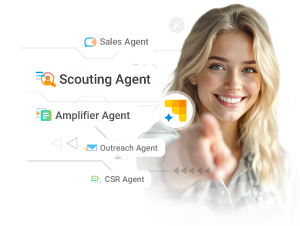
 Find Ideal Prospects
 Create Engaging Content
 Launch Outreach Campaigns
 Capture Website Leads
 Provide Customer Support