- The Problem That Appears After the First Few Apps
- What Makes Internal Apps Specifically Risky
- The Governance Framework Gap
- The Architecture That Solves This at the Source
- What This Means for Different Internal App Categories
- The Developer Experience Question
- Before You Build Another Internal App
- What “No Compliance Liability” Actually Requires
- Talk to CloudApper About Your Internal Application Backlog
Every enterprise has a backlog of internal applications that never get built.
Scheduling tools that would save ops teams hours per week. Compliance tracking workflows that currently live in spreadsheets. Vendor onboarding processes held together with email chains and manual follow-up. Maintenance request systems that haven’t been modernized since the previous IT director left.

The backlog exists not because nobody wants these tools, but because internal IT development capacity is always allocated to higher-priority work. Business-critical systems, customer-facing products, core infrastructure. The internal productivity tools keep getting deprioritized until someone leaves, something breaks, or an auditor asks about a process that should have been automated two years ago.
AI development tools changed that calculus. Teams that adopted Copilot, Cursor, or similar tools found they could build internal applications in days instead of weeks. The backlog started moving. People were genuinely happy about it.
Then the compliance question arrived.
The Problem That Appears After the First Few Apps
When a team builds one or two internal apps with AI tools, compliance exposure is limited and manageable. Someone reviews the code, tests the access controls, adds it to the asset inventory. Done.
When a team has been building internal apps at AI speed for six months — an operations manager built a shift tracker, two developers built a vendor onboarding workflow, a data analyst built an internal reporting dashboard, an IT administrator built an employee self-service portal — the picture is different.
You now have multiple applications, built by different people, using different tools, with different data access patterns, different authentication implementations, and different logging behaviors. Some of them touch regulated data. Some of them connect to enterprise systems that are within your compliance boundary. None of them were assessed against your security baseline before they went live because the process for doing that hadn’t caught up to the pace at which they were being built.
This is the situation most enterprise IT leaders are actually managing right now. Not a single risky application — an accumulation of applications that individually seemed fine and collectively represent a governance problem.
What Makes Internal Apps Specifically Risky
Internal apps occupy an uncomfortable middle ground in most enterprise security programs. They’re not customer-facing products, so they don’t get the scrutiny of a major software release. They’re not purchased SaaS, so they don’t go through vendor management. They’re not core infrastructure, so they don’t get the architecture review that major systems do.
They’re also, frequently, the applications that have the most direct access to sensitive data. An internal HR workflow tool touches employee records. An internal compliance tracker handles audit evidence. An internal operations dashboard pulls from ERP data that includes financial and supply chain information. An internal scheduling tool in a healthcare environment may interact with clinical staffing data.
The informality of how internal apps get built stands in direct contrast to the sensitivity of the data they often touch. That gap is where compliance liability lives.
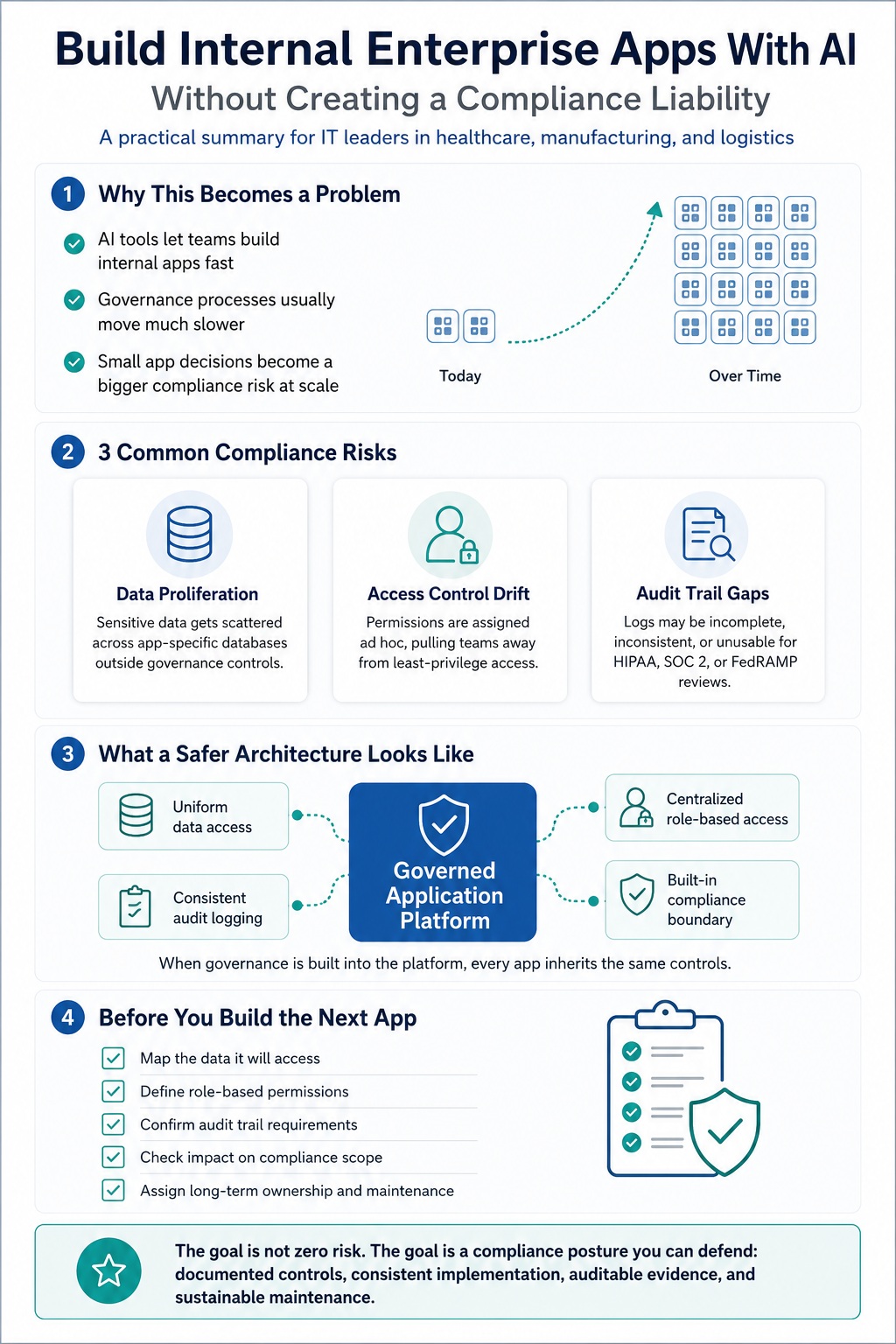
Three specific patterns show up consistently:
Uncontrolled data proliferation: AI coding tools generate applications with their own data stores. An internal app built to track vendor compliance creates its own database table. Another one built to manage contractor access creates its own user table. Six months later, sensitive business data is distributed across a dozen application-specific databases that aren’t in your data governance inventory, aren’t included in your backup and recovery processes, and aren’t subject to the access controls your main systems enforce.
Access control drift: Internal apps built quickly tend to get access control decisions made on the fly. “The ops team needs to see this, so let’s give the ops role read access.” “The manager needs to edit these records, so let’s give manager-level accounts write access.” These decisions aren’t wrong individually. In aggregate, across a portfolio of internal apps, access permissions drift away from the least-privilege model your security policy requires. Nobody intended it. Nobody noticed it happening.
Audit trail gaps: Compliance frameworks — HIPAA, SOC 2, FedRAMP — require that you can reconstruct activity in systems handling regulated data. Internal apps built with AI coding tools generate whatever logging the AI tool decided was appropriate. That logging may not be complete enough for compliance purposes, may not be in a format that integrates with your SIEM, and may not be retained according to your policy requirements. When an auditor asks for activity logs from an internal compliance tracking tool, “the logs are in a format we can’t query” is not a good answer.
The Governance Framework Gap
Most enterprise IT governance programs were designed before AI-speed internal app development existed as a category. Change management processes assume weeks-long development cycles. Application security reviews assume dedicated review resources. Vendor management assumes that tools go through formal assessment before use.
None of these assumptions hold at AI development pace. An operations manager who built a scheduling tool in Cursor over a weekend didn’t go through change management. A data analyst who built an internal dashboard didn’t submit a security assessment request. They solved a problem, the problem got solved, and the application went into use.
The governance question isn’t whether those people did something wrong. They did what reasonable people do when good tools are available and processes aren’t adapted to them. The question is whether your governance framework can adapt to the pace at which AI development enables internal applications to be built.
Two paths exist. The first is to retrofit governance onto the current situation — inventory every AI-built internal app, assess each one, document the access controls, update your compliance records. That’s a significant backlog item and it starts from behind.
The second is to change the architecture so that governance is built into the development platform rather than applied after the fact.
The Architecture That Solves This at the Source
The fundamental problem with AI-speed internal app development and compliance is that most AI coding tools separate the act of building from the act of governing. You build fast with the AI tool. You govern slowly with your compliance processes. At scale, the gap between those two speeds becomes a liability.
A platform-based approach collapses that gap. When internal applications are built on a governed platform rather than as standalone codebases, every application inherits the platform’s compliance posture automatically. There’s no separate governance step because governance is structural.
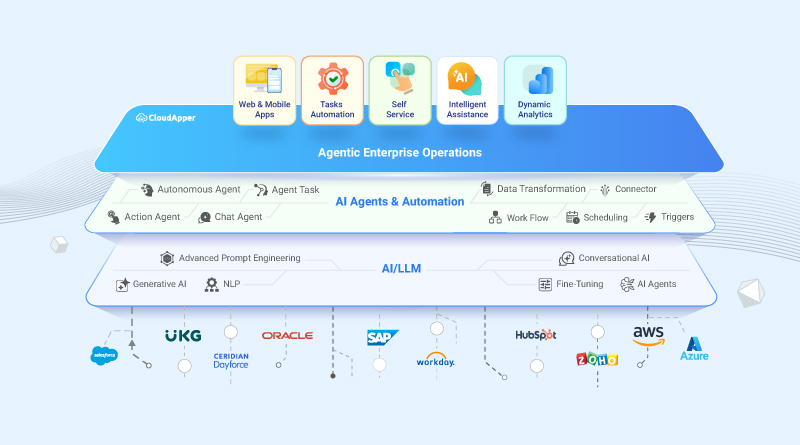
This is what CloudApper’s AI platform provides for internal enterprise application development. Instead of generating source code that creates new databases, new access control implementations, and new logging behaviors — CloudApper generates application blueprints that run on a certified application server. Every internal app built on the platform:
- Accesses data through a uniform data access layer, not through application-specific database connections
- Inherits role-based access controls from the platform’s centralized access model, not from per-app implementation
- Writes audit logs in a consistent format that integrates with enterprise security infrastructure
- Runs within the platform’s certified security boundary, not as a separate application with its own security profile
For the three patterns described above — data proliferation, access control drift, and audit trail gaps — the platform approach addresses each one structurally.
Data doesn’t proliferate because applications don’t create their own data stores. Access controls don’t drift because they’re managed centrally, not per-app. Audit trails are consistent because logging is a platform characteristic, not an application implementation detail.
You can see how this works in practice in CloudApper’s overview of how to create custom enterprise software and apps using AI — the platform handles backend creation, access logic, and deployment packaging, leaving development teams to focus on what the application needs to do rather than how to build it securely.
What This Means for Different Internal App Categories
The compliance implications vary by the type of internal application being built. Here’s how the platform approach maps to common internal app categories:
HR and workforce management tools: Internal apps in this category — scheduling, time tracking, employee self-service, onboarding workflows — frequently handle employee PII. In some industries, they intersect with HIPAA (healthcare staffing data) or FIPS requirements (defense contractor employee data). A platform-based approach means these applications inherit access controls aligned with your HR data governance policies and generate logs suitable for employment compliance audits.
Operations and supply chain tools: Inventory trackers, vendor management applications, maintenance request systems, and procurement workflows handle business-critical operational data that is often subject to SOC 2 confidentiality requirements. Applications built on a governed platform maintain consistent access control and data handling across all operational tooling rather than creating pockets of inconsistency.
Compliance and audit management tools: This is the category where the irony of non-compliant compliance tools is most obvious. An internal application built to track compliance activities needs to itself be compliant — with proper access controls, complete audit trails, and documented security review. Building compliance management tooling on a certified platform resolves that circularity.
Clinical and healthcare workflow tools: In healthcare organizations, internal tools that touch clinical workflows — patient scheduling, clinical staffing, care coordination support — interact with data that carries HIPAA obligations. These are not edge cases where you might be able to argue PHI adjacency. They’re clear HIPAA scope applications that need to be built on infrastructure with documented HIPAA controls.
CloudApper’s AI software development platform has been used to build applications across all of these categories — launching compliance tracking tools and workflow applications in days rather than the weeks that traditional development requires, without the security review backlog that raw AI coding tools create.
The Developer Experience Question
An argument for governed application development that ignores developer and builder experience will fail in practice. If the compliance-safe path is slower, more restrictive, and harder to use than the alternative, people will use the alternative.
The platform approach only works if it’s also genuinely faster and more capable than building standalone applications with raw AI coding tools. For most internal enterprise applications, it is.
The reason is that internal apps don’t usually require complex custom code. They require workflow logic, data access, role-based permissions, reporting, and mobile access — all of which a well-designed platform handles through configuration rather than code. A developer who would spend two weeks building a vendor management application from scratch in Cursor — and then spend another week on security review — can describe that application in natural language and have CloudApper’s AI generate it in a day, running on the certified server, with access controls already aligned to the platform’s role model.
That’s not a marginal improvement in development speed. It’s a structural change in how internal applications get built, and it comes with a compliance posture that actually holds up at audit time.
The practical effect for enterprise development teams is that the internal application backlog becomes approachable. Tools that were perpetually deprioritized because the development overhead was too high become buildable. The operations manager who needed a scheduling tool gets it. The compliance team that needed an audit tracker gets it. The maintenance team that needed a request management system gets it — all without adding to the compliance review backlog.
Before You Build Another Internal App
If your organization is currently using AI coding tools to build internal applications — or is about to start — a brief assessment before the next application goes live is worth the time.
Data access mapping: What data will this application access? Does any of that data fall under HIPAA, SOC 2 confidentiality requirements, FedRAMP scope, or other compliance frameworks? If yes, the application needs to be built on infrastructure with documented controls for those frameworks.
Access control design: Who will use this application? What data can each role see and modify? Does the planned access control implementation align with your organization’s least-privilege policy? Is access control implemented at the platform level (inherited) or at the application level (custom)?
Audit trail requirements: What compliance frameworks require audit trails for the data this application handles? Does the planned application generate logs in a format compatible with your SIEM? Are log retention periods consistent with your compliance requirements?
Compliance boundary impact: Does this application connect to any system within your SOC 2, HIPAA, or FedRAMP compliance boundary? If so, does the application itself need to be included in scope, and has the relevant compliance documentation been updated?
Ownership and maintenance: Who will own this application after it goes live? Who is responsible for security patching, dependency updates, and compliance documentation maintenance? Is that person’s workload realistic given the number of other AI-built applications they already own?
Working through this list before building — rather than after — changes the cost and complexity of getting the compliance posture right. Enterprise AI can be genuinely secure when these questions are answered by the platform rather than resolved individually for each application.
What “No Compliance Liability” Actually Requires
The goal isn’t zero risk — software development always carries some risk. The goal is a compliance posture you can actually defend: documented controls, consistent implementation, auditable evidence, and maintenance processes that keep up with the applications in your environment.
That posture is achievable with AI-speed internal app development. It requires making the right architectural choice about where governance lives — in the development platform, where it applies automatically to every application built, or in a post-development review process that struggles to keep pace with the rate at which AI tools enable new applications to be created.
Organizations that have made that architectural choice — building internal applications on a governed platform rather than as standalone AI-generated codebases — are not moving slower. They’re building more internal applications, faster, with less review overhead, and with a compliance posture that holds up when their auditors arrive.
That’s the combination that makes AI-speed internal app development sustainable rather than just fast.
Talk to CloudApper About Your Internal Application Backlog
If your organization has a backlog of internal applications that need to be built, or is currently managing AI-generated internal apps and wants to understand the compliance exposure, CloudApper can walk through your specific situation.
Schedule a conversation with the CloudApper team →
Bring your current internal application inventory — built and backlogged — and your active compliance frameworks. The conversation will focus on what’s buildable, what’s already at risk, and how the platform architecture addresses both.

What is CloudApper AI Platform?
CloudApper AI is an advanced platform that enables organizations to integrate AI into their existing enterprise systems effortlessly, without the need for technical expertise, costly development, or upgrading the underlying infrastructure. By transforming legacy systems into AI-capable solutions, CloudApper allows companies to harness the power of Generative AI quickly and efficiently. This approach has been successfully implemented with leading systems like UKG, Workday, Oracle, Paradox, Amazon AWS Bedrock and can be applied across various industries, helping businesses enhance productivity, automate processes, and gain deeper insights without the usual complexities. With CloudApper AI, you can start experiencing the transformative benefits of AI today. Learn More
- Useful Links:
- Agentic AI
- No-Code/Low-Code
- Custom Software
- HCM Personalization
- iPaaS
- FedRAMP