- Why This Evaluation Is Different From Standard Software Procurement
- The Eight Evaluation Criteria That Actually Matter
- Structuring the Evaluation Process
- Red Flags That Should Pause an Evaluation
- How CloudApper Addresses Each Criterion
- The Decision That Outlasts the Evaluation
- Talk to CloudApper About Your Evaluation
By the time a CIO or President starts formally evaluating enterprise application development platforms, they’ve usually already lived through the alternative. A team that built too fast with too little governance. An audit finding that traced back to an AI-generated application nobody fully understood. A compliance review that surfaced applications nobody knew existed. An incident response process that started from “we’re not sure what this application does.”
The evaluation isn’t theoretical at that point. It’s a procurement decision with a specific history behind it, and the criteria that matter have been sharpened by experience.
This article is a vendor evaluation framework for organizations in exactly that position — enterprises with active compliance obligations, development teams using AI tools, and a genuine need to select infrastructure that holds up when compliance is not optional. It’s written for the person running the evaluation, not for the developer choosing a tool.
Why This Evaluation Is Different From Standard Software Procurement
Enterprise software procurement has established processes. You define requirements, issue an RFP, evaluate responses against criteria, conduct demos, negotiate terms. That process works well for well-defined categories of software — ERP systems, HCM platforms, CRM tools — where vendor capabilities are relatively standardized and the evaluation criteria are mature.
Secure enterprise app development platforms are a newer category, and the evaluation criteria aren’t yet standardized across the market. Vendors in this space range from general-purpose AI coding assistants that have added enterprise features to platforms architected from the ground up for enterprise governance. The marketing language is similar. The underlying architectures are very different. And those architectural differences are exactly what compliance evaluation needs to surface.

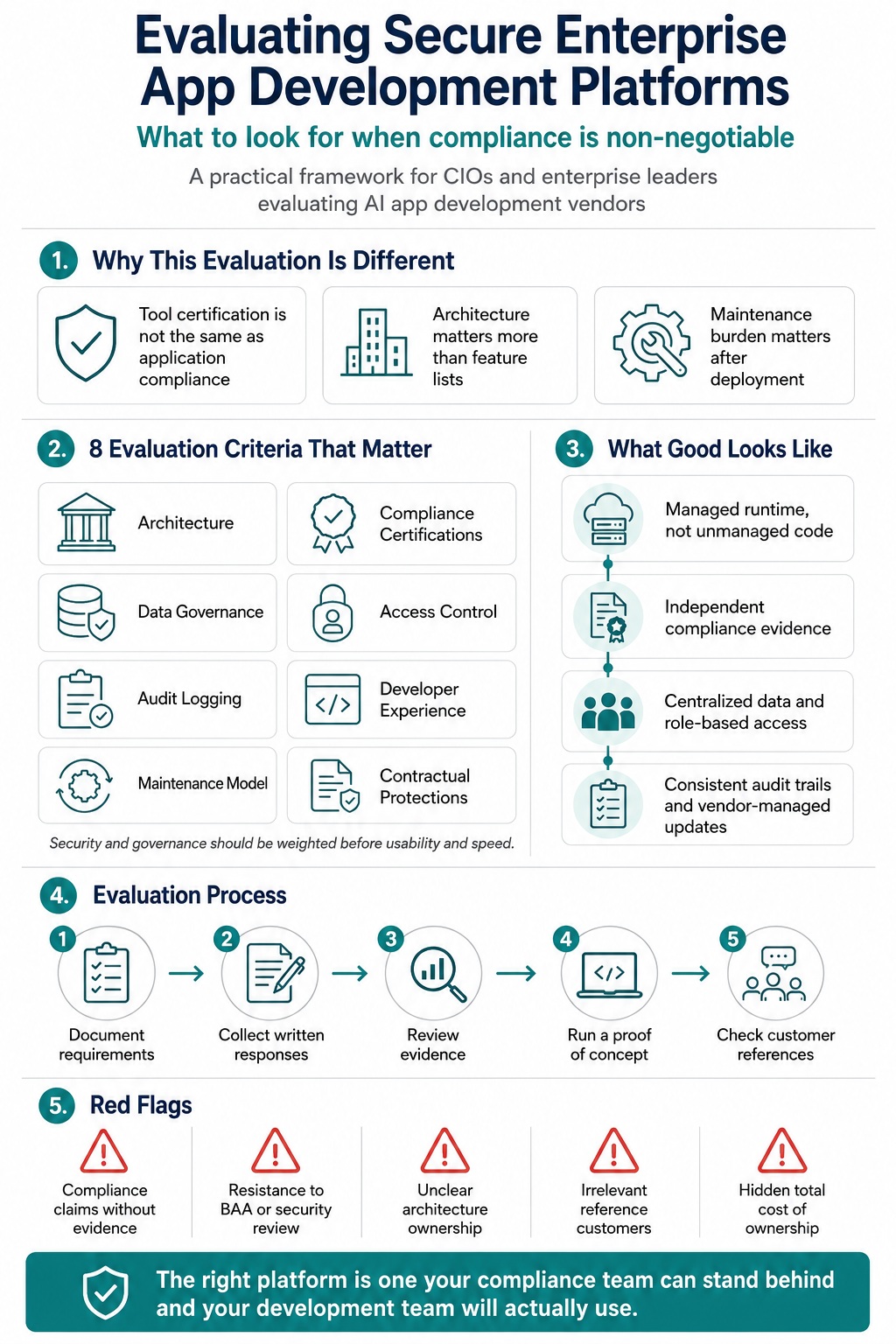
Three specific evaluation failures are common in this space:
Conflating tool certification with application compliance: A vendor running on SOC 2-audited infrastructure is not the same as a vendor whose platform produces applications that inherit SOC 2 controls. These are different claims. Evaluation frameworks that don’t distinguish between them will accept the former as evidence of the latter — and discover the gap during an audit.
Evaluating features rather than architecture: Enterprise feature lists look similar across vendors. What differs is the underlying architecture — whether compliance controls are structural (built into the platform runtime) or procedural (applied through review processes on top of raw output). Procedural controls are weaker at scale. Structural controls aren’t dependent on reviewer capacity or process discipline.
Underweighting maintenance and operational burden: The evaluation often focuses on what the platform produces at deployment. What it should also evaluate is what it requires over time — security patch management, dependency updates, compliance documentation maintenance, incident response capability. Platforms that generate standalone codebases transfer these burdens to your team. Platforms with managed runtimes retain them at the vendor level.
The Eight Evaluation Criteria That Actually Matter
The following criteria are organized in the order they should be weighted for organizations with active compliance requirements. Security and governance criteria come first. Developer experience and capability criteria come later — not because they matter less, but because they matter only after the compliance questions have real answers.
Criterion 1: Architecture — What Does the Platform Actually Produce?
This is the foundational question. Everything downstream depends on the answer.
What to ask:
- Does the platform generate raw source code, or does it generate structured application definitions that run on a managed runtime?
- If source code is generated, who owns it, who maintains it, and who is responsible for its security posture?
- If applications run on a managed runtime, what are the certification and security posture of that runtime?
What good looks like: The platform generates governed application blueprints or configurations that execute on a certified, managed runtime. New applications inherit the runtime’s security controls rather than implementing their own. Security decisions are made at the infrastructure level, not re-implemented per application.
What to be cautious about: Vendors who describe their output as “production-ready code” or “enterprise-grade generated code” are producing source code. That code may be high quality. It is still code that your team owns, maintains, and is responsible for governing — regardless of what generated it.
Criterion 2: Compliance Certifications — Independent and Verifiable
Compliance claims require evidence. Evaluation should not accept self-attestation for compliance certifications that matter to your specific obligations.
What to ask:
- For each relevant framework (HIPAA, SOC 2, FedRAMP, FIPS, GDPR, CCPA): is the platform independently certified or assessed?
- Who conducted the assessment, when was it conducted, and when is the next assessment?
- Does the certification cover the platform as a whole, or specific components?
- Are assessment reports available under NDA for review by your compliance team?
What good looks like: Independent third-party assessments for each relevant framework, conducted within the past 12 months, with reports available for review. For FedRAMP, a current FedRAMP Ready designation or Active authorization. For SOC 2, a Type II report (not just Type I) covering a 12-month period. For HIPAA, documented controls mapped to the Security Rule’s technical, physical, and administrative safeguard categories.
What to be cautious about: Vendors claiming HIPAA “compliance” without specifying what that means — the term isn’t a certification, it’s a posture. Vendors with SOC 2 Type I reports only (a point-in-time snapshot, not an operating effectiveness assessment). Vendors whose FedRAMP claims reference the tool’s underlying cloud infrastructure rather than the platform itself.
Criterion 3: Data Governance — Where Does Data Go and Who Controls It?
For enterprise organizations in regulated industries, data residency and data handling are often dealbreaker criteria. This needs explicit, documented answers — not general assurances.
What to ask:
- Where is customer data stored, and does it stay within a defined geographic region?
- Is customer data used for any purpose outside the contracted service — model training, analytics, product improvement?
- What are the data retention and deletion policies, and how are they enforced?
- Does the platform enforce a uniform data access layer, or does each application create its own data storage and access patterns?
What good looks like: Customer data stored in regional cloud environments that stay within the customer’s jurisdiction (specifically relevant for HIPAA data residency requirements and GDPR). Explicit contractual commitment that customer data is not used for model training or any purpose outside the contracted service. A uniform data access layer that prevents applications from creating independent data stores outside governed architecture.
CloudApper’s data handling approach is explicit on these points: customer data stays in regional AWS environments local to that customer, is never used outside the contracted service, and is governed through a centralized data access layer that all applications share. These are specific, verifiable claims — the kind evaluation should require of all vendors.
What to be cautious about: Vendors who describe data handling in general terms (“we take data security seriously”) without specific, auditable commitments. Vendors whose data handling terms are buried in subprocessor agreements that change without notice. Platforms where each application manages its own data storage — creating fragmentation that undermines consistent governance.
Criterion 4: Access Control Architecture — Centralized or Per-Application?
Access control consistency is one of the most significant compliance differentiators between platform architectures. It deserves explicit evaluation rather than assumption.
What to ask:
- Are access controls managed centrally at the platform level, or implemented separately in each application?
- How are role-based permissions defined, and how are changes propagated across applications?
- Does the platform support SSO integration with enterprise identity providers (Active Directory, Okta, etc.)?
- What happens to application access when an employee is terminated — is offboarding platform-wide or per-application?
What good looks like: Centralized role-based access control managed at the platform level, with permissions inherited by all applications. SSO integration that connects to your existing identity infrastructure. Platform-wide access revocation on termination rather than per-application offboarding processes. Audit logs of access control changes that are consistent across all applications.
What to be cautious about: Platforms where access control is configured per-application — even with good tooling to make that easier, per-application access control is a governance fragmentation problem that compounds with scale. Also watch for platforms that support SSO as an add-on feature rather than a core architectural component.
Criterion 5: Audit Logging — Consistent, Complete, and SIEM-Compatible
Compliance frameworks require audit trails. The evaluation question is not whether the platform produces logs — they all do. It’s whether those logs are consistent, complete, and integrated with your security infrastructure in a way that satisfies your specific compliance requirements.
What to ask:
- Are audit logs consistent across all applications built on the platform, or does each application produce its own log format?
- What security events are logged, and is the event coverage sufficient for your compliance framework requirements?
- Can audit logs be exported to your existing SIEM in a supported format?
- What are the log retention policies, and are they configurable to match your compliance requirements?
What good looks like: Platform-level audit logging that applies uniformly to all applications, in a format compatible with your SIEM infrastructure. Event coverage that satisfies HIPAA audit control requirements (§ 164.312(b)), SOC 2 CC7 monitoring requirements, or applicable FedRAMP AU controls. Configurable retention periods aligned with your compliance requirements. Tamper-evident log storage.
What to be cautious about: Platforms where audit logging is an application-level feature that developers implement (or don’t) per application. Logging that covers tool usage but not application activity within the produced applications. Log formats that require transformation before your SIEM can process them — transformation gaps create monitoring blind spots.
Criterion 6: Developer Experience and Capability Range
After the compliance criteria have been evaluated, developer experience and capability matter enormously. A platform that satisfies all compliance requirements but that developers route around is not a solution — it’s an expensive policy document.
What to ask:
- What categories of enterprise applications can be built on the platform? Can you see examples relevant to your industry?
- How does the development workflow actually work — what does a developer or non-developer do to build an application?
- What is the realistic time from requirement to deployed application for a typical internal enterprise app?
- Can the platform integrate with your existing enterprise systems (ERP, HCM, CRM)?
- Does the platform support a hybrid model where custom code can be incorporated for specialized requirements?
What good looks like: A natural language or low-code development workflow that enables both developers and technically capable non-developers to build applications. Realistic deployment timelines measured in days for typical internal applications, not weeks. Native integration with major enterprise systems — Workday, SAP, Oracle, UKG, Salesforce, and others. A documented hybrid model that allows custom code to be incorporated while maintaining the platform’s security and governance posture.
CloudApper’s platform supports natural language application creation, integrates with major enterprise systems, and includes a hybrid architecture that allows native code modules to run on top of the established data and security layers. The enterprise application development platform has been used to build applications across HR, operations, compliance, healthcare, manufacturing, and logistics — with realistic deployment timelines that hold up at scale, not just in demos.
What to be cautious about: Demo applications that look impressive but don’t reflect the complexity of real enterprise use cases. Development workflows that require significant technical expertise that your team doesn’t have. Platforms that handle simple applications well but require custom development workarounds for anything with moderate complexity.
Criterion 7: Maintenance and Operational Model
The evaluation question most teams underweight — and most regret not asking — is who is responsible for what after deployment.
What to ask:
- Who is responsible for security patches and platform updates — the vendor or your team?
- How are security patches delivered to applications — do they require per-application updates or are they applied platform-wide automatically?
- What DevOps and operational overhead does your team need to manage on an ongoing basis?
- What does the vendor’s SLA and incident response commitment look like for security incidents?
What good looks like: Platform-level security updates that apply automatically to all applications without per-application remediation cycles. No ongoing DevOps overhead for individual applications — the vendor manages infrastructure, your team manages application logic. Documented SLAs for security incident response and uptime. A clear escalation path for security concerns.
What to be cautious about: Platforms that generate applications but leave security patch management to your team. Operational models where each AI-generated application accumulates its own maintenance backlog. Vendors who provide strong deployment support but limited ongoing operational ownership.
Criterion 8: Contractual Protections — What the Agreement Actually Says
The final evaluation criterion is the vendor agreement. Compliance postures documented in marketing materials and demonstrated in demos need to be reflected in binding contractual terms.
What to ask:
- Is a Business Associate Agreement available for healthcare customers, and what does it cover?
- What are the data handling commitments in the agreement, and are they specific enough to satisfy your compliance requirements?
- What are the breach notification timelines and notification obligations?
- What intellectual property protections apply to applications built on the platform?
- What happens to your applications and data if the vendor relationship ends?
What good looks like: A BAA that covers the platform’s handling of PHI in healthcare contexts. Specific, non-generic data handling commitments that address residency, retention, and non-use outside the contracted service. Breach notification timelines consistent with HIPAA’s 60-day requirement and any applicable state law requirements. Clear IP ownership of applications built on the platform by your team. Data portability and deletion commitments that give you control if the relationship ends.
What to be cautious about: BAAs that are available but narrow in scope, covering only certain aspects of the service. Data handling terms that are general and not specifically enforceable. Breach notification timelines that exceed regulatory requirements. Vendor agreements that claim IP ownership over applications built using their platform.
Structuring the Evaluation Process
With eight criteria defined, the evaluation process itself needs structure to produce a defensible decision.
Phase 1 — Documented requirements: Before contacting vendors, document your specific requirements for each criterion. What compliance frameworks apply? What are your data residency requirements? What enterprise systems need integration? What is your development volume and team capability? Requirements documented before vendor contact prevent requirements from drifting toward what vendors offer.
Phase 2 — Written responses: Issue a structured questionnaire covering all eight criteria. Require written responses rather than demo-based answers. Verbal demo answers are hard to hold vendors accountable to. Written responses become part of the vendor record and can be compared systematically across vendors.
Phase 3 — Evidence review: For compliance certifications, request actual documentation — SOC 2 Type II reports, FedRAMP authorization packages or readiness assessment reports, HIPAA compliance documentation. Evaluate the evidence, not the claim. Your compliance or legal team should review this documentation, not just your IT procurement team.
Phase 4 — Proof of concept in your environment: Before final selection, require a proof of concept that builds an application relevant to your actual use case in your actual environment. Demo environments with sample data don’t surface the integration challenges, data governance behaviors, and operational characteristics that matter.
Phase 5 — Reference conversations: Speak with existing customers in your industry and compliance context — not just general enterprise references. A healthcare organization’s experience with a platform is more relevant to your evaluation than a general enterprise’s experience. Ask specifically about audit experience, compliance findings, and operational challenges — not just capability satisfaction.
Red Flags That Should Pause an Evaluation
Several vendor behaviors during evaluation are reliable signals of underlying problems:
Compliance claims without evidence: Any vendor who claims HIPAA compliance, FedRAMP readiness, or SOC 2 certification without being able to provide documentation within a reasonable timeframe has a problem. Legitimate certifications come with documentation.
Resistance to BAA negotiations: For healthcare organizations, a vendor who is reluctant to execute a BAA or proposes a BAA with significant carveouts should be evaluated with significant caution. The BAA negotiation reveals how the vendor thinks about compliance obligations.
Architecture evasion: Vendors who can’t clearly answer “what does your platform produce and who owns the security of that output” are either unclear on their own architecture or are avoiding an answer that doesn’t serve the sale.
Reference customers who don’t match your compliance context: A vendor with impressive enterprise references in unregulated industries has not demonstrated that their platform holds up in your context. Request references who have been through the specific audits you face.
Pricing structures that obscure the total cost: Platforms with low per-seat pricing and significant overages for application volume, data storage, or compliance features can be significantly more expensive than their headline pricing suggests. Evaluate total cost of ownership, including operational overhead.
How CloudApper Addresses Each Criterion
For organizations who have worked through the evaluation framework above and want to understand how CloudApper maps to it:
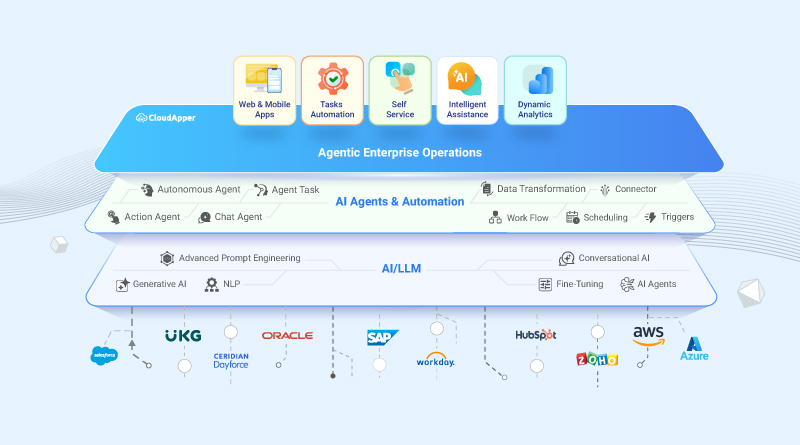
Architecture: CloudApper generates governed application blueprints that run on a certified application server. No raw source code is produced. Every application inherits the server’s security and compliance controls. The platform architecture was designed specifically to eliminate unmanaged AI-generated code from the enterprise stack.
Compliance certifications: FedRAMP Ready, SOC 2 audited, with documented controls for HIPAA, FIPS 140-2, CCPA, FERPA, and GDPR. Assessment documentation is available for review.
Data governance: Customer data stays in regional AWS environments. No customer data is used outside the contracted service. A uniform data access layer prevents application-level data fragmentation.
Access control: Centralized RBAC managed at the platform level, SSO integration supported, platform-wide access management.
Audit logging: Consistent logging across all applications, SIEM-compatible formats, configurable retention.
Developer experience: Natural language application creation, integration with major enterprise systems, days-to-deployment for typical internal applications, hybrid model for custom code requirements. The no-code AI platform enables both developers and non-developers to build applications.
Maintenance model: Platform-level security updates, no per-application DevOps overhead, vendor-managed infrastructure.
Contractual protections: BAA available for healthcare customers, specific data handling commitments, clear IP ownership for customer-built applications.
The comprehensive buyer’s guide on CloudApper’s site covers additional evaluation dimensions if you want to go deeper on any specific criterion before a conversation.
The Decision That Outlasts the Evaluation
Vendor selection for a development platform is not a decision you revisit frequently. Applications built on a platform create dependencies — on the data architecture, the access control model, the runtime environment. Switching costs are real.
That makes the upfront evaluation more important, not less. A platform selected primarily for development velocity that creates compliance exposure will generate remediation costs that dwarf the productivity gains. A platform selected on compliance posture that developers route around provides compliance documentation for applications that aren’t actually being built on it.
The right decision is a platform that your compliance team can stand behind and your development team will actually use. Those two requirements are harder to satisfy simultaneously than the market suggests. But they’re both necessary, and the evaluation framework above is designed to surface which vendors actually satisfy both.
Talk to CloudApper About Your Evaluation
If your organization is formally evaluating secure enterprise app development platforms and wants to run CloudApper through the framework above, we’re ready for the conversation — including evidence review, BAA discussion, and a proof of concept in your environment.
Schedule an evaluation conversation with the CloudApper team →
Bring your documented requirements and your compliance framework list. We’ll work through the criteria specifically, not in generalities.

What is CloudApper AI Platform?
CloudApper AI is an advanced platform that enables organizations to integrate AI into their existing enterprise systems effortlessly, without the need for technical expertise, costly development, or upgrading the underlying infrastructure. By transforming legacy systems into AI-capable solutions, CloudApper allows companies to harness the power of Generative AI quickly and efficiently. This approach has been successfully implemented with leading systems like UKG, Workday, Oracle, Paradox, Amazon AWS Bedrock and can be applied across various industries, helping businesses enhance productivity, automate processes, and gain deeper insights without the usual complexities. With CloudApper AI, you can start experiencing the transformative benefits of AI today. Learn More
- Useful Links:
- Agentic AI
- No-Code/Low-Code
- Custom Software
- HCM Personalization
- iPaaS
- FedRAMP