School districts face a critical bus driver shortage—78% report serious recruiting difficulties. CloudApper AI Recruiter screens candidates 24/7 via SMS, asks safety-focused interview questions automatically, verifies CDL qualifications, and fills positions 90% faster. Transform your driver hiring from crisis management to stable, pre-screened talent pipelines.

Table of Contents
The school bus driver shortage has reached crisis levels across the United States. According to recent SHRM data, 78% of school districts report serious difficulties recruiting qualified bus drivers, with some districts offering signing bonuses up to $5,000 and still struggling to fill routes. The National School Transportation Association reports that districts are short approximately 51,000 drivers nationwide—a shortage that forces school schedule changes, route consolidations, and leaves families scrambling for transportation alternatives.
The hiring challenges are multifaceted and intensifying. Average time-to-hire for bus drivers has stretched to 52 days, yet the position requires someone to start immediately when routes go uncovered. Candidate drop-off rates hover around 71% between initial application and interview completion—partly because applicants with CDL licenses have numerous lucrative options in commercial trucking. Add in rigorous compliance requirements (CDL verification, background checks, DOT physicals, drug testing, driving record reviews), and the administrative burden becomes overwhelming for transportation departments already operating on thin margins.
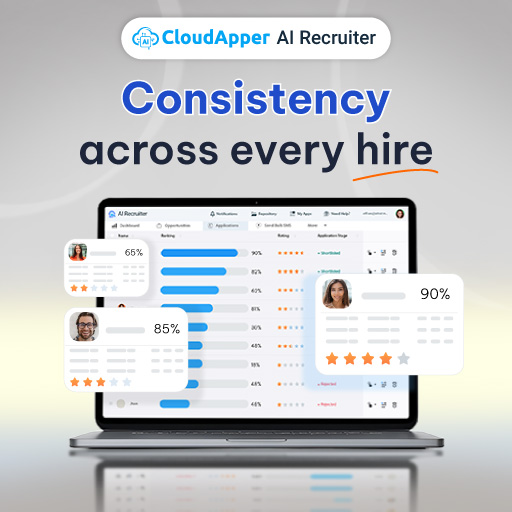
CloudApper AI Recruiter revolutionizes this entire process. This conversational AI chatbot conducts screening interviews 24/7 via SMS or web chat, processes candidates 90% faster than traditional methods, eliminates unconscious bias in initial screening, and automatically verifies key qualifications before human recruiters invest their time. Districts using AI-powered recruiting report filling driver positions in under 12 days—even during the peak hiring season when schools compete for the same limited CDL talent pool.
We’ll give you the exact interview questions that identify safe, reliable, student-focused bus drivers, then show you how CloudApper AI Recruiter handles the heavy lifting automatically—so you can keep buses running and students safe.
TL;DR
School districts struggle with a severe bus driver shortage and lengthy hiring processes. This article lists 10 essential behavioral and safety-focused interview questions to identify top candidates who prioritize student safety, handle emergencies, manage behavior, and align with the role’s demands. It also highlights how CloudApper’s AI Recruiter automates screening with these questions, verifies qualifications, reduces bias, and accelerates hiring by up to 90%.
Why These Questions Matter for School Bus Drivers
The school bus driver role has transformed significantly in recent years. Today’s drivers aren’t just operating vehicles—they’re managing complex behavioral situations with minimal supervision, navigating sophisticated GPS and communication technology, implementing trauma-informed approaches with vulnerable students, responding to medical emergencies, and serving as critical safety officers who may be the first to identify abuse or neglect. Post-pandemic, drivers also manage health protocols, monitor student wellbeing, and communicate proactively with families and school staff through digital platforms.
Traditional interview questions like “Do you have a clean driving record?” or “Why do you want to drive a bus?” barely scratch the surface of what predicts success in this role. The drivers who stay long-term and maintain impeccable safety records demonstrate emotional intelligence, crisis management skills, cultural competence, and genuine commitment to child welfare—qualities that generic questions simply don’t reveal. Modern school bus driver interviews must assess judgment under pressure, de-escalation abilities, technological adaptability, and mission alignment, all while processing high volumes of candidates efficiently to keep critical transportation services running.
Top 10 Essential School Bus Driver Interview Questions (Plus How AI Recruiter Can Automate The Entire Hiring Process)
1. “Walk me through your pre-trip inspection process. What specific safety items do you check, and what would cause you to take a bus out of service?”
Why ask this? This reveals safety consciousness, technical knowledge, and adherence to DOT regulations—non-negotiables for this role.
Sample Strong Answer: “I start every shift with a comprehensive pre-trip inspection following the CDL checklist. I walk around the entire bus checking tire pressure and tread depth, looking for any fluid leaks underneath, testing all lights including stop arms and amber flashers, and inspecting mirrors and windows for cracks. Inside, I test the emergency exits and windows, ensure the fire extinguisher is charged and accessible, verify the first aid kit is stocked, and test the two-way radio communication system. I check that all seats are secure and the aisle is clear. I’d absolutely take a bus out of service for brake system issues, malfunctioning stop arms or lights, emergency exit failures, steering problems, or anything that compromises student safety—no trip is worth risking children’s lives. I document everything through our digital inspection app and immediately report any issues to the maintenance supervisor.”
2. “Describe a situation where a student was behaving in a way that threatened safety on your bus. How did you handle it?”
Why ask this? Behavioral management while driving requires unique multitasking, judgment, and de-escalation skills specific to student transportation.
Sample Strong Answer: “I had a middle school student who repeatedly stood up while the bus was moving despite multiple warnings. I immediately pulled over at a safe location, secured the bus, and calmly addressed the student individually at the front of the bus, away from peer attention. I explained that standing while moving could cause serious injury if I had to brake suddenly, using a real example of a student injury I’d heard about in safety training. I gave the student a choice: sit safely for the rest of the route, or I’d need to contact their parent and the school administration with a bus conduct report. The student chose to comply. I documented the incident through our student management system and called the parent that evening to partner on addressing the behavior. I also positioned the student in a front seat for the next week where I could monitor more easily. It’s about firm boundaries delivered with respect, and following through consistently on consequences.”
3. “A parent confronts you angrily at a bus stop, accusing you of skipping their stop yesterday and making their child late. You know you followed the route exactly. How do you respond?”
Why ask this? Customer service under pressure, professionalism, and conflict resolution are daily requirements in community-facing roles.
Sample Strong Answer: “I’d stay calm and respond with empathy first: ‘I understand how frustrating that must have been for you and your child.’ I’d explain that I followed the designated route and schedule exactly, but offer to review my GPS data from yesterday with the transportation office to confirm timing and stops—our buses track every location. I’d say, ‘Let’s figure out what happened together. Can you give me your address and your child’s name so I can have the transportation coordinator call you today?’ I’d never argue at the bus stop or in front of students. If the parent continued being aggressive, I’d politely say I need to focus on getting students to school safely and provide the transportation office number. I’d document the interaction immediately and notify my supervisor before the parent calls. Often these situations stem from miscommunication or the student missing the bus but not wanting to admit it—either way, staying professional and involving the right people resolves it without escalating.”
4. “Imagine you’re approaching a railroad crossing and you notice your brake lights have stopped working. What do you do?”
Why ask this? This tests safety protocol knowledge, emergency decision-making, and prioritization under unexpected circumstances.
Sample Strong Answer: “First, I’d never cross the railroad tracks with a safety equipment malfunction—that’s both illegal and incredibly dangerous. I’d immediately pull over in a safe location before the tracks, turn on hazard lights, and contact dispatch via radio to report the brake light failure. I’d request a replacement bus and inform them of my exact location and number of students on board. I’d keep students calm and seated, explaining there’s a minor equipment issue being fixed. Depending on proximity to school and district protocol, dispatch might send another bus to transfer students, or send a mechanic if it’s a quick fix. I’d never continue the route with malfunctioning safety equipment—if a bus isn’t safe, it doesn’t move. I’d document everything in an incident report and ensure maintenance is aware before that bus returns to service.”
5. “Tell me about your experience with students who have special needs or require specific accommodations during transport.”
Why ask this? Many routes include students with IEPs, medical needs, or mobility devices—drivers must demonstrate competence and compassion.
Sample Strong Answer: “I’ve transported students with a wide range of needs—students using wheelchairs, students with autism who need sensory accommodations, students with seizure disorders, and students with behavioral support plans. I always review each student’s transportation IEP accommodation before they’re on my route so I understand their needs—whether that’s specific loading procedures, harness requirements, communication methods, or behavioral strategies. For example, I had a student with autism who became overwhelmed by noise and chaos during loading. I worked with their aide to let them board first in a quiet environment, used visual schedules to show our route, and maintained the same seat assignment daily for consistency. For wheelchair securement, I’m certified in proper tie-down procedures and always double-check that all four points are secure. I see these students as individuals deserving dignity and safe transport, and I coordinate closely with special education staff and parents to ensure their specific needs are met every single day.”
6. “Describe your experience with GPS routing systems, two-way radios, student tracking technology, or other tech tools used in modern school transportation.”
Why ask this? Technology integration is now standard in bus operations, and comfort with these systems improves efficiency and safety.
Sample Strong Answer: “In my previous district, I used Versatrans routing software daily, which provided turn-by-turn navigation and automatically logged all stops and timing. I’m comfortable with two-way radio protocols—using proper codes, keeping communication concise, and knowing when to switch to secure channels for sensitive information. I’ve also used Zonar student tracking systems where students scan ID cards when boarding and exiting, giving parents real-time updates and creating accountability. I’m quick to learn new systems—when my last district switched to a new GPS platform mid-year, I attended the training session and practiced on my own time until it became second nature. I understand these tools aren’t just gadgets—they’re safety systems that help us account for every student, maintain efficient routes, respond to emergencies faster, and keep parents informed. I’m always willing to learn whatever technology improves our service and safety.”
7. “What would you do if you suspected a student on your bus was being abused or neglected at home?”
Why ask this? Bus drivers are mandated reporters and often see warning signs others miss due to daily interaction with students.
Sample Strong Answer: “As a mandated reporter, if I observe physical signs of abuse—unexplained bruises, injuries, extreme fearfulness, or a student discloses abuse—I’m legally required to report immediately to the appropriate authorities, which in schools typically means reporting to the principal or designated administrator who then contacts child protective services. I’d document exactly what I observed or what the student said, using their exact words if they disclosed something. I wouldn’t investigate myself or confront parents—that’s outside my role and could endanger the child. For signs of neglect like a child consistently having no coat in winter, appearing malnourished, or expressing that they’re home alone inappropriately, I’d report those concerns to school counselors or social workers who can assess and connect families with resources. The key is acting quickly, documenting carefully, and trusting the system’s professionals to investigate—my job is to notice and report, not determine if abuse occurred.”
8. “You’re running 15 minutes late due to unexpected traffic and have students who will miss the start of important standardized testing. Parents are calling dispatch upset. What’s your approach?”
Why ask this? Time management, communication, and grace under pressure separate adequate drivers from excellent ones.
Sample Strong Answer: “First, I’d have already notified dispatch the moment I realized we’d be significantly delayed, giving them the heads-up so they could inform the school and parents could be contacted before calling in upset. While driving, I’d stay focused on safety—rushing leads to accidents, so I maintain safe driving regardless of time pressure. Once at school, I’d apologize to students for the delay and reassure them that it wasn’t their fault. I’d coordinate with school staff about the testing situation—often accommodations can be made for late arrivals during standardized testing. After completing my route, I’d document what caused the delay, whether it was truly unavoidable, and discuss with my supervisor if there’s a route modification that could prevent this issue in the future, like adjusting pickup times on days with predictable traffic patterns. The reality is unexpected delays happen—what matters is safe driving, proactive communication, and problem-solving afterward to prevent recurrence.”
9. “How do you handle the physical and mental demands of split shifts, early morning starts, and maintaining focus during repetitive routes?”
Why ask this? The schedule reality causes significant turnover—candidates must demonstrate realistic understanding and coping strategies.
Sample Strong Answer: “I’m naturally an early riser, so 5 AM starts aren’t a challenge for me. I maintain a consistent sleep schedule even on weekends so my body stays adjusted. During the mid-day split between morning and afternoon routes, I use the time productively—sometimes I’ll exercise, run errands, or pick up a part-time remote job that fits that window, which several of my fellow drivers do. For maintaining focus, I treat every route like it’s the first—I never go on autopilot. I actively scan for hazards, engage with students in appropriate ways, and vary my routine slightly to stay mentally sharp. I also build in small rewards—stopping for coffee after the morning route, listening to audiobooks during non-student times. I’m honest that split shifts aren’t for everyone, but they work well for my lifestyle and financial goals. The key is going into it with eyes open, having strategies to stay healthy and alert, and recognizing this job is about consistency and reliability—students depend on me showing up every single day.”
10. “Why do you want to be a school bus driver specifically, rather than a commercial truck driver where the pay is often higher and the schedule more traditional?”
Why ask this? Mission alignment predicts retention—drivers motivated solely by CDL employment rarely stay when better-paying options emerge.
Sample Strong Answer: “While I have my CDL and could pursue commercial trucking, I’m specifically drawn to school transportation because I value working with kids and being part of their daily experience. I grew up in a rough neighborhood, and my bus driver, Ms. Rodriguez, was sometimes the most positive adult interaction I had on difficult days. She remembered our names, asked about our lives, and made us feel seen. I want to be that person for students. I also value the community connection—I’m not just transporting cargo, I’m transporting families’ most precious responsibility, which gives the work real meaning. The split schedule actually works well for my family obligations, and the benefits and summers off are competitive advantages over trucking. I’m looking for a career where I make a difference, not just a paycheck. When a kindergartner waves at me excitedly because they see ‘their bus,’ or a high schooler tells me ‘thanks for getting us here safe,’ that’s worth more than an extra few dollars an hour in long-haul trucking where I’d rarely see the same faces twice.”
How CloudApper AI Recruiter Makes Hiring School Bus Drivers Effortless
Imagine this scenario: A bus driver gives notice on Monday. By Tuesday morning, your AI Recruiter has already screened 12 qualified candidates with active CDLs, asked all ten questions above (plus your district-specific requirements), verified license status, assessed their answers for safety consciousness and student focus, ranked them by qualification match, and scheduled your top three candidates for road tests—all without you spending a single minute on phone screening. This isn’t a future possibility. It’s happening right now with CloudApper AI Recruiter.
Here’s how it revolutionizes school bus driver hiring specifically:
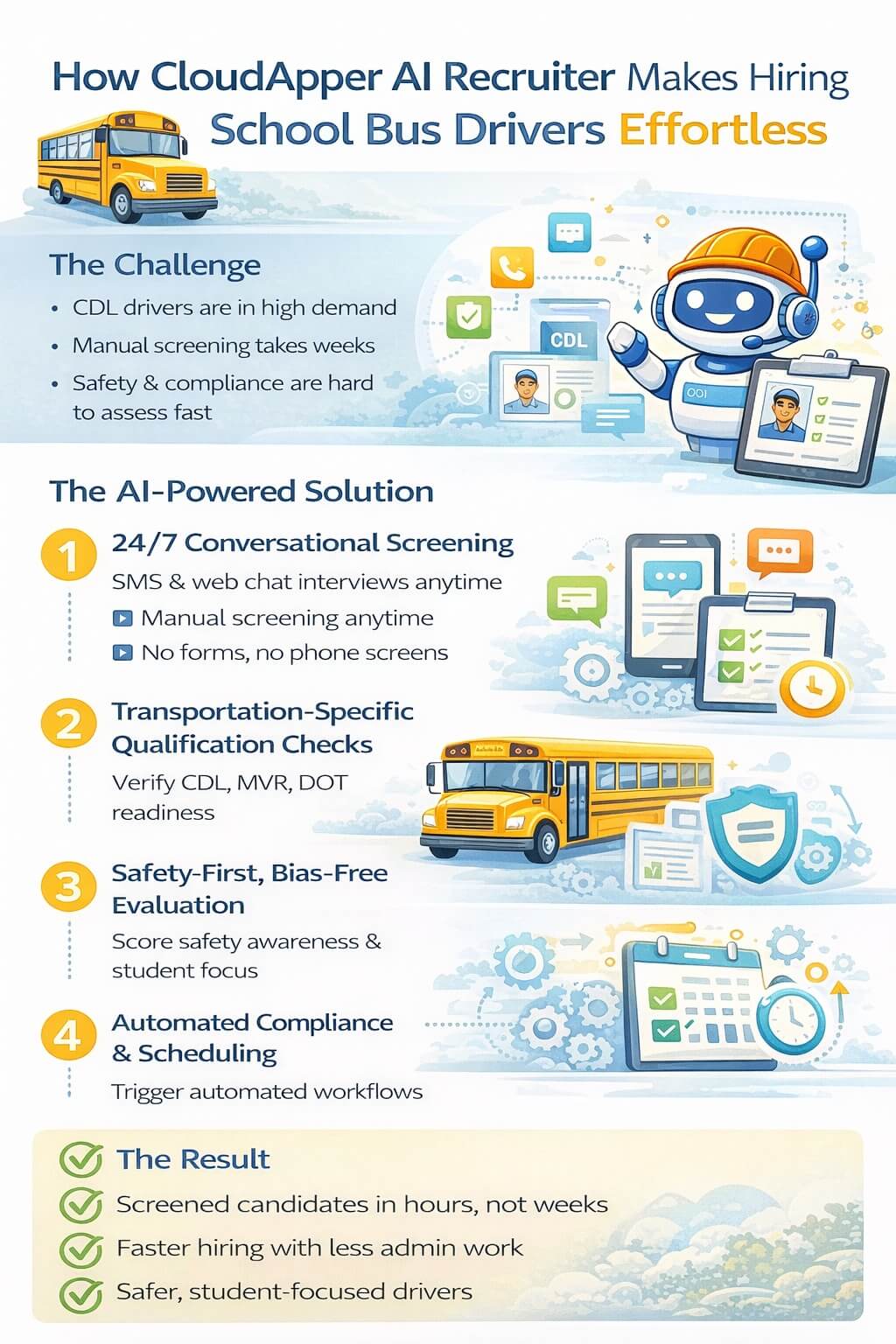
24/7 Conversational Screening via SMS & Web Chat
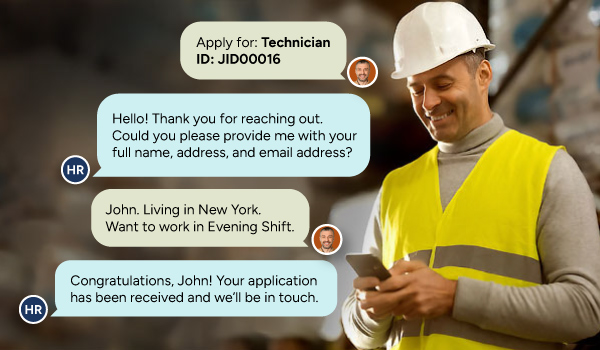
CDL-holding candidates are in high demand and actively juggling multiple opportunities. CloudApper meets them where they are—they can complete screening interviews via text message while waiting between commercial driving shifts, during lunch breaks, or at 11 PM after putting their kids to bed. The AI conducts natural, conversational exchanges that feel human, not like filling out endless forms. It asks your exact interview questions, follows up when answers are vague, and probes deeper on critical safety topics. For bus driver recruitment specifically, it can immediately verify CDL class and endorsements, confirm clean driving record status, assess availability for split shifts, and evaluate student-focused mindset—all before your transportation director reviews a single application.
Transportation-Specific Qualification Screening
CloudApper AI Recruiter comes configured with qualification checkpoints specific to school transportation: active CDL with passenger and school bus endorsements, MVR (motor vehicle record) status, DOT physical currency, willingness to undergo drug testing and fingerprinting, availability during required hours (typically 6-9 AM and 2-5 PM), and experience level with student populations. You can customize additional requirements like size of bus experience, special needs transportation certification, or bilingual capabilities. The AI automatically disqualifies candidates who don’t meet minimum requirements and immediately flags top-tier candidates for fast-track processing.
Bias-Free, Safety-Focused Evaluation
Every candidate answers identical questions evaluated against the same safety-first rubric. The AI doesn’t make assumptions based on age (bus driving can be an excellent second career for retirees), accent, employment gaps, or career transitions. This is especially powerful in transportation where diverse life experiences often produce the most reliable, student-focused drivers. The system scores responses objectively: Did they demonstrate proper safety protocol knowledge? Did they express genuine care for students? Did they show good judgment in scenario questions? That’s what determines ranking, not unconscious biases.
Automated Compliance Tracking & Scheduling
After initial screening, CloudApper can automatically trigger next steps in your compliance workflow—sending candidates links to submit MVR authorization, scheduling DOT physicals with approved providers, and coordinating background check initiation. For qualified candidates, it can schedule road tests and final interviews directly on your transportation supervisor’s calendar, eliminating the phone-tag that causes so much candidate drop-off. The system maintains a live pipeline of pre-screened, compliance-progressing candidates so you always have drivers ready when needs arise.
Real-World Success Story
A large suburban school district with 180 buses was chronically short 15-20 drivers, forcing route consolidations that increased ride times and caused student tardiness. After implementing CloudApper AI Recruiter, they reduced time-to-hire from 52 days to 14 days, grew their qualified applicant pool by 89%, and filled all vacant positions within 90 days. Most dramatically, their candidate completion rate (application through hire) jumped from 29% to 71% because the frictionless SMS screening process kept candidates engaged instead of losing them to commercial trucking companies who moved faster. The transportation director reported, “We went from constantly crisis-managing driver shortages to actually having a waiting list of pre-screened candidates. It completely changed our operational stability.”
Mobile-First Design Perfect for CDL Professionals
Bus drivers and CDL candidates aren’t sitting at desks—they’re on the move. CloudApper’s SMS-first interface lets them complete screening during any free moment without downloading apps or creating accounts. The conversational format feels natural and respectful of their time. Completion rates are 4x higher than traditional application portals that require lengthy form-filling on small phone screens.
Ready to transform your driver recruitment? See how CloudApper AI Recruiter builds and maintains your driver pool automatically: Explore CloudApper AI Recruiter for Transportation
FAQ
Q: Why is there a school bus driver shortage in education districts?
A: 78% of school districts report serious difficulties recruiting drivers, with a nationwide shortage of over 51,000 drivers, leading to average time-to-hire of 52 days and high applicant drop-off rates (71%).

Q: What makes a good school bus driver interview question?
A: Effective questions go beyond basic CDL checks to assess safety consciousness, emergency decision-making, student behavior management, conflict resolution, special needs experience, tech familiarity, and genuine motivation for the role.
Q: How can AI help with hiring school bus drivers?
A: Tools like CloudApper AI Recruiter automate 24/7 screening via SMS/chat, ask targeted questions, evaluate responses for key traits, verify qualifications (e.g., CDL, MVR), reduce bias, and speed up the process by 90%, turning hiring crises into efficient pipelines.
Q: Are school bus drivers mandated reporters?
A: Yes, bus drivers are mandated reporters and must immediately report suspected child abuse or neglect to school authorities or child protective services, documenting observations without investigating themselves.
Q: What should interviewers look for in bus driver responses?
A: Strong answers demonstrate prioritization of safety (e.g., never compromising on equipment issues), calm de-escalation, adherence to protocols, compassion for students (especially those with special needs), and long-term commitment to the role over higher-paying alternatives.
Stop the Driver Shortage Crisis—Start Hiring Smarter Today
The school bus driver shortage won’t resolve itself, but your hiring process can evolve to compete successfully for limited CDL talent. By asking the right interview questions and leveraging CloudApper AI Recruiter’s conversational intelligence, you can build a stable roster of safe, qualified, student-focused drivers who show up reliably—not 52 days from now, but within two weeks.
Districts using CloudApper AI Recruiter consistently report:

- 90% faster screening processes
- 73% reduction in time-to-hire
- 4x larger qualified candidate pools
- 68% decrease in candidate drop-off rates
- Elimination of evening/weekend screening work for staff
The interview questions we’ve shared reveal whether candidates have the safety knowledge, judgment, student focus, and resilience to succeed long-term as school bus drivers. But asking them manually for dozens of candidates while also managing routes, maintaining buses, and keeping transportation services running? That’s where most districts fail.
Don’t let outdated hiring processes leave routes uncovered and students stranded.
Book your personalized demo of CloudApper AI Recruiter and discover how it screens, qualifies, and schedules school bus drivers automatically—while your team focuses on training and safety.
What’s your biggest challenge in recruiting and retaining school bus drivers? Share in the comments below. Our team actively monitors discussions and often provides customized strategies for specific transportation hiring challenges.
You might also like to read:

What is CloudApper AI Platform?
CloudApper AI is an advanced platform that enables organizations to integrate AI into their existing enterprise systems effortlessly, without the need for technical expertise, costly development, or upgrading the underlying infrastructure. By transforming legacy systems into AI-capable solutions, CloudApper allows companies to harness the power of Generative AI quickly and efficiently. This approach has been successfully implemented with leading systems like UKG, Workday, Oracle, Paradox, Amazon AWS Bedrock and can be applied across various industries, helping businesses enhance productivity, automate processes, and gain deeper insights without the usual complexities. With CloudApper AI, you can start experiencing the transformative benefits of AI today. Learn More
CloudApper AI Solutions for HR

- Works with


- and more.








Similar Posts
How cNPS Reflects Your Recruitment and Employer Brand
The Recruitment-to-HRIS Gap: Why Your “System of Record” Should Start…