Hiring effective substitute teachers is vital for school districts facing shortages and disruptions. These 10 essential substitute teacher interview questions evaluate classroom control, flexibility, and student engagement. CloudApper AI Recruiter automates screening with conversational AI, cutting time-to-hire by 90% while ensuring high-quality education hires.

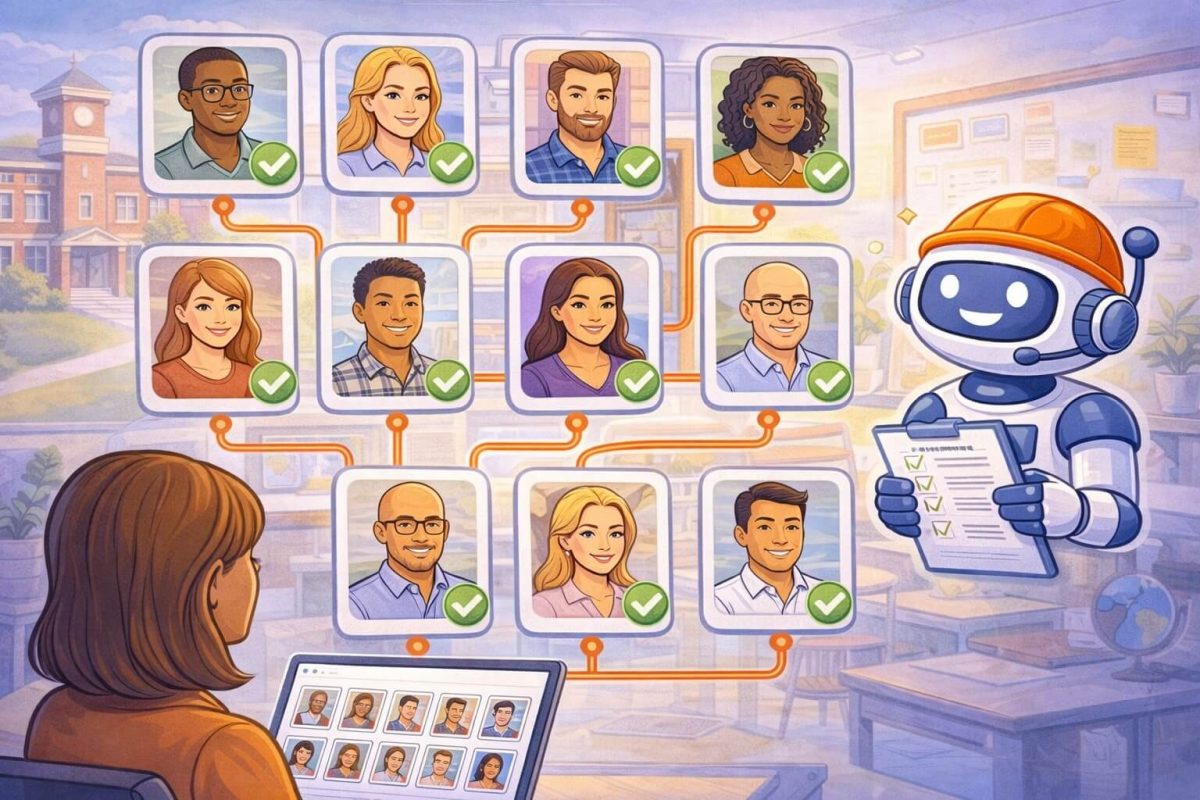
Table of Contents
School districts across America are facing an unprecedented substitute teacher crisis. According to recent SHRM research, 72% of education administrators report difficulty finding qualified substitute teachers, with some districts canceling classes or combining classrooms due to shortages. The problem has intensified since 2023, with average time-to-fill for substitute positions stretching to 45 days—time school districts simply don’t have when a teacher calls in sick at 6 AM.
The challenges extend beyond availability. Rising candidate drop-off rates (averaging 68% between initial application and interview scheduling), increasing compliance requirements around background checks and certifications, and the need to assess both classroom management skills and cultural fit make substitute teacher hiring uniquely complex. Traditional phone screening methods can’t keep pace when you need someone in a classroom by 8 AM, and manual interview processes miss qualified candidates who apply outside business hours.

That’s where CloudApper AI Recruiter transforms the game. This conversational AI chatbot conducts interviews 24/7 via SMS or web chat, screens candidates 90% faster than traditional methods, eliminates unconscious bias, and simulates real interview scenarios with sophisticated natural language processing. Districts using AI-powered recruiting report filling substitute positions in under 10 days—even during peak flu season.
We’ll give you the exact interview questions that separate great substitute teachers from mediocre ones, then show you how CloudApper AI Recruiter handles the heavy lifting automatically—so you can focus on filling classrooms, not chasing candidates.
TL;DR
Substitute teachers keep classrooms running smoothly during absences. Use these 10 proven substitute teacher interview questions to identify adaptable, skilled candidates. CloudApper AI Recruiter streamlines hiring with 24/7 screening, unbiased evaluation, and fast scheduling—reducing costs and filling education roles quicker.
Why These Questions Matter for Substitute Teachers
The substitute teacher role has evolved dramatically. Today’s substitutes aren’t just “babysitters with lesson plans”—they’re expected to maintain instructional continuity, manage diverse learning needs, navigate education technology platforms, handle behavioral challenges independently, and adapt to different grade levels and teaching styles on zero notice. Post-pandemic, they must also understand hybrid learning tools, social-emotional learning protocols, and trauma-informed classroom practices.
Old interview questions like “Why do you want to be a substitute?” or “Tell me about yourself” no longer reveal whether a candidate can de-escalate a fifth-grade meltdown or pivot from teaching algebra to leading a kindergarten art class in the same day. Modern substitute teacher interviews must assess adaptability, crisis management, technological competence, and cultural responsiveness—all while processing high volumes of candidates quickly. That’s exactly what these questions accomplish.
Top 10 Essential Substitute Teacher Interview Questions (Plus How AI Recruiter Can Automate The Entire Hiring Process)
1. “Describe how you would handle walking into a classroom with no lesson plan and limited context about where students left off.”
Why ask this? This reveals adaptability, resourcefulness, and composure under pressure—the core competencies for substitute teaching.
Sample Strong Answer: “First, I’d quickly review any available materials on the teacher’s desk and check the online learning management system for recent assignments. I’d introduce myself and ask students what they were working on last class, using that as a starting point. I always carry a ‘substitute toolkit’ with flexible activities—critical thinking prompts, collaborative projects, and educational games—that work across grade levels and subjects. For example, when I once subbed for a middle school science class with no plan, I facilitated a Socratic seminar on a recent environmental news article I had saved, which aligned with their Earth science curriculum and kept students engaged for the full period.”
2. “A student refuses to follow directions and is disrupting the entire class. The regular classroom management plan isn’t working. What’s your approach?”
Why ask this? Behavioral management is the #1 challenge substitutes face, and this assesses de-escalation skills and professionalism.
Sample Strong Answer: “I’d first use proximity—calmly move closer to the student while continuing instruction, which often resolves minor disruptions. If it continues, I’d speak privately with the student during independent work time to understand what’s triggering the behavior, offering choices that give them agency while maintaining boundaries: ‘Would you prefer to work on this at your desk or at the back table?’ If the disruption persists and impacts other students’ learning, I’d follow the school’s documented intervention protocol—usually starting with a timeout or referral to a designated support staff member. I document everything clearly for the regular teacher and administration. Building positive relationships quickly is key, so I always start class with an engaging icebreaker that establishes me as friendly but firm.”
3. “You’re assigned to substitute for three different grade levels in one week—second grade, eighth grade, and high school chemistry. How do you prepare for such varied assignments?”
Why ask this? This tests versatility and preparation habits—critical for substitutes who rarely know their assignment in advance.
Sample Strong Answer: “I maintain grade-level-specific resource folders organized by age group, each containing engagement strategies, classroom management techniques, and backup activities. For younger students, I bring interactive read-alouds and hands-on manipulatives; for middle schoolers, I focus on collaborative problem-solving activities; for high school, I prepare discussion-based prompts and current event connections. I also research the school’s specific systems before each assignment—their LMS platform, bell schedule, and emergency procedures—usually available on the district website. When possible, I arrive 15 minutes early to review materials and set up. For specialized subjects like chemistry where I’m not an expert, I focus on facilitating the existing lesson, lab safety supervision, and keeping students on task rather than attempting to teach new content.”
4. “Tell me about a time you had to quickly learn and use educational technology you’d never encountered before.”
Why ask this? Tech fluency is now non-negotiable with Google Classroom, Seesaw, Canvas, smart boards, and countless other platforms.
Sample Strong Answer: “Last semester, I was called to substitute for a fourth-grade class that used Seesaw for all assignments—a platform I’d never used. I arrived early, watched two YouTube tutorials on my phone, and explored the teacher’s existing classroom setup. Within 20 minutes, I was comfortable posting assignments, reviewing student submissions, and using the announcement feature. I stayed after school to watch more advanced tutorials so I’d be fully prepared for future Seesaw classrooms. I’ve learned that most education platforms have similar core functions, and my general tech competence lets me adapt quickly. I’m also proactive—I’ve taken free online courses on Google Classroom, Clever, and Canvas so I’m prepared for the most common systems districts use.”
5. “How would you modify instruction if you noticed several students weren’t understanding the material in a lesson you’re delivering?”
Why ask this? This assesses instructional flexibility and student-centered thinking, not just compliance with “following the plan.”
Sample Strong Answer: “I’d first check for understanding through quick formative assessment—thumbs up/down, a quick whiteboard check, or asking students to explain the concept to a partner. If multiple students are struggling, I’d pause and re-teach using a different modality. For example, if I was teaching a math concept using verbal explanation and students weren’t getting it, I’d switch to visual modeling with manipulatives or a real-world example. I might break students into small groups, working more intensively with those who need support while providing extension activities for students who’ve mastered it. I’d also document this for the regular teacher with specifics about what worked and what students need reinforcement on.”
6. “Describe your approach to maintaining student confidentiality and professionalism when you observe something concerning in a classroom.”
Why ask this? This tests understanding of mandated reporting, FERPA compliance, and professional boundaries.
Sample Strong Answer: “As a mandated reporter, if I observe signs of abuse, neglect, or imminent danger, I’d immediately report to administration and follow the district’s specific reporting protocol—this isn’t negotiable. For other concerns like academic struggles, behavioral patterns, or peer conflicts, I’d document objectively and communicate directly with the regular teacher and appropriate staff like school counselors, never discussing student issues with other substitutes, parents I encounter, or on social media. I’m careful about FERPA—I never photograph students without explicit permission, don’t discuss individual students by name outside professional contexts, and ensure any student work or information is secured. Professionalism means treating every classroom situation as confidential and every student with dignity.”
7. “A parent approaches you with questions about their child’s progress or grade. How do you handle this conversation?”
Why ask this? Boundary-setting and communication skills are essential when parents expect the same access they’d have with regular teachers.
Sample Strong Answer: “I’d respond politely and professionally, thanking them for their involvement, but explain that since I’m the substitute teacher, I don’t have access to their child’s full records or grading information. I’d say something like, ‘I can share that [child’s name] participated well today and completed their assignment, but for specific questions about grades or progress, Mr./Ms. [Regular Teacher] would be the best resource—I’ll make sure they know you’d like to connect.’ I’d document the parent interaction for the regular teacher. If a parent becomes insistent or confrontational, I’d offer to have them speak with the front office or administration immediately. Clear boundaries protect everyone while maintaining positive relationships.”
8. “What strategies do you use to build rapport quickly with students who don’t know you and may test boundaries with a substitute?”
Why ask this? Relationship-building speed determines classroom management success for substitutes.
Sample Strong Answer: “I start with a 30-second personal introduction that humanizes me—’I’m Mr./Ms. [Name], I love hiking and reading sci-fi, and I’m excited to learn with you today.’ I learn and use student names immediately, using name tents if needed. I set clear, positive expectations at the start: ‘Here’s what our time together will look like, and here’s how we’ll make it great.’ I incorporate student choice whenever possible—letting them choose their work partners or which assignment to complete first. I also use humor strategically and share genuine curiosity about their interests. Most importantly, I follow through consistently—if I say there’s a consequence, I implement it calmly; if I promise something, I deliver. Students respond to authenticity and consistency, even from substitutes they’ll only see once.”
9. “How do you ensure you’re meeting the needs of students with IEPs, 504 plans, or English Language Learners when you’re unfamiliar with their specific accommodations?”
Why ask this? Legal compliance and equitable instruction are non-negotiable, and substitutes often have limited information about accommodations.
Sample Strong Answer: “I always review any accommodation documents left by the teacher and check with special education staff or paraprofessionals who support those students. If documentation isn’t available, I implement universal design strategies that benefit all learners—providing instructions both verbally and written, allowing extra processing time, offering multiple ways to demonstrate understanding, using visual supports, and checking in individually with students who seem to be struggling. For ELL students, I use simplified language, visual aids, and peer buddies when appropriate. I never single students out or discuss their accommodations publicly. If I’m unsure about a specific accommodation, I ask the student discreetly or contact special education staff rather than guessing. Documentation is critical—I note what supports I provided so the regular teacher knows what happened in their absence.”
10. “Describe a situation where you had to make a quick decision during an emergency or safety situation.”
Why ask this? Crisis response and student safety are the ultimate responsibility, especially when the regular teacher isn’t present.
Sample Strong Answer: “During a substitute assignment, a student had a severe allergic reaction during lunch. I immediately called the office on the classroom phone while another adult present retrieved the student’s EpiPen from the nurse’s office. I kept the student calm, positioned them safely, cleared space around them, and had another student hold the door for the nurse. I followed the school’s emergency protocol exactly and documented everything afterward. In another situation, when a fire alarm sounded and I wasn’t familiar with the building’s evacuation route, I quickly checked the posted map, led students calmly outside following other classes, took attendance, and kept students grouped until the all-clear. These experiences reinforced that I need to review emergency procedures for every building I work in—it’s now the first thing I do when I arrive.”
How CloudApper AI Recruiter Makes Hiring Substitute Teachers Effortless
Imagine this: A teacher calls in sick at 6:00 AM. By 6:45 AM, your AI Recruiter has already screened five available substitutes, asked all ten questions above (or your customized versions), assessed their responses using natural language processing, ranked them by qualification match, and sent you the top three candidates—ready for you to confirm with a single click. That’s not science fiction. That’s CloudApper AI Recruiter.
Here’s how it transforms substitute teacher hiring specifically:
24/7 Conversational Screening via SMS & Chat
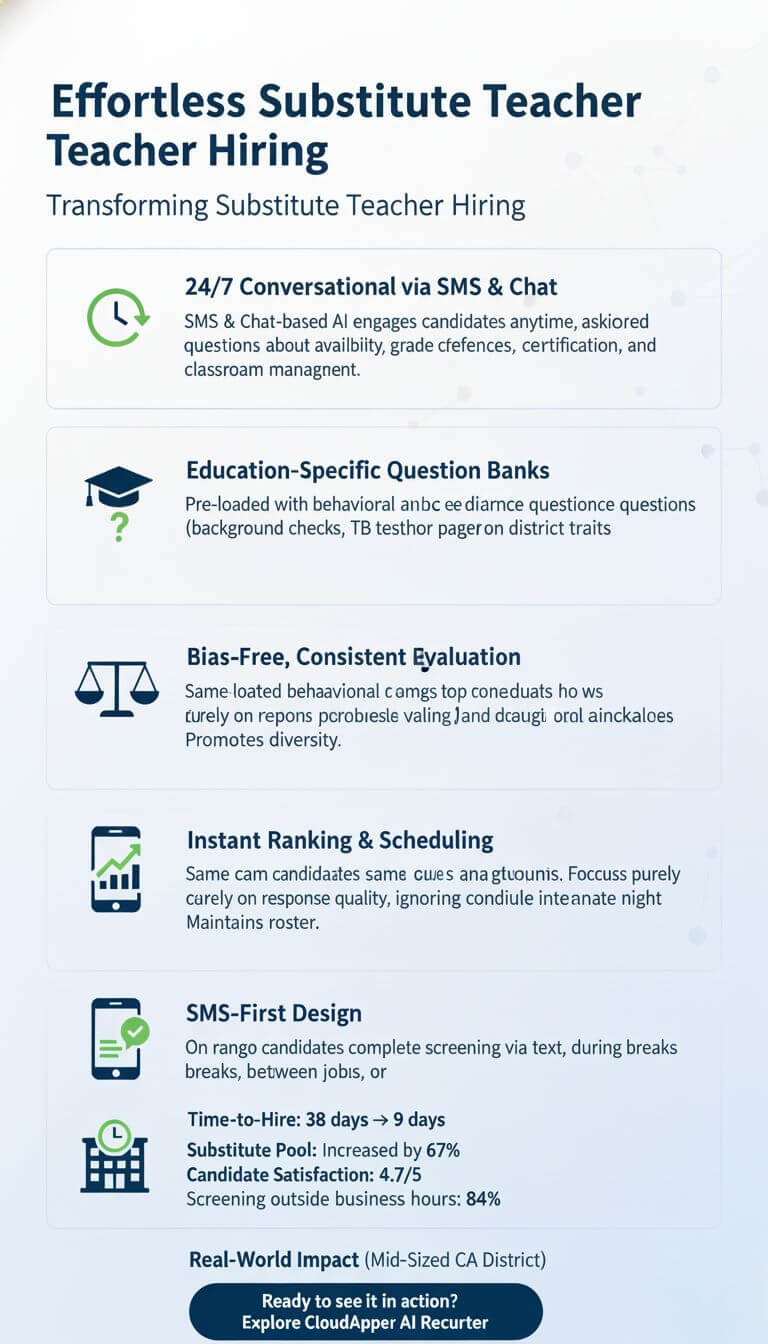
Candidates text your dedicated number or interact via web chat whenever they apply—no more waiting for business hours. The AI conducts natural, human-like conversations that ask your exact interview questions, follow up on answers, and probe deeper when responses are vague. For substitute teachers specifically, it can assess availability across multiple schools, grade-level preferences, certification status, and classroom management philosophy—all before a human ever gets involved.
Education-Specific Question Banks
CloudApper AI Recruiter comes preloaded with interview questions tailored to education roles, including scenario-based behavioral questions, compliance checks (background clearances, TB tests, credential verification), and district-specific policy assessments. You can customize every question to match your district’s values and requirements, and the AI learns which answers correlate with successful hires over time.
Bias-Free, Consistent Evaluation
Every candidate gets asked the same questions in the same way, evaluated against the same rubric. The AI doesn’t care about accents, gaps in employment, or unconventional backgrounds—it focuses purely on response quality and qualification match. This is especially powerful for substitute teaching, where diverse backgrounds and non-traditional paths often produce the most adaptable candidates.
Instant Ranking & Scheduling
After screening, CloudApper automatically ranks candidates based on your criteria, flags top performers, and can even schedule interviews or send conditional offers. For substitute pools, it maintains an active, pre-screened roster so you always have qualified candidates ready when regular teachers are absent. No more frantic 6 AM phone calls down your list.
Real-World Mini Case Study
A mid-sized California school district with 45 schools was struggling to maintain an adequate substitute teacher pool, often leaving classes without coverage during peak absence periods. After implementing CloudAapper AI Recruiter, they reduced their time-to-hire from 38 days to just 9 days, increased their substitute pool by 67%, and saw candidate satisfaction scores jump to 4.7/5 because applicants appreciated the fast, convenient screening process. Most impressively, 84% of screening conversations happened outside traditional business hours—capturing qualified candidates who would have given up on traditional phone-tag screening processes.
SMS-First Design Perfect for On-the-Go Candidates
Substitute teachers are often juggling multiple districts, part-time jobs, or other commitments. CloudAapper’s SMS-based interface lets them complete screening during lunch breaks, between assignments, or late at night—whenever works for them. The conversational format feels natural, not like filling out endless forms, and completion rates are 3x higher than traditional application portals.
Ready to see it in action? Discover how CloudApper AI Recruiter can build and maintain your substitute teacher pool effortlessly: Explore CloudAapper AI Recruiter
Frequently Asked Questions
1. Why are behavioral interview questions important for substitute teachers?
Behavioral questions reveal how candidates handle real classroom scenarios like disruptions or diverse student needs—critical for short-term sub roles.
2. How can I assess a substitute teacher’s classroom management skills?
Ask about past experiences maintaining order, handling misbehavior, and engaging students without established routines.
3. What questions evaluate adaptability for substitute teaching positions?
Probe scenarios involving unfamiliar lesson plans, sudden changes, or varied grade levels to gauge flexibility and quick thinking.
4. How do I test a candidate’s ability to engage students as a sub?
Use questions on building rapport quickly, motivating learners, and differentiating instruction in limited time.
5. Why ask about communication with staff and parents?
Subs must collaborate with regular teachers and report issues effectively—questions uncover clear, professional communication skills.
6. How does CloudApper AI Recruiter automate substitute teacher hiring?
It engages applicants 24/7 via SMS/chat, screens for certifications, experience, and availability, verifies details, and schedules interviews instantly.
7. What benefits does AI recruiting offer for school district substitute staffing?
Reduces time-to-hire by 90%, lowers costs, eliminates bias, boosts application conversion, and handles high-volume seasonal needs.
8. Can CloudApper handle urgent or last-minute substitute teacher hiring?
Yes—it scales to screen thousands quickly, asks role-specific questions (e.g., grade preferences, emergency availability), and maintains consistency.
9. How does AI ensure fair screening for substitute teacher roles?
Standardized questions focus on qualifications, skills, and experience—removing human bias from initial reviews.
10. Is CloudApper suitable for small school districts or only large ones?
Fully scalable—small districts get affordable, fast hiring; larger ones manage volume without overwhelming staff.
11. How quickly can CloudApper reduce time-to-hire for substitute teachers?
Clients report cutting from weeks to days, helping fill critical gaps before absences disrupt learning.
12. Does CloudApper integrate with existing ATS for education recruiting?
Yes—seamless integration automates outreach, screening, and data sync across popular platforms.
Stop Scrambling for Substitutes—Start Hiring Smarter
The substitute teacher shortage isn’t going away, but your hiring process can evolve to meet the moment. By asking the right interview questions and leveraging CloudAapper AI Recruiter’s conversational intelligence, you can build a deep bench of qualified, pre-screened substitutes who are ready when you need them—not 45 days later.
Our clients consistently report:

- 90% faster screening processes
- 70% reduction in time-to-hire
- 3x larger candidate pools
- 60% decrease in no-shows and drop-offs
- Elimination of after-hours admin work
The interview questions we’ve covered reveal whether candidates can truly handle the unique demands of substitute teaching in 2025. But asking them manually, at scale, for dozens or hundreds of candidates? That’s where most districts fail.
Don’t let outdated hiring processes keep your classrooms empty.
Book a personalized demo of CloudAapper AI Recruiter and see how it can screen, rank, and schedule substitute teachers automatically—while you focus on supporting students and teachers.
What’s your biggest challenge in hiring substitute teachers? Drop a comment below and let’s discuss how AI-powered recruiting can solve it. Our team monitors these conversations and often shares additional strategies tailored to your specific situation.
CloudAapper AI Recruiter: Building better workforces through conversational AI—because great hiring shouldn’t require sacrificing your nights and weekends.
You might also like to read:

What is CloudApper AI Platform?
CloudApper AI is an advanced platform that enables organizations to integrate AI into their existing enterprise systems effortlessly, without the need for technical expertise, costly development, or upgrading the underlying infrastructure. By transforming legacy systems into AI-capable solutions, CloudApper allows companies to harness the power of Generative AI quickly and efficiently. This approach has been successfully implemented with leading systems like UKG, Workday, Oracle, Paradox, Amazon AWS Bedrock and can be applied across various industries, helping businesses enhance productivity, automate processes, and gain deeper insights without the usual complexities. With CloudApper AI, you can start experiencing the transformative benefits of AI today. Learn More
CloudApper AI Solutions for HR

- Works with


- and more.








Similar Posts
How cNPS Reflects Your Recruitment and Employer Brand
The Recruitment-to-HRIS Gap: Why Your “System of Record” Should Start…