Hiring Certified Nursing Assistants faster starts with asking the right questions. Discover 10 essential CNA interview questions that reveal clinical judgment, empathy, and tech skills—plus learn how CloudApper AI Recruiter automates screening, engages candidates 24/7 via SMS, and reduces time-to-hire by 70% for healthcare facilities.

Table of Contents
TL;DR
Too Long; Didn’t Read:
Hiring CNAs is challenging with 100,000+ shortages projected, 60% candidate drop-off, and 42-day time-to-fill averages. This guide provides 10 essential CNA interview questions covering clinical judgment, patient safety, EHR proficiency, empathy, teamwork, and infection control—with sample strong answers for each.
The game-changer: CloudApper AI Recruiter automates 90% of CNA screening through conversational AI chatbot (SMS/web), asks customized questions 24/7, verifies certifications automatically, eliminates bias, and integrates with your ATS. Real results: facilities reduced time-to-hire from 38 to 11 days and cut recruiter workload by 70%. Book a demo to start screening CNAs faster.
Hiring Certified Nursing Assistants (CNAs) and Patient Care Technicians has never been more challenging. According to recent healthcare workforce reports, the U.S. is projected to face a shortage of over 100,000 CNAs by 2025, driven by an aging population and post-pandemic burnout. The average cost-per-hire for frontline healthcare roles now exceeds $4,100, and time-to-fill has stretched to 42+ days—all while patient care demands continue to escalate.
But here’s the real pain point: candidate drop-off. Nearly 60% of healthcare applicants abandon the hiring process due to slow response times, complicated applications, or lack of engagement. Traditional screening methods—phone tag, manual resume reviews, scheduling conflicts—simply can’t keep pace with the volume and urgency healthcare facilities face today.
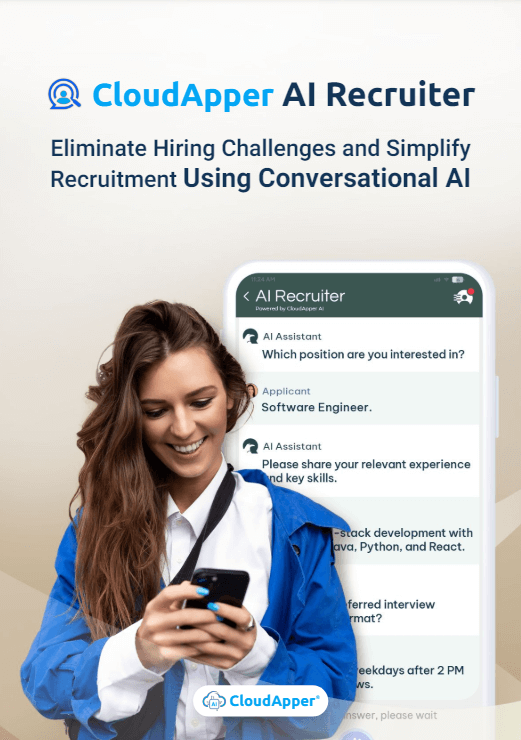
That’s where CloudApper AI Recruiter transforms the game. Our conversational AI chatbot engages candidates instantly via SMS or web chat, conducts intelligent screening interviews 24/7, and automates up to 90% of your initial screening work—all while eliminating unconscious bias and ensuring compliance. Whether a candidate applies at 2 PM or 2 AM, our AI is ready to ask the right questions, assess competency, and fast-track qualified CNAs directly to your hiring managers.
In this guide, we’ll give you the exact interview questions you need to identify exceptional CNAs and Patient Care Techs, complete with sample strong answers. Then we’ll show you how CloudApper AI Recruiter handles the heavy lifting, so you can focus on what matters: getting compassionate, skilled caregivers to the bedside faster.
Why These Questions Matter for CNAs & Patient Care Techs
The CNA role has evolved dramatically. Today’s Patient Care Technicians aren’t just assisting with daily living activities—they’re operating digital patient monitoring systems, documenting care in electronic health records (EHRs), communicating across multidisciplinary teams, and serving as the frontline defense for patient safety and satisfaction.
Old-school questions like “Why do you want to be a CNA?” barely scratch the surface. You need to assess clinical judgment under pressure, empathy in difficult situations, tech adaptability, and cultural competency. The best CNAs combine technical skills with emotional intelligence, and your interview questions must uncover both. With turnover rates for CNAs hovering around 65-70% annually in some facilities, asking the right questions upfront isn’t just smart—it’s essential to building a stable, high-performing care team.
Top 10 Essential CNA & Patient Care Tech Interview Questions (With Sample Strong Answers)
1. Describe a time when you cared for a patient who was confused, agitated, or resistant to care. How did you handle it?
Why ask this?
This reveals problem-solving skills, patience, and the ability to de-escalate situations—critical for CNAs working with dementia patients or those in acute distress.
Sample Strong Answer:
“I once cared for a patient with advanced dementia who became very agitated during morning care. Instead of forcing the routine, I took a step back, spoke calmly, and validated her feelings. I learned from her family that she loved old jazz music, so I played some softly on my phone. Within minutes, she relaxed, and I was able to complete her care while she hummed along. It taught me that person-centered care means adapting my approach to meet the patient where they are.”
2. What steps do you take to ensure patient safety during transfers or when assisting with mobility?
Why ask this?
Falls are a leading cause of injury in healthcare settings. This question assesses knowledge of proper body mechanics, use of assistive devices, and safety protocols.
Sample Strong Answer:
“First, I always assess the patient’s mobility level and check their care plan. I make sure the environment is clear—no clutter, bed at the right height, brakes locked. I use gait belts when appropriate and never rush. I also communicate with the patient throughout, explaining what we’re doing so they feel secure. If I’m uncertain, I always ask for help from another team member. Safety is a team effort, and I’d rather take an extra two minutes than risk a fall.”
3. How comfortable are you with using electronic health record (EHR) systems and digital monitoring equipment?
Why ask this?
Technology is now integral to patient care. CNAs must document accurately and operate tools like vital sign monitors, glucose meters, and communication platforms.
Sample Strong Answer:
“I’m very comfortable with EHR systems—I’ve used Epic and Cerner in my previous roles. I document vitals, intake/output, and behavioral observations in real-time to ensure accuracy. I’ve also been trained on digital thermometers, pulse oximeters, and automated blood pressure cuffs. I see technology as a tool that helps me provide better care because it gives the whole team instant access to important patient information.”
4. Tell me about a time you noticed a change in a patient’s condition. What did you do?
Why ask this?
CNAs are often the first to spot subtle changes. This question tests clinical observation skills and communication with the nursing team.
Sample Strong Answer:
“I was assisting a post-op patient when I noticed her breathing seemed more labored than usual, and her oxygen saturation had dropped to 89%. I immediately informed the RN, stayed with the patient to reassure her, and helped elevate the head of her bed. The nurse discovered she had developed a small pulmonary embolism. Because we caught it early, she recovered well. It reinforced how important it is to trust your instincts and communicate quickly.”
5. How do you maintain patient dignity and privacy, especially during personal care tasks?
Why ask this?
Compassion and respect are the foundation of quality care. This question assesses emotional intelligence and professionalism.
Sample Strong Answer:
“I always knock before entering a room, explain what I’m about to do, and ask permission. During bathing or toileting, I close curtains, cover the patient as much as possible, and work efficiently to minimize discomfort. I also engage them in conversation or let them guide the process when they’re able. Every patient deserves to feel respected, no matter their condition.”
6. Describe your experience working as part of a healthcare team. How do you handle disagreements or miscommunication?
Why ask this?
CNAs collaborate with RNs, LPNs, physicians, therapists, and families. Teamwork and conflict resolution are essential.
Sample Strong Answer:
“I see myself as part of a larger care team. I communicate clearly during shift handoffs and speak up if I notice something important. When there’s been miscommunication—like conflicting instructions—I address it respectfully and directly, usually by bringing both parties together to clarify. I’ve learned that most issues come from being busy, not from bad intentions, so I approach disagreements with curiosity, not defensiveness.”
7. How do you prioritize tasks when you’re assigned multiple patients with different needs?
Why ask this?
Time management and clinical prioritization are make-or-break skills for CNAs during busy shifts.
Sample Strong Answer:
“I start by reviewing each patient’s care plan and identifying urgent needs—like scheduled vitals, time-sensitive medications assistance, or anyone at high fall risk. I group tasks by location to be efficient, but I stay flexible because patient needs can change quickly. If I’m feeling overwhelmed, I communicate with my charge nurse so we can redistribute or get support. Patient safety always comes first.”
8. Can you give an example of how you’ve provided emotional support to a patient or their family?
Why ask this?
Empathy is at the heart of patient care. This reveals the candidate’s ability to connect on a human level.
Sample Strong Answer:
“I cared for an elderly patient who had just lost his wife. He barely spoke and refused meals. I took a few extra minutes each shift to sit with him, listen to stories about his wife, and just be present. I also coordinated with our social worker to connect him with grief counseling. Over time, he began to open up and re-engage. Sometimes the best care we give isn’t clinical—it’s just showing up with compassion.”
9. What infection control practices do you follow consistently?
Why ask this?
Infection prevention is critical, especially post-COVID. This tests knowledge of standard precautions and accountability.
Sample Strong Answer:
“I follow hand hygiene religiously—before and after every patient contact, after removing gloves, before handling food. I use PPE appropriately based on isolation precautions, and I’m diligent about environmental cleaning, especially high-touch surfaces. I also make sure to dispose of sharps and biohazard waste properly. Infection control isn’t optional; it protects patients, families, and staff.”
10. Why did you choose to become a CNA, and what keeps you motivated in this role?
Why ask this?
This uncovers intrinsic motivation and cultural fit, helping you identify candidates who’ll stay long-term.
Sample Strong Answer:
“I became a CNA because I wanted a career where I could make a tangible difference every single day. I love the relationships I build with patients and the variety of the work—no two days are the same. What keeps me motivated is knowing that when patients or families thank me, it’s because I helped them through one of the hardest times in their lives. That’s incredibly meaningful.”
Bonus Questions:
11. How do you handle high-stress or emotionally difficult situations, such as a patient passing away?
12. Describe your experience with documenting care and why accurate charting matters.
How CloudApper AI Recruiter Makes Hiring CNAs & Patient Care Techs Effortless
Now imagine this: instead of spending hours screening dozens of CNA applicants, CloudApper AI Recruiter does it for you—automatically, intelligently, and instantly.
Here’s how it works:
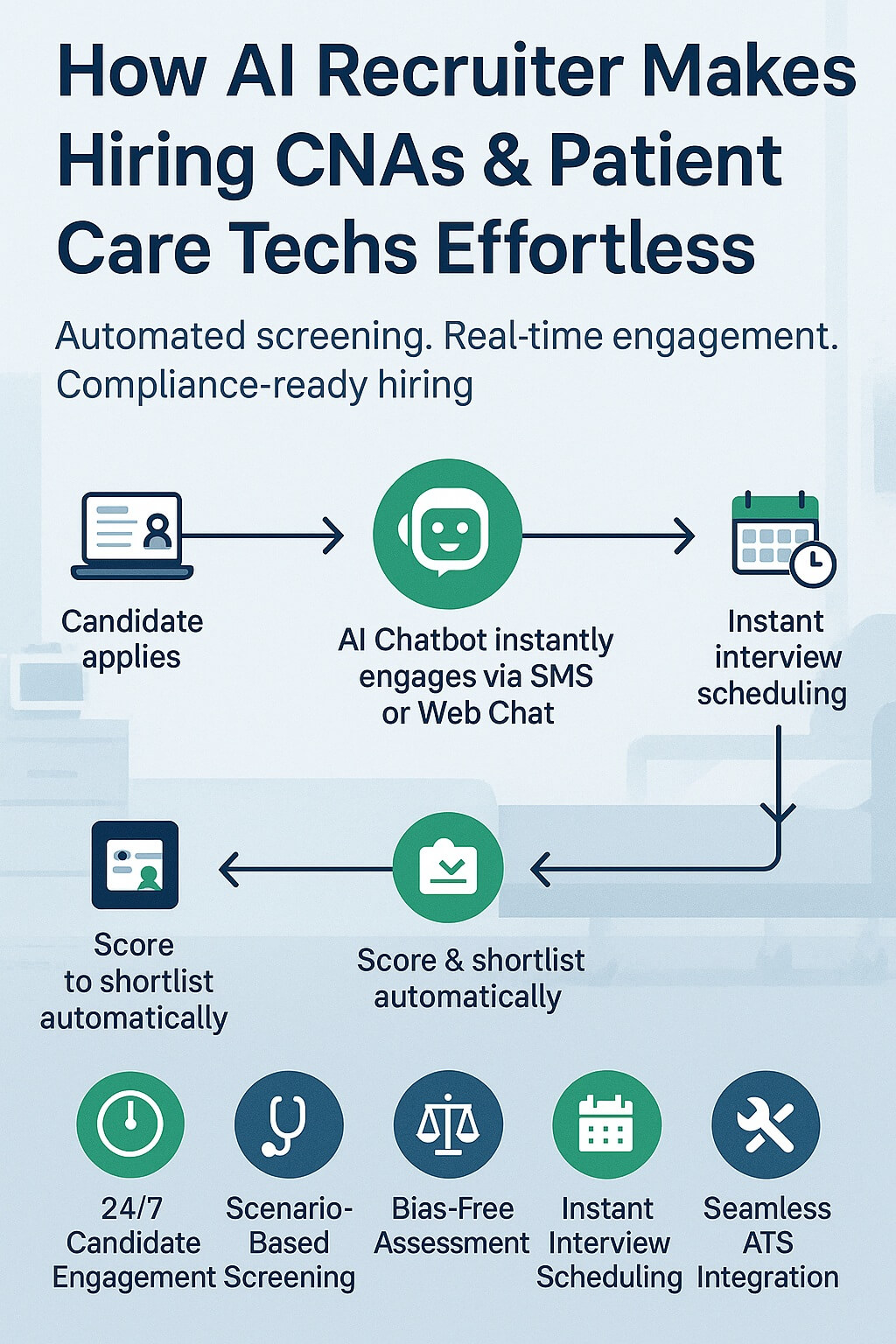
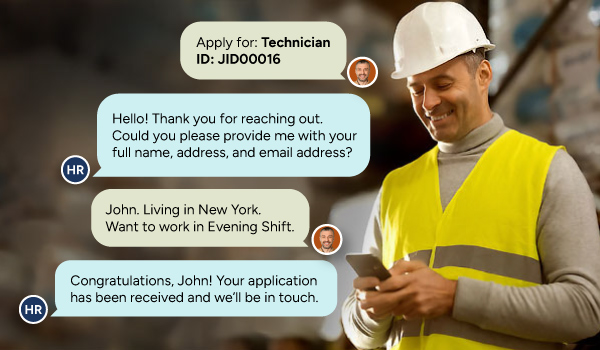
The moment a candidate applies (via your careers page, Indeed, or even a QR code at a job fair), our conversational AI chatbot engages them immediately through SMS or web chat. No waiting. No phone tag. The AI asks customized screening questions—like the ones above—assesses their experience with patient care scenarios, verifies certifications, checks shift availability, and even gauges cultural fit through behavioral questions.
Key Features That Transform CNA Hiring:
- 24/7 Candidate Engagement: Whether someone applies at midnight after their shift or on a Sunday morning, CloudApper AI responds instantly, keeping candidates warm and engaged.
- Scenario-Based Screening: Our AI can simulate real patient care situations (“A patient refuses medication—what do you do?”) and evaluate responses for clinical judgment and empathy.
- Certification & Compliance Verification: Automatically confirms active CNA licenses, CPR certifications, TB test status, and background check consent—eliminating manual follow-up.
- Bias-Free Assessments: Every candidate gets the same questions in the same tone, ensuring fair, compliant screening that focuses purely on qualifications and fit.
- Instant Scheduling: Once a candidate passes initial screening, the AI offers interview slots directly from your hiring manager’s calendar—no back-and-forth emails.
- Seamless ATS Integration: CloudApper syncs with your existing applicant tracking system (Workday, Greenhouse, iCIMS, etc.), so all data flows automatically into your workflow.
Real-World Impact:
A 250-bed skilled nursing facility in Ohio recently implemented CloudApper AI Recruiter and reduced their CNA time-to-hire from 38 days to just 11 days. By automating initial screening and engaging candidates instantly, they cut recruiter workload by 70% and improved candidate satisfaction scores by 40%. Their HR director told us, “We went from drowning in applications to having a pipeline of pre-screened, qualified CNAs ready to interview. It’s been a game-changer for our staffing crisis.”
Another healthcare system used CloudApper to screen over 600 CNA applicants in one month during a surge hiring push—something that would have required an entire team of recruiters working overtime. The AI handled it flawlessly, identifying top candidates based on experience, certifications, empathy indicators, and availability.
Ready to see it in action? Explore CloudApper AI Recruiter here and discover how healthcare organizations are filling CNA roles faster, smarter, and more efficiently than ever before.
Stop Losing Great CNAs to Slow Hiring Processes
The reality is simple: in today’s competitive healthcare talent market, speed wins. The best CNAs—the compassionate, skilled, reliable ones—are off the market in days, not weeks. If your hiring process involves multiple rounds of phone screening, delayed responses, and manual scheduling, you’re losing top talent to facilities that move faster.
CloudApper AI Recruiter levels the playing field. It gives you enterprise-grade recruiting automation at a fraction of the cost, so you can compete for talent like the major hospital systems—even if you’re a smaller facility or long-term care community.
Book a demo today and see how our AI can start screening CNA candidates in under 48 hours. Your patients deserve the best caregivers. Let us help you find them—10× faster.
Frequently Asked Questions About CNA Interview Questions & AI Recruiting
Q1: What are the most important CNA interview questions to ask?
A: The most important CNA interview questions assess clinical judgment, patient safety practices, empathy, technology skills, and teamwork. Key questions include asking candidates to describe handling agitated patients, ensuring safety during transfers, using EHR systems, noticing patient condition changes, maintaining dignity during personal care, and managing multiple patient priorities. These questions reveal both technical competency and the emotional intelligence essential for quality patient care.
Q2: How can AI help with hiring CNAs and Patient Care Technicians?
A: AI recruiting tools like CloudApper AI Recruiter automate initial candidate screening through conversational chatbots that engage applicants 24/7 via SMS or web chat. The AI asks customized interview questions, assesses responses for clinical knowledge and empathy, verifies certifications, checks shift availability, and schedules interviews automatically. This reduces recruiter workload by 70%, cuts time-to-hire from weeks to days, eliminates unconscious bias, and prevents candidate drop-off by providing instant engagement.
Q3: What should I look for in a strong CNA candidate’s answers?
A: Strong CNA answers demonstrate specific examples (not generic responses), patient-centered thinking, safety awareness, clear communication skills, adaptability, empathy, teamwork orientation, and familiarity with healthcare technology. Look for candidates who describe validating patient feelings, following proper protocols, asking for help when needed, documenting accurately, and treating patients with dignity. The best answers show both clinical competence and genuine compassion.
Q4: How long does it typically take to hire a CNA?
A: Traditional CNA hiring takes 35-45 days on average, but healthcare facilities using AI recruiting automation like CloudApper reduce this to 10-15 days. The biggest delays in traditional hiring come from slow candidate communication, manual resume screening, phone tag for scheduling, and verification of certifications. AI eliminates these bottlenecks by engaging candidates instantly, screening automatically, and coordinating interviews seamlessly.
Q5: Can CloudApper AI Recruiter integrate with our existing hiring system?
A: Yes, CloudApper AI Recruiter integrates seamlessly with major Applicant Tracking Systems (ATS) including Workday, Greenhouse, iCIMS, Lever, and others. All candidate data, screening responses, and interview schedules sync automatically into your existing workflow, so your team doesn’t need to learn new systems or manually transfer information. Learn more about integrations here.
Q6: What’s the biggest challenge in CNA recruitment right now?
A: The biggest challenges are candidate drop-off (60% abandon applications due to slow response times), talent shortages (100,000+ CNA shortage projected by 2025), high turnover (65-70% annually in some facilities), and rising cost-per-hire ($4,100+ for frontline healthcare roles). Slow, manual screening processes can’t keep pace with high application volumes and urgent staffing needs, causing facilities to lose top candidates to competitors who respond faster.
Q7: Does AI screening remove the human element from CNA hiring?
A: No—AI handles the repetitive, time-consuming initial screening so your human hiring team can focus on what they do best: building relationships with qualified candidates and making final hiring decisions. CloudApper AI conducts the first interview, asks consistent questions, verifies basics, and identifies top candidates. Your recruiters and hiring managers then conduct in-depth interviews with a pre-screened pool of qualified CNAs, making the process more efficient and personal, not less.
Q8: How does CloudApper AI Recruiter ensure fair, unbiased CNA screening?
A: CloudApper AI asks every candidate the exact same questions in the same conversational tone, eliminating unconscious bias related to age, gender, accent, appearance, or interviewer mood. The AI evaluates responses based purely on content—clinical knowledge, relevant experience, problem-solving ability, and cultural fit indicators—not on subjective factors. This creates a more equitable hiring process while maintaining compliance with EEOC guidelines.
You might also like to read:
10 Essential Home Health Aide & Phlebotomist Interview Questions (+ AI Recruiter Automation Guide)
10 Essential Registered Nurse (RN) Interview Questions to Ask (And How AI Makes Hiring Stress-Free and 10× Faster)
10 Essential Medical Assistant Interview Questions to Ask (Plus How AI Recruiter Can Automate The Entire Hiring Process)

What is CloudApper AI Platform?
CloudApper AI is an advanced platform that enables organizations to integrate AI into their existing enterprise systems effortlessly, without the need for technical expertise, costly development, or upgrading the underlying infrastructure. By transforming legacy systems into AI-capable solutions, CloudApper allows companies to harness the power of Generative AI quickly and efficiently. This approach has been successfully implemented with leading systems like UKG, Workday, Oracle, Paradox, Amazon AWS Bedrock and can be applied across various industries, helping businesses enhance productivity, automate processes, and gain deeper insights without the usual complexities. With CloudApper AI, you can start experiencing the transformative benefits of AI today. Learn More
CloudApper AI Solutions for HR

- Works with


- and more.







Similar Posts
How cNPS Reflects Your Recruitment and Employer Brand
The Recruitment-to-HRIS Gap: Why Your “System of Record” Should Start…