AI is transforming recruitment by automating resume screening, candidate engagement, and interview scheduling. This guide explores how modern AI tools like CloudApper AI Recruiter help teams hire faster, reduce bias, improve candidate experience, and make smarter hiring decisions without increasing workload.

Table of Contents
- What Is AI in Recruitment?
- AI vs. Machine Learning in Recruitment
- Why AI Matters More in Recruitment Now
- How AI Improves the Recruitment Process
- The Core Use Cases for AI in Recruitment
- How CloudApper AI Recruiter Works
- What Makes a Strong AI Recruiter?
- Can AI Reduce Bias in Hiring?
- Is AI Good for High-Volume Hiring?
- Does AI Replace Recruiters?
- How AI Helps Candidate Experience
- Security, Compliance, and Responsible Use
- Why CloudApper AI Recruiter Is Different
- The Future of AI in Recruitment
- Final Thoughts
Artificial intelligence is changing recruitment from a slow, manual process into a faster, more responsive hiring workflow. Instead of spending hours sorting resumes, coordinating interviews, and following up with candidates, recruiting teams can now automate repetitive work and focus on evaluation, decision-making, and candidate relationships. That shift matters because hiring speed, consistency, and candidate experience now directly affect whether great talent enters your pipeline or drops out before the interview stage.
AI in recruitment refers to the use of artificial intelligence to support and automate tasks such as candidate sourcing, resume screening, pre-screening, interview scheduling, communication, and hiring analysis. In practice, that means recruiters can move faster, maintain more consistent evaluation standards, and create a smoother experience for applicants. Tools like CloudApper AI Recruiter take this a step further by combining AI automation with conversational workflows, contextual resume analysis, and integration with existing ATS and HCM systems.
The broader business case for AI is only getting stronger. McKinsey has estimated that AI could add roughly $13 trillion to the global economy by 2030, while generative AI alone could contribute $2.6 trillion to $4.4 trillion annually across use cases. In talent acquisition, LinkedIn’s 2025 Future of Recruiting research also found that talent acquisition professionals already using generative AI report an average 20% reduction in workload, which translates into more time for strategic recruiting work
What Is AI in Recruitment?
AI in recruitment is the use of intelligent software to improve how organizations attract, assess, and hire talent. Instead of relying entirely on manual review and recruiter bandwidth, AI helps teams process applications faster, identify qualified candidates more consistently, automate scheduling and communication, and reduce friction across the hiring process.

This does not mean AI replaces recruiters. It means AI handles the repetitive and operational parts of hiring so recruiters can spend more time on judgment-based work like interviewing, stakeholder alignment, candidate relationship-building, and final selection. That distinction matters because the best recruiting teams are not trying to remove humans from hiring. They are trying to remove delay, inconsistency, and avoidable admin work.
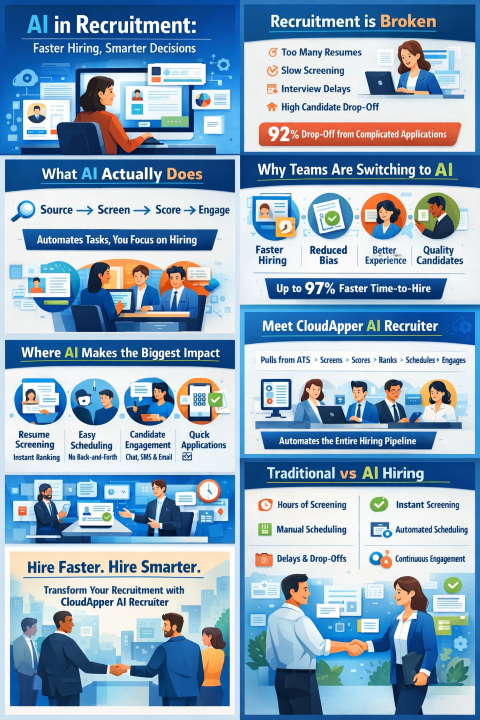
CloudApper AI Recruiter fits this model by automating resume screening, candidate scoring, pre-screening, interview scheduling, candidate engagement, and offer-letter workflows while still keeping recruiters in control of final decisions.
AI vs. Machine Learning in Recruitment
Artificial intelligence is the broad category. Machine learning is one of the technologies inside it. In recruiting, AI is the system that helps automate and optimize hiring tasks, while machine learning helps the system improve its recommendations by learning from patterns in hiring data, job requirements, and candidate interactions.
For recruiters, the distinction matters less than the outcome. What matters is whether the system can interpret resumes beyond simple keyword matching, rank candidates intelligently, support consistent evaluation, and make recruiting workflows faster and easier to manage. That is where modern platforms outperform older rule-based automation tools.
Why AI Matters More in Recruitment Now
Recruitment has become more complex. Application volume is high, candidate expectations are rising, and hiring teams are expected to move faster without sacrificing quality or fairness. At the same time, skills-based hiring is becoming more important as organizations look beyond job titles and credentials to identify real capability. The World Economic Forum’s 2025 workforce research highlights the growing importance of skills in hiring and workforce planning, which makes AI-assisted evaluation and matching even more relevant for modern talent teams.
This is exactly where AI creates value. It helps recruiters scale decision support without scaling manual workload.
How AI Improves the Recruitment Process
One of the clearest advantages of AI is efficiency. Traditional hiring workflows often slow down because recruiters are forced to move through screening, communication, scheduling, and coordination in sequence. AI removes much of that bottleneck by handling several of those steps at once. While a recruiter is reviewing finalists, the system can be screening new applicants, sending reminders, answering candidate questions, and coordinating interview times in parallel.
AI also improves consistency. Manual screening is vulnerable to fatigue, time pressure, and inconsistent interpretation across recruiters or hiring managers. AI can apply the same screening logic, scoring framework, and pre-screening sequence across every candidate in the pipeline. That does not guarantee perfect hiring decisions, but it does create a more structured process.
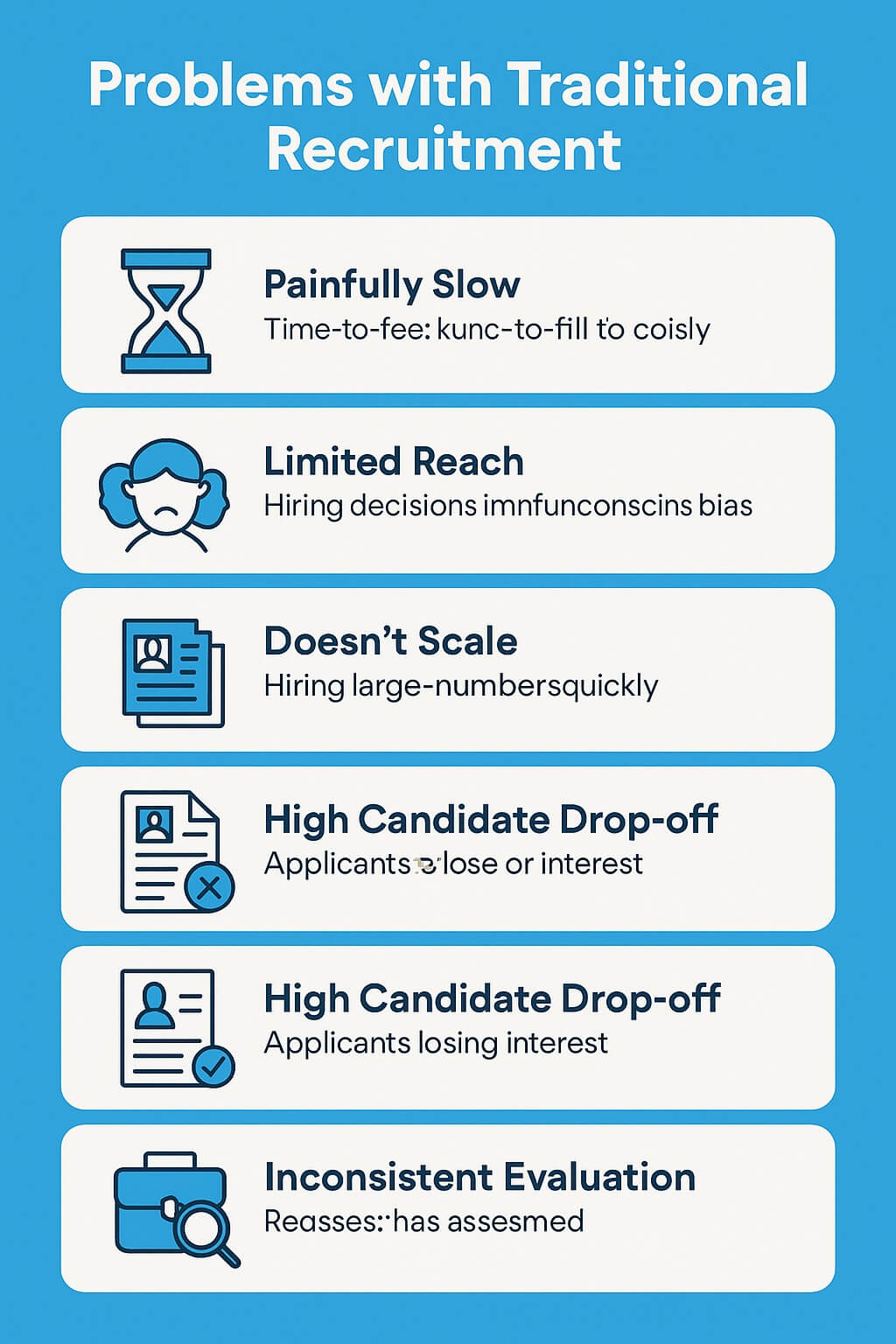
Candidate experience is another major factor. Long or clunky application journeys can push qualified people out of the funnel. CareerPlug’s 2025 candidate experience data notes that application friction and interview format choices can lead to abandonment, including one-way video interview drop-off. Faster communication and simpler workflows help reduce that kind of candidate loss.
CloudApper AI Recruiter addresses this by supporting conversational application flows, QR-code and text-based apply options, automated follow-ups, and instant interview coordination. That keeps candidates engaged instead of leaving them waiting through silence and back-and-forth emails.
The Core Use Cases for AI in Recruitment
AI is most useful when applied to the specific parts of hiring that consume the most recruiter time.
In sourcing, AI can help identify relevant candidates faster by scanning job boards, talent pools, social platforms, and internal databases. Instead of relying only on manual searches, recruiters can surface stronger-fit profiles sooner and widen the funnel more intelligently.
In screening, AI can analyze resumes contextually rather than simply matching isolated keywords. That is important because strong candidates do not always phrase experience the same way. A contextual system is more likely to recognize adjacent skills, transferable experience, and relevant accomplishments.
In pre-screening and assessment, AI can ask structured questions, collect responses, evaluate fit against role criteria, and help verify whether a candidate’s experience aligns with the actual demands of the job.
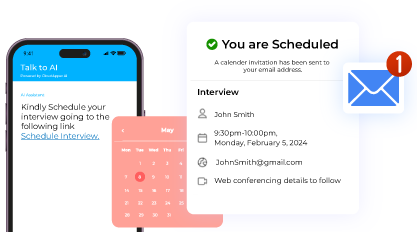
In scheduling, AI can eliminate one of the most tedious parts of recruiting by coordinating calendars, sending invitations, managing reminders, and handling reschedules automatically.
In communication, AI can keep candidates informed with updates, reminders, FAQs, and next-step guidance through email, chat, or SMS. That matters because candidate silence often creates uncertainty, and uncertainty increases drop-off.
In offer and onboarding workflows, AI can reduce delays by supporting offer generation, workflow triggers, and handoff steps that move candidates from selection to start date more smoothly.
How CloudApper AI Recruiter Works
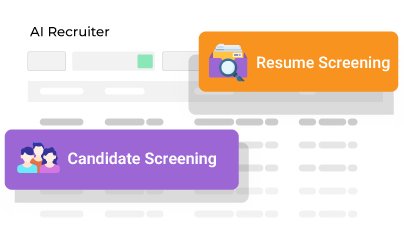
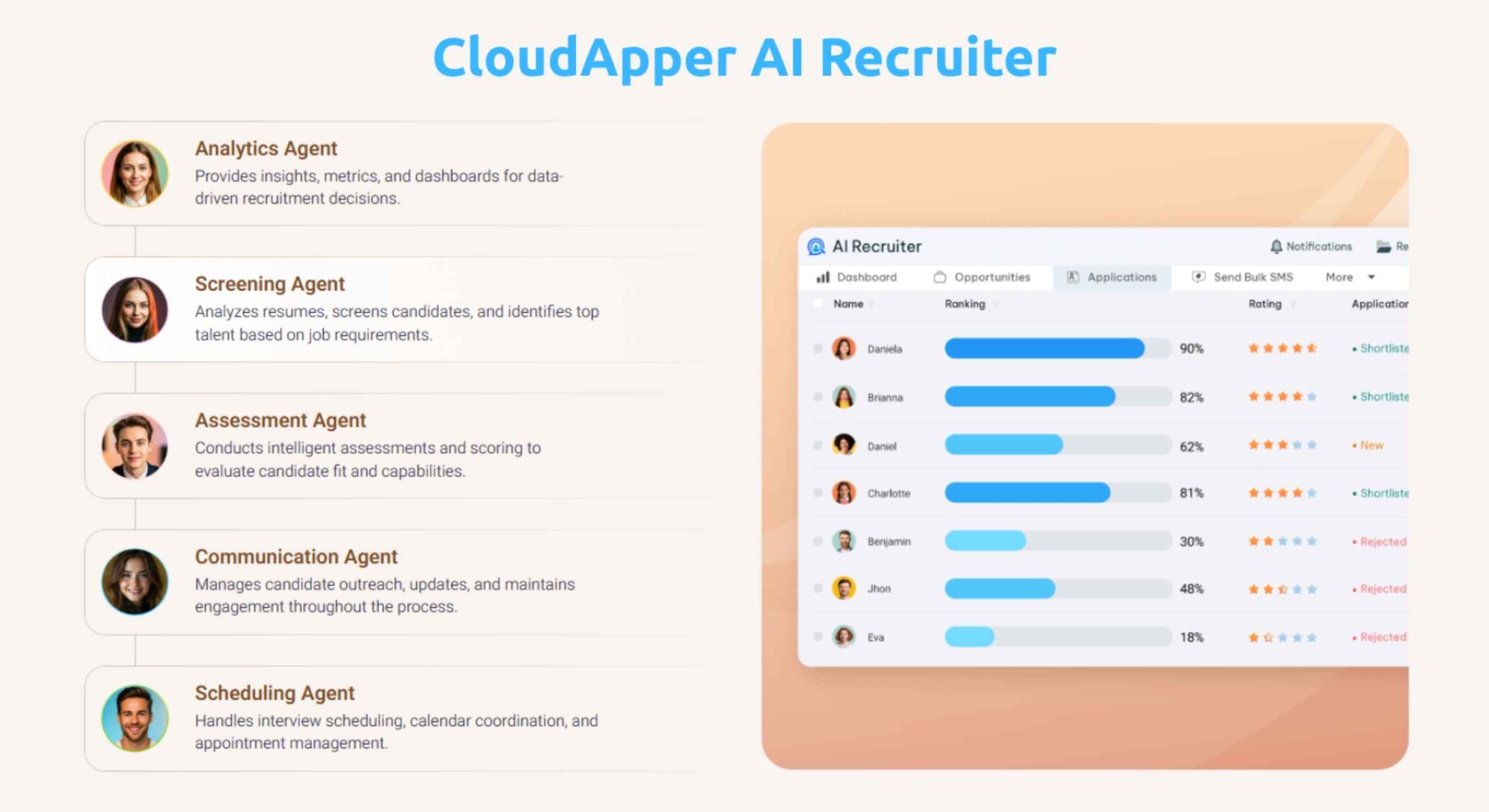
CloudApper AI Recruiter is built to automate the most time-consuming parts of recruitment while fitting into the systems teams already use. It pulls candidate data from existing ATS or HCM platforms, analyzes resumes in context, scores applicants based on configurable hiring criteria, and produces ranked shortlists for recruiter review.
From there, the platform can continue moving candidates forward through conversational pre-screening, interview scheduling, reminders, candidate engagement, and offer-related workflows. Rather than forcing organizations into a disruptive rip-and-replace model, CloudApper AI Recruiter works alongside major ATS, HRIS, and HCM systems to strengthen the existing recruiting process.
That matters for real-world recruiting teams because most are not looking for another disconnected tool. They want a system that improves speed and accuracy without creating extra complexity.
What Makes a Strong AI Recruiter?
The best AI recruitment tool is not the one with the most automation claims. It is the one that improves hiring outcomes without making the process harder to manage.
A strong AI recruiter should understand resumes in context, not just by keywords. It should support structured and configurable scoring. It should reduce manual coordination, especially in high-volume hiring. It should help maintain consistent evaluation standards. It should improve candidate experience rather than turning recruiting into an impersonal automation funnel. And it should integrate with the systems the organization already depends on.
That is why teams evaluating AI recruiting software should look beyond generic “AI-powered” language and ask more practical questions. Can the system support your actual workflow? Can it fit your ATS or HCM environment? Can it help you move faster without losing control? Can it keep candidates engaged throughout the process? Can it help recruiters focus on better decisions instead of more admin?
CloudApper AI Recruiter is positioned well here because it combines automation, conversational engagement, integration, and customizable workflows instead of treating AI as a single-feature add-on.
Can AI Reduce Bias in Hiring?
AI can help reduce bias, but only when it is designed and used responsibly. In recruitment, bias reduction usually comes from standardizing how candidates are evaluated, limiting the influence of irrelevant personal identifiers, and applying consistent job-based criteria across the funnel.
CloudApper AI Recruiter supports this by evaluating candidates against role-specific requirements, using structured scoring logic, and helping teams focus more on qualifications, fit, and demonstrated ability than on subjective first impressions. That does not remove the need for human oversight. It makes the process more structured and auditable.
The strongest message here is not that AI makes hiring bias disappear. It is that well-designed AI can help reduce inconsistency and make fairer evaluation easier to maintain at scale.
Is AI Good for High-Volume Hiring?
Yes, and this is one of the clearest use cases. High-volume hiring breaks down when recruiters are buried in repetitive screening, scheduling, and follow-up tasks. Roles in retail, healthcare, hospitality, logistics, manufacturing, and call centers often create exactly that problem.
AI helps because it can process large application volumes quickly, identify likely-fit candidates, automate early-stage communication, and keep the process moving even when recruiter capacity is limited. Instead of letting application volume create delays, AI turns that volume into a more manageable pipeline.
CloudApper AI Recruiter is particularly suited to this kind of environment because it combines resume screening, candidate scoring, communication, and interview scheduling into one automated flow.
Does AI Replace Recruiters?
No. AI changes how recruiters spend their time; it does not eliminate the need for them.
Recruiters still make final hiring decisions, assess nuance, build trust with candidates, align stakeholders, and evaluate context that software alone cannot fully capture. LinkedIn’s 2025 recruiting research makes a similar point: AI is increasing recruiter productivity, which allows more focus on uniquely human skills such as communication, relationship-building, and adaptability.
The better way to frame AI in recruiting is this: AI handles repetitive work, while recruiters handle judgment, relationships, and hiring strategy.
How AI Helps Candidate Experience
Candidate experience is often treated as secondary, but it directly affects conversion. The easier it is to apply, get answers, and move forward, the more likely qualified candidates are to stay engaged.
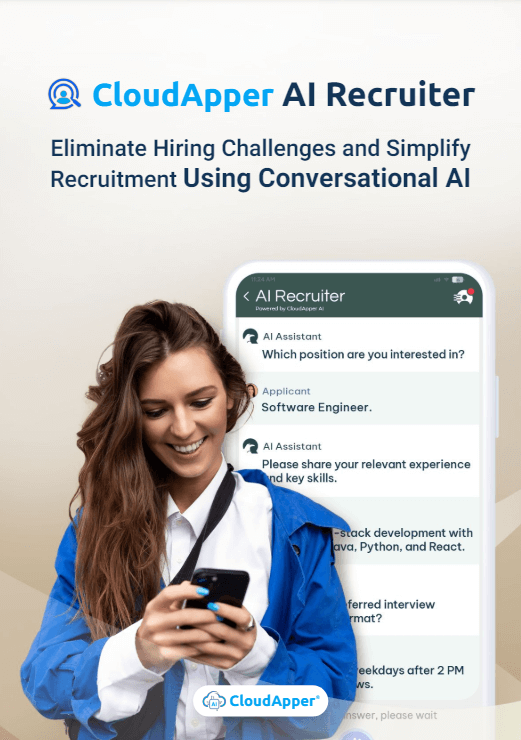
AI can help by reducing friction at every stage. It can simplify application flows, offer conversational guidance, answer common questions instantly, send reminders, and accelerate interview coordination. That speed and clarity are especially valuable for mobile-first candidates and time-sensitive roles.
CloudApper AI Recruiter improves this experience through chat, SMS, and email engagement, along with QR-based and conversational apply flows that reduce the burden of long, traditional application forms.
Security, Compliance, and Responsible Use
AI in recruitment must be secure and responsibly implemented. Candidate data is sensitive, and hiring decisions are high-stakes. That means any recruiting platform should support secure data handling, access controls, transparency, and workflow accountability.
CloudApper AI Recruiter is positioned as a secure, integration-friendly solution that helps organizations automate responsibly while maintaining visibility into recruiting actions and workflows. That balance is important because companies increasingly need systems that support both speed and governance.
Why CloudApper AI Recruiter Is Different
Many recruiting tools automate one part of the process. CloudApper AI Recruiter is stronger when viewed as an end-to-end recruitment acceleration platform. It does not just sort resumes. It helps teams source, screen, assess, schedule, communicate, and move candidates through the funnel with far less manual effort.
It is also designed to work with existing ATS, HRIS, and HCM systems rather than requiring disruptive process changes. That makes it more practical for organizations that want faster hiring without reworking their entire recruiting stack.
For teams dealing with application overload, slow follow-up, candidate drop-off, or inconsistent early-stage screening, that combination is where the value becomes clear.
The Future of AI in Recruitment
AI in recruitment is moving beyond simple automation into workflow orchestration, structured decision support, and skills-based talent matching. As companies continue to prioritize faster hiring, better candidate experience, and more consistent evaluation, AI will become a more embedded part of recruiting operations rather than a separate experiment.
The winners will not be the organizations that automate everything blindly. They will be the ones that use AI to remove friction, improve visibility, and help recruiters do better work.
Final Thoughts
AI is reshaping recruitment because it solves real problems: too much manual screening, too much delay, too much coordination overhead, and too many qualified candidates slipping away. When implemented well, AI helps recruiting teams move faster, evaluate more consistently, and deliver a stronger experience to candidates.
CloudApper AI Recruiter brings those benefits together in one platform by automating resume screening, candidate ranking, conversational engagement, interview scheduling, and workflow integration across existing recruiting systems.
If your team is trying to hire faster without sacrificing quality, consistency, or candidate experience, AI is no longer optional to explore. It is becoming a practical advantage. Discover how CloudApper AI Recruiter can help your organization attract, engage, and hire top talent efficiently. Contact us today!
What is CloudApper AI Platform?
CloudApper AI is an advanced platform that enables organizations to integrate AI into their existing enterprise systems effortlessly, without the need for technical expertise, costly development, or upgrading the underlying infrastructure. By transforming legacy systems into AI-capable solutions, CloudApper allows companies to harness the power of Generative AI quickly and efficiently. This approach has been successfully implemented with leading systems like UKG, Workday, Oracle, Paradox, Amazon AWS Bedrock and can be applied across various industries, helping businesses enhance productivity, automate processes, and gain deeper insights without the usual complexities. With CloudApper AI, you can start experiencing the transformative benefits of AI today. Learn More
- Useful Links:
- Agentic AI
- No-Code/Low-Code
- Custom Software
- HCM Personalization
- iPaaS
- FedRAMP
CloudApper AI Solutions for HR

- Works with







- and more.
Similar Posts

How to Reduce Interview Rounds Without Lowering Your Hiring Standards

How to Stop Losing Shortlisted Candidates During a Hiring Surge…