Screening 500+ applications in Dayforce manually takes weeks and causes you to lose top candidates. AI recruiting automation reviews every resume in minutes, asks qualifying questions automatically, schedules interviews instantly, and syncs everything back to Dayforce—helping healthcare, retail, and manufacturing companies hire 10X faster.


Table of Contents
Why Screening Hundreds of Applications Quickly Matters
Picture this: It’s Monday morning. You have 500/1000 new applications in Dayforce for your open nursing positions, retail store associates, or manufacturing line workers. Your hiring manager needs people by next week. But you’re staring at a screen, clicking through resume after resume, trying to figure out who’s actually qualified. Hours pass. You’ve only reviewed 50 applications. You still have 450 to go.
Sound familiar? If you work in healthcare, retail, or manufacturing, you know this problem too well. When you need to hire 50, 100, or even 1,000 people quickly, manually screening applications in Dayforce becomes nearly impossible. The system works great for managing HR tasks, but when applications flood in, the clicking, sorting, and reviewing can eat up your entire week.
Here’s why this matters: In 2025, the average company takes 42 days to fill a position. That’s six weeks! When you’re competing for talent in tight labor markets, the best candidates are gone in 10 days. If your screening process takes too long, you lose great people to faster companies. Plus, every day a position stays empty costs you money—about $98 per day according to recent research. For 50 empty positions, that’s nearly $5,000 lost every single day.
The good news? There’s a better way. You don’t need to replace Dayforce or hire more recruiters. You just need to add smart automation that does the heavy lifting for you.
What Problems Does Slow Screening Create?
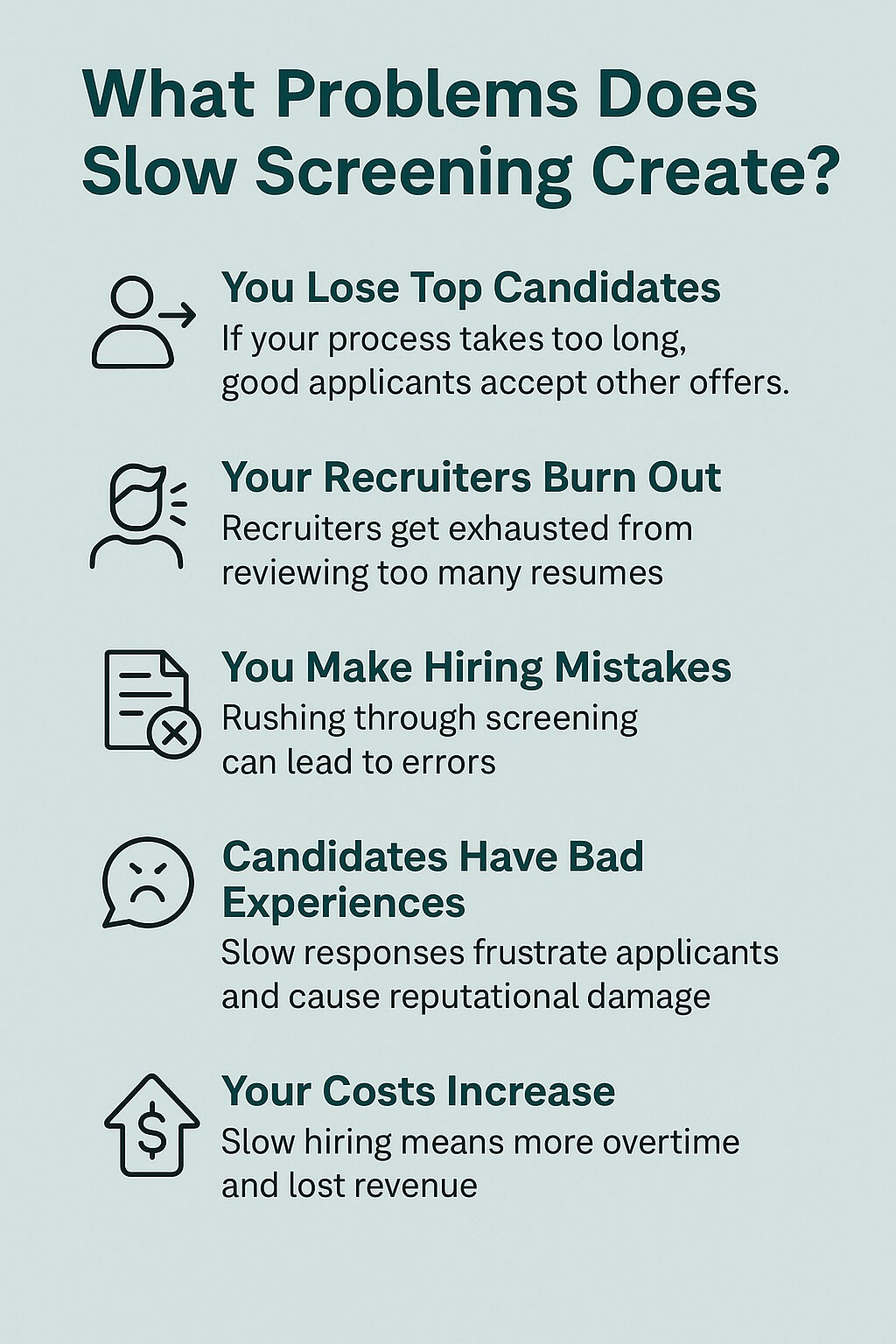
You Lose Top Candidates
The best nurses, retail workers, and skilled manufacturing employees get multiple job offers. If your screening process takes days or weeks, these candidates accept other jobs while waiting to hear from you. Speed wins in today’s hiring market.
Your Recruiters Burn Out
When recruiters spend 40 hours per week just reading resumes and answering basic candidate questions, they get exhausted. This isn’t why they got into HR. They want to talk with people, assess fit, and make smart hiring decisions—not click buttons all day.
You Make Hiring Mistakes
When you’re rushing through hundreds of applications, you miss things. Maybe you overlook a great candidate because their resume was formatted differently. Maybe you accidentally move forward someone who doesn’t have the required license or certification. When screening is manual and you’re overwhelmed, mistakes happen.
Candidates Have Bad Experiences
Today’s job seekers expect fast responses. When they apply to your company and hear nothing for weeks, they assume you’re not interested. They get frustrated. They tell their friends about the bad experience. Your company’s reputation suffers, making future hiring even harder.
Your Costs Increase
Slow hiring means empty positions stay empty longer. That means overtime costs for your current employees who pick up the slack. It might mean using expensive temporary staffing agencies. It could mean lost revenue because you don’t have enough people to serve customers or meet production goals.
How Dayforce Works (And Why It Slows Down With Volume)
Dayforce is a powerful system. It handles payroll, benefits, time tracking, and yes, recruiting too. But here’s the thing: Because Dayforce does so many different things, the recruiting part can feel complicated and click-heavy when you’re dealing with hundreds of applications at once.
Think of Dayforce as a Swiss Army knife—it has lots of tools, but some tasks need something more specialized. When you’re trying to quickly screen 500 applications, you need a specialized tool built specifically for that purpose.
In Dayforce, screening typically means:
- Opening each application one by one
- Reading through the resume
- Checking if they meet basic requirements
- Manually sending emails to candidates
- Trying to schedule interviews through back-and-forth messages
- Updating candidate status
- Moving to the next application
When you have 10 applications, this works fine. When you have 500? It becomes a full-time job—or several full-time jobs.
How AI Automation Solves the High-Volume Problem
This is where AI recruiting automation changes everything. Instead of you doing all that clicking and reading, smart AI software does it for you—in minutes instead of days.
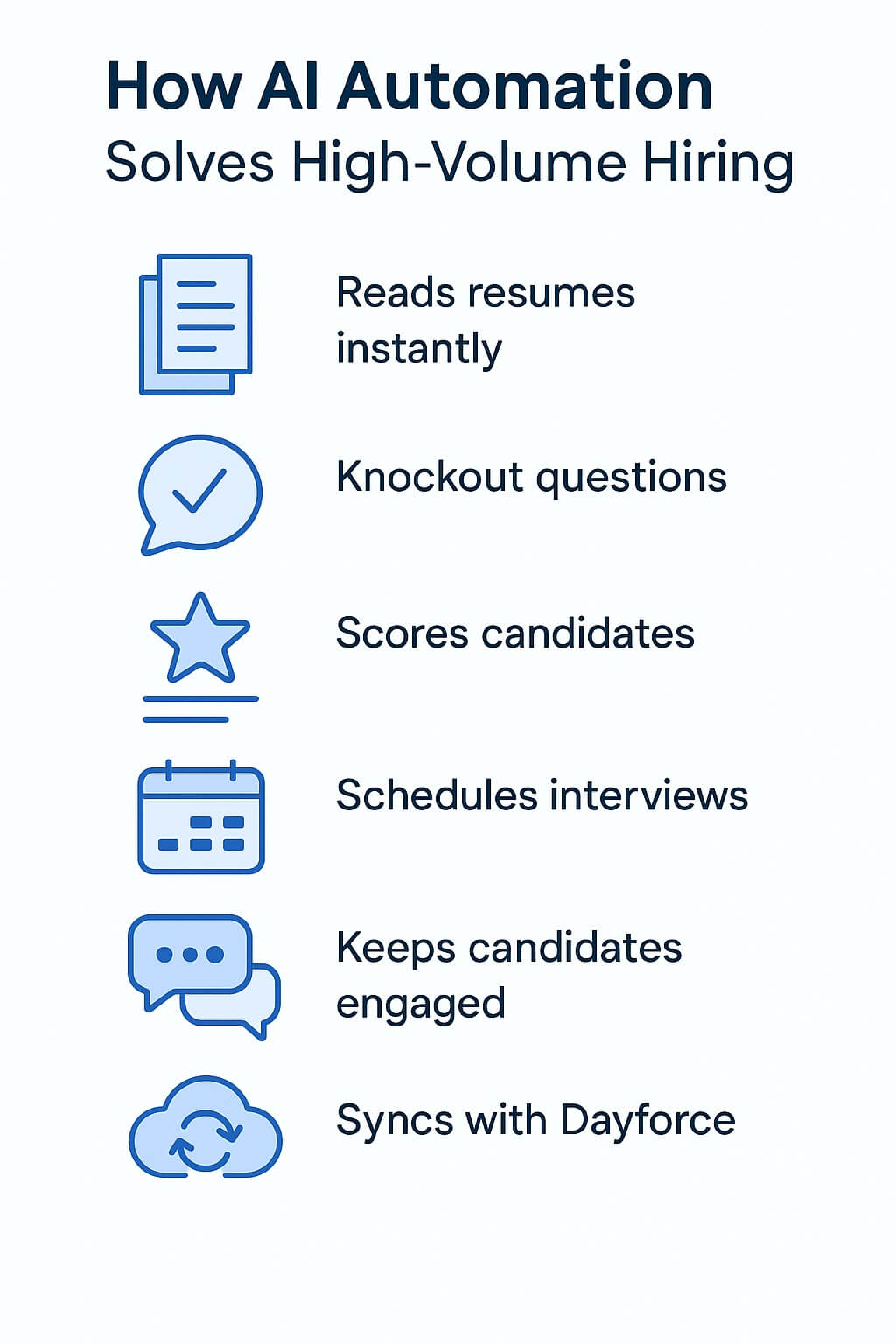
What AI Automation Actually Does
Think of AI automation as a super-smart assistant that works 24/7 and never gets tired. Here’s what happens:
Step 1: AI Reads Every Resume Instantly
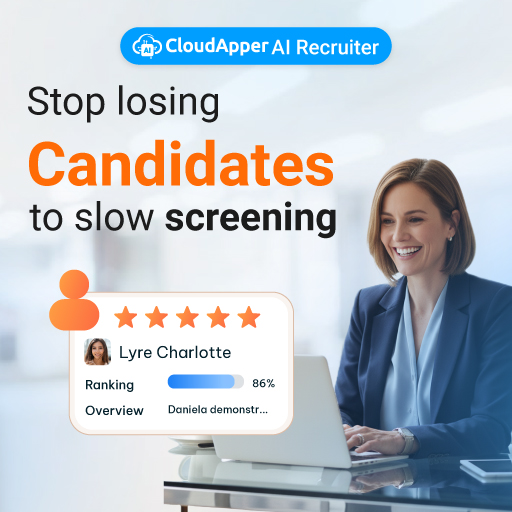
The moment someone applies through Dayforce, AI software pulls their application and reads it. Not just looking for keywords like “nurse” or “retail”—it actually understands their experience. It sees that someone worked as a “patient care coordinator” and recognizes that’s similar to nursing experience. It catches things human eyes might miss when tired.
Step 2: AI Asks Knockout Questions
For every job, there are deal-breaker questions. For a nursing job: “Do you have an active RN license?” For retail: “Can you work weekends?” For manufacturing: “Can you work night shifts?”
The AI automatically asks candidates these questions through text message, email, or chat. Candidates answer on their phones in minutes. The AI instantly knows who passes and who doesn’t.
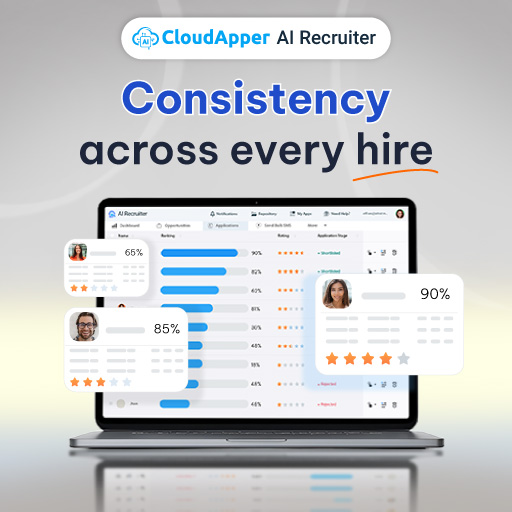
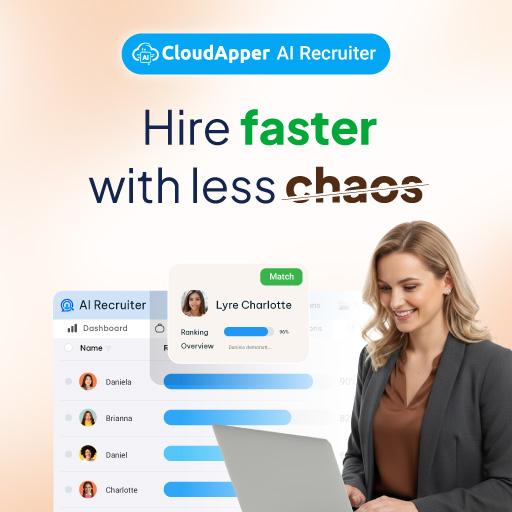
Step 3: AI Scores Every Candidate
Based on the resume and their answers, the AI gives each candidate a score. The best matches get high scores. People who don’t meet requirements get low scores. You instantly see who’s worth interviewing, ranked from best to worst.
Step 4: AI Schedules Interviews Automatically
For qualified candidates, the AI looks at your calendar and sends them available interview times. Candidates pick a time that works. The AI puts it on your calendar and sends reminders. No back-and-forth emails. No phone tag. Just scheduled interviews with qualified people.
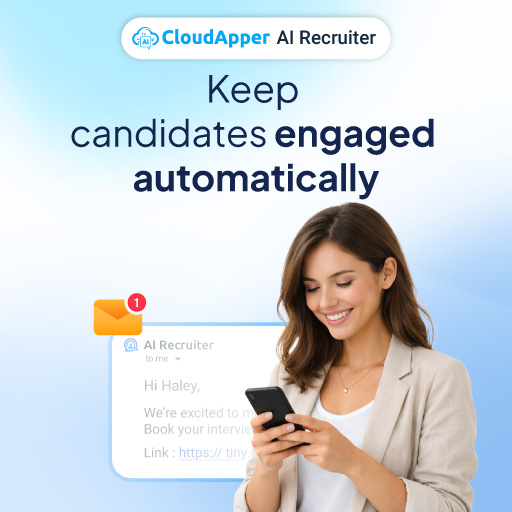
Step 5: AI Keeps Candidates Engaged
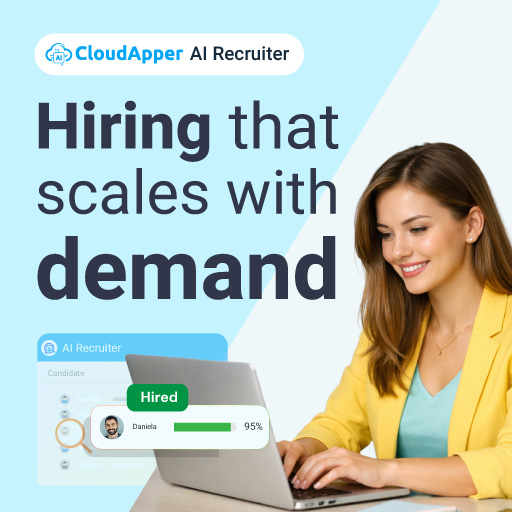
The AI automatically answers common candidate questions (“What are the hours?” “What’s the pay?” “When will I hear back?”). It sends updates. It keeps people interested in your job while you’re reviewing the top candidates.
Step 6: Everything Syncs Back to Dayforce
All this happens in the background, and everything—scores, notes, scheduled interviews, candidate responses—automatically gets saved in Dayforce. Your system stays organized without you having to enter anything manually.
Real Results: From Days to Minutes
Let’s look at real numbers. Here’s what changes when you add AI automation to Dayforce:
Before AI Automation:
- Time to screen 500 applications: 25-50 hours (one to two full work weeks)
- Applications lost in the pile: About 30% of good candidates get missed
- Time to schedule 50 interviews: 15-20 hours of back-and-forth emails
- Candidate response time: 3-7 days
- Recruiter workload: Overwhelmed, mostly doing admin work
After AI Automation:
- Time to screen 500 applications: Minutes (AI does it automatically)
- Applications lost in the pile: Nearly zero—AI reviews every single one
- Time to schedule 50 interviews: Happens automatically while you sleep
- Candidate response time: Instant
- Recruiter workload: Focused on interviewing and hiring decisions
One healthcare system reported screening 1,000 nursing applications in under an hour using AI automation—work that previously took their team three weeks. A retail company filled 500 seasonal positions in two weeks instead of their usual two months.
Benefits That Transform Your Hiring
Hire 10X Faster
When screening happens in minutes instead of days, your entire hiring process speeds up. Positions that used to take 45 days to fill now take 15 days. For industries like healthcare and retail where every day counts, this is game-changing.
Never Miss a Great Candidate
The AI reviews every single application thoroughly. It doesn’t get tired after application number 50. It doesn’t accidentally skip someone with a weird resume format. Every qualified person gets seen and scored fairly.
Free Up Your Team for Important Work
Your recruiters stop spending 70% of their time on boring admin tasks. Instead, they focus on interviewing, building relationships with candidates, working with hiring managers, and making smart hiring decisions. This is what they want to do anyway—the work they’re actually good at.
Give Candidates a Modern Experience
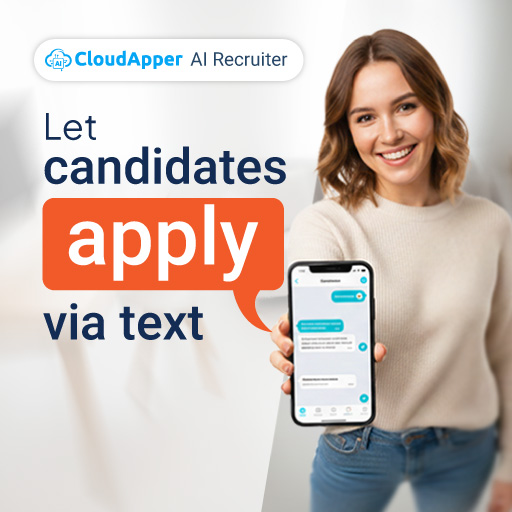
Today’s workers—especially younger ones—expect fast, mobile-friendly experiences. They want to apply by texting a number or scanning a QR code. They want instant answers to questions. They want quick responses. AI automation delivers all of this, making your company look modern and organized.
Reduce Hiring Costs Dramatically
When you hire faster, you spend less. Less overtime for current staff. Fewer days with empty positions. No need for expensive temporary staffing agencies. Lower cost-per-hire because your recruiters handle more volume with the same team size. Companies typically save 40-60% on cost-per-hire.
Remove Bias and Hire More Fairly
AI evaluates everyone using the same criteria. It doesn’t care about names, ages, or where someone went to school. It looks at skills and qualifications. This leads to fairer hiring and more diverse teams—which research shows perform better and are more innovative.
Scale Up or Down Easily
Having a slow season? The AI handles that. Suddenly need to hire 1,000 people for the holidays? The AI handles that too. You don’t need to hire temporary recruiters or stress about training them. The AI scales instantly to whatever volume you need.
How This Works With Your Dayforce System
You might be wondering: “Do I need to replace Dayforce?” Absolutely not. That would be expensive, disruptive, and unnecessary.
AI recruiting automation works as an add-on layer that sits on top of Dayforce. Think of it like adding a turbo booster to your car—the car is the same, but now it goes faster.
Here’s how the integration works:
- AI Connects to Dayforce: The automation software connects directly to your Dayforce system. It can read job postings, pull in new applications, and see candidate information.
- AI Does the Work: All the screening, scoring, questions, and scheduling happens in the AI system. Candidates interact with the AI through text, email, or chat.
- Results Go Back to Dayforce: Everything the AI learns—candidate scores, notes, scheduled interviews, answers to questions—automatically gets saved in Dayforce. Your central system stays updated without manual data entry.
- You See the Best Candidates: When you log into Dayforce, you see a clean list of qualified candidates, already ranked, with interviews already scheduled. The grunt work happened automatically.
Your IT team doesn’t need to do major integration work. Your recruiters don’t need to learn a completely new system. Everything works smoothly in the background.
Industries This Helps Most
While AI recruiting automation helps any company with high-volume hiring, it’s particularly valuable for:
Healthcare: Hospitals, nursing homes, home health agencies, and medical facilities constantly need nurses, CNAs, medical assistants, and support staff. Credentials need verification, licenses need checking, and positions need filling fast to maintain patient care. AI handles all of this automatically.
Retail: Whether hiring seasonal workers for the holidays or staffing new store locations, retail needs to process hundreds of applications quickly. Many applicants are hourly workers applying from their phones. AI makes the application process mobile-friendly and fast.
Manufacturing: Production facilities need reliable workers who can handle specific equipment, work particular shifts, and meet safety requirements. AI can verify these qualifications quickly and keep a steady pipeline of qualified candidates ready.
Frequently Asked Questions
How much does AI recruiting automation cost?
It’s much more affordable than you might think—typically far less than hiring even one additional recruiter. Most companies see return on investment within 2-3 months through faster hiring and reduced costs. Think about it this way: If AI saves your team 30 hours per week of screening time, that’s almost a full-time position’s worth of work. The cost is usually a fraction of that salary.
Will candidates be upset interacting with AI instead of a person?
Actually, most candidates prefer it! They like getting instant responses instead of waiting days for emails. They appreciate being able to apply and answer questions from their phone. They enjoy picking their own interview times instead of playing phone tag. What frustrates candidates is slow responses and complicated processes—AI fixes both of these problems.
What if the AI makes a mistake and rejects a good candidate?
Quality AI systems are less likely to make mistakes than tired humans reviewing their 300th resume of the day. The AI applies the same criteria consistently every single time. Plus, the AI doesn’t reject anyone permanently—it ranks candidates so you can review the scores and make final decisions. You’re still in control, but now you have smart recommendations instead of a pile of unreviewed applications.
How long does it take to set up?
Most systems are up and running within days, not months. You’ll work with the AI team to configure your specific needs—what questions to ask, how to score candidates, how to connect with Dayforce. Then you’re ready to go. Many companies start seeing results in the first week.
Do we still need our recruiting team?
Yes! AI doesn’t replace recruiters—it makes them better at their jobs. Your team stops doing boring tasks like reading hundreds of resumes and scheduling interviews. Instead, they focus on the human parts of recruiting: conducting great interviews, assessing cultural fit, building relationships with hiring managers, and making smart hiring decisions. Most companies find their recruiters are happier because they’re doing more meaningful work.
What about jobs that need special screening or complex requirements?
That’s actually where AI shines. You can configure the AI to ask specific questions for each job. Need to verify nursing licenses? The AI asks. Need to confirm forklift certification? The AI checks. Need to assess shift availability? The AI figures it out. The AI adapts to your requirements—you’re not stuck with generic screening.
Can we try it before fully committing?
Most AI recruiting automation companies offer demos where they show you exactly how it works with your Dayforce system. Some offer pilot programs where you can test it on a specific job or location before rolling it out company-wide. This lets you see the real results before making a full commitment.
Will this work for our small company, or is it just for big corporations?
AI recruiting automation works great for small and mid-sized companies—often better than for large ones! If you’re a small HR team drowning in applications, AI can make you as productive as a team five times your size. The technology scales to your needs, whether you’re hiring 50 people or 5,000.
Taking Action: What To Do Next
If you’re tired of drowning in applications, losing great candidates to faster companies, and watching your recruiting team burn out on admin work, AI recruiting automation might be exactly what you need.
Here’s how to explore this option:
- Assess Your Current Process: How many hours per week does your team spend just screening resumes? How long do your positions stay open? How many great candidates do you think you’re missing? Get honest about the current state.
- Calculate the Cost: Add up what slow hiring costs you. Empty position costs, overtime, agency fees, lost productivity. The number is probably bigger than you think.
- Request a Demo: See how AI automation actually works with Dayforce. Good vendors will show you real examples and can demonstrate the integration with your actual system.
- Start Small: You don’t have to automate everything at once. Try it for one job category or location. See the results. Then expand.
- Measure Results: Track time-to-hire, cost-per-hire, candidate quality, and recruiter satisfaction. You’ll see the difference quickly.
The companies that embrace AI recruiting automation now are the ones winning the talent war. They’re hiring faster, saving money, and building better teams. Meanwhile, companies still manually screening hundreds of applications are falling behind.
In healthcare, retail, and manufacturing—where every position matters and speed is crucial—you can’t afford to keep doing things the old way. Your competitors are already using these tools. Your best candidates are already applying to companies with faster processes. The time to modernize is now.
The question isn’t whether AI recruiting automation works—thousands of companies have already proven it does. The real question is: How much longer can you afford to wait?

What is CloudApper AI Platform?
CloudApper AI is an advanced platform that enables organizations to integrate AI into their existing enterprise systems effortlessly, without the need for technical expertise, costly development, or upgrading the underlying infrastructure. By transforming legacy systems into AI-capable solutions, CloudApper allows companies to harness the power of Generative AI quickly and efficiently. This approach has been successfully implemented with leading systems like UKG, Workday, Oracle, Paradox, Amazon AWS Bedrock and can be applied across various industries, helping businesses enhance productivity, automate processes, and gain deeper insights without the usual complexities. With CloudApper AI, you can start experiencing the transformative benefits of AI today. Learn More
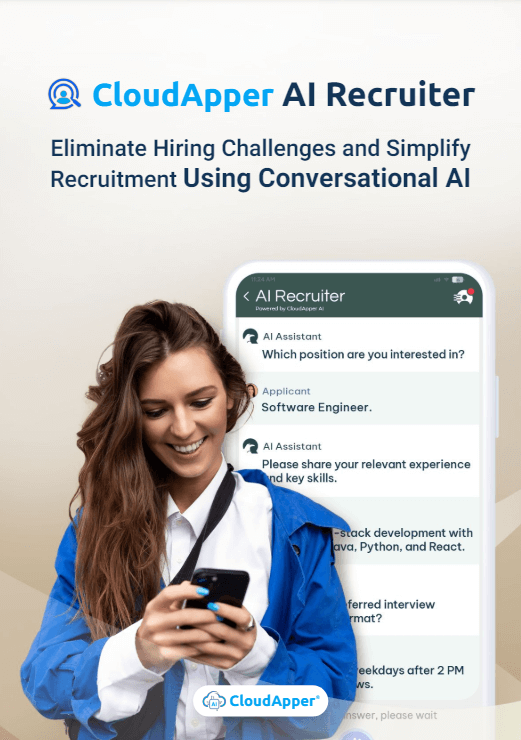
CloudApper AI Solutions for HR
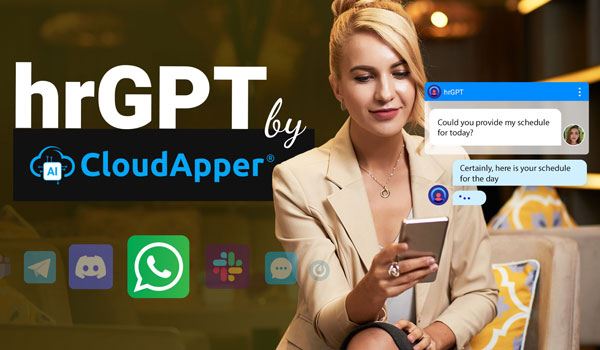
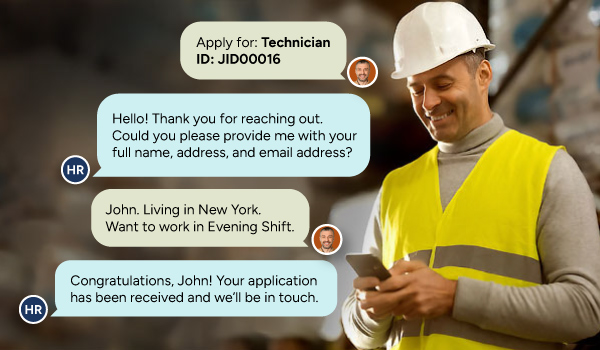

- Works with


- and more.






Similar Posts
How cNPS Reflects Your Recruitment and Employer Brand
The Recruitment-to-HRIS Gap: Why Your “System of Record” Should Start…