Legacy HR systems were not built for modern hiring speed. This article explains how AI recruitment software enhances existing HR and ATS platforms, improves screening and candidate experience, reduces admin work, and helps teams hire faster without replacing trusted systems.

TL;DR
- AI recruitment software enhances legacy HR systems without replacing them.
- It speeds up screening and reduces manual recruiter workload.
- Candidates experience faster progress and clearer communication.
- Recruiters stay in control while AI supports early hiring steps.
- Hiring teams gain visibility into bottlenecks and delays.
Table of Contents
If you work in HR or recruiting, you already feel the pressure. Hiring needs keep growing, but the systems you rely on often feel slow and rigid. You log into your HR or ATS platform, open a long list of applications, and start sorting resumes one by one. By the time you identify the best candidates, some have already moved on.
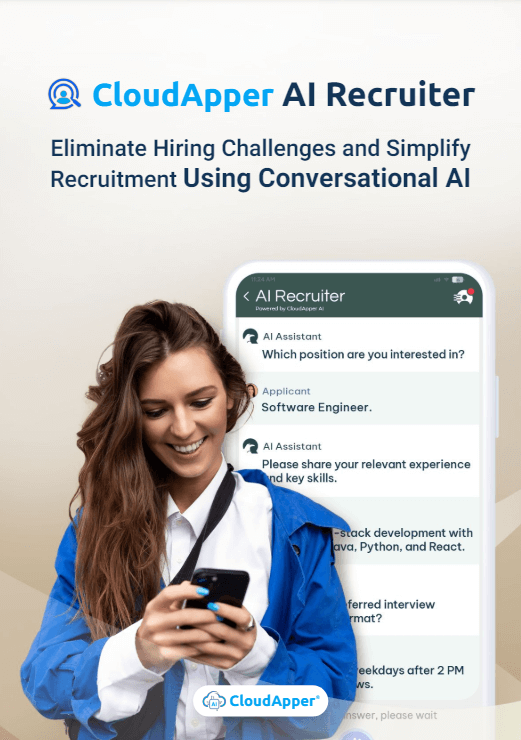
This is where AI is changing how recruitment works. Instead of replacing your existing systems, AI recruitment software adds intelligence on top of them. CloudApper AI Recruiter is one example of how organizations are modernizing hiring without starting over. It helps automate early recruitment tasks while allowing you to stay in control of decisions and workflows.
In this article, you will see how AI talent acquisition tools transform legacy HR systems, what intelligent talent acquisition looks like in practice, and how you can modernize hiring without disrupting what already works.
Why Legacy HR Systems Struggle With Modern Hiring
Legacy HR systems still play an important role in most organizations. They store employee data, track applications, and support compliance. However, hiring today moves faster than these systems were designed for. Understanding where the gaps exist helps explain why many teams look for support instead of replacement.
Built for Record Keeping, Not Hiring Speed
Traditional HR systems were designed to document processes and maintain consistency. Speed was not a priority when these platforms were created. While they work well for audits and reporting, they offer little help when recruiters need to move quickly through active hiring cycles.
When applications arrive in large numbers, the system stores them but does not help you prioritize or act on them. Recruiters must still decide what to review first, which slows progress when time matters most.
Manual Screening Creates Hidden Bottlenecks
Resume screening is still manual in many organizations. Recruiters open each application, scan for relevance, and decide whether to move forward. This process becomes difficult to manage as application volume increases.
Strong candidates may sit in the queue longer than they should. Recruiters feel pressure to move fast, which can affect screening quality. These bottlenecks are often invisible, but they quietly slow hiring outcomes.
Slow Responses Push Candidates Away
Candidates expect timely communication. When days pass without an update, many assume they are no longer being considered and move on.
This lack of responsiveness affects more than one role. It shapes how candidates view your organization and makes future hiring harder. Even interested candidates lose trust when communication feels slow.
Recruiters Lose Time in Administrative Work
Recruiters want to spend time evaluating talent and working with hiring managers. Instead, many hours go into sorting applications, sending follow-ups, and coordinating interviews.
As administrative work grows, strategic hiring work shrinks. This leads to slower hiring, frustrated teams, and burnout among recruiters.
What Intelligent Talent Acquisition Really Means
Intelligent talent acquisition is often discussed in broad terms, which can make it feel abstract. In reality, it is about improving how hiring flows from application to decision. It removes friction while keeping people involved at every step.
A Smarter Way to Support Recruiters
Recruiters are not being replaced. Your experience and judgment remain central to hiring. What changes is how much time you spend on repetitive tasks that add little value.
When early screening happens automatically, recruiters can focus on conversations, evaluation, and alignment with hiring managers. The work becomes more meaningful and less rushed.
Smoother Movement From Application to Interview
Hiring often slows down after applications arrive. Intelligent talent acquisition helps prevent this by keeping candidates moving through the process.
Applications are reviewed as they come in instead of waiting in a backlog. Candidates receive clearer signals about next steps. Hiring managers see more relevant shortlists earlier, which supports faster decisions.
Human Judgment Still Guides Every Decision
AI provides structure and insight, not final answers. Recruiters review recommendations, adjust criteria, and step in whenever needed.
This balance ensures fairness and accountability. Intelligent talent acquisition works because it strengthens human decision-making rather than removing it.
You do not need a new platform. You need faster hiring on top of what you already use.
How AI Recruitment Software Enhances Legacy HR Systems
Legacy HR systems are not broken. They are just not built for the pace and complexity of modern hiring. AI recruitment software enhances these systems by adding speed, structure, and visibility where they struggle most. Instead of replacing your HR platform, AI strengthens it in ways that directly improve how hiring works day to day.
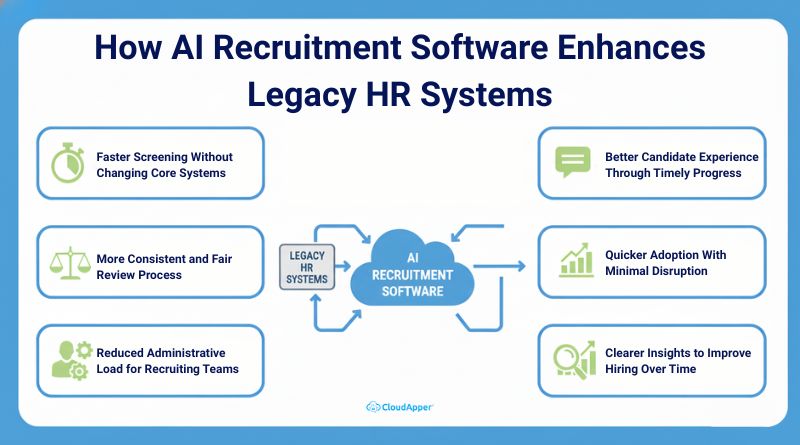
Faster Screening Without Changing Your Core System
One of the biggest benefits of AI recruitment software is speed. Your HR or ATS system continues to receive and store applications as usual, but AI reviews those applications as soon as they arrive. This removes the delay caused by manual resume reviews.
Recruiters no longer need to dig through large volumes of applications to find qualified candidates. Instead, they start with a clearer view of who deserves attention first. Hiring moves forward faster without changing your system of record.
A More Consistent and Fair Review Process
Manual screening often leads to inconsistency. Different recruiters may prioritize different things, especially when they are under time pressure. AI recruitment software brings structure to early screening by applying the same criteria across every application.
This consistency helps reduce accidental bias and missed talent. Recruiters can still adjust criteria and apply judgment, but the initial review process becomes more reliable and repeatable.
Better Candidate Experience Through Timely Progress
Legacy HR systems often struggle to keep candidates informed during busy hiring cycles. AI helps close that gap by keeping the process moving.
When screening happens faster, and workflows stay organized, candidates receive updates sooner. They spend less time waiting and wondering. Even candidates who are not selected experience a clearer and more respectful process, which improves how they view your organization.
Reduced Administrative Load for Recruiting Teams
Recruiting teams spend a large portion of their time on coordination rather than evaluation. AI recruitment software reduces this burden by handling repetitive workflow steps that slow teams down.
As a result, recruiters can focus on conversations, interviews, and collaboration with hiring managers. The work becomes more strategic, and teams feel less overwhelmed during high-volume hiring periods.
Quicker Adoption With Minimal Disruption
Many HR teams worry that adding new technology will slow them down. AI recruitment software is designed to avoid that problem by working with existing systems and familiar workflows.
Implementation typically focuses on setting criteria and connecting systems, not retraining entire teams or rebuilding processes. This makes adoption faster and lowers resistance across HR and recruiting teams.
Clearer Insights to Improve Hiring Over Time
Legacy HR systems store data, but do not always make it easy to understand where hiring slows down. AI recruitment software adds visibility by showing how candidates move through the funnel.
You can see where delays happen, which roles take longer to fill, and how screening affects outcomes. These insights help you make practical improvements instead of relying on guesswork.
How CloudApper AI Recruiter Fits into Legacy HR Environments
Not all AI tools are built for real-world HR teams. Some require major system changes, while others add unnecessary complexity that slows adoption.
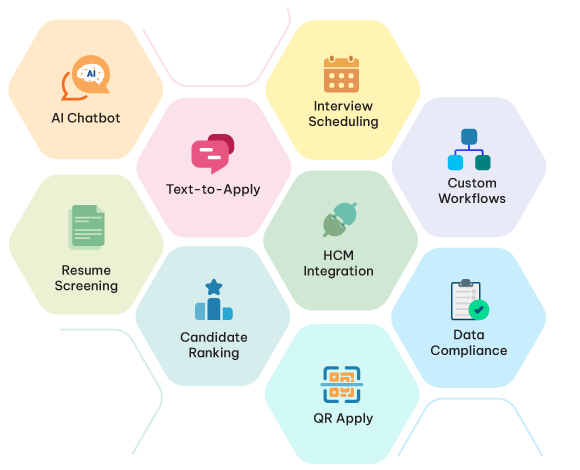
CloudApper AI Recruiter is designed for organizations that already use established HR systems. It integrates seamlessly with all major HCM & ATS systems, e.g., UKG, Workday, Dayforce, Bullhorn, Lever, Greenhouse, etc. Early recruitment tasks like screening and coordination become automated, while recruiters remain fully in control of decisions and workflows. This approach makes it easier to modernize hiring without disrupting compliance, reporting, or core HR operations. You gain speed and structure while keeping the systems and processes your organization already trusts.
Moving Recruitment Forward Without Starting Over
You do not need to replace your HR system to improve hiring. You also do not need to overwhelm your team with change.
AI recruitment software offers a practical way forward. It modernizes the parts of hiring that slow you down while preserving the foundation you trust. With tools like CloudApper AI Recruiter, you can reduce manual work, respond faster, and focus on finding the right people.
Modern hiring is not about more tools. It is about smarter workflows that help you hire with confidence.
If you want faster hiring without replacing your HR system, this is the practical next step.
Reduce Time-to-Hire by 97% with AI for Talent Acquisition
Recruit skilled, culturally fit, and diverse candidates with CloudApper’s state-of-the-art AI resume screening, automated interview scheduling, and offer letter generation.
Learn more | Download BrochureFrequently Asked Questions
-
Do I need to replace my HR system to use AI recruitment software?
No. AI recruitment software enhances your existing HR or ATS by adding speed and structure while your current system continues to store data and support compliance. -
How does AI recruitment software help recruiters save time?
It reduces manual work like reviewing large volumes of resumes, organizing candidates, and managing early workflow steps, allowing recruiters to focus on evaluation and conversations. -
Will AI recruitment software make hiring decisions automatically?
No. Recruiters remain in control. AI helps organize and surface candidates, but humans make all final hiring decisions and can adjust criteria at any time. -
How does AI recruitment software improve the candidate experience?
By keeping hiring moving faster and reducing delays, candidates receive clearer updates and experience less uncertainty during the recruitment process. -
Is AI recruitment software suitable for organizations with high hiring volume?
Yes. It is especially useful for high-volume hiring because it helps teams screen faster, reduce bottlenecks, and maintain consistency when applications increase.
What is CloudApper AI Platform?
CloudApper AI is an advanced platform that enables organizations to integrate AI into their existing enterprise systems effortlessly, without the need for technical expertise, costly development, or upgrading the underlying infrastructure. By transforming legacy systems into AI-capable solutions, CloudApper allows companies to harness the power of Generative AI quickly and efficiently. This approach has been successfully implemented with leading systems like UKG, Workday, Oracle, Paradox, Amazon AWS Bedrock and can be applied across various industries, helping businesses enhance productivity, automate processes, and gain deeper insights without the usual complexities. With CloudApper AI, you can start experiencing the transformative benefits of AI today. Learn More
CloudApper AI Solutions for HR

- Works with


- and more.







Similar Posts
How cNPS Reflects Your Recruitment and Employer Brand
The Recruitment-to-HRIS Gap: Why Your “System of Record” Should Start…