Employee networks help companies hire faster and with better fit. This article explains how employee networks work in recruitment, why they improve hiring quality and speed, and how AI tools like CloudApper AI Recruiter help scale and manage network-sourced candidates.

TL;DR
ul>Table of Contents
Hiring today feels harder than it should. You post a role, review applications, and still struggle to find candidates who truly fit. You spend time screening resumes, scheduling interviews, and restarting searches when candidates drop out or turn out to be mismatched. Over time, this slows your team down and creates pressure to move faster without lowering standards. The issue is rarely a lack of applicants. The issue is finding the right people quickly. This is where an employee network becomes valuable. When employees help surface candidates from their own professional circles, hiring becomes more focused and less random.
An employee network works best when it is supported by the right technology. This is where CloudApper AI Recruiter fits naturally into the process. It helps you take candidates sourced through employee networks and apply consistent screening, ranking, and follow-up without creating more manual work for recruiters. In this article, you will learn what an employee network really is, how it works inside a recruitment process, why it improves hiring quality and speed, and how CloudApper AI Recruiter helps you turn employee networks into a structured and repeatable hiring channel.
What Are Employee Networks?
An employee network is the collective professional reach of your current workforce. It includes people your employees know from previous roles, industries, educational backgrounds, and professional communities. These connections already have some level of trust because they come through someone inside your organization.
In recruitment, an employee network becomes a sourcing channel. Instead of relying only on job boards or agencies, employees share open roles with people they already know. Candidates who come through these networks often understand the company better before they apply. They hear about the role from someone who has direct experience, not just from a job description.
An employee network is not the same thing as a traditional referral program. Referral programs usually focus on formal submissions and incentives. An employee network is broader and more flexible. It encourages employees to talk about open roles naturally and attract interest from people who are already aligned. Referrals can come from employee networks, but the network itself is ongoing and does not depend on a single submission or reward.
How Employee Networks Work in Recruitment
To understand how employee networks actually function in a hiring process, it helps to look at them as a structured flow rather than an informal activity. Employee networks do not replace your existing recruitment workflow. They plug into it at specific points and influence how candidates enter, move through, and stay engaged in the pipeline. The steps below break down what happens in practice, from the moment a role is shared to the point where recruiters take full ownership of screening and decisions.
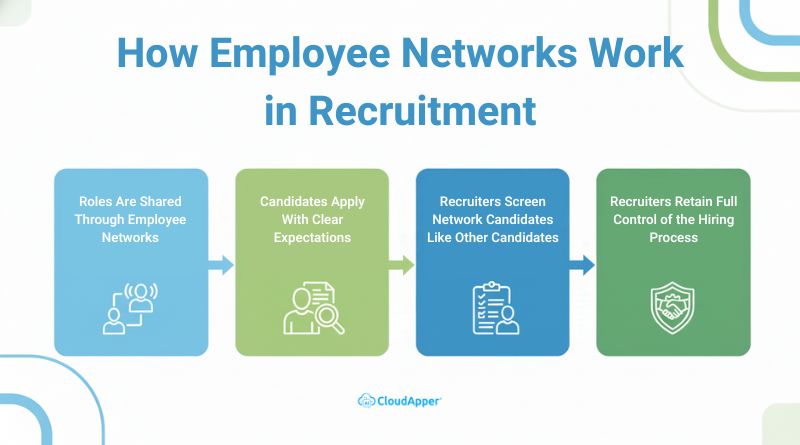
Roles Are Shared Through Employee Networks
Employee network hiring begins when open roles are shared by employees within their professional circles. This can happen through direct messages, social platforms, or informal conversations. Instead of discovering roles through job boards, candidates hear about opportunities from someone they trust.
From a recruitment standpoint, this changes how candidates enter the pipeline. The role reaches people who already have context about the company and the work. This does not replace traditional job postings. It adds a more targeted entry point that brings in candidates with clearer intent.
Candidates Apply With Clear Expectations
Candidates who apply through employee networks usually do so with better awareness of the role. They understand what the job involves and what the work environment looks like because they heard it directly from an employee.
This affects recruitment early. Candidates are less likely to apply casually. Many self-select out before applying if the role does not fit their expectations. This reduces low-quality applications and keeps the pipeline focused before screening even begins.
Recruiters Screen Network Candidates Like Any Other Applicant
Once applications are submitted, employee network candidates move through the same recruitment workflow as everyone else. Recruiters still review qualifications, assess skills, and evaluate fit based on defined criteria.
The difference is not preferential treatment. The difference is signal quality. Recruiters start screening with candidates who already understand the role and organization. This reduces time spent clarifying basics and allows screening conversations to focus on skills and experience.
Recruiters Retain Full Control of the Hiring Process
Employee networks do not take control away from recruiters. Recruiters still decide who moves forward, who is interviewed, and who receives offers. The employee network only influences how candidates enter the pipeline.
This structure keeps hiring consistent and fair. Network-sourced candidates are evaluated using the same standards as all other applicants. Recruiters benefit from a more relevant pool without giving up control or accountability.
How Employee Networks Improve Hiring Quality and Speed
Once employee networks are integrated into the recruitment process, their impact becomes visible in the outcomes. This is where hiring teams start to notice changes in both candidate quality and hiring speed. The improvements do not come from moving faster for the sake of speed. They come from reducing noise, improving alignment, and keeping candidates engaged throughout the process. The sections below explain how employee networks influence these results in practical, measurable ways.
Higher Hiring Quality Through Better Alignment
Employee network candidates often align better with roles because they apply with clearer expectations. They understand the team, the work, and the company culture before interviews begin.
This reduces mismatches later in the process. Interviews become more meaningful because candidates already know what they are stepping into. Over time, this leads to stronger hiring decisions and better long-term retention.
Faster Hiring Through Reduced Noise
Hiring speed improves when recruiters spend less time filtering irrelevant applications. Employee networks naturally reduce noise at the top of the funnel. You receive fewer applications, but the relevance is higher.
Screening cycles shorten because candidates are more responsive and informed. Interview scheduling becomes easier. Offers move faster because expectations are aligned earlier in the process.
Fewer Drop-Offs During the Hiring Process
Candidates sourced through employee networks tend to stay engaged. They have a personal connection to the organization through the employee who shared the role.
This reduces drop-offs between interview stages. When candidates stay engaged, recruiters spend less time restarting searches and more time closing roles.
This is where many teams realize that employee networks work best when supported by the right hiring tools.
How CloudApper AI Recruiter Helps You Leverage Employee Network
Employee networks are powerful, but they can become difficult to manage as hiring volume grows. Without structure, screening, and visibility, network-sourced candidates can create inconsistency instead of improvement. This is where CloudApper AI Recruiter plays a supporting role. The following sections explain how the platform helps you apply consistent screening, ranking, and communication to employee network candidates while keeping recruiters fully in control of hiring decisions.
Consistent Screening for Employee Network Candidates
One concern with employee networks is fairness. CloudApper AI Recruiter ensures that all candidates, regardless of source, are screened using the same criteria.
Employee network candidates do not bypass evaluation. Skills, experience, and role fit are assessed consistently. This protects hiring quality and reduces the risk of bias.
Faster Candidate Ranking Without Extra Manual Work
Employee networks can increase candidate flow, especially in growing teams. CloudApper AI Recruiter helps manage this by automatically ranking candidates based on predefined requirements.
Recruiters can focus on the most relevant candidates first without manually comparing profiles. This saves time and keeps hiring moving without added workload.
Better Engagement Throughout the Hiring Process
Speed also depends on communication. CloudApper AI Recruiter helps keep candidates informed through timely interactions.
This matters for employee network candidates because delays reflect back on the employees who shared the roles. Faster responses improve both candidate experience and employee confidence in the hiring process.
Clear Visibility for Recruiters and Hiring Managers
CloudApper AI Recruiter provides visibility into how employee network candidates move through the pipeline. Recruiters and hiring managers can see progress, outcomes, and patterns clearly.
This makes it easier to understand which networks perform well and where adjustments are needed. Over time, hiring becomes more predictable and easier to manage.
Conclusion
Employee networks improve hiring quality and speed by changing how candidates enter the recruitment process. When roles are shared through trusted connections, candidates apply with better understanding and clearer intent. This leads to stronger alignment, fewer drop-offs, and faster decisions without lowering standards.
CloudApper AI Recruiter helps you turn employee networks into a structured hiring channel. By combining human connections with consistent screening and ranking, you get a process that scales without losing control.
Employee networks become far more effective when hiring teams apply consistent screening and clear structure.
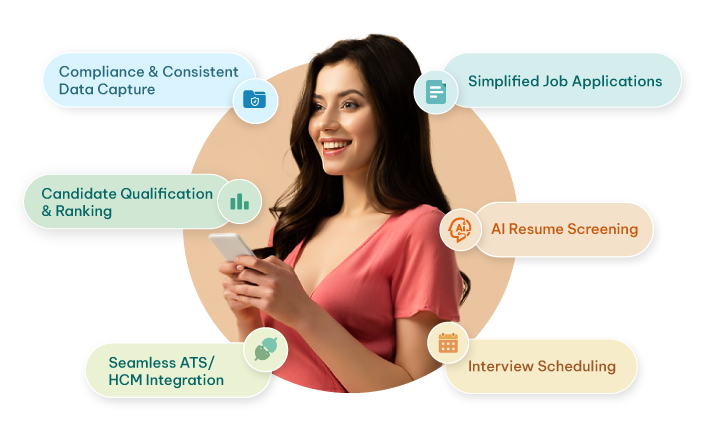
CloudApper AI Recruiter Transforms Your Hiring Stress Into Success
The Best AI Recruiting Tool For Talent Acquisition
Cut time-to-hire, reduce candidate drop-offs, and automate routine recruitment tasks-without replacing your current HCM or ATS.
Learn more | Download BrochureHow To Enhance Recruitment with CloudApper AI Recruiter
- Encourage Employee Participation: Start by fostering a culture where employees are motivated to refer candidates. Consider setting up an incentive program for successful referrals. Learn more about creating effective referral systems here.
- Integrate CloudApper AI Recruiter: Use the AI Recruiter to facilitate initial screenings. This tool will automate assessing candidates based on predefined criteria such as skills and cultural fit. Find out how AI transforms HR in our article on transforming HR with AI.
- Analyze AI-Provided Data: Leverage the analytics provided by CloudApper AI Recruiter to gain insights into candidate suitability, allowing for informed decision-making. These data-driven insights can significantly improve recruitment outcomes.
- Maintain Communication: Ensure continuous feedback and communication with candidates through the AI system to create a positive candidate experience, enhancing your organization's reputation as an employer of choice.
- Evaluate and Adjust: Regularly assess the effectiveness of your recruitment strategy and make necessary adjustments. Consider participating in feedback sessions to refine the processes continually.
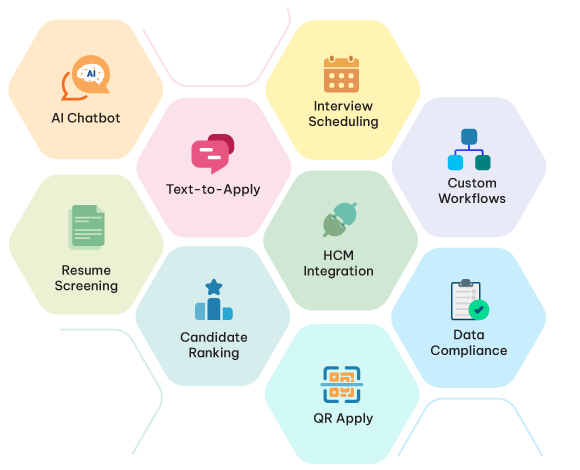
Reduce Time-to-Hire by 97% with AI for Talent Acquisition
Recruit skilled, culturally fit, and diverse candidates with CloudApper’s state-of-the-art AI resume screening, automated interview scheduling, and offer letter generation.
Learn more | Download BrochureFrequently Asked Questions
-
What is an employee network in recruitment?
An employee network is the collective professional connections of your workforce that can be used to source candidates who already have context about your company and roles.
-
How is an employee network different from an employee referral program?
Employee networks are broader and ongoing, while referral programs usually focus on formal submissions and incentives tied to individual hires.
-
Do employee networks improve hiring quality?
Yes. Candidates from employee networks often apply with clearer expectations, better alignment, and stronger understanding of the role and company culture.
-
Can employee networks really speed up hiring?
Employee networks reduce low-intent applications, shorten screening cycles, and lower candidate drop-off, which helps teams move through hiring stages faster.
-
How does AI support employee network hiring?
AI tools help screen, rank, and engage employee network candidates consistently so recruiters can scale network hiring without increasing manual work.
What is CloudApper AI Platform?
CloudApper AI is an advanced platform that enables organizations to integrate AI into their existing enterprise systems effortlessly, without the need for technical expertise, costly development, or upgrading the underlying infrastructure. By transforming legacy systems into AI-capable solutions, CloudApper allows companies to harness the power of Generative AI quickly and efficiently. This approach has been successfully implemented with leading systems like UKG, Workday, Oracle, Paradox, Amazon AWS Bedrock and can be applied across various industries, helping businesses enhance productivity, automate processes, and gain deeper insights without the usual complexities. With CloudApper AI, you can start experiencing the transformative benefits of AI today. Learn More
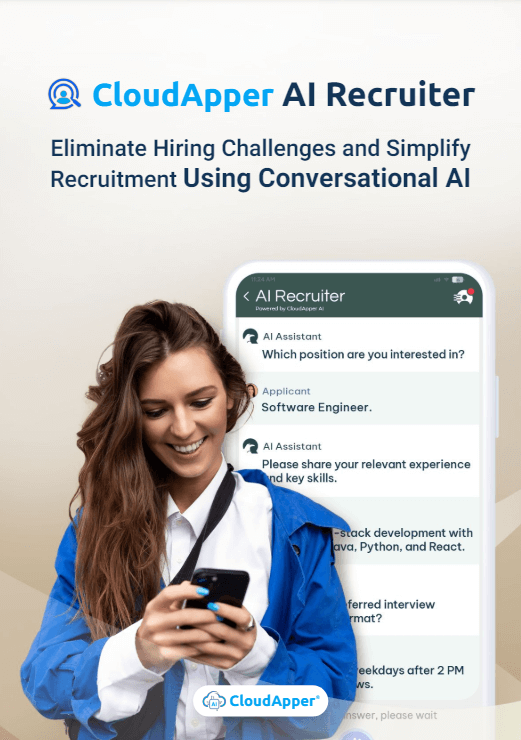
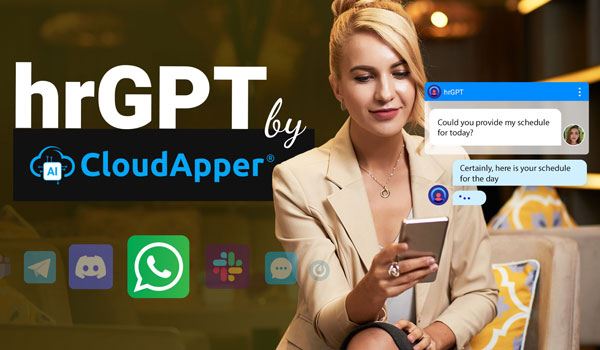
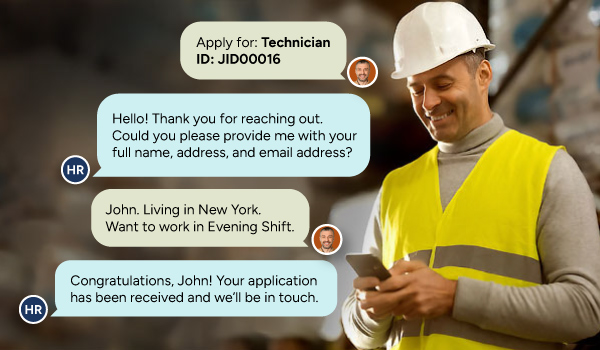
CloudApper AI Solutions for HR

- Works with


- and more.






Similar Posts
How cNPS Reflects Your Recruitment and Employer Brand
The Recruitment-to-HRIS Gap: Why Your “System of Record” Should Start…