Automate High-Volume Candidate ScreeningAutomate High-Volume Candidate Screening to reduce manual review, apply consistent criteria, rank applicants, coordinate outreach and scheduling, synchronize ATS records, and help talent teams create a scalable screening process while keeping consequential hiring decisions under human control.

Table of Contents
- TL;DR
- What High-Volume Candidate Screening Automation Actually Means
- The Real Problems With High-Volume Candidate Screening
- Which Parts of High-Volume Hiring Can Be Automated With AI?
- How CloudApper AI Recruiter Automates High-Volume Candidate Screening
- Benefits of Automating High-Volume Candidate Screening
- Frequently Asked Questions
- Build a More Scalable Candidate Screening Process
High-volume hiring can overwhelm even experienced talent acquisition teams. When hundreds or thousands of applications arrive across multiple roles or locations, recruiters must identify qualified candidates quickly while managing communications, ATS updates, and interview coordination.

CloudApper AI Recruiter helps automate these repetitive stages by capturing candidate information, applying role-specific screening criteria, ranking applicants, supporting outreach, and coordinating interviews within the organization’s existing recruitment ecosystem. This allows recruiters to focus on qualified candidates and consequential hiring decisions while creating a faster, more consistent screening process.
TL;DR
- AI can automate candidate capture, screening, scoring, outreach, ATS updates, and interview scheduling.
- Role-specific criteria help employers screen large applicant pools faster and more consistently.
- CloudApper AI Recruiter connects screening automation with existing ATS and HCM systems.
- Recruiters retain control over exceptions, candidate progression, interviews, and hiring decisions.
- Automation reduces administrative work while improving time-to-shortlist and candidate responsiveness.
What High-Volume Candidate Screening Automation Actually Means
High-volume candidate screening automation uses rules, artificial intelligence, and connected workflows to evaluate large applicant pools and move qualified candidates through the early stages of hiring.
It goes beyond resume screening. A complete workflow can capture candidate information, ask job-specific questions, extract relevant qualifications, evaluate applicants against predefined requirements, rank candidates for recruiter review, send updates, schedule interviews, and write results back to the ATS.
The process begins with criteria established by recruiters and hiring managers. These may include required certifications, work authorization, location, shift availability, relevant skills, and minimum experience.
Automation applies these criteria consistently, but it should not operate as an uncontrolled black box. Recruiters need to understand why candidates received particular scores, review the supporting information, and override recommendations when necessary. The objective is to automate repetitive screening and coordination while keeping consequential hiring decisions under human control.
The Real Problems With High-Volume Candidate Screening
High-volume hiring creates more than a resume-review problem. It places pressure on recruiter capacity, candidate experience, process consistency, and hiring speed.
Application Volume Exceeds Recruiter Capacity
One-click applications and broad job distribution help employers reach more people, but they also increase the number of incomplete, duplicate, and poorly matched applications entering the funnel.
Recruiters must separate potentially qualified candidates from applicants who do not meet basic requirements. As volume increases, manual review becomes difficult to sustain without adding recruiters or extending hiring timelines.
Qualified Candidates Get Buried
Strong candidates do not always appear at the top of a recruiter’s queue. They may be buried beneath hundreds of applications, particularly when resumes are reviewed chronologically or searched for narrow keywords.
Recruiters may reach suitable candidates too late or overlook applicants whose relevant experience is expressed differently from the job description.
Time-to-Shortlist Increases
Screening delays affect the entire recruitment process. Candidates wait longer for updates, hiring managers wait longer for shortlists, and interviews start later. In competitive labor markets, qualified candidates may accept another offer before an organization completes its initial review.
Screening Becomes Inconsistent
Different recruiters may interpret the same requirement differently. One may consider a skill essential while another treats it as optional. Hiring managers may also introduce new preferences after screening begins.
Without structured criteria, decisions become harder to compare, explain, and review. Inconsistent screening can also prevent qualified applicants from receiving equal consideration.
Communication and Candidate Data Breakdown
Recruiters managing large applicant pools cannot always respond promptly. Candidates may receive no confirmation, wait too long for next steps, or miss opportunities because of scheduling delays.
At the same time, resumes may reside in the ATS, screening notes in spreadsheets, interview feedback in email, and appointments in separate calendars. This fragmentation creates duplicate work and prevents talent leaders from seeing where candidates are getting stuck.
The combined result is less time for meaningful candidate conversations, hiring-manager collaboration, workforce planning, and other work that requires human expertise.
Which Parts of High-Volume Hiring Can Be Automated With AI?
AI can support several stages between a candidate’s initial interest and the first human interview. The appropriate level of automation depends on the role, applicant population, hiring risk, and governance requirements.
Candidate Capture and Initial Screening
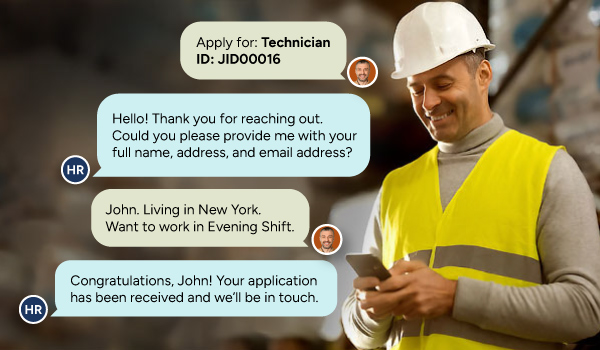
Candidates may enter the pipeline through career pages, job boards, mobile chatbots, text messages, QR codes, or recruitment events. Conversational applications can collect contact details, resumes, location preferences, availability, and other relevant information without forcing candidates through a lengthy form.
Automated workflows can then ask consistent questions about objective requirements such as work authorization, certifications, shift availability, location, travel, or minimum experience. Clear pass-or-review rules can identify candidates who satisfy basic requirements while routing ambiguous cases to recruiters.
Resume Review, Scoring, and Ranking
AI can extract skills, qualifications, and employment history from resumes and applications. It can organize that information around the requirements of the role and generate structured candidate summaries.
Applicants can then be evaluated against a scoring framework defined by the hiring team. The resulting scores and rankings help recruiters decide which candidates to review first.
Ranking should remain a decision-support mechanism rather than an automatic final decision. Recruiters should be able to inspect the criteria and reconsider candidates when context requires human judgment.
Talent-Pool Matching
Previous applicants and existing talent-pool members can be matched with newly opened positions. This helps employers reconsider qualified candidates who were not selected for an earlier role and reduces the need to begin every search from zero.
Candidate Outreach and Scheduling
Automated workflows can send application confirmations, qualification questions, reminders, status updates, and interview invitations through email or SMS.
Once candidates reach the appropriate stage, they can select an available interview time. Invitations, reminders, and rescheduling can then be handled automatically, reducing back-and-forth communication.
ATS Updates and Workflow Handoffs
Screening responses, candidate scores, summaries, appointments, and status changes can be synchronized with the organization’s ATS or HCM platform. This keeps the existing system of record current while reducing duplicate entry and shadow spreadsheets.
Recruiters and hiring managers should continue to define screening criteria, review recommendations, handle accommodations and exceptions, monitor outcomes, approve candidate progression, and make final hiring decisions.
How CloudApper AI Recruiter Automates High-Volume Candidate Screening
CloudApper AI Recruiter works alongside existing ATS and talent acquisition systems to automate repetitive steps between candidate entry and recruiter review.
Connect Candidate Entry Points
Candidates may apply through a job board or careers page before entering the ATS. They can also begin through a mobile chatbot, text-based application, QR code, or physical recruitment location.
CloudApper AI Recruiter brings these entry paths into a connected recruitment pipeline, helping organizations manage candidate information consistently regardless of where the interaction began.
Capture and Screen Candidates Conversationally
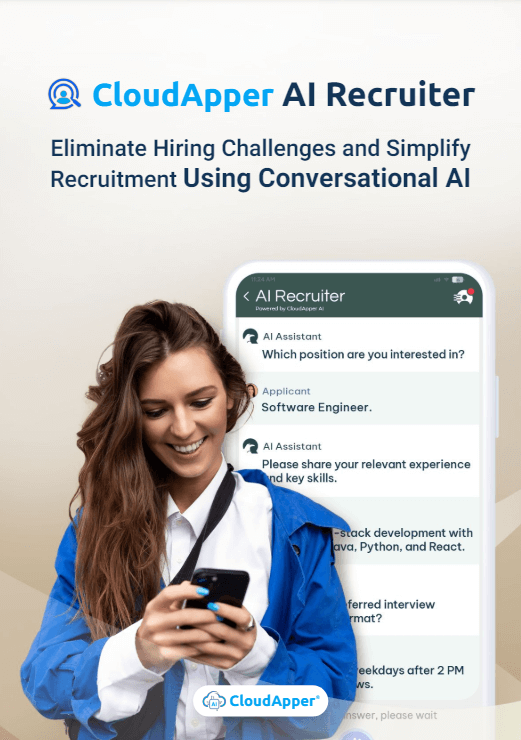
AI Recruiter can guide applicants through a mobile-friendly conversation, collect relevant information, answer common questions, and present role-specific screening questions.
Recruiters can configure qualification criteria for different positions, locations, business units, and hiring programs. The system organizes candidate responses and identifies whether basic requirements have been met, without requiring the employer to replace its existing ATS.
Score Candidates for Recruiter Review
CloudApper AI Recruiter evaluates candidate information against role-specific criteria and produces ranked shortlists with supporting scores and summaries.
These recommendations help recruiters focus their attention while retaining control over who advances. CloudApper also supports blind candidate ranking designed to exclude demographic signals and concentrate evaluation on skills and job fit.
Rediscover Existing Candidates
AI Recruiter can help identify potentially relevant applicants already present in the organization’s talent pool. Candidates who were qualified for a previous opening can be reconsidered and re-engaged when an appropriate position becomes available.
This allows enterprise talent acquisition teams to obtain more value from candidate data they already possess.
Automate Outreach and Interview Scheduling
The platform supports personalized email and SMS communication, including updates, reminders, follow-up questions, and invitations to continue the process.
Qualified candidates can select an interview time based on available calendars. Confirmations, reminders, and rescheduling can be handled within the workflow, allowing candidates to advance without waiting for manual coordination.
Synchronize With Existing ATS and HCM Systems
Candidate information, screening responses, scores, summaries, statuses, and scheduling activity can be synchronized with existing ATS and HCM platforms.
Recruiters can continue working from their established system of record while adding automation to the stages where manual effort creates the greatest bottlenecks.
Benefits of Automating High-Volume Candidate Screening
Faster Shortlists and Better Recruiter Capacity
Qualification, scoring, and ranking can begin when an application enters the pipeline. Recruiters can identify promising candidates without waiting for every application to be reviewed manually.
Reducing repetitive review, communication, data entry, and scheduling also gives recruiters more time for candidate engagement and complex hiring decisions.
More Consistent Screening
Job-specific questions and scoring criteria can be applied across every applicant for the same position. This creates a more repeatable process and makes it easier to identify when requirements or scoring rules need adjustment.
Improved Candidate Responsiveness
Automated confirmations, updates, reminders, and scheduling reduce periods of silence. Qualified candidates can progress without waiting for a recruiter to complete every administrative step.
Scalable, Connected Hiring
Automation helps talent acquisition teams manage seasonal surges, expansion hiring, and multi-location recruitment without increasing administrative work at the same rate as application volume.
Keeping screening activity connected to the ATS also creates a more complete record for collaboration, review, governance, and process improvement.
Frequently Asked Questions
What Is High-Volume Candidate Screening?
High-volume candidate screening is the process of reviewing and evaluating large applicant pools across multiple openings, locations, or recurring roles. It is common in retail, healthcare, hospitality, manufacturing, logistics, and customer service.
How Do You Automate High-Volume Candidate Screening?
Define objective minimum qualifications and scored criteria first. An automated workflow can then capture information, ask screening questions, organize resume data, evaluate candidates, create rankings, send updates, and coordinate interviews.
Can AI Screen Thousands of Applications?
AI can process large application volumes much faster than manual review. However, output quality depends on the job requirements, screening questions, scoring framework, candidate data, and human oversight.
How Can Employers Avoid Overlooking Good Candidates?
Use knockout questions only for genuine minimum requirements. Treat broader experience, transferable skills, and preferred qualifications as scored criteria. Ambiguous answers, accommodations, incomplete information, and nontraditional backgrounds should have a recruiter-review path.
Does AI Candidate Screening Replace Recruiters?
No. AI reduces repetitive work and helps recruiters prioritize their attention. People are still needed to define criteria, evaluate context, review recommendations, handle exceptions, engage candidates, conduct interviews, and make hiring decisions.
How Does Automated Screening Integrate With an ATS?
A connected solution can retrieve candidate and job information from the ATS and return screening responses, scores, summaries, statuses, and interview details. The ATS remains the primary system of record.
Can AI Candidate Screening Reduce Bias?
Structured questions and consistent criteria can reduce some inconsistency, but AI does not automatically eliminate bias. Employers should use job-related criteria, retain human review, test outcomes, monitor selection rates, support accommodations, and understand how recommendations are produced.
Build a More Scalable Candidate Screening Process
Manual candidate screening becomes harder to sustain as application volume grows. A well-designed automation strategy applies role-specific criteria, organizes candidate information, prioritizes recruiter review, keeps applicants informed, and connects screening activity to the existing ATS.
CloudApper AI Recruiter brings candidate capture, screening, ranking, talent-pool matching, outreach, and scheduling into one connected workflow while keeping hiring teams responsible for the decisions that matter.
See how CloudApper AI Recruiter can support your existing recruitment process and help your team manage high-volume screening without adding another disconnected system.

What is CloudApper AI Platform?
CloudApper AI is an advanced platform that enables organizations to integrate AI into their existing enterprise systems effortlessly, without the need for technical expertise, costly development, or upgrading the underlying infrastructure. By transforming legacy systems into AI-capable solutions, CloudApper allows companies to harness the power of Generative AI quickly and efficiently. This approach has been successfully implemented with leading systems like UKG, Workday, Oracle, Paradox, Amazon AWS Bedrock and can be applied across various industries, helping businesses enhance productivity, automate processes, and gain deeper insights without the usual complexities. With CloudApper AI, you can start experiencing the transformative benefits of AI today. Learn More
- Useful Links:
- Agentic AI
- No-Code/Low-Code
- Custom Software
- HCM Personalization
- iPaaS
- FedRAMP
CloudApper AI Solutions for HR


- Works with








- and more.
Similar Posts

How to Stop Losing Shortlisted Candidates During a Hiring Surge…
Recording Candidate Video Interviews in Illinois: Consent, Retention, and Deletion…