Manual candidate screening hides massive hidden costs—up to $30,000–50,000 annually per position in frontline recruiting through recruiter time, delays, quality issues, and lost productivity. CloudApper AI Recruiter eliminates these by automating conversational screening, freeing 90% of time, reducing errors, and accelerating hires for high-volume hourly roles.


Table of Contents
Your CFO just asked a simple question: “Why does it cost us $847 to hire each nursing assistant when the job pays $18/hour?” You pull up your recruiting budget, see the obvious line items—job board fees, recruiter salaries, background checks—but those don’t fully explain the number. The real costs are hidden in the dozens of hours your team spends manually screening applications, playing phone tag with candidates, rescheduling no-show phone screens, and repeating the same qualification questions to 200 people monthly.
These hidden costs of manual screening don’t appear on budget reports as discrete line items, making them nearly invisible to leadership despite consuming 40-60% of total recruiting expenditure. A recruiter spending 15 minutes manually reviewing each nursing assistant application, 20 minutes conducting phone screens, and 10 minutes documenting results doesn’t trigger accounting alerts. But multiply those 45 minutes by 200 monthly applicants, factor in the recruiter’s loaded cost, add the opportunity cost of what else they could accomplish, and suddenly you’re looking at $30,000-50,000 annually in hidden manual screening costs for a single high-volume position.
For talent acquisition professionals managing continuous frontline hiring in healthcare, retail, and manufacturing, understanding and eliminating these hidden costs isn’t just about budget optimization—it’s about demonstrating recruiting’s business value and freeing resources to focus on strategic hiring activities that actually require human judgment.
TL;DR
Hidden costs of manual screening consume 40-60% (often 50-70% total) of frontline recruiting budgets via direct labor ($43+/hour recruiter time), opportunity loss, inconsistent quality, delays ($200-500/day vacancy), scaling limits, errors, and compliance risks. Conversational AI like CloudApper automates initial review, qualification, and documentation—cutting screening time by 90% (e.g., 150 hours/month freed for 200 applicants), speeding time-to-fill by 40-60%, improving hire quality, enabling non-linear scaling, and yielding 300-600% first-year ROI. Ideal for high-volume hourly hiring in retail, healthcare, and manufacturing.
The True Cost Structure of Manual Screening
Manual screening seems free because it’s just “recruiters doing their jobs.” But economic reality is more complex. Every hour spent on manual screening carries multiple cost layers that compound into substantial hidden expenditure:
Direct Labor Costs: A recruiter earning $65,000 annually has a loaded cost (including benefits, taxes, overhead) of approximately $90,000, or $43/hour. If they spend 20 hours weekly on manual screening activities—reviewing applications, conducting phone screens, documenting results—that’s $44,720 annually in direct labor cost for one recruiter. Multiply across a team, and the numbers become staggering.

Opportunity Costs: Perhaps more significant than direct costs is what recruiters aren’t doing while manually screening. Time spent asking the same qualification questions to 50 warehouse applicants is time not spent building relationships with hiring managers, developing creative sourcing strategies, improving candidate experience, or conducting thorough interviews with top candidates. The opportunity cost—value of alternative uses of time—often exceeds direct costs.
Quality Costs: Manual screening at high volumes degrades quality. Fatigued recruiters make inconsistent decisions, miss qualified candidates, advance unqualified ones, and create compliance risks through inconsistent evaluation. The cost of poor quality hires—early turnover, performance issues, team disruption—dwarfs obvious recruiting costs.
Speed Costs: Manual screening is slow. Applications sit in queues, phone tag stretches for days, and candidates move to faster competitors. Each day of delay in filling positions costs $200-500 in lost productivity, overtime coverage, and operational strain. Manual screening’s slowness multiplies vacancy costs across your entire operation.
Scale Costs: As hiring volume increases, manual screening requires proportional recruiter additions. Doubling hiring volume means doubling screening workload, which means adding recruiters. This linear scaling prevents efficiency gains and makes growth expensive.
Error and Rework Costs: Manual processes generate errors—typos in candidate notes, missed qualifications, scheduling mistakes, lost applications. Fixing these errors consumes additional time and sometimes costs lost candidates when mistakes create poor experiences.
Compliance Costs: Inconsistent manual screening creates legal exposure. When different recruiters apply different standards, ask different questions, or document differently, you risk disparate treatment claims. Legal defense costs and potential settlements far exceed recruiting budgets.
When you sum direct labor, opportunity costs, quality degradation, speed penalties, scaling limitations, error correction, and compliance risks, the hidden costs of manual screening often represent 50-70% of total recruiting expenditure—most of which leadership never sees broken out explicitly.
Why Manual Candidate Screening Persists Despite High Costs
If manual screening is so expensive, why do most organizations still rely on it? Several factors perpetuate this inefficiency:
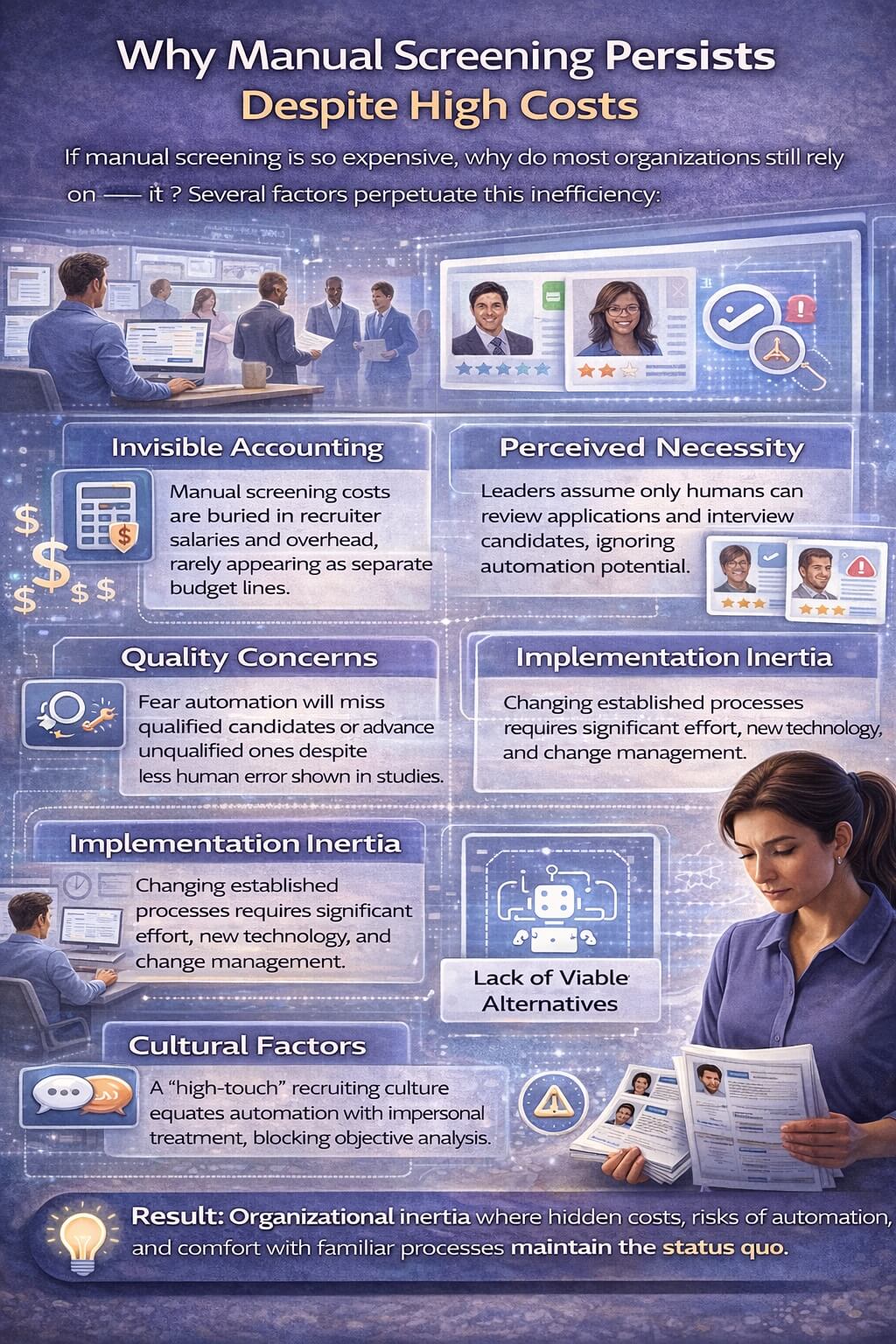
Invisible Accounting: Manual screening costs are buried in recruiter salaries and overhead, never appearing as discrete budget lines. CFOs see “recruiting team cost” but not “manual screening cost within recruiting team cost.” Invisible costs are rarely optimized.
Perceived Necessity: Many recruiting leaders believe manual screening is unavoidable—someone has to review applications and talk to candidates, right? The assumption that humans must perform these tasks prevents considering automation alternatives.
Quality Concerns: Fear that automation will miss qualified candidates or advance unqualified ones causes organizations to default to manual processes despite evidence that fatigued humans make more errors than well-designed AI.
Implementation Inertia: Changing established processes requires effort, technology investment, and change management. Even when leaders recognize manual screening’s costs, the activation energy to transform seems daunting.
Lack of Viable Alternatives: Until recently, automation options for conversational candidate screening didn’t exist at quality levels suitable for high-stakes hiring. Organizations stuck with manual processes because alternatives were worse.
Cultural Factors: Some recruiting cultures pride themselves on “high-touch” candidate engagement, equating automation with impersonal treatment. This cultural bias prevents objective cost-benefit analysis.
The result is organizational inertia where everyone knows manual screening is inefficient but no one addresses it because the costs are hidden, alternatives seem risky, and current processes are familiar.
How Conversational AI Eliminates Manual Candidate Screening Costs
Modern conversational AI specifically designed for hourly hiring eliminates manual screening costs by automating the repetitive, time-consuming tasks that consume recruiter capacity while improving quality and speed:
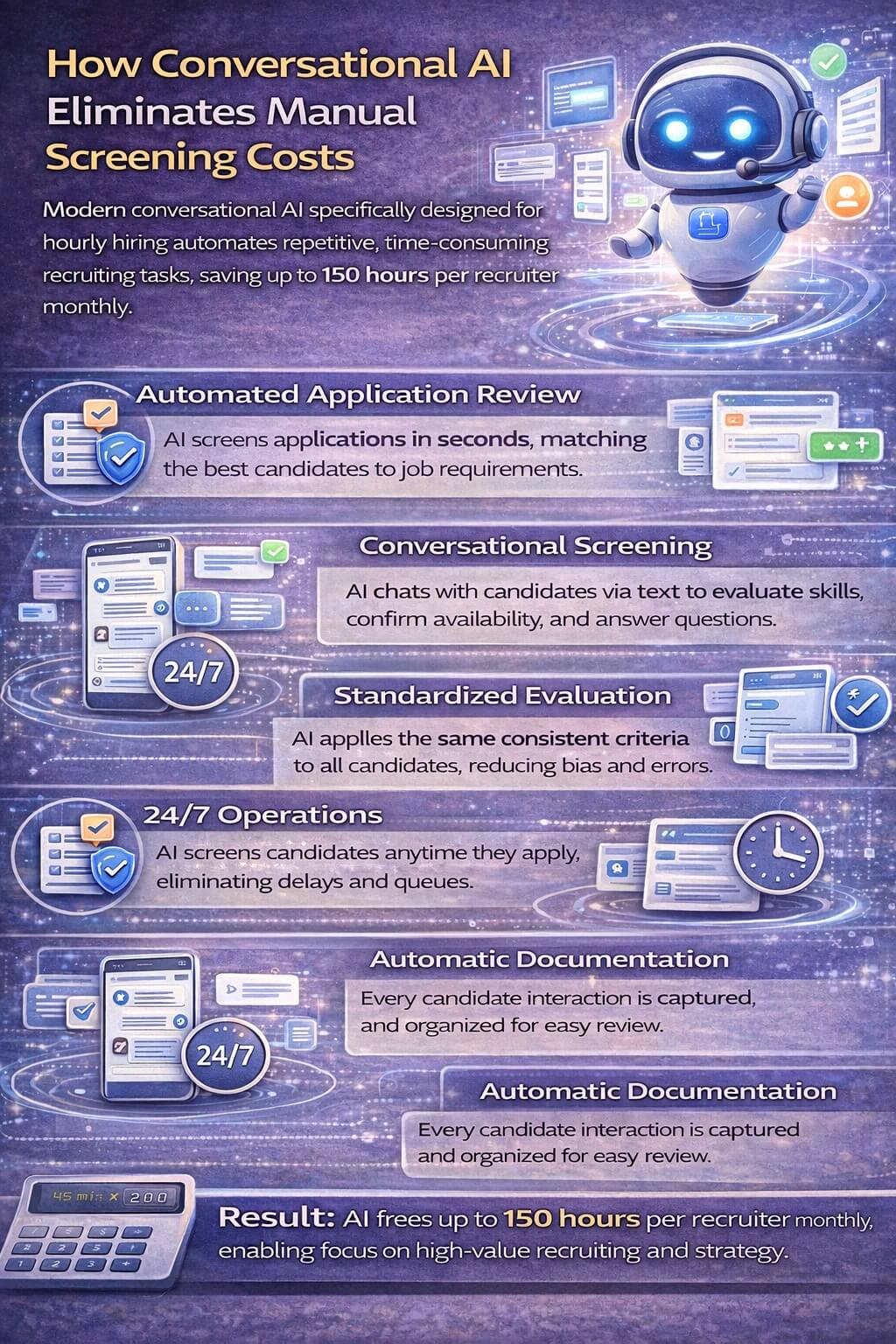
Automated Application Review: AI instantly evaluates applications against job requirements, identifying qualified candidates based on experience, certifications, availability, and other relevant factors. What takes recruiters 10-15 minutes per application happens in seconds, with higher consistency.
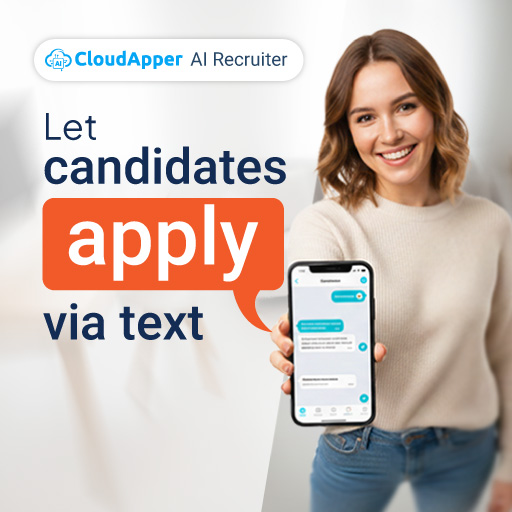
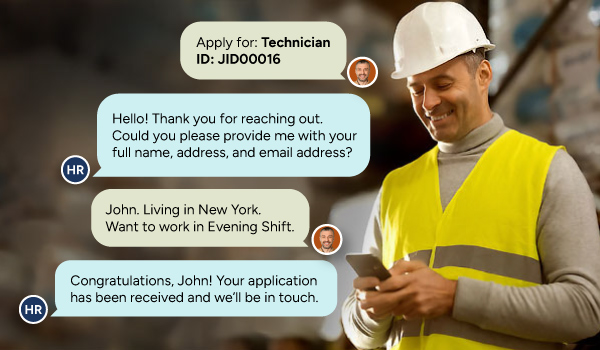
Conversational Screening: Instead of recruiters conducting repetitive phone screens asking the same questions, AI engages candidates through text message conversations that assess qualifications, evaluate relevant skills, confirm availability, and gather all information needed for hiring decisions. A 20-minute phone screen becomes a 5-minute text exchange candidates can complete anytime.
Standardized Evaluation: AI applies identical screening criteria to every candidate, eliminating the inconsistency that occurs when different recruiters emphasize different factors or when the same recruiter’s standards shift due to fatigue. Standardization improves quality and reduces compliance risk.
24/7 Operations: AI screens candidates whenever they apply—2 AM Saturday or 3 PM Wednesday makes no difference. This continuous operation eliminates queues, reduces delays, and ensures no candidate waits for business-hours recruiter availability.
Automatic Documentation: Every candidate interaction is captured, transcribed, and organized automatically. Recruiters review complete conversation histories without spending time on notes, summaries, or data entry.
Intelligent Escalation: AI handles routine screening while flagging complex situations or exceptional candidates for human attention. Recruiters focus their expertise where it matters most rather than on repetitive qualification verification.
The economic transformation is substantial. A recruiter manually screening 200 monthly applicants at 45 minutes each spends 150 hours monthly on screening—nearly their entire capacity. With AI handling this automatically, those 150 hours are freed for high-value activities: interviewing top candidates, building hiring manager relationships, developing sourcing strategies, and improving recruiting processes.
Quantifying the Financial Impact
The cost elimination from automating manual screening delivers measurable ROI:
Direct Labor Savings: If a $90,000/year recruiter (loaded cost) spends 75% of time on manual screening, that’s $67,500 annually in direct labor cost. AI automation eliminates this expense, either allowing the same recruiter to manage 4x more positions or reducing the recruiting team size needed for a given hiring volume.
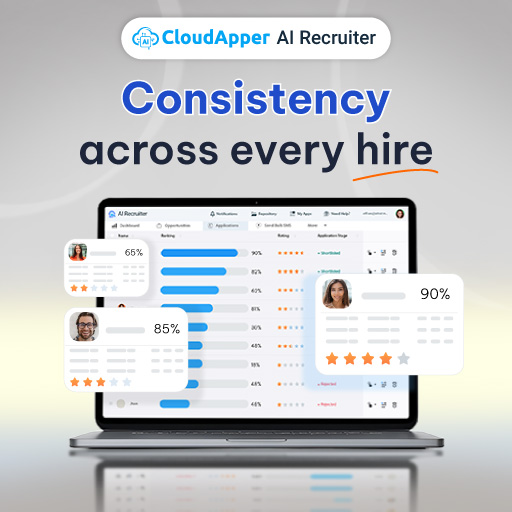
Opportunity Value Creation: Freed from manual screening, recruiters can conduct twice as many quality interviews, build stronger candidate pipelines, improve hiring manager satisfaction, and reduce time-to-fill—all activities that directly improve business outcomes. The value creation from better time allocation often exceeds direct cost savings.
Quality Improvement Savings: Consistent AI screening reduces bad hires that cost 50-150% of annual compensation when factoring in turnover, training, productivity losses, and replacement recruiting. Reducing bad hires by just 10-20% through better screening generates savings multiples of recruiting costs.
Speed Acceleration Savings: Automated screening reduces time-to-fill by 40-60%, cutting vacancy costs proportionally. For a $40,000/year hourly position with $300 daily vacancy cost, reducing time-to-fill from 20 to 8 days saves $3,600 per hire. Across 100 annual hires, that’s $360,000 in reduced vacancy costs.
Scaling Efficiency Gains: With AI handling screening, organizations can double hiring volume without doubling recruiting team size. This non-linear scaling creates efficiency gains impossible with manual processes.
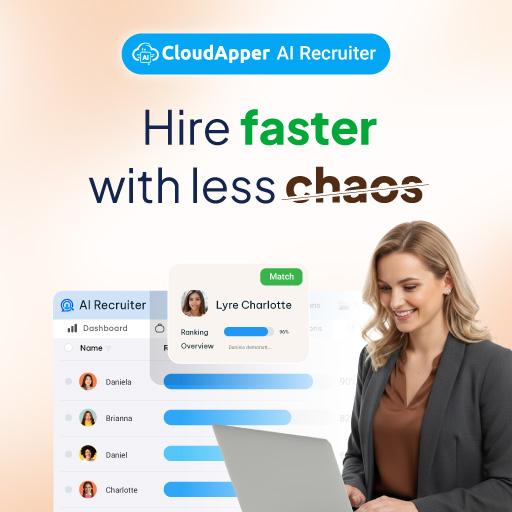
Compliance Risk Reduction: Standardized AI screening documented comprehensively reduces legal exposure from inconsistent treatment. The cost avoidance from preventing even one discrimination lawsuit exceeds typical recruiting technology investment.
When organizations conduct rigorous cost analysis comparing manual screening total costs to AI automation investment, ROI typically ranges from 300-600% in the first year—among the highest returns of any recruiting technology.
How CloudApper AI Recruiter Delivers Cost Elimination
CloudApper AI Recruiter was designed specifically to eliminate manual screening costs in high-volume hourly hiring while improving quality and speed.
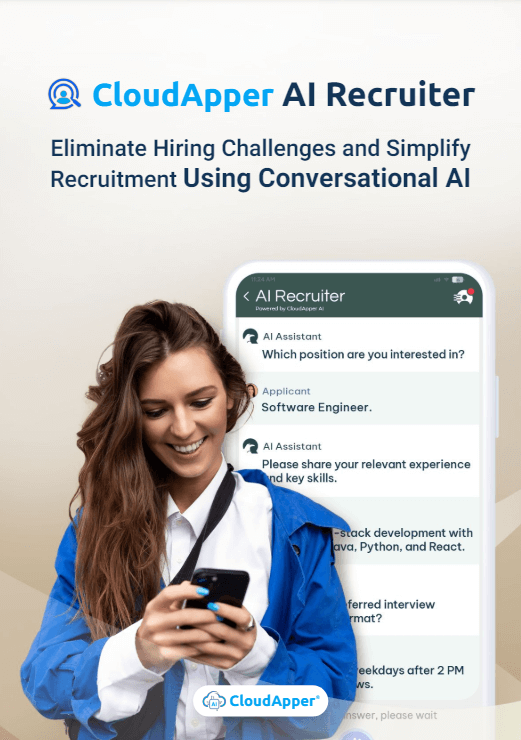
The platform automates the entire screening process through conversational AI that engages candidates via text message. When someone applies to your nursing assistant position, CloudApper immediately initiates a screening conversation: “Thanks for applying! I can verify your qualifications and answer questions right now. Do you have your CNA certification?”
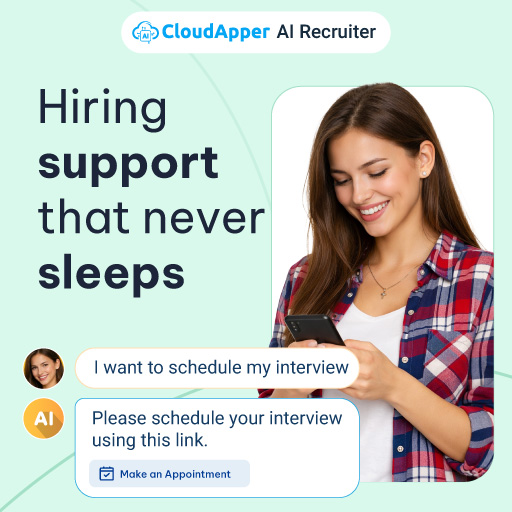
The AI conducts comprehensive screening through natural dialogue, assessing:
- Required certifications and licenses
- Relevant experience levels and contexts
- Schedule availability and shift preferences
- Physical capabilities for job requirements
- Transportation and location feasibility
- Salary expectations and benefits needs
- Communication skills through conversation quality
- Motivation and cultural fit indicators
This screening happens automatically for every applicant, 24/7, with perfect consistency. Whether you receive 5 or 500 applications weekly, every candidate gets the same thorough evaluation without consuming recruiter time.
For recruiters, CloudApper presents complete screening results with full conversation histories. Instead of spending hours conducting phone screens, they review AI-generated candidate profiles showing qualifications, concerns, preferences, and red flags. The information quality often exceeds manual screening because AI never gets fatigued, forgets to ask questions, or fails to document responses.
The time savings are dramatic. A recruiter manually screening 200 monthly applicants at 45 minutes each (150 hours) can now review 200 AI-screened candidates at 5 minutes each (17 hours)—a 90% reduction in screening time. Those 133 freed hours can be redirected to interviewing, relationship building, process improvement, and strategic initiatives.
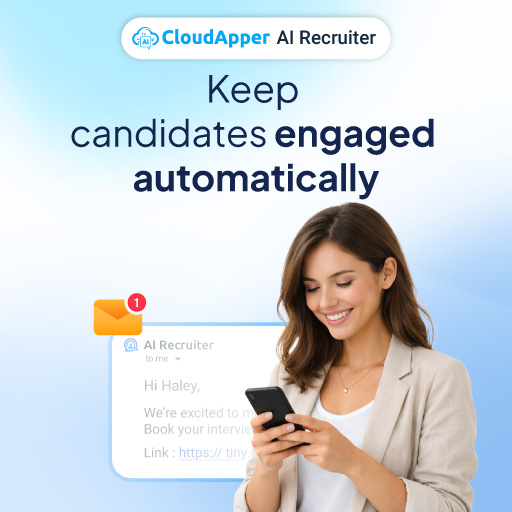
CloudApper also eliminates costs beyond direct screening time. Automated interview scheduling removes coordination delays. Continuous engagement reduces candidate drop-off. Standardized evaluation improves quality of hire. Complete documentation supports compliance. The cumulative cost reduction extends across the entire recruiting operation.
For organizations hiring across multiple locations, CloudApper provides centralized screening that maintains quality standards everywhere. No more variation between recruiters or sites—every candidate for nursing assistant positions receives identical screening regardless of location, timing, or which recruiter ultimately interviews them.
The platform also generates analytics showing exactly where screening time was historically spent and how automation delivers savings. You can demonstrate to leadership the specific hours eliminated, positions filled faster, and quality improvements achieved—making the business case concrete rather than theoretical.
Implementation Strategy for Maximum Candidate Screening Cost Reduction
Successfully eliminating manual screening costs requires thoughtful implementation:
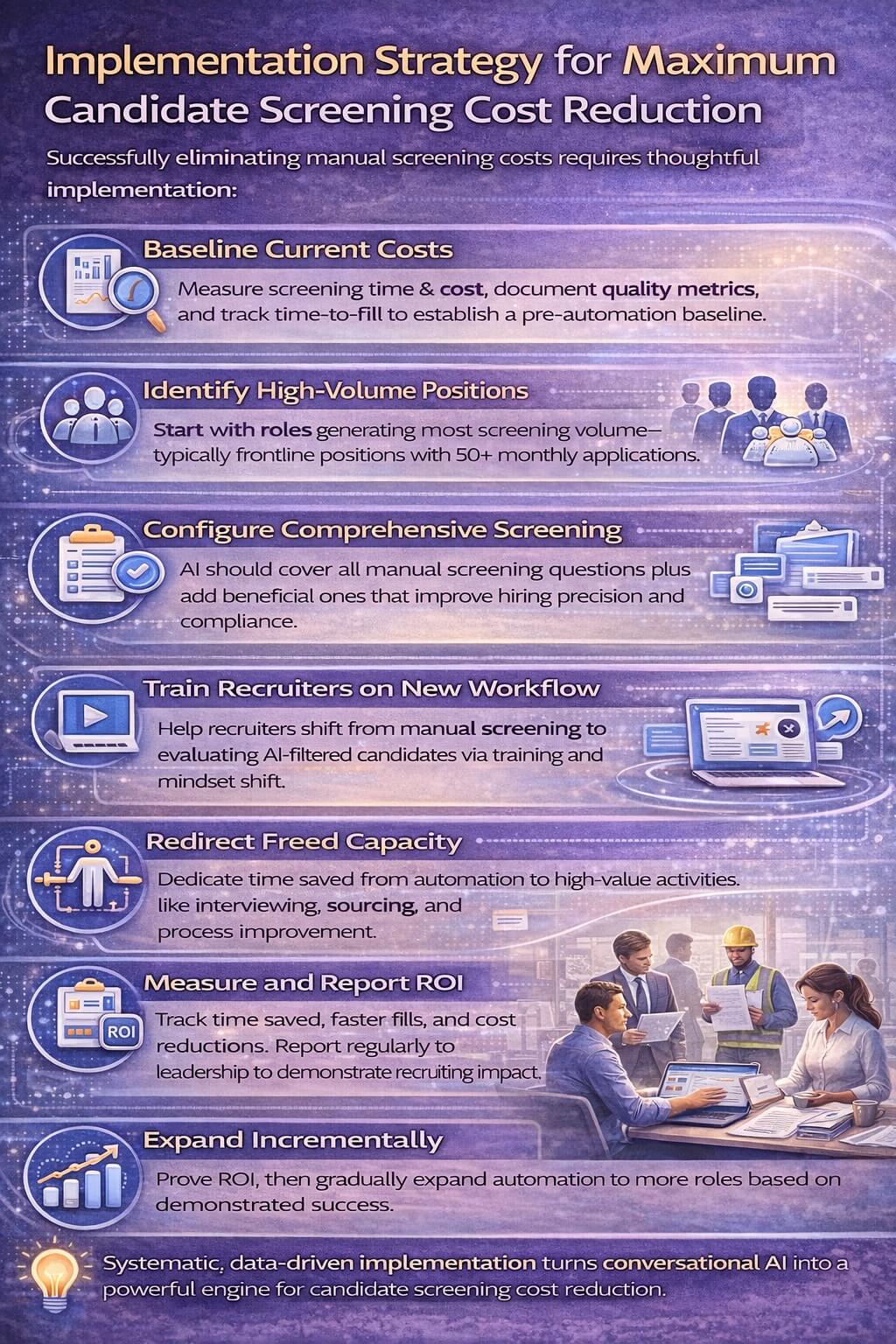
Baseline Current Costs: Before automation, measure time recruiters spend on manual screening, calculate loaded hourly costs, document quality metrics, and track time-to-fill. This baseline enables ROI demonstration post-implementation.
Identify High-Volume Positions: Start with roles generating most screening workload—typically frontline positions with 50+ monthly applications. These deliver fastest ROI because screening volume is highest.
Configure Comprehensive Screening: Ensure your AI asks all questions manual screening covered plus additional beneficial questions. Don’t just replicate manual processes—improve them by adding screening depth that manual processes couldn’t accommodate.
Train Recruiters on New Workflow: Help recruiters transition from conducting screening to reviewing screening results. This mindset shift—from doing to evaluating—requires training and adjustment.
Redirect Freed Capacity: Explicitly reallocate time saved from screening elimination to high-value activities. Don’t just create slack—channel it into interviewing, sourcing, relationship building, or process improvement.
Measure and Report ROI: Track time saved, positions filled faster, quality improvements, and cost reductions. Report these regularly to leadership to demonstrate recruiting’s business impact.
Expand Incrementally: After proving ROI with initial positions, expand to additional roles systematically. Build momentum through demonstrated success.
FAQ: Hidden Costs of Manual Screening
What are the main hidden costs of manual screening in frontline recruiting?
They include direct recruiter labor (often $30,000–50,000/year per position), opportunity costs (time not spent on sourcing or interviews), quality issues (inconsistent decisions, higher bad-hire rates at 50-150% of salary), speed delays (vacancy costs $200–500/day), scaling challenges, errors/rework, and compliance risks—totaling 40-60% of recruiting spend.
Why do these hidden costs of manual screening persist despite being so expensive?
They’re invisible on budgets (no line item), perceived as necessary for quality, driven by inertia/lack of alternatives, fear of losing control, cultural biases toward human judgment, and underestimation of cumulative impact.
How does conversational AI eliminate the hidden costs of manual screening?
It automates application review (seconds vs. 10-15 minutes), text-based qualification (5 minutes vs. 20-minute calls), consistent evaluation, documentation, and escalation—freeing 90% of recruiter time, enabling 24/7 operations, reducing bias/errors, and scaling without added headcount.
Can AI really maintain or improve hire quality when replacing manual screening?
Yes—AI applies consistent, objective criteria across all applicants, reduces fatigue-induced errors, flags nuanced cases for human review, and often lowers bad-hire rates (10-20% reduction), while speeding decisions and engaging candidates better.
What ROI can organizations expect from automating to eliminate hidden costs of manual screening?
Typically 300-600% in the first year, combining direct time savings, faster fills (40-60% reduction), lower vacancy/overtime costs, fewer bad hires, and productivity gains—e.g., $360,000/year saved for 100 hires at scale.
Is CloudApper AI Recruiter suitable for high-volume frontline roles?
Absolutely—it’s designed for hourly hiring (e.g., nursing assistants, retail associates), handling 200+ applicants/month with instant text engagement, skills/availability screening, auto-scheduling, and seamless integration with UKG/Workday systems.
Transforming Cost Center to Strategic Function
Recruiting teams often struggle to demonstrate business value because their costs are visible while their contributions are diffuse. Eliminating manual screening costs changes this dynamic fundamentally.
When you can show leadership that automation reduced screening time by 90%, cut time-to-fill by 50%, improved quality of hire by 20%, and freed recruiters to focus on strategic initiatives, recruiting shifts from cost center to strategic business function. The conversation moves from “Can we reduce recruiting headcount?” to “How can we leverage recruiting’s increased capacity for competitive advantage?”
For talent acquisition professionals and HR leaders managing frontline hiring, exposing and eliminating hidden manual screening costs isn’t just about efficiency—it’s about positioning recruiting as a strategic driver of business performance rather than an administrative burden to be minimized.
The costs are real, substantial, and mostly hidden. The technology to eliminate them exists and delivers measurable ROI. The question is whether you’ll quantify these costs, make the business case, and implement solutions before competitive pressure forces the issue.
Learn more about how CloudApper AI Recruiter eliminates manual screening costs for high-volume hourly hiring.

What is CloudApper AI Platform?
CloudApper AI is an advanced platform that enables organizations to integrate AI into their existing enterprise systems effortlessly, without the need for technical expertise, costly development, or upgrading the underlying infrastructure. By transforming legacy systems into AI-capable solutions, CloudApper allows companies to harness the power of Generative AI quickly and efficiently. This approach has been successfully implemented with leading systems like UKG, Workday, Oracle, Paradox, Amazon AWS Bedrock and can be applied across various industries, helping businesses enhance productivity, automate processes, and gain deeper insights without the usual complexities. With CloudApper AI, you can start experiencing the transformative benefits of AI today. Learn More
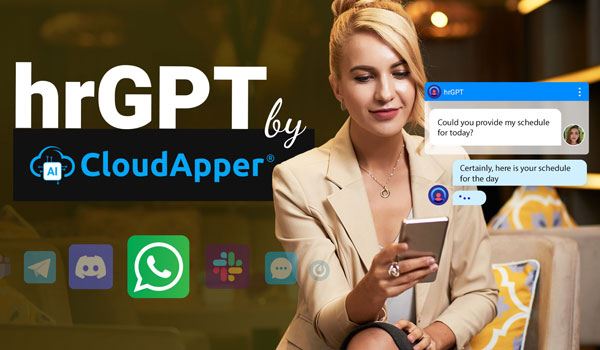
CloudApper AI Solutions for HR

- Works with


- and more.








Similar Posts
How cNPS Reflects Your Recruitment and Employer Brand
The Recruitment-to-HRIS Gap: Why Your “System of Record” Should Start…