High application volume makes identifying quality candidates harder than ever. This step-by-step recruiter’s guide breaks down a proven 12-step process to screen faster, reduce bias, and consistently identify candidates who actually perform on the job.


TL;DR
- Define what “quality” means for the role before reviewing a single resume
- Use structured scorecards and objective scoring to eliminate guesswork
- Prioritize demonstrated skills and problem-solving over credentials
- Move fast—top candidates are off the market within 10 days
- Use AI to scale screening without sacrificing consistency or fairness
Table of Contents
You just posted a job opening for a mid-level marketing manager. Within 48 hours, 250 applications flood your inbox. You start reviewing resumes at 9 AM, and by noon, your eyes are glazing over. Every candidate looks qualified on paper, but you know from experience that most won’t make it past the phone screen. Three weeks later, you’re still sifting through applications while your hiring manager is breathing down your neck about the empty seat. Sound familiar? Learning how to identify quality candidates quickly isn’t just a nice-to-have skill anymore. It’s the difference between filling roles with top performers in days versus settling for mediocre hires after months of frustration.
That’s exactly why we built CloudApper AI Recruiter, and it’s why we’re sharing this guide with you today. Over the past few years, we’ve helped hundreds of talent acquisition and HR leaders transform their screening process from a time-sucking nightmare into a streamlined system that surfaces the best candidates in minutes, not weeks. This step-by-step guide walks you through our proven 12-step process for identifying quality candidates, from defining what quality actually means for your specific role all the way through to final validation before you make an offer.
Phase 1: Preparation (Before You See Candidates)
Step 1: Define What “Quality” Means for Your Specific Role
Quality isn’t universal. What makes someone an excellent sales rep will get them laughed out of an engineering interview. Yet I see recruiters every single day evaluating candidates against some vague, undefined notion of “good” that exists only in their heads. You need to get specific before you see a single resume. Quality has three distinct dimensions: hard skills (technical abilities and certifications), soft skills (communication, adaptability, problem-solving), and cultural fit (values alignment and work style compatibility, not demographic similarity). Take 30 minutes right now to write out what quality actually means for your open role using this template: three must-haves, three nice-to-haves, and three dealbreakers. This half hour of work will save you 20 hours of wasted screening time.
Step 2: Build Your Candidate Scorecard
Now that you know what quality looks like, you need a way to measure it consistently. A good scorecard forces you to evaluate every candidate against the same criteria, weights those criteria based on what matters most, and gives you a numerical score for objective ranking. Start with four to six major criteria. For most positions, technical skills carry 35 to 40 percent of the weight, relevant experience gets 25 to 30 percent, soft skills indicators get 15 to 20 percent, cultural fit signals get 10 to 15 percent, and growth potential rounds it out at 5 to 10 percent. The magic happens when you put numbers to everything. Suddenly “I like this candidate” becomes “This candidate scored 84 out of 100, putting them in the top 12 percent of our applicant pool.” Companies using structured scorecards see a 40 percent improvement in quality of hire and a 30 percent reduction in time to fill. This makes you one step closer to identifying quality candidates.
Step 3: Create Your Screening Workflow
You need a process that consistently moves candidates from application to hire without losing the good ones or wasting time on the wrong ones. A solid workflow has clear stages and decision gates: application submitted, knockout questions, resume review, pre-screening assessment, phone screen, structured interview, final assessment (if needed), and offer.
This is also where tools like CloudApper AI Recruiter quietly make a difference. Instead of recruiters manually pushing candidates through each step, the workflow runs automatically based on predefined score thresholds and responses. Strong candidates move forward faster, weak ones are filtered out early, and nothing stalls because someone forgot to follow up.
Learn how to screen resumes effectively and spot quality candidates using a proven 7-step process.
Phase 2: Initial Screening (First Pass Through Applications)
Step 4: Start with Skills-Based Screening (Not Just Credentials)
That candidate with the Harvard MBA might be a worse hire than the one with a state school degree and three years of directly relevant experience. Skills-based hiring means you evaluate what someone can actually do, not where they went to school. Look for specific projects with measurable outcomes. Not “worked on software projects” but “built a React dashboard that reduced page load time by 60 percent and is now used by 10,000 daily active users.” Quality candidates speak in numbers and use action verbs like built, led, increased, and reduced. Watch for vague descriptions, skill lists without context, and lack of measurable achievements anywhere on the resume.
Step 5: Implement Strategic Pre-Screening Questions
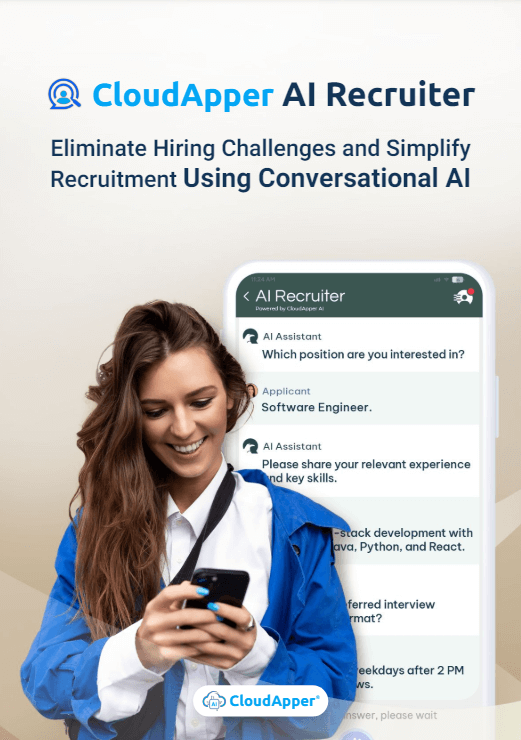
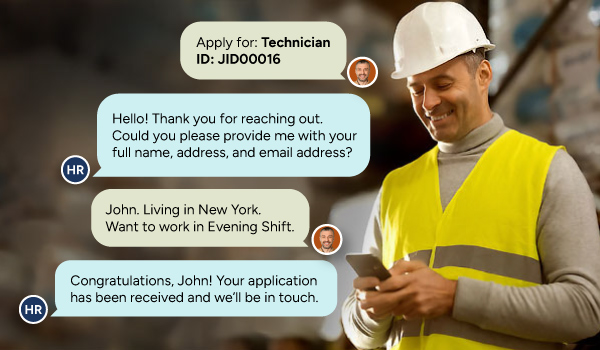
Knockout questions help you immensely to identify quality candidates. Use three types: mandatory requirements (yes or no questions about certifications, work authorization, schedule availability), role-specific scenario questions (that reveal real experience versus theoretical knowledge), and motivation questions (that separate genuine interest from mass applications). Keep it to five to eight questions maximum. Remember, 92 percent of candidates abandon applications they find too tedious. A recruiting chatbot can ask these questions naturally through a chat interface, adapting follow-up questions based on responses and operating 24/7 without any recruiter time required.
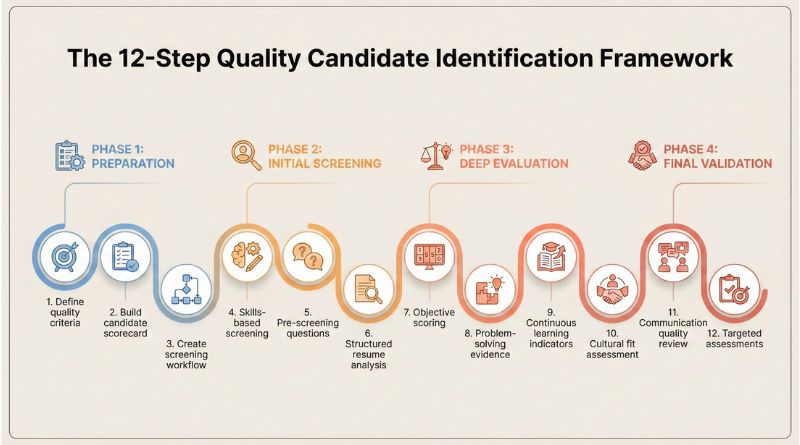
Step 6: Apply Structured Resume Analysis
Structured resume analysis means evaluating the exact same criteria for every single resume in the exact same order. Use this six-point framework: career progression (upward trajectory in responsibility), experience relevance (how closely their background matches your role), achievement orientation (results versus responsibilities), technical fit (required skills and tools), consistency and stability (reasonable tenure and logical transitions), and communication quality (clear writing without errors). Manual structured analysis takes five to 10 minutes per resume. For 250 applications, that’s 20 to 40 hours. AI-powered resume screening applies these criteria to every candidate in minutes, ranking your entire applicant pool by quality score so you review only the top 10 to 15 percent.
Read the full comparison: AI Resume Screening vs Traditional ATS Filters for Recruiters.
Phase 3: Deep Evaluation (Narrowing Down Candidates)
Step 7: Use Objective Candidate Scoring Systems
Your gut feeling is wrong at least 40 percent of the time. Research proves that unstructured interviews and subjective evaluation lead to worse hiring outcomes than structured, objective scoring. Take your weighted scorecard and score each candidate on each criterion. Anyone scoring 85 to 100 is exceptional and should be fast-tracked immediately. Anyone scoring 70 to 84 is strong and should proceed. Anyone below 55 doesn’t meet basic requirements. The same recruiter will evaluate the same candidate differently on different days, with up to 30 percent variance. Objective scoring removes this variance. Companies using structured scoring see a 50 percent reduction in bad hires and a 40 percent improvement in new hire performance.
Most screening problems don’t come from bad resumes. They come from applying the right criteria too late and inconsistently.
Step 8: Look for Problem-Solving Evidence
Past behavior predicts future performance better than anything else you can measure. Quality candidates tell you about challenges they’ve faced and how they overcame them using a natural challenge-action-result structure. Strong problem-solving evidence includes specific context, clear actions taken, and measurable outcomes. For candidates who pass resume screening, ask questions like “Tell me about the most complex problem you’ve solved in your current role” and listen for systematic thinking, resourcefulness, and learning. Watch for vague examples, taking full credit for team work, blaming others, and stories without outcomes.
Step 9: Check for Continuous Learning Indicators
The skills that made someone successful five years ago might be outdated today. Look for recent certifications or courses completed in the last two years, industry engagement through conferences or communities, side projects or portfolio work, and career pivots that required significant skill acquisition. During interviews, ask “What’s something new you’ve learned in the last six months?” and “How do you stay current in your field?” Strong answers are specific and explain the motivation behind their learning. Context matters, though. Someone early in their career might be focused on mastering their current role, or caregiving responsibilities might limit outside learning time.
Step 10: Assess Cultural and Team Fit (Without Bias)
Cultural fit means values alignment and work style compatibility. Cultural clone means demographic similarity or “people like us.” The first is legitimate. The second is bias. Ask questions that reveal values and work preferences: “Describe your ideal work environment,” “How do you prefer to receive feedback,” and “What type of company culture helps you thrive?” Never ask about kids, where they’re from, what they do for fun, or whether they’d “fit in.” Distinguish legitimate concerns (badmouths all previous employers, values contradict company mission) from differences (prefers different communication style, different hobbies, different background). Research-backed AI screening removes demographic information during initial review, focusing exclusively on job-relevant criteria and reducing bias by 60 to 75 percent.
Phase 4: Final Validation (Quality Checks Before Hiring)
Step 11: Evaluate Communication Quality Throughout
Communication quality is one of your earliest predictors of job performance. Quality candidates communicate professionally at every interaction. At the initial application, check for customization, professional email addresses, error-free writing, and following instructions. During pre-screen responses, look for thoughtful complete answers. In email correspondence, notice tone, response time (24 to 48 hours), and appropriate formality. During interview scheduling, watch for flexibility, confirmation without chasing, reasonable rescheduling notice, and appreciation. Adjust expectations based on role level. Entry-level candidates might need more guidance, but senior candidates should communicate like experienced professionals.
Step 12: Deploy Additional Assessment Tools Strategically
You should not be testing every candidate for every role with multiple assessments. Deploy them selectively based on what you need to validate. Skills testing works for technical roles (one to two hours maximum, realistic tasks, compensated if extensive). Work sample projects work for creative or strategic roles (three to four hours maximum, clear rubric, sufficient context). One-way video assessments work for remote or high-volume recruiting (three to five questions, two to three minutes each). Case study presentations work for senior roles (evaluate thinking process, not whether they reach your exact conclusion). Employee referrals have four times better retention rates. Avoid these pitfalls: unpaid work that benefits your company, excessive testing over four hours total, tests unrelated to the job, and testing without feedback.
How AI Accelerates Every Step to Identify Quality Candidates
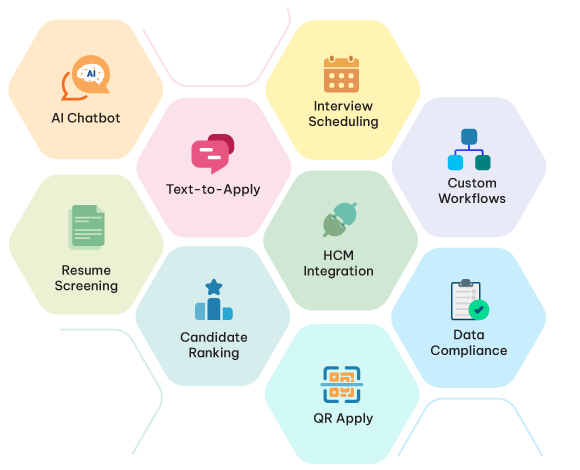
Everything in this guide works fine when you have a low-volume application. The challenge is scale. Applying structured evaluation to 250 candidates manually is unrealistic without burning out your recruiting team. This is where CloudApper AI Recruiter changes the equation by handling repetitive screening work with speed and consistency.
Here’s how AI strengthens each stage of quality candidate identification:
- Instant resume analysis at scale: AI evaluates hundreds of resumes in minutes instead of days, applying the same structured criteria to every candidate without fatigue or inconsistency.
- Custom scorecard-based ranking: With AI candidate ranking, your weighted criteria are applied uniformly, producing objective quality scores and instantly identifying the top 10–15 percent of candidates worth human review.
- Conversational pre-screening, 24/7: AI-driven chat screening asks role-specific and follow-up questions naturally, increasing completion rates and reducing the 92 percent application drop-off seen with long forms.
- Bias reduction in early screening: Demographic identifiers are removed during initial evaluation, so candidates are assessed purely on job-related qualifications, reducing unconscious bias by 60–75 percent.
- Automated candidate engagement: Status updates, interview scheduling, and follow-ups happen automatically, keeping strong candidates engaged without constant recruiter intervention.
- Dramatic time savings per role: Resume review time drops from 20–40 hours to minutes, saving eight to 12 recruiter hours per opening and reducing overall screening time by up to 97 percent.
- Seamless ATS integration: CloudApper AI Recruiter integrates with all major ATS and HCM platforms, e.g., UKG, Workday, Bullhorn, Greenhouse, Lever, Oracle, etc.
The result is not fewer recruiters. It’s recruiters spending their time on judgment, conversations, and final decisions instead of repetitive filtering.
Your Quality Candidate Identification Checklist
- Before screening starts: Define quality for this role (hard skills, soft skills, cultural fit). Build a weighted scorecard with four to six criteria. Create a workflow with clear stages and decision gates. Prepare five to eight role-specific screening questions.
- During initial screening: Evaluate demonstrated skills, not just credentials. Apply structured resume analysis consistently. Use candidate scoring to rank objectively. Check for problem-solving evidence.
- During deep evaluation: Look for continuous learning indicators. Assess cultural fit based on values and work style. Evaluate communication quality at every touchpoint. Use assessments strategically.
- Final validation: Candidate scored above 70 out of 100. References checked and positive. Communication is professional and timely. Assessment results confirm capabilities. Team consensus on fit and quality.
Conclusion
Learning how to identify quality candidates isn’t about finding perfect people. It’s about finding the right people for your specific roles using efficient, objective processes. Preparation prevents poor hiring, so invest two hours upfront to save weeks later. Structure eliminates bias through consistent criteria. Speed matters for quality because the best candidates are hired within 10 days.
The reward for getting recruitment right is exponential: better performance, lower turnover, faster growth, and a reputation that attracts even more quality candidates.
Identifying quality candidates shouldn’t depend on guesswork, gut feel, or how much time you have left in the day.
Reduce Time-to-Hire by 97% with AI for Talent Acquisition
Recruit skilled, culturally fit, and diverse candidates with CloudApper’s state-of-the-art AI resume screening, automated interview scheduling, and offer letter generation.
Learn more | Download BrochureFrequently Asked Questions About Finding Quality Candidates
-
What does a quality candidate actually mean?
A quality candidate meets the role’s required hard skills, demonstrates strong soft skills, aligns with company values, and shows evidence of real-world impact and growth potential. -
How do recruiters identify quality candidates faster?
Recruiters identify quality candidates faster by defining clear criteria upfront, using structured scorecards, applying skills-based screening, and automating early-stage evaluation. -
Why is structured candidate scoring important?
Structured scoring reduces bias and inconsistency by evaluating every candidate against the same weighted criteria, leading to better hiring decisions and fewer bad hires. -
How does AI help identify quality candidates?
AI accelerates candidate identification by analyzing resumes at scale, ranking candidates objectively, conducting pre-screening conversations, and maintaining consistent evaluation. -
What is the biggest mistake recruiters make when screening candidates?
The biggest mistake is relying on gut instinct or credentials alone instead of evaluating demonstrated skills, problem-solving ability, and job-relevant performance indicators.

What is CloudApper AI Platform?
CloudApper AI is an advanced platform that enables organizations to integrate AI into their existing enterprise systems effortlessly, without the need for technical expertise, costly development, or upgrading the underlying infrastructure. By transforming legacy systems into AI-capable solutions, CloudApper allows companies to harness the power of Generative AI quickly and efficiently. This approach has been successfully implemented with leading systems like UKG, Workday, Oracle, Paradox, Amazon AWS Bedrock and can be applied across various industries, helping businesses enhance productivity, automate processes, and gain deeper insights without the usual complexities. With CloudApper AI, you can start experiencing the transformative benefits of AI today. Learn More
CloudApper AI Solutions for HR


- Works with


- and more.








Similar Posts
How cNPS Reflects Your Recruitment and Employer Brand
The Recruitment-to-HRIS Gap: Why Your “System of Record” Should Start…