High-volume hourly hiring faces compliance risks from inconsistent evaluations. AI candidate scoring applies uniform, job-relevant criteria to every applicant, documenting decisions automatically. CloudApper’s conversational AI assesses skills via chat/SMS, provides scores and transcripts, and enables audit-proof records—protecting against EEOC scrutiny while improving hire quality.

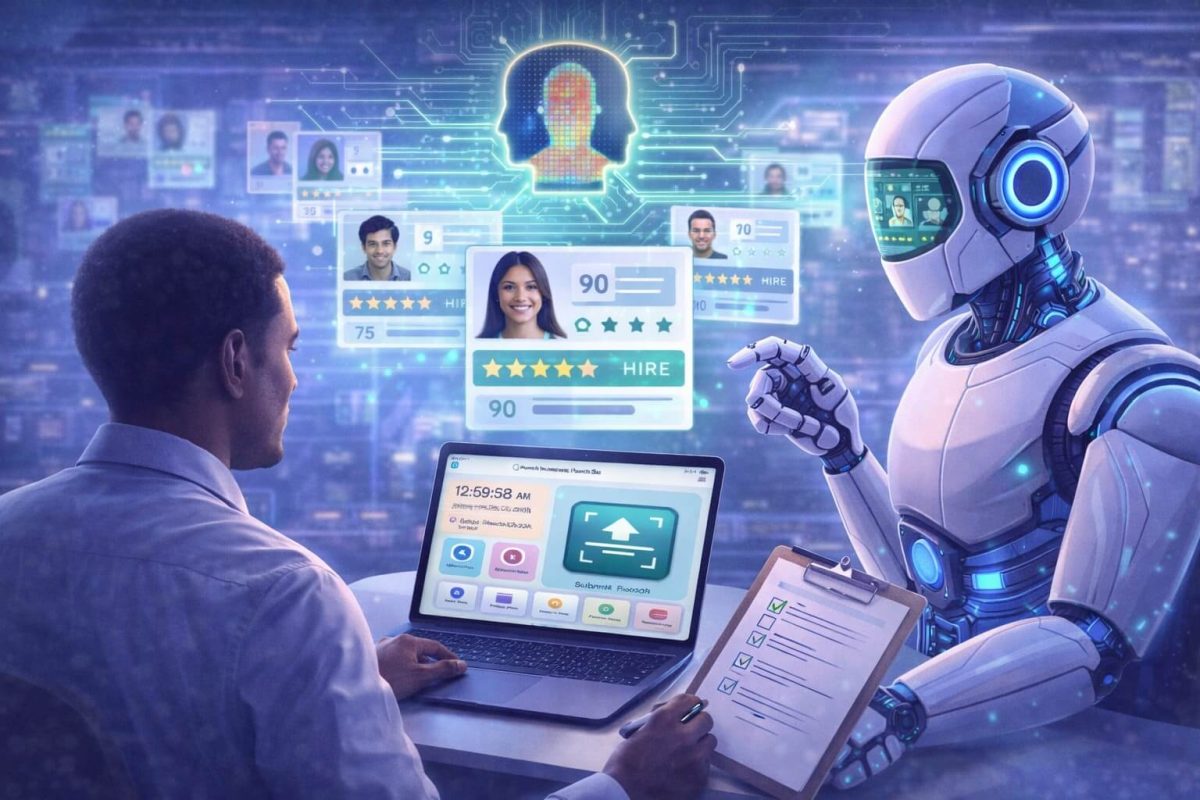
Table of Contents
The EEOC audit notification arrives on a Tuesday morning. Your organization is facing allegations of discriminatory hiring practices across your 47 retail locations. HR scrambles to produce documentation explaining why certain candidates were hired while others weren’t. The problem? Your high-volume hiring process involves twelve different recruiters making subjective decisions on hundreds of weekly applications, with minimal documentation about evaluation criteria or decision rationale.
This nightmare scenario is becoming increasingly common as regulatory scrutiny of hiring practices intensifies. For talent acquisition professionals managing continuous hourly hiring in healthcare, retail, and manufacturing, the question isn’t if you’ll face an audit—it’s when, and whether you’ll be prepared.
The solution lies in AI candidate scoring systems that create transparent, defensible, and consistent evaluation frameworks. When implemented correctly, these systems transform hourly hiring from a compliance liability into an audit-proof process backed by clear documentation and objective criteria.
TL;DR
Traditional hourly hiring risks audits due to subjective, undocumented decisions. AI candidate scoring standardizes evaluation on job-relevant factors (experience, availability, certifications), ensures consistency across recruiters, and auto-documents everything. CloudApper AI Recruiter uses conversational screening to score candidates fairly, flag disparate impact, and create defensible records—making hiring faster, compliant, and audit-ready.
The Compliance Crisis in High-Volume Hourly Hiring
Hourly hiring operates under unique pressures that create perfect conditions for compliance failures. You’re processing enormous application volumes—sometimes hundreds per week per location. Multiple recruiters and hiring managers make independent decisions. Candidates move through the pipeline rapidly, often hired within days. Turnover rates demand constant replacement hiring, creating documentation fatigue.
Under these conditions, inconsistency is inevitable. One recruiter emphasizes customer service experience for retail positions; another prioritizes schedule flexibility. A healthcare facility manager prefers candidates with certifications; another values work ethic over credentials. A manufacturing supervisor unconsciously favors applicants from familiar neighborhoods. Each decision seems reasonable in isolation, but collectively they create patterns that can’t withstand regulatory scrutiny.
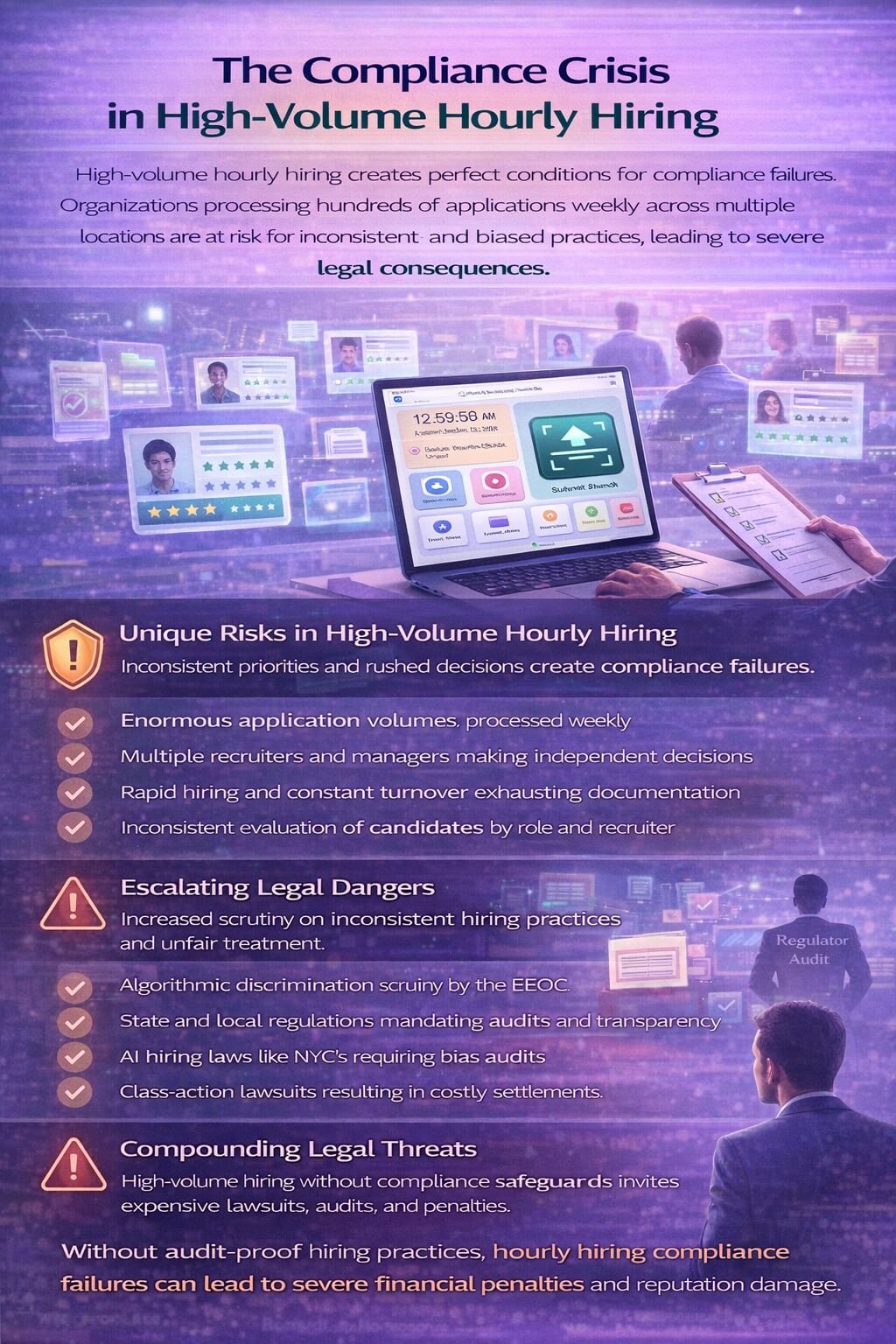
The legal landscape has grown increasingly treacherous. The EEOC’s focus on algorithmic discrimination means both human decision-making and AI systems face examination. State-level regulations like New York City’s AI hiring law require audits and disclosure. Class-action lawsuits targeting hiring practices have resulted in multi-million dollar settlements. The message is clear: organizations must demonstrate that their hiring processes are fair, consistent, and legally defensible.
Yet most hourly hiring operations lack the infrastructure to prove this. Documentation is sparse or non-existent. Evaluation criteria vary by recruiter. Decisions are based on gut feelings rather than structured assessment. Rejected candidates receive little explanation. When auditors come knocking, organizations struggle to produce evidence that their processes don’t discriminate.
Why Traditional Hiring Practices Fail Under Audit
The fundamental problem with traditional hourly hiring isn’t necessarily discrimination—it’s the inability to prove non-discrimination. Even organizations with good intentions often can’t document that their decisions were based on legitimate, job-related criteria consistently applied across all candidates.
Consider typical scenarios that create audit vulnerabilities:
Inconsistent Screening: When different recruiters evaluate similar candidates differently based on personal preferences rather than standardized criteria, you can’t demonstrate consistency. If one recruiter advances candidates with six months of experience while another requires two years, you’re applying different standards—and likely producing different outcomes across demographic groups.
Undocumented Decisions: “She seemed like a good fit” or “His availability didn’t work” might be legitimate reasons to reject candidates, but without documentation of what “good fit” means or why specific availability patterns disqualify applicants, you can’t prove decisions weren’t based on protected characteristics.
Subjective Evaluation: Assessing candidates on vague qualities like “professionalism,” “attitude,” or “culture fit” without clear definitions or measurement frameworks opens the door to bias—conscious or unconscious. These subjective factors often correlate with protected characteristics in ways that create legal liability.
Lack of Comparative Analysis: When you can’t demonstrate why Candidate A was hired over similarly qualified Candidate B, you leave room for allegations that protected characteristics influenced the decision. Without systematic scoring, making these comparisons across hundreds of candidates is impossible.
Poor Record Retention: High hiring volumes and rapid turnover lead to inadequate record-keeping. Application materials are discarded, interview notes are lost, and decision rationale is never recorded. When audits examine hiring patterns from months or years prior, missing documentation is devastating.
Manager Discretion: Giving hiring managers broad discretion without structured frameworks produces wildly inconsistent decisions. What one manager considers essential another views as optional, creating disparate treatment that’s difficult to defend.
How AI Candidate Scoring Creates Audit-Proof Processes
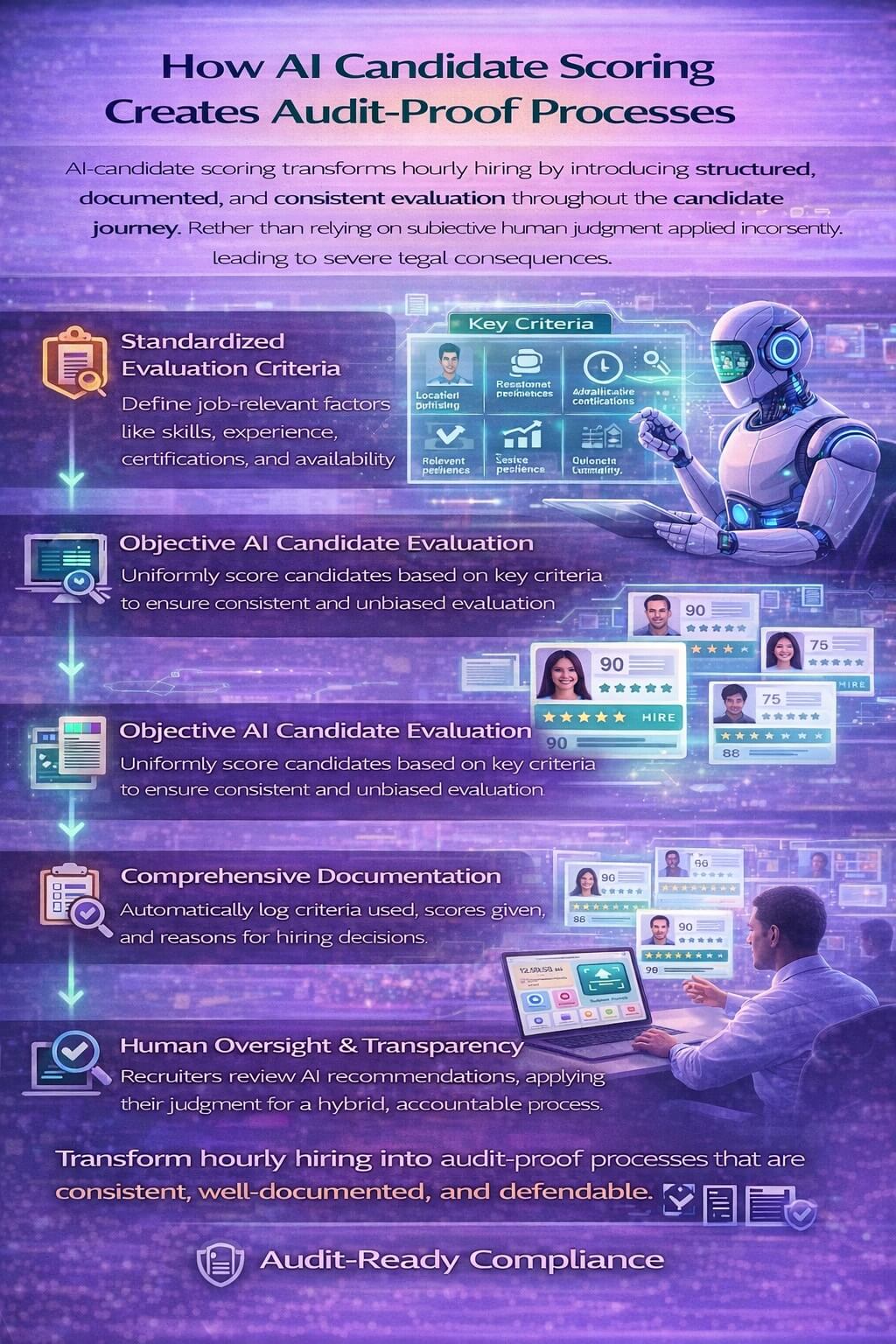
AI candidate scoring transforms hourly hiring by introducing structured, documented, and consistent evaluation throughout the candidate journey. Rather than relying on subjective human judgment applied inconsistently, organizations establish clear criteria that AI systems apply uniformly to every candidate.
The process works by defining specific, job-relevant factors that predict success in your roles: relevant experience level, required certifications, schedule availability, location proximity, demonstrated skills, and other measurable attributes. The AI system evaluates each candidate against these criteria, assigning scores based on how well they meet requirements.
Critically, this evaluation happens the same way for every candidate. The system doesn’t get tired, doesn’t have unconscious biases, doesn’t favor candidates from familiar backgrounds, and doesn’t apply different standards on Mondays versus Fridays. Every nursing assistant applicant answers the same screening questions. Every retail candidate is evaluated using identical criteria. Every manufacturing applicant receives the same consideration.
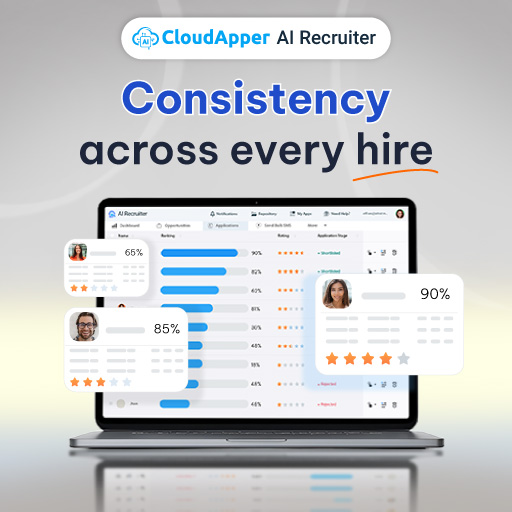
This consistency is the foundation of audit-proof hiring. When regulators examine your process, you can demonstrate that decisions were based on legitimate, job-related factors uniformly applied. You have documentation showing what criteria you used, how candidates scored, and why hiring decisions were made. The entire process is transparent and defensible.
Moreover, AI scoring creates natural checkpoints for human review. Rather than making entirely subjective initial decisions, recruiters review AI-generated scores and recommendations, applying their judgment to validate and contextualize algorithmic assessments. This hybrid approach captures efficiency gains while maintaining human accountability—and creates documentation of both algorithmic and human reasoning.
Essential Elements of Audit-Proof AI Scoring
Not all AI candidate scoring systems provide equal compliance protection. Audit-proof implementations share several critical characteristics:
Job-Relevant Criteria: Scoring must be based exclusively on factors that genuinely predict job performance. Educational requirements, experience levels, certifications, skills, and availability should directly relate to role demands. Criteria that seem neutral but don’t predict performance—like credit scores or employment gaps—create legal risk.
Transparent Logic: You must be able to explain exactly how scores are calculated and why specific factors receive certain weights. Black-box algorithms that can’t be explained are impossible to defend under audit. The system should clearly articulate why Candidate A scored higher than Candidate B.
Consistent Application: The same evaluation criteria must apply to every candidate for a given role type. Variation is acceptable across different positions (nursing assistants versus retail associates), but within role categories, consistency is essential.
Comprehensive Documentation: Every candidate interaction, screening response, score component, and decision point should be automatically documented. This creates an audit trail showing that your process operated as designed and applied criteria uniformly.
Human Oversight: Purely automated decision-making creates compliance risks. Effective systems use AI for evaluation and recommendation while preserving human judgment for final decisions. This oversight should be documented, showing that humans validated algorithmic recommendations.
Regular Validation: Audit-proof systems include mechanisms for monitoring whether scoring criteria actually predict job performance and whether they produce disparate impact across demographic groups. Regular validation allows you to identify and correct problems before they accumulate.
Adverse Impact Analysis: The system should enable analysis of pass-through rates and hiring outcomes across protected groups. If certain populations are screened out at significantly different rates, you need to investigate whether your criteria inadvertently discriminate.
The Benefits Beyond Compliance
While audit-proofing is the primary driver for implementing AI candidate scoring, organizations discover substantial additional benefits that justify investment beyond risk mitigation alone.
Faster Hiring Decisions: Structured scoring accelerates evaluation by eliminating ambiguity. Recruiters don’t deliberate over subjective impressions; they review objective scores and make decisions confidently. This speed advantage is crucial in competitive hourly hiring markets where delays cost candidates.
Improved Quality of Hire: When scoring criteria align with actual job success factors, you naturally hire people who perform better. The system optimizes for predictive factors rather than credential proxies that don’t correlate with performance.
Reduced Recruiter Burden: High-volume hiring exhausts recruiters who must make hundreds of evaluation decisions weekly. Structured scoring removes decision fatigue by handling initial assessment systematically, freeing recruiters to focus on interviewing and relationship building.
Enhanced Candidate Experience: Candidates appreciate transparent processes where they understand how they’re being evaluated and why decisions are made. AI scoring enables consistent communication about qualification requirements and decision status, improving satisfaction even for rejected candidates.
Better Training and Calibration: When new recruiters join your team, AI scoring provides built-in training on evaluation standards. They learn what “qualified” means in your organization by reviewing scored candidates and understanding the rationale behind recommendations.
Data-Driven Optimization: Structured scoring generates rich data about what factors actually predict retention and performance. You can continuously refine criteria based on evidence rather than assumptions, improving hiring outcomes over time.
Scalability: As you expand hiring across locations or increase volume during peak seasons, AI scoring maintains consistency without proportional increases in training, supervision, or quality control efforts.
How CloudApper AI Recruiter Delivers Audit-Proof Scoring
CloudApper AI Recruiter builds audit-proof candidate evaluation directly into its conversational AI platform, creating documentation and consistency from the first candidate interaction through final hiring decisions.
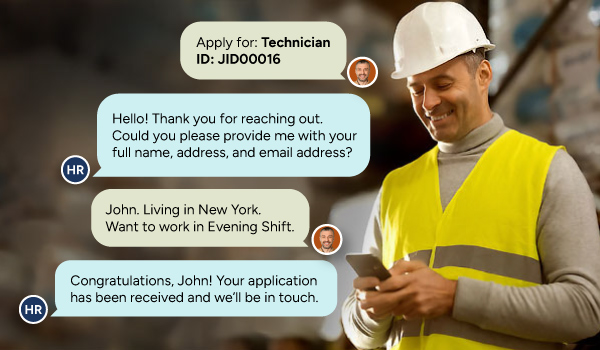
The system engages candidates through text message conversations that systematically assess job-relevant qualifications. Rather than parsing resumes or making inferences from credentials, CloudApper asks candidates directly about their experience, certifications, availability, location, and other factors that matter for your specific roles.
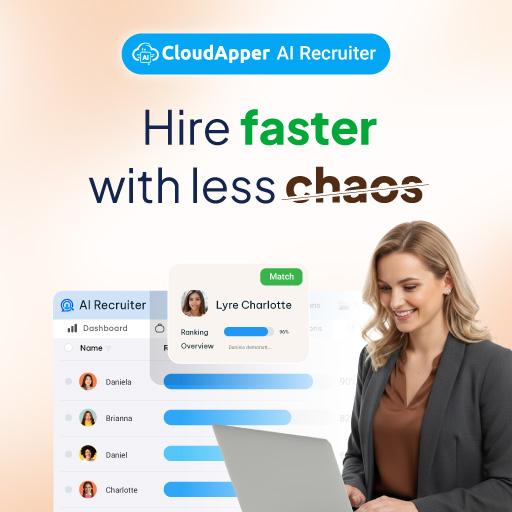
Each candidate response is captured, evaluated against your predefined criteria, and incorporated into a comprehensive qualification score. The platform documents not just the final score but the entire conversation flow—which questions were asked, how candidates responded, and how each response influenced the overall assessment.
This approach provides several audit-proof advantages. First, the evaluation criteria are transparent and customizable to your organization’s specific needs. You define what matters for nursing assistants, retail associates, or manufacturing operators, ensuring scoring aligns with genuine job requirements. Second, every candidate for a given role type has the same conversation and is evaluated using identical standards, eliminating the inconsistency that creates compliance vulnerabilities.
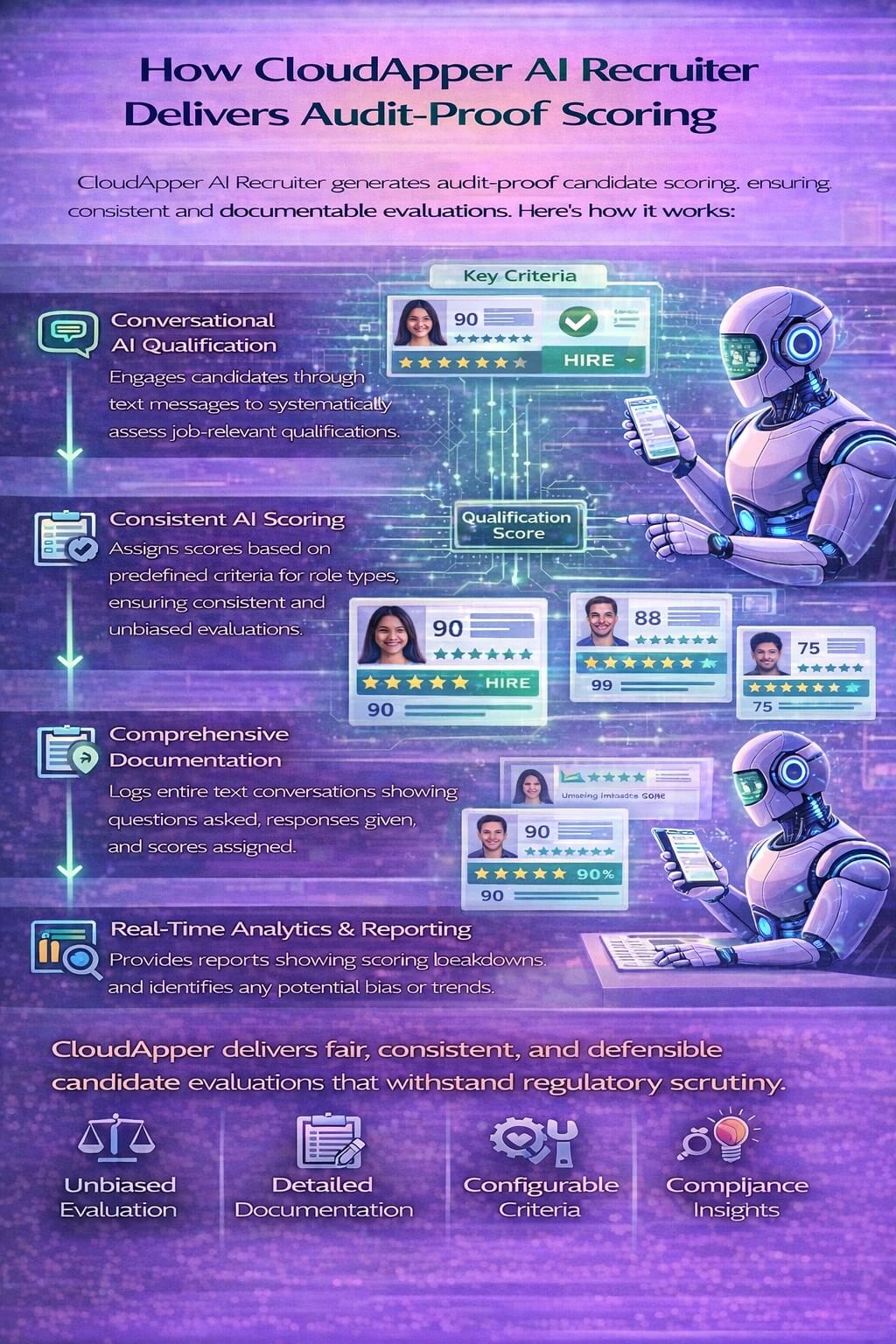
CloudApper’s conversational format also captures nuanced information that traditional resume screening misses. A candidate can explain a gap in employment, provide context about their experience level, or clarify their availability constraints—all information that gets documented and factored into scoring appropriately.
For talent acquisition teams, CloudApper presents candidates with clear qualification scores and comprehensive conversation histories. Recruiters can see exactly why candidates scored as they did, review their responses to specific questions, and make informed decisions about whom to advance. This human review layer is documented, showing that final hiring decisions involved appropriate human judgment rather than pure automation.
The platform also generates the reporting and analytics necessary for compliance monitoring. You can analyze pass-through rates across different candidate populations, identify whether any screening criteria produce disparate impact, and demonstrate that your process operates consistently across locations and time periods.
Perhaps most valuable for audit preparation, CloudAapper maintains complete records of every candidate interaction indefinitely. When auditors request documentation about hiring practices from six months or two years ago, you can produce comprehensive evidence showing how candidates were evaluated, what criteria were applied, and why specific hiring decisions were made.
Best Practices for Implementation
Successfully implementing audit-proof AI scoring requires more than just deploying technology. Organizations should follow proven practices to maximize compliance protection:
Start with Job Analysis: Before configuring scoring criteria, conduct thorough job analysis to identify what truly predicts success in your roles. Involve frontline managers, high-performing employees, and HR professionals in defining requirements. Document this analysis—it becomes evidence that your criteria are job-related.
Validate Against Outcomes: Once your scoring system operates, track whether scores actually correlate with job performance, retention, and other success metrics. This validation demonstrates that your criteria are predictive, not arbitrary.
Monitor for Disparate Impact: Regularly analyze whether your scoring produces different outcomes across protected groups. If certain populations are screened out at significantly higher rates, investigate whether criteria need adjustment even if they seem neutral.
Train Your Team Thoroughly: Ensure recruiters understand how scoring works, what criteria drive decisions, and their role in validating recommendations. They should be able to explain the system confidently to candidates, managers, and auditors.
Document Everything: Maintain records not just of candidate evaluations but of system configuration, criteria changes, validation studies, and training sessions. Comprehensive documentation demonstrates that you take compliance seriously.
Seek Legal Review: Have employment counsel review your scoring criteria and implementation to identify potential legal risks before they become problems. Legal guidance should inform what factors you evaluate and how.
Communicate Transparently: Be open with candidates about how they’re being evaluated. Transparency builds trust and demonstrates that you have nothing to hide about your process.
Frequently Asked Questions
Q: Won’t implementing AI scoring make us more vulnerable to AI discrimination lawsuits?
A: The opposite is true. AI scoring, when implemented properly, provides documentation and consistency that protects you from discrimination claims. The real risk is continuing with subjective, undocumented processes that you can’t defend. Yes, AI systems face scrutiny, but systems designed with compliance in mind and subject to regular validation are far more defensible than inconsistent human decision-making.
Q: How often do we need to audit our own AI scoring system to maintain compliance?
A: Best practice is conducting formal validation at least annually, with continuous monitoring of key metrics. You should regularly review pass-through rates across demographic groups, analyze whether scores predict job success, and assess whether criteria remain job-relevant as roles evolve. Many organizations conduct quarterly reviews with annual comprehensive audits.
Q: What documentation do we need to retain to be audit-proof?
A: Retain records of: (1) job analyses justifying your scoring criteria, (2) system configuration showing how scores are calculated, (3) individual candidate evaluations including all screening responses and scores, (4) validation studies demonstrating criteria predict job success, (5) disparate impact analyses, (6) training materials for your team, and (7) any changes to criteria over time with rationale. Generally, retain hiring records for at least two years, though longer retention is advisable.
Q: Can we use the same scoring criteria across all our locations, or do we need location-specific criteria?
A: You can use standardized criteria for the same role types across locations, which actually strengthens compliance by demonstrating consistency. However, allow for legitimate location-specific factors like shift availability or required certifications. The key is ensuring any variations are based on genuine job requirements rather than preferences of local managers.
Q: What if our AI scoring system produces disparate impact against a protected group? Does that automatically mean we’re violating anti-discrimination laws?
A: Not necessarily. Disparate impact alone doesn’t prove discrimination if your criteria are job-related and consistent with business necessity. However, disparate impact requires investigation. You must examine whether the problematic criteria actually predict job success and whether alternative criteria could achieve similar results with less disparate impact. Document this analysis thoroughly.
Q: How do we handle hiring managers who want to override AI scoring recommendations based on their “gut feeling”?
A: AI scoring should inform rather than dictate decisions, so manager input is valuable. However, overrides should be documented with clear rationale tied to job-relevant factors. If Manager A consistently overrides scores in ways that favor certain demographic groups, that creates compliance risk. Establish protocols requiring documented justification for any decision that contradicts scoring recommendations.
Building Audit-Ready Hiring Infrastructure
High-volume hourly hiring will always involve some degree of subjective human judgment—and that’s appropriate. The goal isn’t removing human decision-making but supporting it with structured frameworks that ensure consistency, transparency, and defensibility.
AI candidate scoring provides this framework. When implemented thoughtfully with attention to compliance requirements, it transforms hourly hiring from a compliance vulnerability into an audit-proof process that stands up to regulatory scrutiny while simultaneously improving hiring speed and quality.
For talent acquisition professionals and HR leaders in healthcare, retail, and manufacturing, the investment in structured, documented, AI-supported evaluation isn’t just about avoiding lawsuits—though that alone justifies the effort. It’s about building sustainable hiring infrastructure that scales with your needs, maintains quality under pressure, and demonstrates to candidates, employees, and regulators that your organization takes fair hiring seriously.
The regulatory environment will only grow more demanding. Organizations that wait until facing an audit to address compliance gaps will find themselves scrambling to defend indefensible processes. Those that proactively implement audit-proof systems will navigate regulatory scrutiny confidently while reaping operational benefits that strengthen their competitive position in talent markets.
To learn more about how CloudApper AI Recruiter creates audit-proof candidate scoring through conversational AI, visit https://www.cloudapper.ai/ai-recruiter-conversational-chatbot/

What is CloudApper AI Platform?
CloudApper AI is an advanced platform that enables organizations to integrate AI into their existing enterprise systems effortlessly, without the need for technical expertise, costly development, or upgrading the underlying infrastructure. By transforming legacy systems into AI-capable solutions, CloudApper allows companies to harness the power of Generative AI quickly and efficiently. This approach has been successfully implemented with leading systems like UKG, Workday, Oracle, Paradox, Amazon AWS Bedrock and can be applied across various industries, helping businesses enhance productivity, automate processes, and gain deeper insights without the usual complexities. With CloudApper AI, you can start experiencing the transformative benefits of AI today. Learn More
CloudApper AI Solutions for HR

- Works with


- and more.







Similar Posts
How cNPS Reflects Your Recruitment and Employer Brand
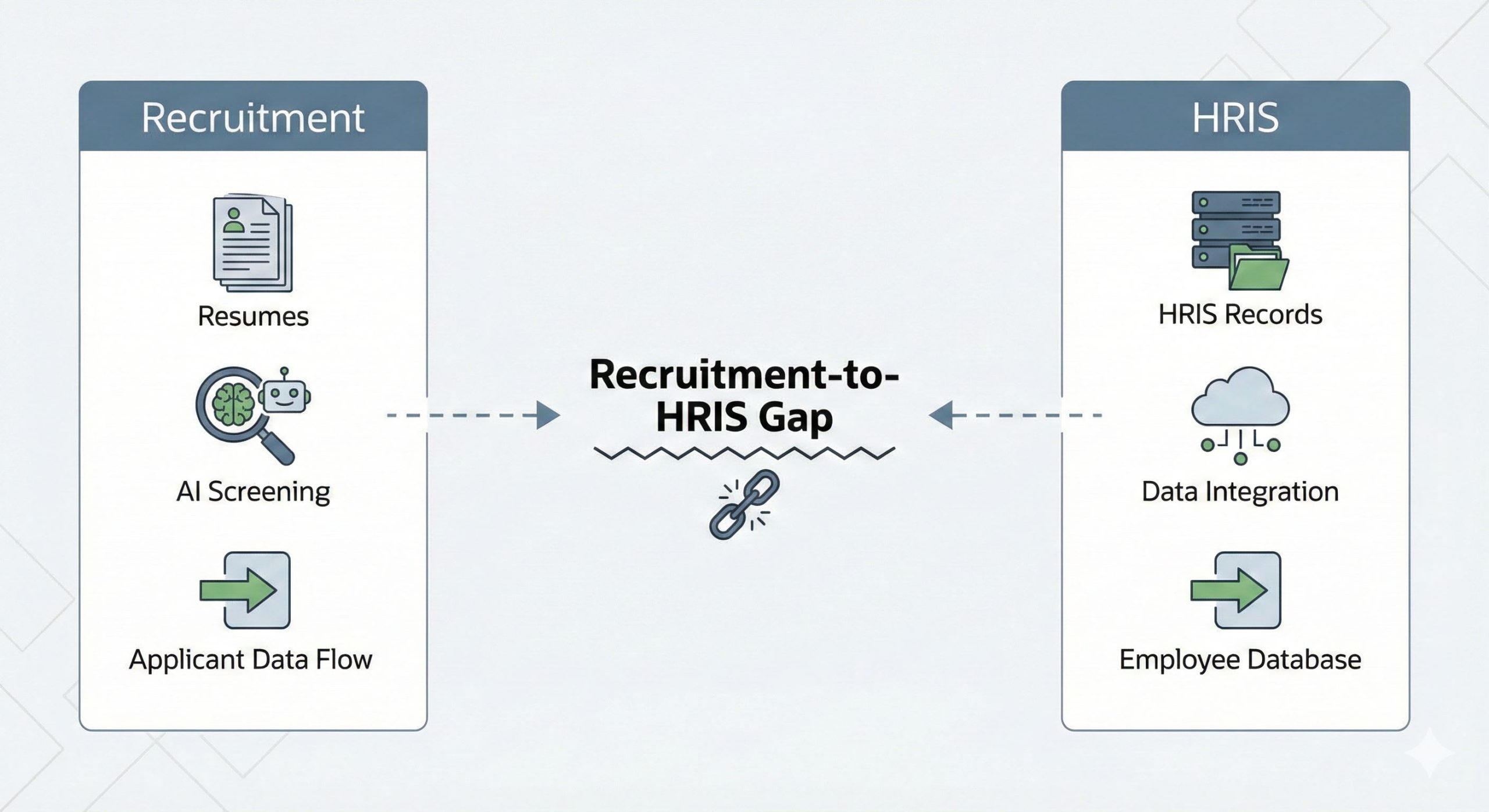
The Recruitment-to-HRIS Gap: Why Your “System of Record” Should Start…