High cost per hire burdens budgets and slows growth. Discover how CloudApper AI Recruiter automates screening, scheduling, and assessments—reducing expenses, expanding talent pools 24/7, and integrating seamlessly with ATS/HCM systems for efficient, affordable hiring.

Table of Contents
Are you frustrated with the cost-per-hire figures? It isn’t only you. A high cost per hire can strangle your budget, slowing the hiring process and potentially leading to less qualified candidates. This could have significant consequences for your entire company. However, recruitment chatbots powered by AI, such as CloudApper’s AI for talent acquisition, can be a valuable tool. By automating processes such as resume screening, interview scheduling, and integration with various well-known ATS and HCM platforms, the AI Recruiter serves as a single platform for automating multiple aspects of your hiring process and lowering your recruitment cost.
TL;DR: Reducing Cost per Hire with AI Recruitment Chatbots
- Cost per hire (CPH) measures total expenses to fill one position, averaging $4,700–$5,475 for nonexecutive roles in the U.S. (SHRM 2025 benchmarks), with executive hires reaching $35,000+.
- High CPH results from manual tasks, prolonged processes, talent shortages, agency fees, and inefficient sourcing channels.
- Recruitment chatbots like CloudApper AI Recruiter automate resume screening, interview scheduling, candidate pre-assessment, and FAQ responses—cutting internal labor costs and time-to-fill.
- Benefits include 24/7 candidate engagement, larger talent pools via QR code access, seamless ATS/HCM integration (e.g., Workday, UKG), and unified platforms to eliminate multiple tools.
- Result: Significant CPH reduction (e.g., up to 39% in success cases), faster hiring, better candidate experience, and optimized budgets.
What is Cost per Hire?
Cost per hire (often abbreviated as CPH) is a key recruitment metric that measures the total amount of money an organization spends to fill a single open position. It encompasses all expenses incurred throughout the entire hiring lifecycle—from sourcing and attracting candidates to interviewing, assessing, onboarding, and sometimes even the initial training of the new hire.
This metric provides a clear picture of recruitment efficiency and helps HR leaders benchmark performance, identify inefficiencies, and justify investments in tools like AI-powered recruitment solutions. According to benchmarks from the Society for Human Resource Management (SHRM), the average cost per hire in the U.S. has hovered around $4,700–$4,800 in recent years, though it can vary significantly by industry, role level (e.g., entry-level vs. executive), location, and company size. High CPH often signals opportunities for optimization, such as automating repetitive tasks to reduce both time and resource drain.
How to Calculate Cost per Hire
The standard and widely accepted formula for cost per hire, formalized through a collaboration between SHRM and the American National Standards Institute (ANSI), is:
Cost per Hire = (Total Internal Recruiting Costs + Total External Recruiting Costs) ÷ Total Number of Hires
This calculation is typically done over a specific time period, such as a quarter, six months, or a full year, to ensure accuracy and comparability.
- Total Internal Recruiting Costs: These include expenses tied to your in-house resources and operations, such as:
- Salaries, benefits, and overhead for recruiters, HR staff, and hiring managers involved in the process (often prorated based on time spent).
- Employee referral bonuses.
- Costs for internal tools, software subscriptions (e.g., ATS or HCM platforms), job posting on company career sites, and interview-related expenses (e.g., travel for in-person interviews or assessment tools).
- Administrative costs like background checks or drug screening when handled internally.
- Total External Recruiting Costs: These cover payments to outside vendors and services, including:
- Job advertising fees (e.g., on LinkedIn, Indeed, or niche job boards).
- Recruitment agency or headhunter fees.
- Third-party screening, assessment, or background check services.
- Career fair or event sponsorships.
- Relocation assistance (if applicable) or signing bonuses tied to external sourcing.
Steps to Calculate It:
- Choose a consistent time frame (e.g., the past 12 months).
- Gather and sum all qualifying internal and external costs for that period.
- Count the total number of hires (successful fills) in the same period—exclude partial or failed attempts.
- Divide the total costs by the number of hires to get your average CPH.
For example, if your organization spent $35,000 on internal costs and $20,000 on external costs over a year, and made 12 hires, your cost per hire would be: ($35,000 + $20,000) ÷ 12 = $4,583.
Tracking this metric regularly allows you to spot trends, compare against industry benchmarks, and measure the impact of optimizations like implementing a recruitment chatbot to automate screening and scheduling—potentially slashing both internal time costs and external sourcing expenses.
What are The Reasons Behind a High Cost per Hire?
A high cost per hire (CPH) often stems from inefficiencies, market dynamics, and structural factors that inflate both internal and external recruiting expenses. While some variation is normal—such as higher costs for specialized roles or competitive industries—uncontrolled increases can strain budgets and signal deeper process issues.
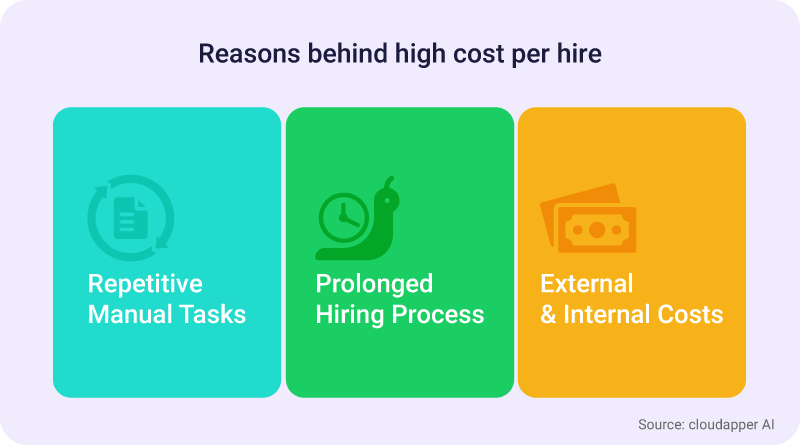
Repetitive Manual Tasks
Screening resumes, scheduling interviews, answering basic candidate questions, and manually coordinating availability across teams are time-intensive and repetitive. These tasks consume significant recruiter and hiring manager hours, driving up internal labor costs (often the largest component of CPH). Cross-checking schedules for conflicts adds further frustration and delays, prolonging the overall process and accumulating expenses.
Prolonged Hiring Process
Lengthy time-to-fill periods—common in high-volume applicant scenarios or when processes aren’t streamlined—directly increase costs. Each additional day or week means more accumulated recruiter time, extended job advertising spend, and opportunity costs from unfilled roles. Industries like tech or engineering often see longer cycles due to skill shortages, pushing CPH higher (e.g., up to $35,000 for specialized roles in competitive markets).
External & Internal Costs
External expenses like recruitment agency fees (often 15–30% of a hire’s salary), premium job board ads, background checks, and relocation packages can quickly escalate. Internally, underutilized HR and hiring manager time on mundane activities wastes valuable expertise and inflates “soft” costs—such as prorated salaries for time spent interviewing or reviewing unqualified applicants—which experts estimate can double or triple the visible hard costs.
Additional Key Contributors
- Talent Shortages and Competition: In tight labor markets, low unemployment, or high-demand fields, organizations compete fiercely for qualified candidates, leading to higher advertising budgets, signing bonuses, or reliance on expensive agencies.
- Role Complexity and Seniority: Executive or specialized positions require more extensive sourcing, multiple interview rounds, and advanced assessments, often resulting in CPH several times higher than entry-level roles (e.g., executive hires averaging $35,000+ per recent benchmarks).
- Inefficient Channels and Poor Employer Branding: Over-reliance on paid external sources instead of cost-effective options like employee referrals or organic social recruiting increases spend. A weak employer brand reduces inbound applications, forcing more outbound efforts and prolonging searches.
- High Turnover Impact: Frequent turnover creates a cycle of repeated hiring, amplifying overall recruitment costs as the same expenses recur without long-term productivity gains.
Addressing these root causes through automation, process optimization, and strategic sourcing can significantly lower CPH while improving hire quality and speed.
How Can CloudApper AI Recruiter Help to Optimize Cost per Hire?
CloudApper AI Recruiter is your secret weapon in the fight against high hiring cost. Here’s how it can help:
Automate Repetitive Tasks
With CloudApper AI Recruiter, you can free up your recruiters’ time by automating repetitive tasks like scheduling interviews, responding to frequently asked questions, asking pre-screening questions, and ranking the best-fit candidates. This lowers internal costs connected with recruiter time and accelerates the recruitment process.
24/7 Availability
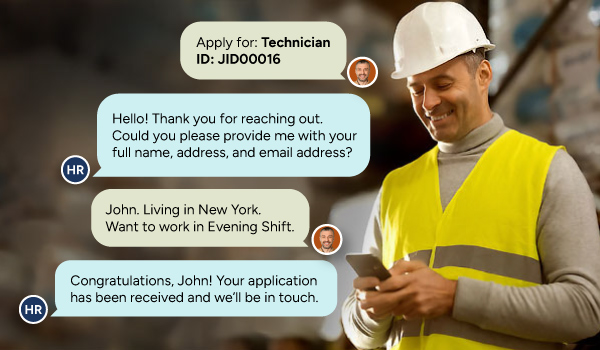
The CloudApper AI Recruiter allows candidates to apply for job postings at any time. All they need to do is scan the QR code of the job opportunity that you will need to create, and the chatbot will open instantly and begin conversations with the candidates. Candidates can ask the chatbot any questions they have regarding the position, and it will readily answer them. This allows Candidates to connect and have their questions answered at any time of day or night, thereby attracting a larger talent pool and improving the candidate experience.
Streamlined Candidate Assessment
CloudApper AI Recruiter can assess candidates based on predefined criteria, excluding those that do not fulfill the basic requirements. Those who pass the pre-screening phase will be prompted to schedule an interview within the date range you specify. This guarantees that your recruiters focus solely on promising candidates, enhancing hiring efficiency and lowering cost per hire.
Study
According to a study by Tidio, 95% of HR professionals believe that AI can help with Application processes.
Singular Platform for Multiple Service
CloudApper AI Recruiter offers a unified platform for candidate screening, interview scheduling, and even employee recommendations. This eliminates the need for different tools and streamlines the hiring process, saving you both time and money.
Seamless Integration
CloudApper AI Recruiter interacts with all major HCM and ATS platforms like UKG, Workday, ICIMS, Oracle, Bullhorn, Greenhouse, Lever, etc., enabling a smooth workflow and maximizing the value of your existing recruiting technology investment.
Conclusion
By automating tasks, being available 24/7, offering a streamlined platform, and integrating seamlessly with your existing HCM and ATS systems, a recruitment chatbot like CloudApper AI Recruiter can significantly reduce your cost per hire. Stop letting a high CPH hold you back.
*Disclaimer: Due to privacy reasons, the identity of the person or company cannot be revealed.

FAQ: Optimize Cost per Hire With Recruitment Chatbots
What is cost per hire (CPH)?
Cost per hire is the total cost an organization incurs to fill one open position, including internal expenses (e.g., recruiter salaries, tools) and external costs (e.g., job ads, agency fees), divided by the number of hires in a given period.
How do you calculate cost per hire?
Use this formula: CPH = (Total Internal Recruiting Costs + Total External Recruiting Costs) ÷ Total Number of Hires. Track over a consistent timeframe (e.g., annually) and include prorated staff time, advertising, and bonuses.
How can a recruitment chatbot reduce cost per hire?
AI chatbots automate repetitive tasks like screening resumes, scheduling interviews, answering candidate questions, and pre-assessing applicants 24/7. This reduces recruiter time, shortens hiring cycles, attracts more candidates, and minimizes reliance on expensive agencies or ads.
What are the main reasons for high cost per hire?
Common causes include manual repetitive tasks, prolonged time-to-fill, talent shortages in competitive markets, high agency fees (15–30% of salary), poor employer branding, inefficient sourcing channels, and role complexity (especially for senior or specialized positions).
*Disclaimer: Due to privacy reasons, the identity of the person or company cannot be revealed.

What is CloudApper AI Platform?
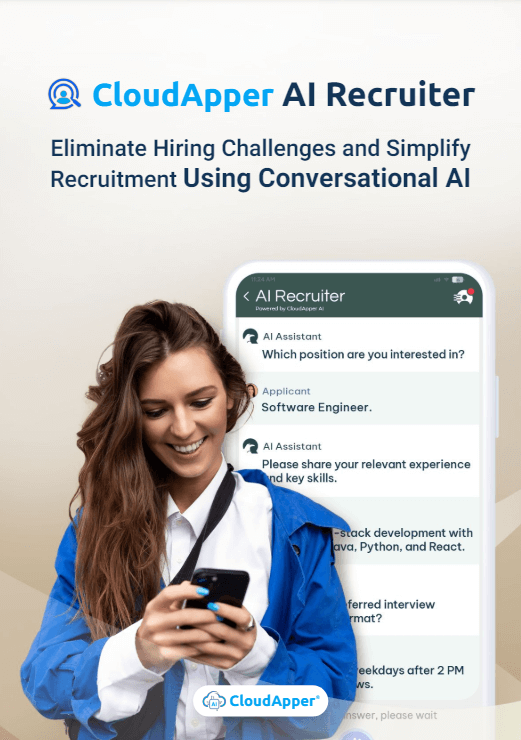
CloudApper AI is an advanced platform that enables organizations to integrate AI into their existing enterprise systems effortlessly, without the need for technical expertise, costly development, or upgrading the underlying infrastructure. By transforming legacy systems into AI-capable solutions, CloudApper allows companies to harness the power of Generative AI quickly and efficiently. This approach has been successfully implemented with leading systems like UKG, Workday, Oracle, Paradox, Amazon AWS Bedrock and can be applied across various industries, helping businesses enhance productivity, automate processes, and gain deeper insights without the usual complexities. With CloudApper AI, you can start experiencing the transformative benefits of AI today. Learn More
CloudApper AI Solutions for HR

- Works with


- and more.







Similar Posts
How cNPS Reflects Your Recruitment and Employer Brand
The Recruitment-to-HRIS Gap: Why Your “System of Record” Should Start…