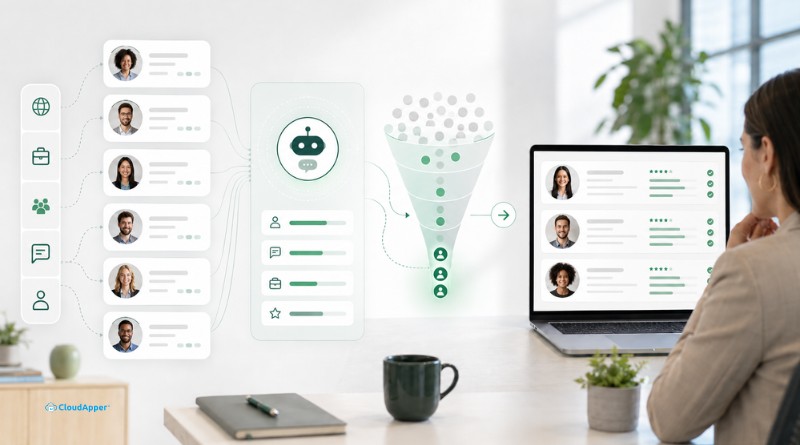
Screening candidates with employment gaps usually means one thing: a flat penalty, no matter the reason. This article looks at why that happens and how AI Recruiter captures the context behind a gap instead of scoring the time away on its own.

TL;DR
Most screening logic scores an employment gap as a negative, regardless of why it exists. That auto-rejects qualified candidates before a recruiter ever reviews them. AI Recruiter can ask candidates directly about a detected gap and add that context to their profile, so scoring reflects skills and experience rather than time away from work.
Table of Contents
- Why screening rules treat every employment gap the same
- What a flat gap penalty costs a high-volume pipeline
- Capturing the reason behind a gap at the point of screening
- Scoring skills and requirements against the job, not time away
Employment gaps are common, and they’re getting more common. A layoff, a health recovery, a caregiving stretch, a career change: none of that shows up as a category on a resume. It shows up as a blank stretch of time, and if you’re screening candidates with employment gaps the way most scoring models are built, every one of those blank stretches gets treated the same way, a flat negative, no room for why it happened. That’s a problem at your hiring volume, because a process that auto-penalizes gaps doesn’t weed out weak candidates. It filters out qualified people before a recruiter ever sees the name, which is the exact failure mode CloudApper AI Recruiter is built to close.
Why screening rules treat every employment gap the same
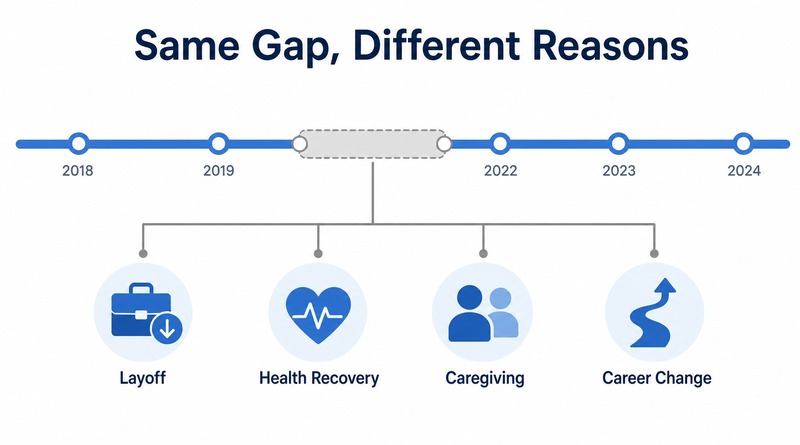

Keyword filters and standard scoring models were built to reward continuity. A resume with no breaks scores higher than one with breaks, full stop. The logic doesn’t distinguish between someone who stepped away to recover from surgery and someone who simply wasn’t working by choice. It counts the gap and scores it down either way.
That worked fine when your team manually reviewed a few dozen resumes and could ask a candidate about a gap on the first call. It breaks down at hundreds or thousands of applications, where a scoring model runs the first pass and a candidate never gets the chance to explain anything before they’re already out of the pipeline.
What a flat gap penalty costs a high-volume pipeline
At your hiring volume, nobody is manually rechecking every borderline score. If a candidate gets auto-scored down for a gap, that candidate usually doesn’t resurface later in the process. The recruiter never sees the name, so nobody catches the mistake.
That adds up fast. Gaps are common enough now, whether from layoffs, caregiving, health, or retraining, that a rule penalizing all of them equally removes a real slice of otherwise qualified applicants from consideration. And it happens quietly, which is exactly why it’s hard to catch without looking directly at how your scoring logic treats gaps.
Capturing the reason behind a gap at the point of screening
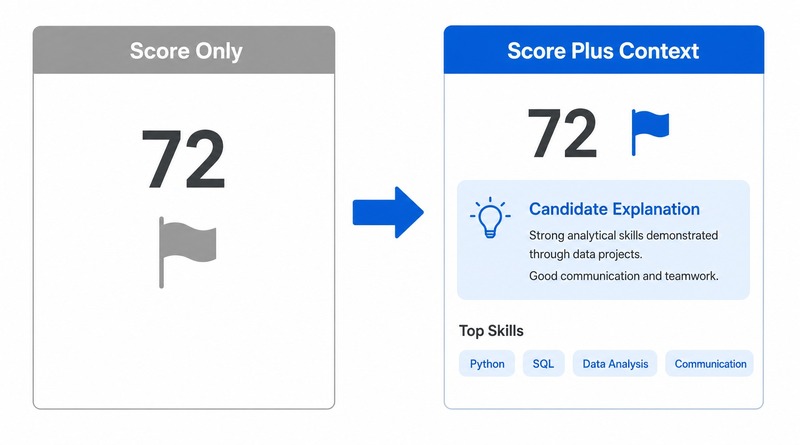
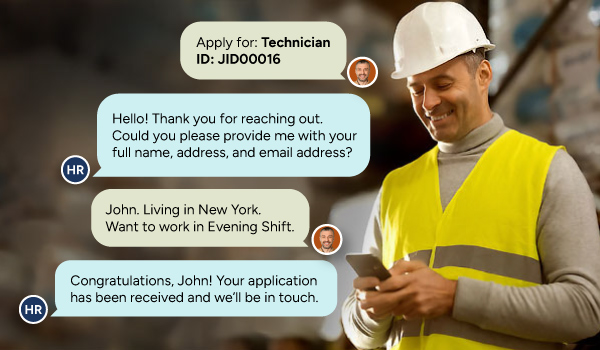
CloudApper AI Recruiter uses a conversational chatbot during candidate intake, and you can configure it to ask about an employment gap the moment it detects one, instead of relying only on a fixed list of pre-defined questions. Say a candidate’s work history shows an eight-month break between two roles. The chatbot flags that stretch during intake and asks a direct, plain-language question about it, something closer to what they were doing during that time, rather than leaving the gap to sit as an unexplained blank on a resume.
The candidate answers in their own words, right there in the application, and that answer gets captured immediately instead of waiting on a phone screen that may never happen because the application never made it that far. That response gets attached to the candidate’s profile next to their score, so when a recruiter reviews the application, they see the reason for the gap alongside the number instead of a bare score with nothing behind it. A recruiter can read in seconds whether a gap was a layoff, a caregiving stretch, or something else entirely, and decide accordingly, instead of trusting a score that already made the decision for them.
Scoring skills and requirements against the job, not time away
You can configure rubric-based scoring to weigh what the role actually requires, relevant skills, experience, and qualifications, rather than penalizing a gap on its own. That distinction matters, because a gap in someone’s timeline says nothing about whether they can do the job. Scoring against the actual quality of hire criteria for the role does.
Giving recruiters the full picture before they decide
You don’t need to remove gaps from scoring altogether. You need your recruiters deciding with the full picture, a score plus the context behind it, instead of a filtered-out name they never got the chance to review. When CloudApper AI Recruiter surfaces that context automatically, screening candidates with employment gaps stops being a blind auto-reject and becomes an informed call your recruiters actually get to make.
Want to see how this would work against your own screening rules? Contact us and we’ll walk through it with you.
Frequently Asked Questions
Why Do Screening Systems Penalize Employment Gaps?
Most scoring models were built to reward an unbroken work history, so any blank stretch on a resume gets scored down the same way, regardless of why it happened. The logic has no way to tell a layoff apart from a caregiving stretch unless something is built in to ask.
Does Asking About a Gap Slow Down High-Volume Screening?
No. The question runs inside the same conversational intake the candidate is already completing, so it adds a few seconds per applicant rather than a separate manual step for a recruiter to chase down later.
What Happens If a Candidate Doesn’t Explain a Gap?
The gap still shows up next to the score with no explanation attached, and the recruiter reviews it the same way they would today, just with the option to ask before ruling the candidate out.

What is CloudApper AI Platform?
CloudApper AI is an advanced platform that enables organizations to integrate AI into their existing enterprise systems effortlessly, without the need for technical expertise, costly development, or upgrading the underlying infrastructure. By transforming legacy systems into AI-capable solutions, CloudApper allows companies to harness the power of Generative AI quickly and efficiently. This approach has been successfully implemented with leading systems like UKG, Workday, Oracle, Paradox, Amazon AWS Bedrock and can be applied across various industries, helping businesses enhance productivity, automate processes, and gain deeper insights without the usual complexities. With CloudApper AI, you can start experiencing the transformative benefits of AI today. Learn More
- Useful Links:
- Agentic AI
- No-Code/Low-Code
- Custom Software
- HCM Personalization
- iPaaS
- FedRAMP
CloudApper AI Solutions for HR


- Works with







- and more.
Similar Posts

The Hidden Cost of Duplicate Candidate Records Across Your Hiring…
The 7-Second Resume Rule Is Killing High-Volume Hiring in Dayforce:…