CloudApper AI Recruiter integrates with Workday Talent Acquisition to streamline hiring by reducing bias, improving time-to-hire, and enhancing candidate experience. Leveraging AI for candidate engagement, data collection, and automated workflows transforms recruitment efficiency and effectiveness.


Table of Contents
- Why Recruiting Teams Are Adding AI to Workday
- What Does Integrating AI Talent Tools with Workday Actually Mean?
- Workday Automated Resume Screening: What It Actually Improves
- Candidate Engagement: Where Workday Hiring Automation Has the Most Impact
- Can AI Reduce Bias in Workday Recruiting?
- Candidate Engagement: Where Workday Hiring Automation Has the Most Impact
- Can AI Reduce Bias in Workday Recruiting?
- CloudApper AI Recruiter: AI Talent Intelligence Integration with Workday
- High-Volume Hiring: Where Workday AI Recruiting Shows Its Value Fastest
- Frequently Asked Questions
- Conclusion
- Key Takeaways
Workday Recruiting is a well-established platform for managing the full talent acquisition lifecycle — from requisition creation and job posting through candidate workflows, interview coordination, and offer management. Workday has invested significantly in AI-powered hiring capabilities, skills-based matching, high-volume workflow support, and tools designed to surface top candidates faster. For most enterprise recruiting teams, Workday is not the problem.
The problem is what happens around Workday. Despite strong platform capabilities, recruiting teams continue to lose time to manual resume review, inconsistent candidate communication, scheduling delays, and application abandonment. These are not failures of the ATS — they are workflow gaps that emerge when hiring volume rises, when candidate expectations accelerate, or when recruiting teams simply do not have enough capacity to manage every touchpoint manually.
AI recruiting for Workday addresses those gaps without replacing the platform organisations already rely on. By layering intelligent automation across resume screening, candidate scoring, pre-screening, scheduling, and communication, AI tools extend Workday’s capabilities into the parts of the recruiting process where manual effort is highest and candidate experience is most at risk. This guide explains what Workday AI recruiting actually means in practice, what to look for when integrating AI talent tools with Workday, and how solutions like CloudApper AI Recruiter help hiring teams move faster, screen more consistently, and convert more candidates from application to interview.
Quick answer: What is AI recruiting for Workday?
AI recruiting for Workday means using intelligent automation to extend Workday’s native hiring capabilities — automating resume screening, candidate scoring, pre-screening questions, interview scheduling, and candidate communication. Rather than replacing Workday, AI recruiting tools work alongside it, reducing manual effort for recruiters and improving the speed and consistency of the hiring process from first application to final shortlist.
Why Recruiting Teams Are Adding AI to Workday
The business case for Workday hiring automation is grounded in a straightforward operational reality: recruiting teams are being asked to do more with the same or fewer resources, and the volume and speed expectations from both hiring managers and candidates have increased substantially.
On the candidate side, the numbers are striking. Research published by SHRM found that 92% of candidates who click an apply button never complete the application — a dropout rate that represents an enormous loss of potential talent at the very first step of the funnel. The primary drivers of abandonment are application length, process complexity, and slow or absent follow-up communication. These are exactly the problems that AI recruiting tools are designed to solve.

On the recruiter side, the challenge is one of volume and consistency. When a single role attracts hundreds of applications, even experienced recruiters struggle to review every resume thoroughly and objectively. Fatigue introduces variability. Time pressure encourages shortcuts. Qualified candidates get missed, or they move on to competitors who respond faster. A McKinsey study found that AI can automate up to 50% of repetitive recruiting tasks — meaning that half of the administrative work consuming recruiter time today is automatable with the right tools in place.
Workday already addresses parts of this challenge through its own AI-powered candidate discovery, skills-based matching, and high-volume hiring support. But for many organisations, these capabilities alone are not sufficient to eliminate the manual friction that slows down front-end recruiting. That is where integrating AI talent tools with Workday creates measurable value — not by replacing what Workday does well, but by automating the steps where recruiters currently spend disproportionate time and where candidates most often disengage.
Statistics
A study by McKinsey & Company found that AI can automate up to 50% of repetitive recruiting tasks, freeing up valuable time for HR teams to focus on strategic initiatives.
What Does Integrating AI Talent Tools with Workday Actually Mean?
For HR directors and IT decision-makers evaluating this space, it is worth being precise about what Workday AI recruiting integration looks like in practice, because the term is used loosely by many vendors.
A genuine AI talent intelligence integration with Workday means the AI tool connects directly to Workday’s recruiting data — pulling job requisitions, candidate records, and application information — and feeding processed outputs back into Workday as the system of record. Workday remains the source of truth for all candidate and hiring data. The AI layer sits on top of that foundation, adding screening logic, scoring, automated communication, and workflow orchestration that Workday’s native tools do not provide at the same level of granularity.
This is meaningfully different from a standalone AI recruiting platform that operates independently of Workday and requires manual data transfer between systems. True integration means no duplicate data entry, no reconciliation overhead, and no risk of Workday records falling out of sync with the AI tool’s outputs. For IT teams evaluating vendor claims, this distinction is critical.
What a Workday AI Recruiting Integration Should Include
When evaluating AI talent tools for Workday integration, recruiting leaders and IT teams should look for the following capabilities working in concert rather than in isolation.
Resume screening and candidate scoring should operate contextually — not just matching keywords but evaluating candidates against the full set of role-specific criteria defined for each requisition. This includes experience, skills alignment, qualification thresholds, and configurable weighting that reflects the organisation’s actual hiring priorities. The output should be a ranked shortlist that recruiters can act on immediately, rather than a raw list of applicants sorted by application date.
Candidate engagement automation should cover the full communication arc from application acknowledgement through pre-screening, interview scheduling, and post-interview follow-up. Candidates should be able to interact through SMS, email, or chat interfaces, receive real-time updates, and complete pre-screening steps without waiting for recruiter availability. The goal is to maintain candidate momentum through every stage where delays typically cause drop-off.
Workday hiring automation should extend to scheduling — one of the most time-consuming administrative tasks in recruiting. AI tools that can coordinate interview availability, send calendar invitations, manage rescheduling, and send reminders without recruiter involvement eliminate a significant source of manual overhead and reduce the time between shortlisting and interview.
Transparency and auditability are non-negotiable for enterprise environments. Every scoring decision, every automated communication, and every workflow trigger should be logged and accessible for review. This protects the organisation from compliance risk and gives recruiting leaders the data they need to evaluate whether the AI tool is performing as intended.
Workday Automated Resume Screening: What It Actually Improves
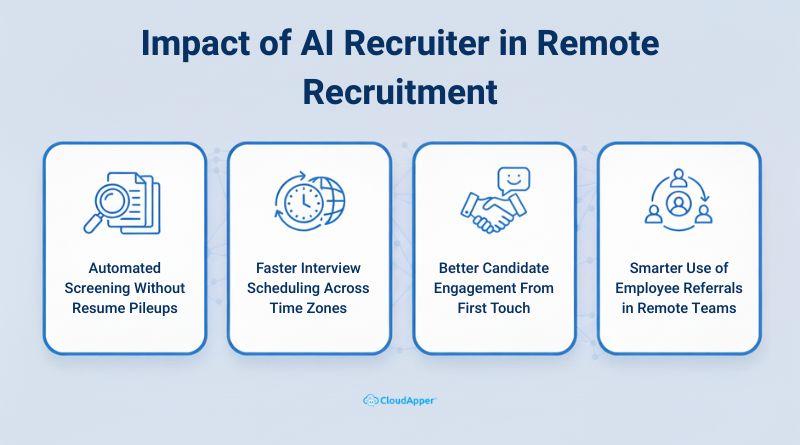
Resume screening is where most recruiting teams feel the pain of manual processes most acutely. When a popular role attracts five hundred applications, the time required to review each one thoughtfully is simply not available. In practice, recruiters under pressure develop shortcuts — filtering by institution, by keyword, by formatting — that introduce variability and risk missing strong candidates who present their experience differently.
Workday promotes its own AI-powered candidate discovery and skills-based matching as part of the platform. For many organisations, these native tools provide genuine value at the requisition and matching layer. The gap tends to appear at the screening and ranking layer, where teams need deeper automation around resume analysis, structured scoring against role-specific criteria, and consistent shortlist generation that does not vary based on who reviewed applications and when.
A Workday resume screening app that operates through genuine integration addresses this by evaluating every applicant against the same defined criteria, in the same order, without the variability introduced by fatigue or volume. The practical benefits are threefold. First, speed: AI can process hundreds of resumes in the time it takes a recruiter to review ten. Second, consistency: every applicant is assessed against the same framework, reducing the subjectivity that creeps into manual review. Third, focus: recruiters direct their attention to the candidates most likely to succeed rather than starting from the top of an unsorted stack.
The larger opportunity is not just screening speed. It is the quality of the shortlist that reaches the hiring manager. When the first five candidates a hiring manager sees are genuinely strong matches, the hiring process moves faster, decision confidence increases, and the likelihood of a successful hire improves. That downstream effect is where AI resume screening for Workday delivers its most significant organisational value.
Candidate Engagement: Where Workday Hiring Automation Has the Most Impact
The single most common reason qualified candidates drop out of a recruiting process is not a better offer from a competitor. It is silence. Candidates who apply and hear nothing for days assume they have been rejected, move on, and are no longer available when the recruiter finally follows up. In high-volume hiring environments, where individual recruiter capacity is stretched across dozens of open roles, this communication gap is almost inevitable without automation.
Workday’s recruiting platform emphasises mobile-friendly experiences, real-time candidate updates, and simplified application flows as part of its modern hiring vision. These are meaningful improvements to the candidate experience at the application stage. The gap tends to emerge in the days and weeks after application, when the burden of keeping candidates informed and engaged falls on individual recruiters managing full workloads.
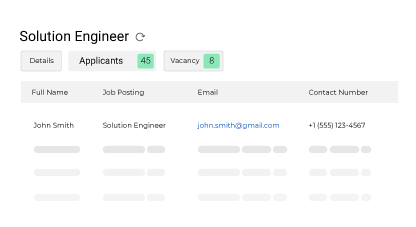
AI recruiting for Workday addresses this by making candidate engagement automatic and continuous. From the moment an application is received, AI can send acknowledgement, trigger pre-screening questions, provide timeline updates, answer candidate queries through conversational interfaces, coordinate interview scheduling, and follow up after each stage — without any recruiter action required. This is not just a convenience for recruiting teams. It is a meaningful improvement in candidate experience that directly affects completion rates, acceptance rates, and the organisation’s employer brand.
For high-volume hiring environments — retail, healthcare, logistics, manufacturing, hospitality — the impact compounds. When an organisation is processing hundreds of applications per week across multiple roles, automated candidate engagement is the difference between a recruiting operation that scales and one that breaks under its own volume.
Can AI Reduce Bias in Workday Recruiting?
This question deserves a careful, honest answer. AI has the potential to reduce certain types of bias in early-stage screening by applying consistent criteria across all applicants and, in some implementations, by removing identifiers that trigger unconscious bias during initial review. Workday itself acknowledges this potential, noting that AI evaluation based on objective factors can support more equitable screening outcomes.
The important qualification is that AI does not eliminate bias — it transforms it. If the criteria used to train or configure a screening model reflect historical hiring patterns that favoured certain groups, the model will reproduce those patterns at scale. This is why the configuration of AI screening tools matters as much as the technology itself. Predefined, skills-focused evaluation criteria, regular auditing of scoring outcomes across demographic groups, and maintained human oversight at key decision points are all necessary components of a responsible AI recruiting implementation.
Used with appropriate governance, AI recruiting for Workday can meaningfully reduce the variability and subjectivity that enter the process when recruiters are overwhelmed by volume or pressed for time. It cannot and should not be positioned as a solution to systemic bias. But as a tool for improving screening consistency and focusing recruiter attention on structured, role-relevant criteria rather than subjective first impressions, it offers genuine value when implemented thoughtfully.
Candidate Engagement: Where Workday Hiring Automation Has the Most Impact
The single most common reason qualified candidates drop out of a recruiting process is not a better offer from a competitor. It is silence. Candidates who apply and hear nothing for days assume they have been rejected, move on, and are no longer available when the recruiter finally follows up. In high-volume hiring environments, where individual recruiter capacity is stretched across dozens of open roles, this communication gap is almost inevitable without automation.
Workday’s recruiting platform emphasises mobile-friendly experiences, real-time candidate updates, and simplified application flows as part of its modern hiring vision. These are meaningful improvements to the candidate experience at the application stage. The gap tends to emerge in the days and weeks after application, when the burden of keeping candidates informed and engaged falls on individual recruiters managing full workloads.
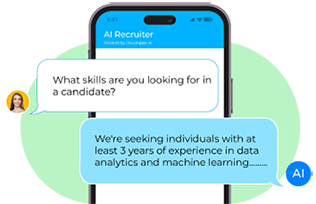
AI recruiting for Workday addresses this by making candidate engagement automatic and continuous. From the moment an application is received, AI can send acknowledgement, trigger pre-screening questions, provide timeline updates, answer candidate queries through conversational interfaces, coordinate interview scheduling, and follow up after each stage — without any recruiter action required. This is not just a convenience for recruiting teams. It is a meaningful improvement in candidate experience that directly affects completion rates, acceptance rates, and the organisation’s employer brand.
For high-volume hiring environments — retail, healthcare, logistics, manufacturing, hospitality — the impact compounds. When an organisation is processing hundreds of applications per week across multiple roles, automated candidate engagement is the difference between a recruiting operation that scales and one that breaks under its own volume.
Can AI Reduce Bias in Workday Recruiting?
This question deserves a careful, honest answer. AI has the potential to reduce certain types of bias in early-stage screening by applying consistent criteria across all applicants and, in some implementations, by removing identifiers that trigger unconscious bias during initial review. Workday itself acknowledges this potential, noting that AI evaluation based on objective factors can support more equitable screening outcomes.
The important qualification is that AI does not eliminate bias — it transforms it. If the criteria used to train or configure a screening model reflect historical hiring patterns that favoured certain groups, the model will reproduce those patterns at scale. This is why the configuration of AI screening tools matters as much as the technology itself. Predefined, skills-focused evaluation criteria, regular auditing of scoring outcomes across demographic groups, and maintained human oversight at key decision points are all necessary components of a responsible AI recruiting implementation.
Used with appropriate governance, AI recruiting for Workday can meaningfully reduce the variability and subjectivity that enter the process when recruiters are overwhelmed by volume or pressed for time. It cannot and should not be positioned as a solution to systemic bias. But as a tool for improving screening consistency and focusing recruiter attention on structured, role-relevant criteria rather than subjective first impressions, it offers genuine value when implemented thoughtfully.
CloudApper AI Recruiter: AI Talent Intelligence Integration with Workday
CloudApper AI Recruiter is designed to work alongside Workday rather than replace it. Workday remains the system of record for all candidate and hiring data. CloudApper AI Recruiter adds the automation, conversational workflows, and screening intelligence that help recruiting teams move faster and communicate more effectively across the full hiring lifecycle.
Automated Resume Screening and Candidate Scoring
CloudApper AI Recruiter evaluates incoming applications contextually, scoring candidates against role-specific criteria configured for each requisition. Rather than relying on keyword matching alone, the system assesses experience alignment, skills coverage, qualification thresholds, and configurable weighting that reflects the organisation’s actual hiring priorities. Recruiters receive a ranked shortlist they can act on immediately, with the supporting data needed to understand why each candidate was ranked where they were.
Conversational Application Flows
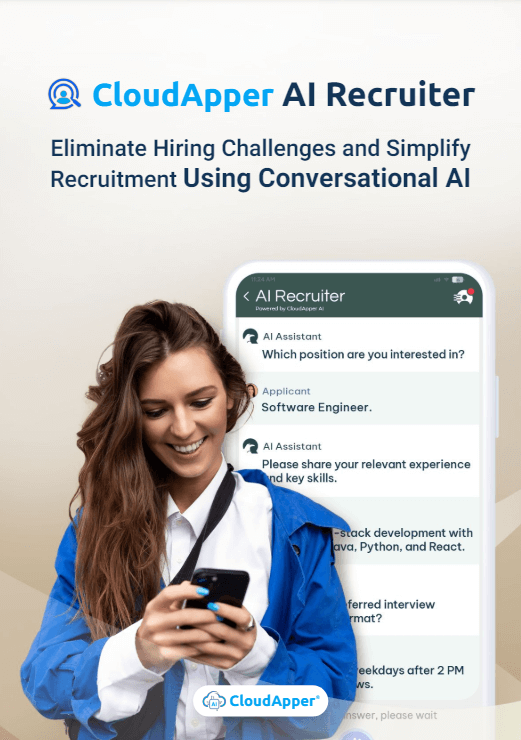
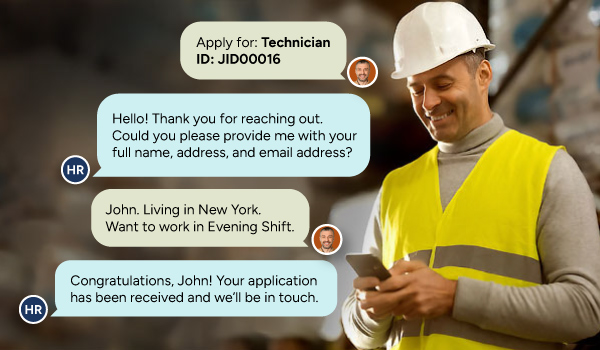
One of the most distinctive features of CloudApper AI Recruiter is its support for conversational application experiences. Candidates can apply via SMS, chat interface, or QR code — entering a guided, conversational flow rather than a long-form application portal. This approach significantly reduces application abandonment by making the first step faster, simpler, and more accessible from any device. The structured data collected through conversational flows feeds directly into the screening and scoring process, maintaining the integrity of the candidate record in Workday.
Automated Pre-Screening and Scheduling
After initial screening, CloudApper AI Recruiter automates the pre-screening stage — sending targeted questions, collecting responses, and updating candidate scores based on answers. Interview scheduling is handled through automated coordination that identifies available slots, sends calendar invitations, manages rescheduling requests, and dispatches reminders without recruiter involvement. This eliminates one of the most time-consuming administrative tasks in the recruiting workflow and significantly reduces the time between shortlisting and interview.
Always-On Candidate Engagement
CloudApper AI Recruiter maintains continuous candidate communication through SMS, email, and chat. Candidates receive acknowledgements, status updates, pre-screening prompts, interview confirmations, and follow-up messages automatically at each stage of the process. This removes the communication gaps that cause candidate drop-off and gives every applicant — regardless of how many open roles the recruiting team is managing simultaneously — a responsive, attentive experience.
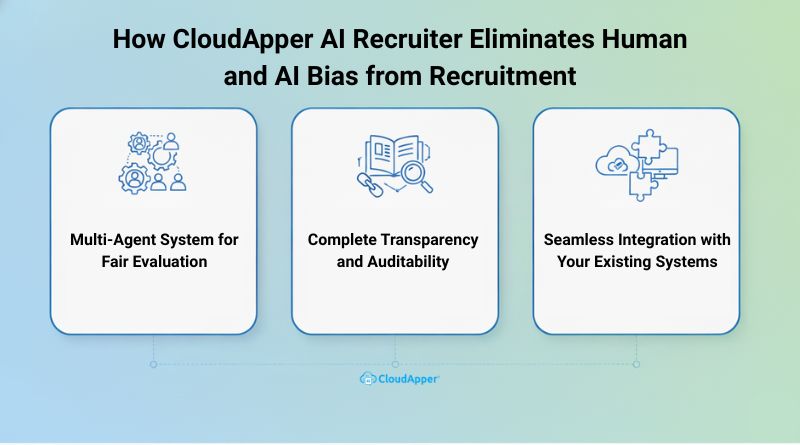
Multi-Agent Evaluation for Fairer Screening
CloudApper AI Recruiter uses a multi-agent evaluation approach in which multiple independent scoring models assess each candidate before a final score is generated. This reduces the risk of any single model’s biases or blind spots dominating the outcome, and provides a more balanced and auditable basis for screening decisions. All scoring logic and evaluation outputs are logged and accessible for review, supporting the transparency that enterprise compliance environments require.
Seamless Workday Integration
All candidate data, scoring outputs, and workflow events within CloudApper AI Recruiter synchronise directly with Workday. Workday remains the authoritative system of record throughout. There is no manual data transfer, no reconciliation overhead, and no risk of candidate records falling out of sync between systems. For IT teams evaluating integration quality, CloudApper AI Recruiter connects through standard APIs and does not require bespoke development work or ongoing technical maintenance.
High-Volume Hiring: Where Workday AI Recruiting Shows Its Value Fastest
The return on investment from AI recruiting for Workday is most immediate and most visible in high-volume hiring environments. Organisations in retail, healthcare, logistics, hospitality, manufacturing, and other sectors that hire at scale experience the benefits of automation most acutely, because the manual effort displaced by AI is greatest and the risk of candidate drop-off at scale is highest.
Workday already positions its recruiting platform around high-volume hiring support, with evergreen requisitions, bulk processing, and workflow automation designed for organisations managing large applicant pools. CloudApper AI Recruiter extends that value by taking on the repetitive front-end work that still consumes recruiter time even with Workday in place: resume review, initial scoring, pre-screening coordination, candidate communication, and shortlist preparation.
For a retail organisation hiring three hundred seasonal associates across fifteen locations, this means the recruiting team spends less time processing applications and more time conducting structured interviews with pre-screened, ranked candidates. For a healthcare network filling clinical and support roles across a large facility, it means faster time-to-hire without sacrificing the rigour of the evaluation process. For a logistics company managing continuous high-volume hiring for warehouse and driver roles, it means a recruiting operation that scales with demand rather than requiring proportional increases in recruiting headcount.
Frequently Asked Questions
What is AI recruiting for Workday?
AI recruiting for Workday means using intelligent automation to extend Workday’s native hiring capabilities across resume screening, candidate scoring, pre-screening, interview scheduling, and candidate communication. Rather than replacing Workday, AI recruiting tools work alongside the platform, reducing manual effort for recruiters and improving the speed, consistency, and candidate experience of the hiring process.
Does Workday already have AI recruiting capabilities?
Yes. Workday’s recruiting platform includes AI-powered candidate discovery, skills-based matching, high-volume workflow support, and tools designed to surface top candidates faster. AI recruiting tools like CloudApper AI Recruiter build on that foundation by adding deeper automation around resume analysis, candidate scoring, conversational application flows, and multi-stage engagement — capabilities that complement rather than duplicate what Workday provides natively.
What is the best Workday resume screening app?
The best Workday resume screening app is one that integrates directly with Workday as the system of record, evaluates candidates contextually against role-specific criteria rather than relying on keyword matching alone, produces ranked shortlists with transparent scoring, and automates candidate engagement after screening. CloudApper AI Recruiter is designed specifically to meet these requirements within Workday recruiting environments.
How does integrating AI talent tools with Workday work technically?
A genuine AI talent intelligence integration with Workday connects to Workday’s recruiting data through standard APIs, pulling job requisitions and candidate records and feeding processed outputs — scoring results, engagement events, scheduling updates — back into Workday as the system of record. This bidirectional integration means no manual data transfer, no reconciliation overhead, and no risk of Workday records falling out of sync with the AI tool’s outputs.
Can AI reduce candidate drop-off in Workday recruiting?
Yes. Application abandonment is a major issue — SHRM research found that 92% of candidates who click apply never complete the process. AI reduces drop-off by simplifying the application experience through conversational flows, automating acknowledgement and follow-up communication, and maintaining candidate engagement throughout the process without depending on recruiter availability. Faster, more responsive communication keeps candidates in the process rather than moving on.
Will Workday hiring automation replace recruiters?
No. Workday hiring automation is designed to eliminate repetitive administrative work — resume sorting, scheduling, reminders, status updates — so that recruiters can focus on the parts of the process that require human judgment: assessing cultural fit, building candidate relationships, advising hiring managers, and making final decisions. AI makes recruiting teams more productive; it does not make them redundant.
Is Workday AI recruiting suitable for high-volume hiring?
Yes, and it is often where AI delivers the fastest and most measurable return on investment. Organisations hiring at scale in retail, healthcare, logistics, manufacturing, and hospitality benefit most from automated screening, scoring, and candidate engagement, because the manual effort displaced is greatest and the risk of candidate drop-off across large applicant pools is highest.
Conclusion
Workday Recruiting gives organisations a strong, well-supported foundation for talent acquisition. Its AI-powered hiring capabilities, skills-based matching, and high-volume workflow tools represent a genuine investment in modern recruiting infrastructure. For many teams, however, the gap between what Workday provides and what the day-to-day recruiting workflow demands is still significant — filled by manual effort, inconsistent communication, and administrative tasks that consume recruiter capacity without adding hiring value.
AI recruiting for Workday closes that gap by automating the steps where manual effort is highest and candidate experience is most at risk. Resume screening becomes faster and more consistent. Candidate communication becomes continuous and responsive. Scheduling delays are eliminated. Shortlists improve in quality. And recruiting teams regain the capacity to focus on the work that genuinely requires human judgment.
The goal is not to start over with a new platform. It is to make the platform already in place significantly more effective. CloudApper AI Recruiter is built specifically to deliver that outcome within Workday environments — extending hiring automation, improving candidate engagement, and providing the AI talent intelligence integration that helps recruiting teams hire better, faster, and at greater scale.
Ready to extend your Workday recruiting workflow with AI? Contact CloudApper today to see how AI Recruiter can reduce time-to-hire, improve shortlist quality, and keep candidates engaged from application to offer.
Key Takeaways
- AI recruiting for Workday extends the platform’s native capabilities — automating resume screening, candidate scoring, pre-screening, scheduling, and communication without replacing Workday as the system of record.
- SHRM research found that 92% of candidates who click apply never complete the process — AI reduces this drop-off through conversational application flows and automated, responsive communication at every stage.
- McKinsey found that AI can automate up to 50% of repetitive recruiting tasks, freeing recruiters to focus on relationship-building, hiring manager advisory, and final decision-making.
- A genuine Workday AI recruiting integration connects bidirectionally through standard APIs — no manual data transfer, no reconciliation overhead, and no risk of records falling out of sync.
- CloudApper AI Recruiter adds contextual resume scoring, conversational application flows, multi-agent evaluation, automated scheduling, and always-on candidate engagement to Workday recruiting environments.
- High-volume hiring in retail, healthcare, logistics, manufacturing, and hospitality sees the fastest and most measurable ROI from Workday hiring automation — where displaced manual effort is greatest and candidate drop-off risk is highest.
What is CloudApper AI Platform?
CloudApper AI is an advanced platform that enables organizations to integrate AI into their existing enterprise systems effortlessly, without the need for technical expertise, costly development, or upgrading the underlying infrastructure. By transforming legacy systems into AI-capable solutions, CloudApper allows companies to harness the power of Generative AI quickly and efficiently. This approach has been successfully implemented with leading systems like UKG, Workday, Oracle, Paradox, Amazon AWS Bedrock and can be applied across various industries, helping businesses enhance productivity, automate processes, and gain deeper insights without the usual complexities. With CloudApper AI, you can start experiencing the transformative benefits of AI today. Learn More
- Useful Links:
- Agentic AI
- No-Code/Low-Code
- Custom Software
- HCM Personalization
- iPaaS
- FedRAMP
CloudApper AI Solutions for HR

- Works with







- and more.
Similar Posts

How to Reduce Interview Rounds Without Lowering Your Hiring Standards

How to Stop Losing Shortlisted Candidates During a Hiring Surge…