Resume fraud has evolved into a systemic threat costing U.S. businesses nearly $600 billion annually. As AI accelerates deception, traditional hiring systems fail to keep up. This article explores why verification—not speed—is now the foundation of responsible, scalable, and secure recruitment, and how AI-driven contextual screening is redefining modern hiring.

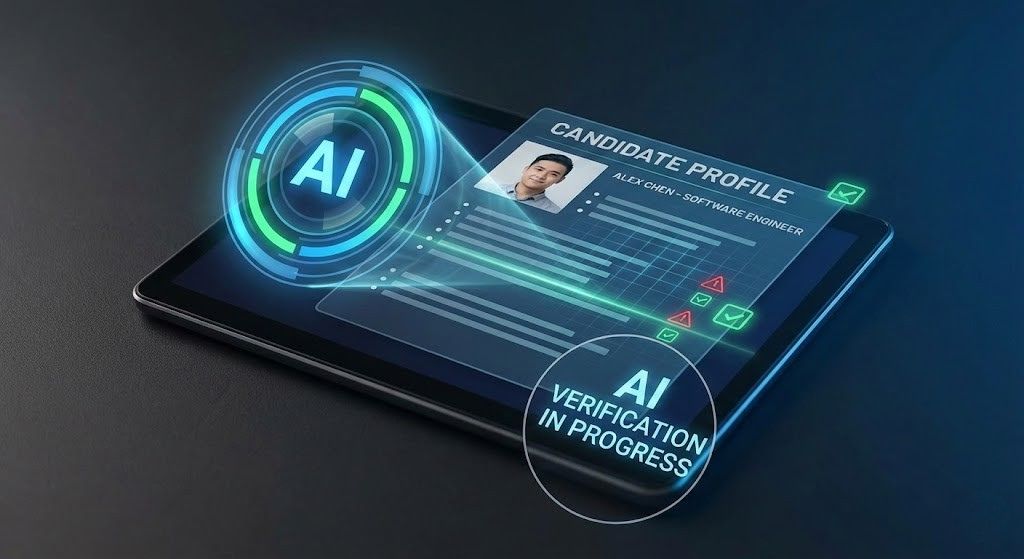
Table of Contents
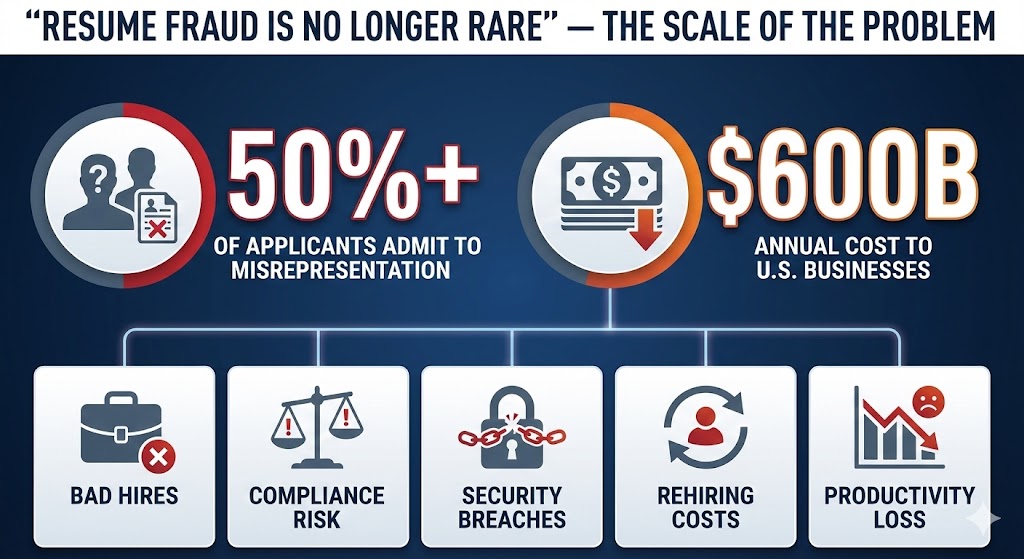
The hiring industry is facing a problem that many leaders still underestimate. Resume fraud is no longer an edge case or a matter of occasional exaggeration. It has become a systemic risk with real financial, operational, and reputational consequences. When more than half of applicants admit to misrepresenting themselves and hiring managers confirm that deception is routine, the issue stops being about individual dishonesty and starts being about broken systems.
Estimates now place the annual cost of resume fraud to U.S. businesses at nearly $600 billion. That figure includes bad hires, compliance failures, productivity losses, rehiring costs, security breaches, and reputational damage. Yet the most alarming part of this crisis is not the scale of deception. It is the fact that many hiring processes still rely on verification models designed for a pre-AI world.
After years of working closely with recruitment teams across healthcare, retail, logistics, technology, and public sector hiring, one conclusion is unavoidable. Traditional screening methods are no longer sufficient. Verification is no longer a back-office step. It has become the core of responsible recruiting.
Resume Fraud Has Changed, but Hiring Systems Have Not
Resume fraud used to look familiar. Inflated job titles, stretched employment dates, embellished responsibilities, or a degree that was almost finished. Recruiters knew these patterns and learned how to spot them through experience, reference checks, and careful interviews.
That world is gone.
Today’s resume fraud is faster, more scalable, and far more sophisticated. AI tools can generate polished resumes, tailored cover letters, and role-specific career narratives in minutes. Deepfake technology can produce professional headshots and even realistic video appearances. Coordinated fraud networks can fabricate entire work histories, complete with fake companies, online footprints, and synchronized references.
This is not speculation. It is already happening.
In several high-profile cases, organizations discovered months after onboarding that an employee’s identity, credentials, and work history were entirely fabricated. In regulated industries, these failures triggered audits, fines, and contract terminations. In security-sensitive roles, the consequences were even more severe.
The uncomfortable truth is that resume screening built on keyword matching and manual review was never designed to withstand this level of deception.
Why Verification Is Now the Real Bottleneck in Hiring
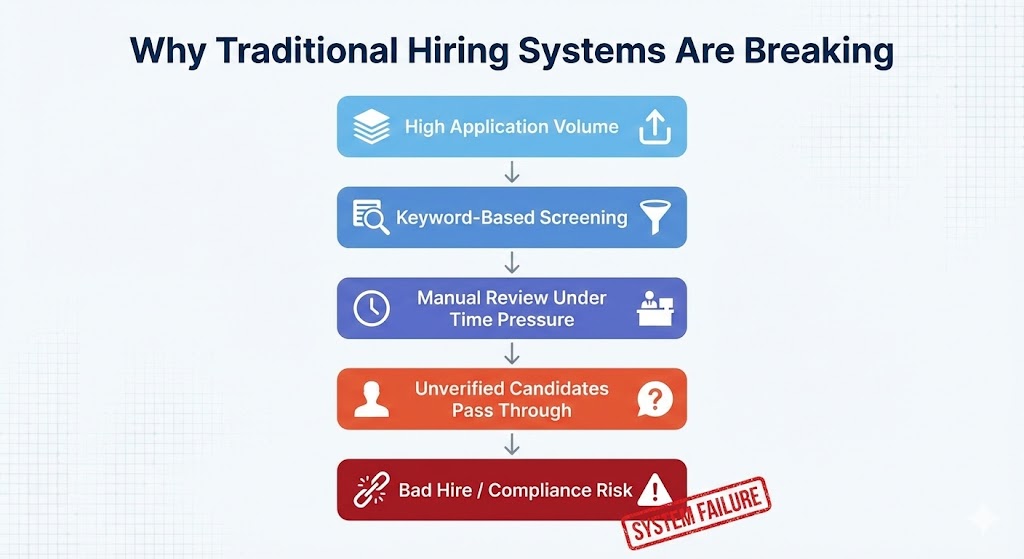
Most recruitment leaders focus on speed, candidate experience, and time-to-hire metrics. Those goals still matter. But speed without verification is no longer efficiency. It is risk.
Verification has become the weakest link in the hiring chain for three reasons.
First, volume has exploded. High-volume hiring roles regularly attract hundreds or thousands of applications. Even the most diligent recruiter cannot deeply verify that many candidates manually.
Second, deception has scaled. One fraudulent applicant can now generate dozens of tailored applications across multiple organizations using AI. The cost of lying has dropped to near zero, while the payoff remains high.
Third, hiring teams are under pressure. Recruiters are expected to move fast, communicate constantly, and fill roles under tight deadlines. Verification often becomes a casualty of urgency.
The result is predictable. Fraud slips through not because recruiters are careless, but because the system is structurally incapable of validating candidates at scale.
Why Keyword Screening Fails in an AI-Driven Market
Many applicant tracking systems still rely on keyword-based filtering. These tools were never meant to validate truth. They were built to manage volume.
AI-generated resumes exploit this weakness perfectly. They are optimized to match job descriptions precisely. They include the right skills, phrasing, and experience patterns. On paper, they look ideal.
But paper is no longer evidence.
Without contextual analysis, behavioral validation, and structured verification, recruiters are left ranking candidates who may be technically aligned but fundamentally unverified.
This is where modern recruitment must change direction. The future of hiring is not about reading resumes faster. It is about verifying claims before they reach the interview stage.
Verification Does Not Mean Slowing Down Hiring
One of the biggest misconceptions among HR leaders is that stronger verification inevitably slows hiring. In reality, the opposite is now true.
Manual verification is slow. Intelligent verification is fast.
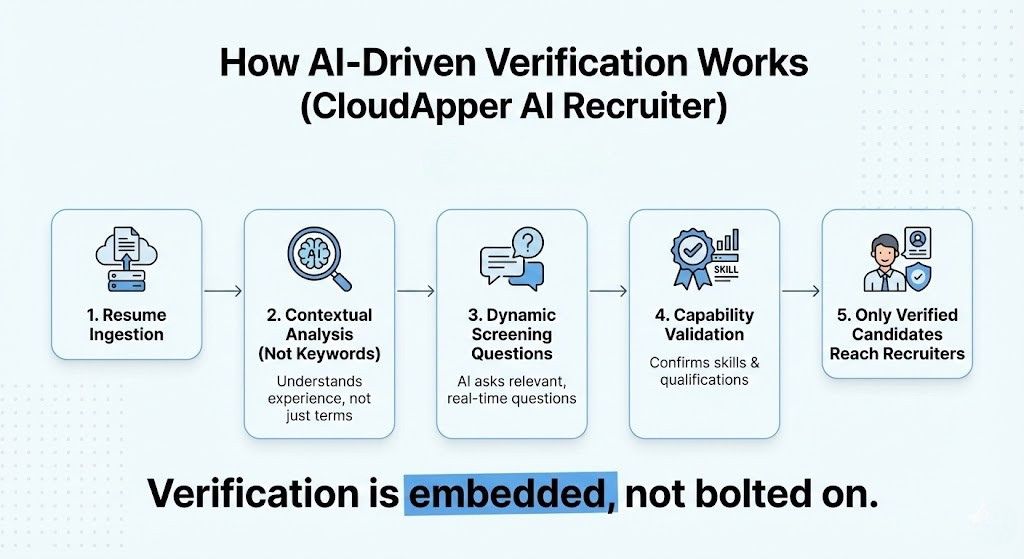
Modern AI-driven recruitment systems can validate candidates continuously and automatically as part of the workflow. They do not wait until the final stages. They do not rely on memory or gut instinct. They verify at scale, in real time.
This is where platforms like CloudApper AI Recruiter represent a fundamental shift in how hiring operates.
Rather than treating verification as an afterthought, CloudApper AI Recruiter embeds it directly into the hiring pipeline. Resumes are analyzed contextually, not just scanned for keywords. Candidate claims are validated through dynamic, role-specific screening questions that require applied knowledge rather than rehearsed answers. Inconsistencies surface early, before time and resources are wasted.
The result is not slower hiring. It is cleaner hiring.
Contextual Verification Is the New Screening Standard
The most effective way to detect resume fraud is not to ask candidates to repeat what is already written. It is to ask them to demonstrate understanding.
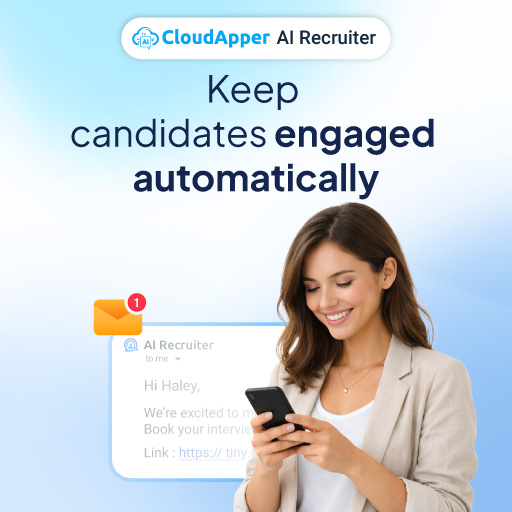
Contextual verification focuses on how candidates explain their experience, solve problems, and respond to scenarios relevant to the role. AI can assess these responses consistently across large candidate pools, identifying mismatches between claimed experience and demonstrated capability.
This approach has several advantages.
It reduces bias by applying the same evaluation logic to every candidate. It scales effortlessly during high-volume hiring. And it filters out fraudulent or misrepresented profiles before they ever reach a recruiter’s desk.
Recruiters no longer waste hours interviewing candidates who look perfect on paper but fall apart under basic scrutiny.
Candidate Experience Improves When Verification Is Done Right
One fear often raised about verification is that it might alienate candidates. In practice, the opposite is happening.
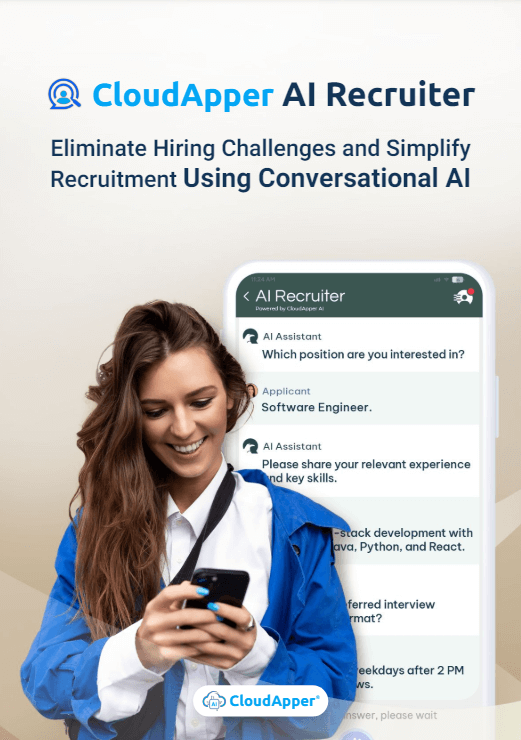
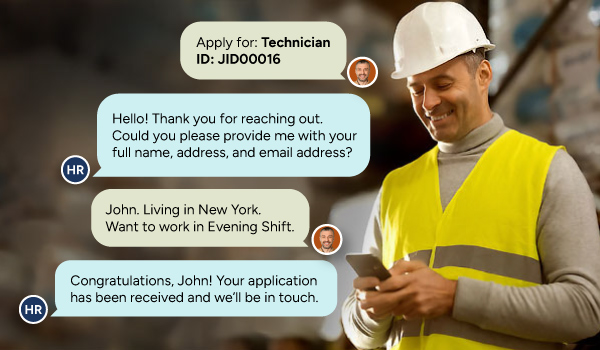
Candidates are increasingly frustrated by long forms, repetitive questions, and slow communication. Conversational, AI-driven verification feels more natural. Candidates engage through chat or mobile interfaces, answer questions in real time, and receive immediate feedback on next steps.
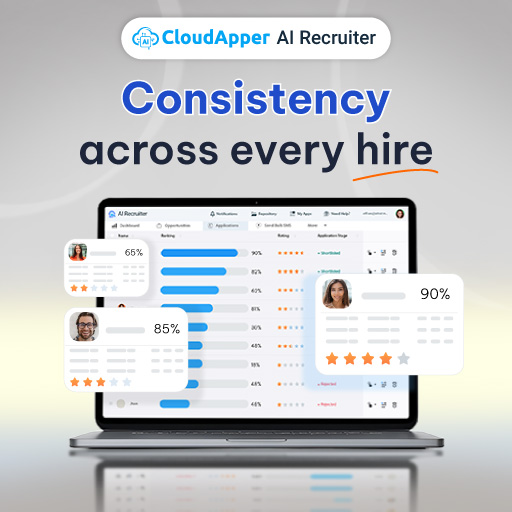
When verification is embedded into a conversational flow, drop-off decreases. Serious candidates stay engaged. Fraudulent applicants self-select out when they realize claims must be demonstrated, not just stated.
This is one reason CloudApper AI Recruiter places such emphasis on conversational workflows, SMS engagement, and mobile-first application experiences. Verification happens without friction, and qualified candidates move forward faster.
Why Verification Protects More Than Just Hiring Outcomes
Resume fraud is not just a talent problem. It is a business risk.
In regulated industries, hiring an unverified candidate can lead to compliance violations. In customer-facing roles, it can damage brand trust. In security-sensitive environments, it can expose systems and data.
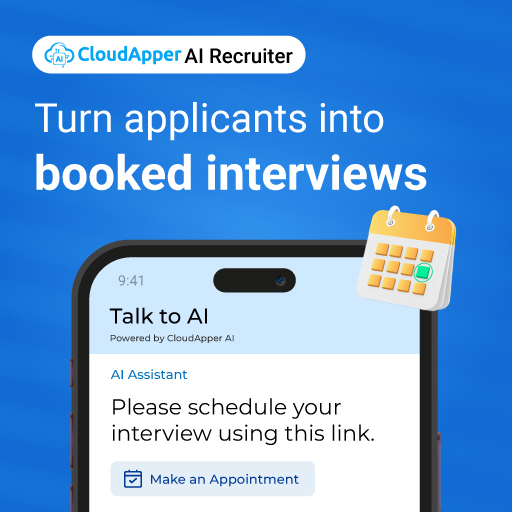
Verification also protects diversity and inclusion efforts. When hiring decisions rely on structured, skills-based validation rather than surface-level signals, candidates from nontraditional backgrounds are less likely to be overlooked or unfairly filtered out.
Strong verification does not narrow the talent pool. It clarifies it.
The Role of AI in Ethical, Compliant Hiring
AI is often blamed for enabling deception. But when used responsibly, AI is also the strongest defense against it.
Ethical AI recruitment focuses on transparency, auditability, and human oversight. Platforms like CloudApper AI Recruiter are designed to support compliance by anonymizing data where appropriate, maintaining evaluation logs, and allowing recruiters to configure scoring rules and workflows.
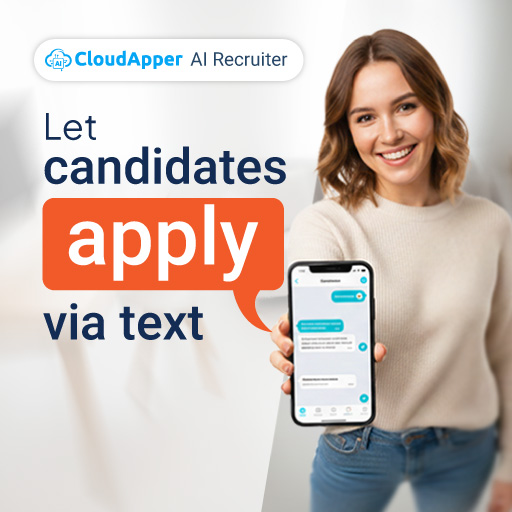
AI does not replace human judgment. It strengthens it by removing noise, inconsistency, and manual overload from the process.
Recruiters still make final decisions. AI ensures those decisions are based on verified, comparable information rather than assumptions.
Verification Is No Longer Optional
The resume crisis is not coming. It is already here.
Organizations that continue to rely on outdated screening methods will face increasing fraud risk, longer hiring cycles, and growing operational costs. Those that invest in intelligent, AI-driven verification will hire faster, safer, and with greater confidence.
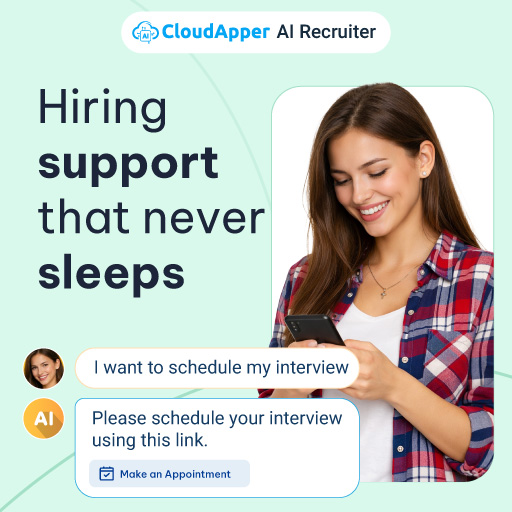
Verification is no longer a checkpoint at the end of hiring. It is the foundation of modern recruitment.
As someone who has watched hiring evolve over years of volume spikes, compliance audits, and technology shifts, the message is clear. The future belongs to teams that treat verification as a strategic priority, not an administrative burden.
The tools exist. The risk is real. The only question left is whether hiring systems will evolve fast enough to meet the moment.

What is CloudApper AI Platform?
CloudApper AI is an advanced platform that enables organizations to integrate AI into their existing enterprise systems effortlessly, without the need for technical expertise, costly development, or upgrading the underlying infrastructure. By transforming legacy systems into AI-capable solutions, CloudApper allows companies to harness the power of Generative AI quickly and efficiently. This approach has been successfully implemented with leading systems like UKG, Workday, Oracle, Paradox, Amazon AWS Bedrock and can be applied across various industries, helping businesses enhance productivity, automate processes, and gain deeper insights without the usual complexities. With CloudApper AI, you can start experiencing the transformative benefits of AI today. Learn More
CloudApper AI Solutions for HR


- Works with


- and more.







Similar Posts
How cNPS Reflects Your Recruitment and Employer Brand
The Recruitment-to-HRIS Gap: Why Your “System of Record” Should Start…