The low-fit applicant flood is being fueled by GenAI-powered mass applying. This article explains why it happens and how HR teams can prevent it with instant screening, ranking, and faster candidate engagement.

Table of Contents
The GenAI resume wave has fundamentally changed recruiting math. Candidates can generate tailored resumes in minutes and mass-apply at scale, creating a low-fit applicant flood that overwhelms screening capacity and slows down the hiring of genuinely qualified people. The New York Times highlighted that applications on LinkedIn surged 45%+ year over year, reaching roughly 11,000 applications per minute, with generative AI contributing to the volume spike.
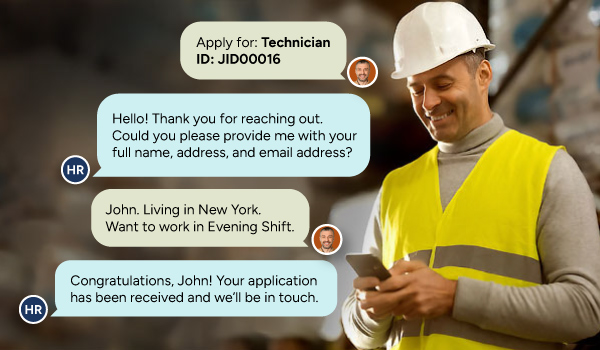
To stay competitive, HR teams need a model that can verify requirements instantly, rank every applicant consistently, and respond faster than human bandwidth allows. Early in that shift, many teams are using CloudApper AI Recruiter as a 24/7 concierge that answers candidate questions instantly, enables self-scheduling, and uses job-relevant knock-out questions to politely redirect obvious mismatches before a recruiter ever has to step in.
What’s Driving The GenAI Resume Wave
GenAI is not just improving writing quality. It is reducing the cost of applying to nearly zero, which changes candidate behavior in predictable ways:
- More applications per candidate: Hays has reported that 51% of employers have seen an increase in job applications since AI tools became mainstream.
- More “polished” but less diagnostic resumes: With AI doing the formatting, phrasing, and keyword tuning, resumes can look highly aligned even when the candidate fails basic constraints like shift availability, location, or licensing.
- Faster volume growth than recruiter capacity: When applications arrive at machine speed, manual review becomes a bottleneck by design.
This is how the low-fit applicant flood becomes persistent: not because candidates are “worse,” but because the funnel is no longer naturally self-filtering.
The Operational Causes HR Can Control
Even in a high-volume world, the flood is not inevitable. It tends to come from three controllable mechanics.
1) No early verification of non-negotiables
If your first real filter is a recruiter reading resumes, you will pay for it in wasted hours and slower time-to-hire. Non-negotiables like work authorization, required credentials, shift coverage, and location constraints must be verified before a resume ever reaches a human.
2) Job requirements written as wish lists
When postings blur “must-have” and “nice-to-have,” candidates (and their AI tools) interpret the description as flexible. That invites broader applications and increases downstream screening work.
3) Slow responsiveness increases churn among your best candidates
Once screening slows, scheduling slows. Candidates notice. Cronofy’s Candidate Expectations Report (2024) found 21% of candidates expecting to schedule the first interview within 2–6 days (before they give up), and 29% expect it within a week. When your funnel is delayed by volume, you lose the exact candidates you are trying to protect.
Why Manual Screening Breaks Faster In The GenAI Era
Traditional screening assumes resumes are scarce, time-consuming to produce, and therefore somewhat self-selecting. GenAI flips that assumption. In practical terms, the low-fit applicant flood is accelerated by two realities:
- The resume is no longer a strong proof artifact. It is increasingly a marketing document optimized for parsing and keywords.
- Recruiters are forced into triage, not evaluation. Time is spent identifying obvious mismatches rather than assessing true capability.
The fix is not “read harder.” The fix is redesigning screening as a structured decision that happens immediately.
A Prevention Framework That Works
The most reliable way to reduce low-fit volume without shrinking access for strong candidates is a three-part approach: verify, rank, and respond.
Step 1: Convert true non-negotiables into short knock-out questions
Keep knock-out questions objective, consistent, and tied directly to job constraints. Examples include:
- Work authorization (country-specific)
- Active license or certification (where required)
- Shift and schedule availability (with specific windows)
- Location or travel requirements (specific, not vague)
This eliminates obvious mismatches early, without any manual review.
Step 2: Add a small set of “fit signals” that reflect real performance
Instead of relying on resume wording, collect 3–5 structured signals such as:
- Tools used weekly in the last 12 months (role-specific list)
- A short scenario question that mirrors daily work
- A work sample link when relevant
- Confirmed availability and start window
This shifts evaluation from “who wrote the best resume” to “who can do the work.”
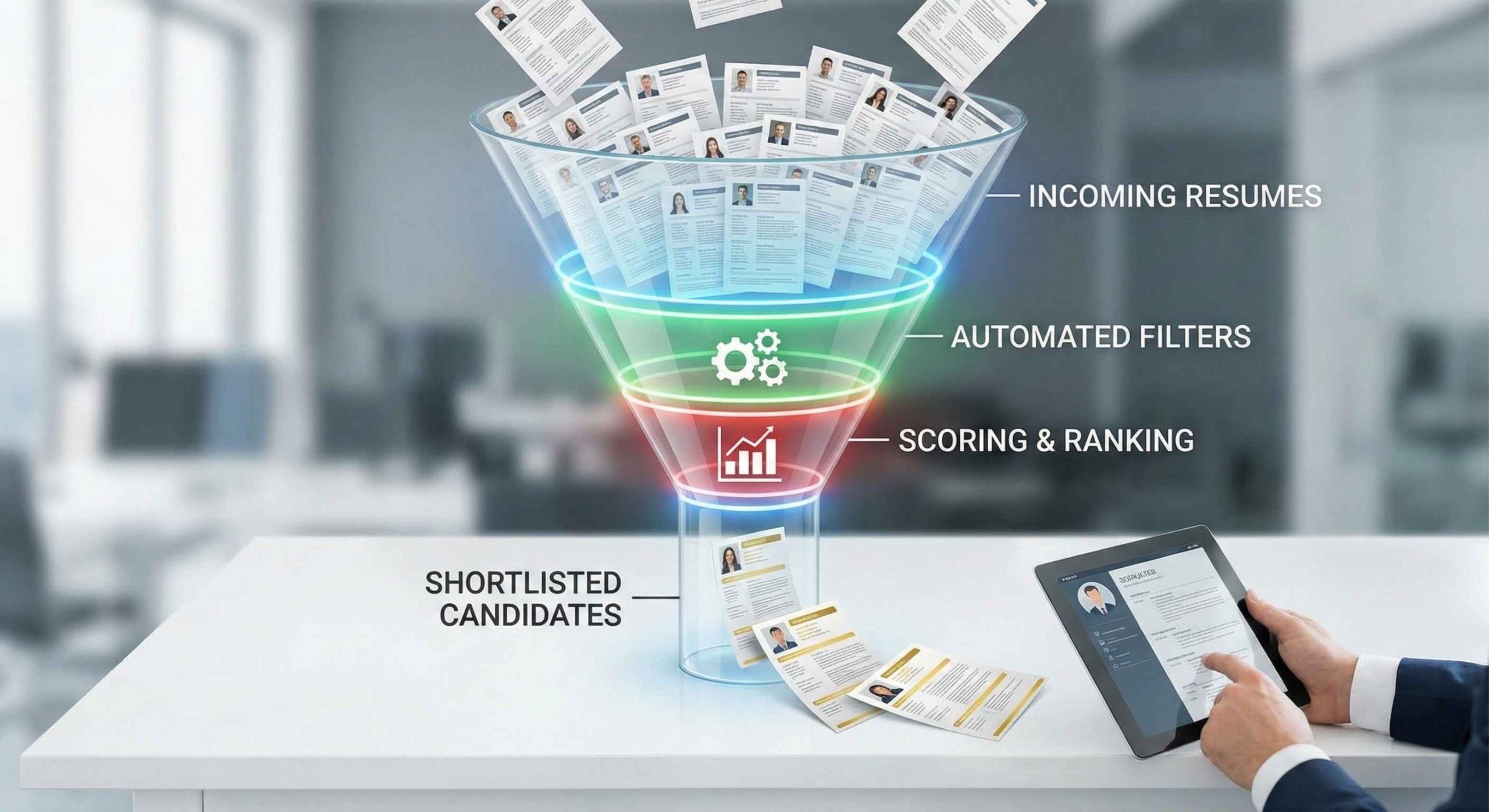
Step 3: Rank every applicant instantly, then review in priority order
CareerPlug’s Recruiting Metrics Report shows the scale of the sorting problem: employers in the study averaged 180 applicants per hire (up from 93 the year before), and invited only about 3% of applicants to interview. Ranking is how you turn volume into an actionable shortlist and prevent the low-fit applicant flood from consuming recruiter time.
How CloudApper AI Recruiter Helps HR Prevent Low-Fit Volume From Reaching Recruiters
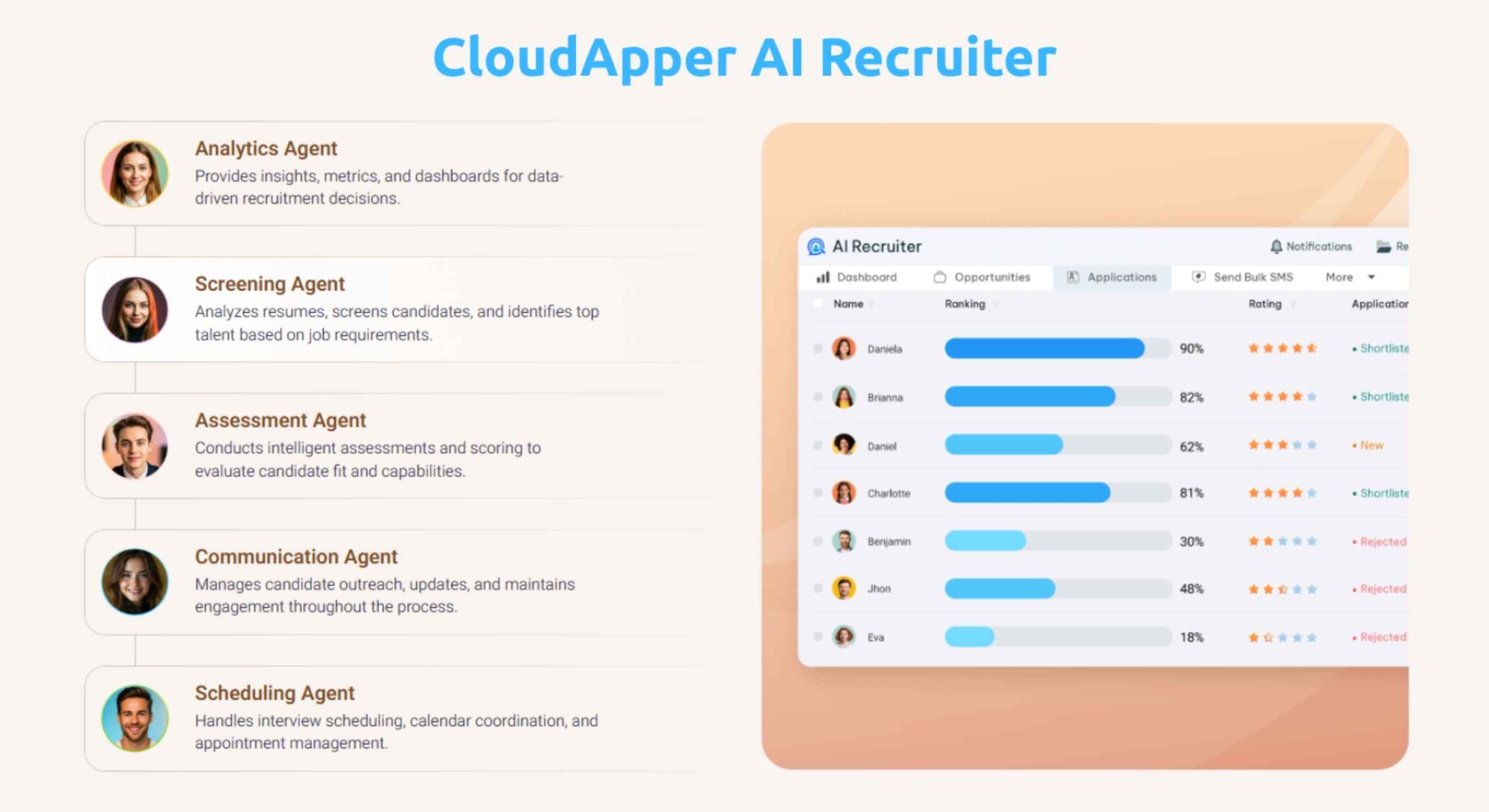
CloudApper AI Recruiter supports this prevention framework by combining automated qualification, instant ranking, and fast candidate movement through the funnel.
Instant screening and ranking across the entire applicant pool
Instead of pushing a resume pile to recruiters, CloudApper AI Recruiter evaluates candidates immediately against structured criteria and produces a prioritized list. This is the direct countermeasure to GenAI-driven mass applications: HR does not need fewer applicants, it needs faster separation of signal from noise.
Automated knock-out questions with respectful routing
When candidates fail true non-negotiables, CloudApper AI Recruiter can identify mismatches early and respond politely with clear next steps (for example, redirecting to better-aligned roles or future opportunities). That protects the employer brand while removing repetitive manual screening work.
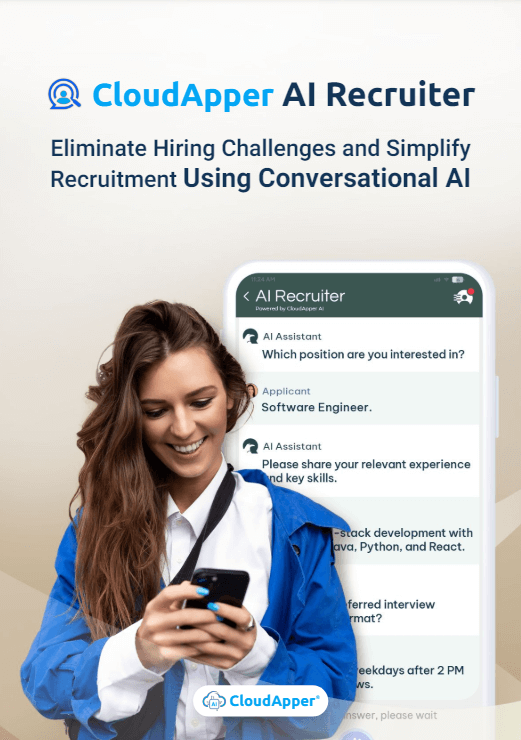
Faster engagement for qualified candidates through self-scheduling and instant answers
Qualified candidates can move forward quickly by getting immediate answers to common questions and booking interviews without back-and-forth. This matters because candidate patience is time-bound: many candidates expect scheduling within days, not weeks.
In practice, this approach reduces recruiter workload, improves speed, and protects qualified candidates from being buried.
What To Measure In The First 30 Days
To prove impact, track a small set of metrics tied to throughput and conversion:
- Knock-out pass rate (are non-negotiables defined correctly?)
- Applicant-to-interview ratio (is noise shrinking?)
- Time from application to scheduled interview (is speed improving?)
- Qualified candidate drop-off rate (are you losing good people mid-funnel?)
- Recruiter hours spent on manual screening (is capacity returning?)
When these improve, the funnel becomes predictable again, even under high volume.
Closing Perspective
The GenAI resume wave is now part of the recruitment baseline, and the low-fit applicant flood will continue wherever screening relies on manual review as the first gate. HR can prevent it by verifying non-negotiables upfront, ranking every applicant instantly, and accelerating qualified candidates through fast scheduling and clear responses. When the system does the sorting, recruiters can focus on what actually drives better hires: human judgment at the right moment, applied to the right shortlist.

What is CloudApper AI Platform?
CloudApper AI is an advanced platform that enables organizations to integrate AI into their existing enterprise systems effortlessly, without the need for technical expertise, costly development, or upgrading the underlying infrastructure. By transforming legacy systems into AI-capable solutions, CloudApper allows companies to harness the power of Generative AI quickly and efficiently. This approach has been successfully implemented with leading systems like UKG, Workday, Oracle, Paradox, Amazon AWS Bedrock and can be applied across various industries, helping businesses enhance productivity, automate processes, and gain deeper insights without the usual complexities. With CloudApper AI, you can start experiencing the transformative benefits of AI today. Learn More
CloudApper AI Solutions for HR

- Works with


- and more.







Similar Posts
How cNPS Reflects Your Recruitment and Employer Brand
The Recruitment-to-HRIS Gap: Why Your “System of Record” Should Start…