Credentials are easier to obtain, but skills reveal how candidates actually perform. This article explains why hiring teams are shifting toward demonstrated capability to improve clarity, fairness, and confidence in hiring decisions.


Table of Contents
Hiring teams are operating in a fundamentally different environment than they were even a few years ago. Credentials are easier to obtain, resumes are easier to optimize, and professional presentation has become nearly universal. As a result, traditional indicators no longer separate candidates the way they once did.
What changed is not access to talent. What changed is how difficult it has become to determine who can actually perform once the role begins. Organizations now face a widening gap between how candidates present themselves and how they perform in real work situations.
Early in this shift, many organizations began rethinking how candidates are evaluated before human judgment enters the process. Some introduced structured screening earlier in the funnel, using solutions like CloudApper AI Recruiter to surface clearer indicators before resumes and credentials dominate decision-making.
Why Skills Are Replacing Credentials in Modern Hiring
Credentials once served as a reliable shorthand. Degrees, certifications, and job titles helped hiring teams assess readiness quickly, especially when applicant volume was manageable. Over time, however, those indicators became easier to acquire and harder to validate as predictors of real performance.
At the same time, resumes became increasingly standardized. Automated tools improved formatting, alignment, and language quality across the board. Hiring teams began encountering candidates who looked equally qualified on paper yet performed very differently once hired.
This shift is why skills are becoming central to hiring decisions. They provide insight into how someone reasons, adapts, and responds to realistic scenarios rather than where they studied or how they summarize past experience.
The Limits of Resume-First Evaluation
Resume-first evaluation assumes that written history correlates with future execution. In practice, that assumption breaks down under scale.
When every resume appears polished, recruiters must spend more time validating claims instead of evaluating readiness. Hiring managers receive shortlists that feel interchangeable. Candidates experience longer processes without clear feedback. Over time, confidence erodes across the entire hiring workflow.
These outcomes are not the result of poor recruiting practices. Instead, they reflect systems that were designed for a hiring landscape where presentation still carried meaningful variation.
How Skills Translate Into Better Hiring Decisions
When candidates respond to consistent, role-specific prompts, patterns emerge. Recruiters can compare how applicants prioritize work, explain trade-offs, and reason through uncertainty. Hiring managers gain context that resumes alone cannot provide.
This is where skills create measurable value. They offer explainable, comparable signals early in the process. Instead of relying on assumptions derived from static documents, teams gain visibility into how candidates think before interviews begin.
Organizations applying this approach often position CloudApper AI Recruiter as a front-end screening layer, allowing recruiters to invest time where human judgment matters most.

How CloudApper AI Recruiter Addresses These Challenges
The core challenge is not a lack of candidates, tools, or data. It is a lack of early clarity.
CloudApper AI Recruiter is designed to address this gap by introducing structured, role-specific screening before resumes and credentials carry disproportionate weight. Rather than replacing recruiter judgment, it prepares better inputs for that judgment by ensuring every candidate is evaluated against the same criteria.
By capturing consistent responses and organizing them into comparable signals, the platform helps recruiters spend less time filtering noise and more time interpreting meaningful differences. This approach restores confidence early in the process while keeping hiring decisions transparent and explainable for all stakeholders.
Why This Shift Improves Hiring Confidence
Hiring confidence weakens when decisions feel arbitrary. That uncertainty affects recruiters, hiring managers, and candidates alike.
When evaluation centers on demonstrated capability, clarity returns. Recruiters can articulate why candidates advance. Hiring managers trust shortlists because they understand the underlying rationale. Candidates experience a process that feels transparent rather than opaque.
At this stage, skills stop being an abstract concept and become a practical framework for decision-making. They reduce second-guessing later in the hiring cycle and help teams move forward with confidence rather than hesitation.
The Role of Technology in Supporting Judgment
Technology remains essential in modern hiring, but its role has evolved.
Effective tools handle consistency, scale, and structure. They reduce manual effort and prepare information for review. They do not replace judgment, nor should they attempt to.
Hiring outcomes improve when systems surface meaningful input and humans interpret it. This division of responsibility ensures that automation strengthens decisions instead of distorting them.

Building a More Durable Hiring Model
Hiring strategies built solely on credentials age quickly. Roles evolve. Business needs shift. Static indicators lose relevance.
By contrast, evaluation rooted in demonstrated ability adapts naturally over time. Teams gain flexibility without sacrificing rigor. They identify candidates who can grow into roles rather than merely match yesterday’s requirements.
In the long run, hiring success no longer comes from reaching more candidates or collecting more resumes. It comes from making clearer decisions earlier in the process, which is why many organizations choose to explore CloudApper AI Recruiter as part of building a more reliable, future-ready hiring approach.

What is CloudApper AI Platform?
CloudApper AI is an advanced platform that enables organizations to integrate AI into their existing enterprise systems effortlessly, without the need for technical expertise, costly development, or upgrading the underlying infrastructure. By transforming legacy systems into AI-capable solutions, CloudApper allows companies to harness the power of Generative AI quickly and efficiently. This approach has been successfully implemented with leading systems like UKG, Workday, Oracle, Paradox, Amazon AWS Bedrock and can be applied across various industries, helping businesses enhance productivity, automate processes, and gain deeper insights without the usual complexities. With CloudApper AI, you can start experiencing the transformative benefits of AI today. Learn More
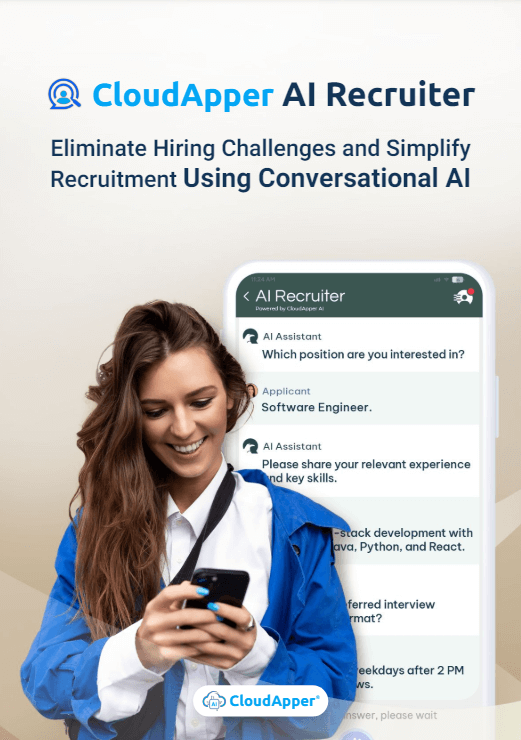
CloudApper AI Solutions for HR

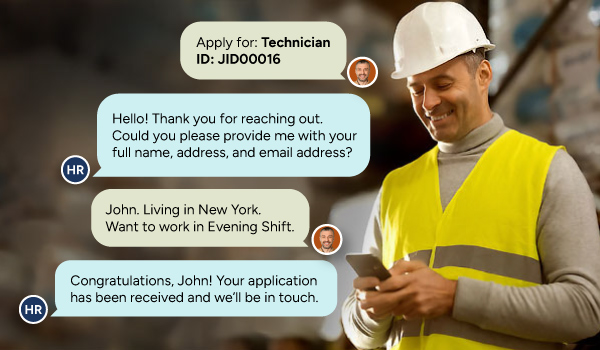

- Works with


- and more.








Similar Posts
How cNPS Reflects Your Recruitment and Employer Brand
The Recruitment-to-HRIS Gap: Why Your “System of Record” Should Start…