Employee referral programs work well at small scale but often break down as hiring volume grows. This article explains why traditional referral processes fail at scale and how AI helps teams add structure, improve fairness, and manage referrals more efficiently.


TL;DR
- Employee referral programs often fail at scale due to manual screening and lack of prioritization.
- High referral volume overwhelms recruiters and slows feedback to employees.
- AI helps add structure through consistent screening and fair prioritization.
- Recruiters stay in control while repetitive tasks are reduced.
- Scalable referral programs protect recruiter time and employee trust.
Table of Contents
Employee referral programs often work well when hiring volume is low. Employees recommend people they trust, recruiters move faster, and hiring managers feel confident about culture fit. At this stage, referrals feel simple and effective, and very little structure is needed to keep things moving.
The problem starts when hiring scales. Referral volume increases, but the process behind it stays informal. Recruiters struggle to keep up, employees stop getting feedback, and hiring managers assume every referral should move forward. At that point, employee referral programs begin to fail at scale, not because referrals are ineffective, but because the process cannot support the volume. This is where tools like CloudApper AI Recruiter comes in clutch.
The Core Reasons Traditional Employee Referral Programs Fail at Scale
Lack of Early Screening
When referral volume is low, teams often skip early screening. Recruiters trust employees to send strong candidates and move referrals forward quickly. As volume increases, this approach creates delays. Recruiters spend time reviewing every referral in detail, which slows down the pipeline and pushes feedback further out.
No Prioritization Across Referrals and Applicants
Many teams automatically prioritize referrals over other applicants. This works at a small scale but causes an imbalance as referrals increase. Recruiters lose visibility into who should be reviewed first, strong candidates wait longer than necessary, and overall hiring quality suffers.
Manual Review Overload
Manual resume review does not scale well. As referrals pile up, recruiters face inconsistent decision-making and growing backlogs. Two similar candidates may receive different outcomes simply based on timing or workload, which reduces trust in the referral process.
Inconsistent Feedback to Employees
Employees expect updates on their referrals. At scale, recruiters struggle to provide timely feedback. When communication slows down, employees disengage from the referral program or repeatedly follow up, which adds even more pressure on recruiters.
Bias Creeping Into Referrals
Referrals come from personal networks. Without consistent screening and evaluation, bias can influence decisions. Over time, this limits access to diverse talent and introduces risk into the hiring process.
How AI Helps Fix Employee Referral Programs at Scale
AI helps employee referral programs by bringing structure to the parts of the process that tend to break first under volume. When referral numbers grow, recruiters struggle most with intake, screening, prioritization, and follow-up. AI supports these steps so you can manage scale without losing control or fairness. It does not replace your judgment. It gives you clearer signals so you can make better decisions faster.
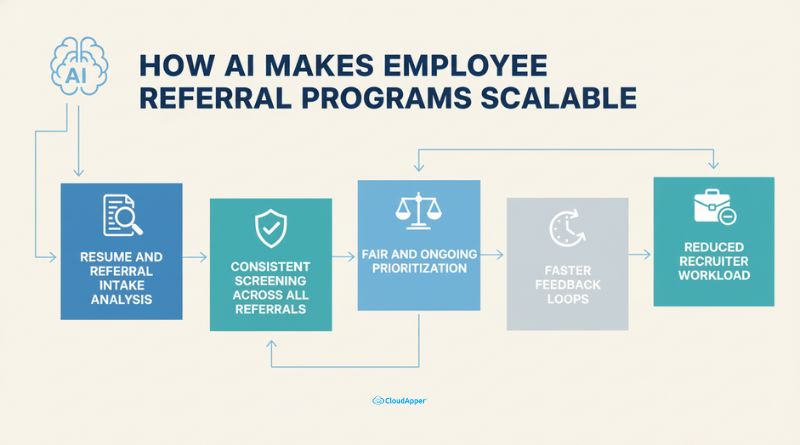
Resume and Referral Intake Analysis
When referral volume is low, recruiters can read every resume carefully. At scale, that approach stops working. AI helps by reviewing referral resumes as soon as they enter the system and organizing key details such as skills, experience, and role alignment in a consistent way.
This early analysis gives you a clear snapshot of each referral without requiring full manual review upfront. Instead of starting from a blank slate with every resume, you begin with structured information that highlights what matters most for the role. This helps you move faster while still understanding who the candidate is and how they may fit.
Consistent Screening Across All Referrals
One of the biggest challenges at scale is inconsistency. Different recruiters may screen referrals differently depending on workload, urgency, or personal assumptions. AI helps remove that variation by applying the same screening criteria to every referral.
This consistency improves fairness and predictability. Strong candidates surface more reliably, and weaker fits are identified earlier. Over time, this builds trust in the referral program because outcomes feel more objective and less dependent on who reviewed the referral first.
Fair and Ongoing Prioritization
At scale, prioritization matters more than filtering. AI helps you keep referrals and applicants ordered based on role relevance rather than referral status alone. This ensures that the most suitable candidates receive attention first.
Ongoing prioritization also matters as new referrals come in. Instead of reviewing candidates in batches, the pipeline stays organized continuously. This prevents strong candidates from getting stuck behind volume and helps you maintain steady hiring momentum.
Faster Feedback Loops
Slow feedback is one of the fastest ways to damage referral programs. Employees want to know what happened to their referrals, and candidates expect timely updates. AI helps speed up early decisions so feedback does not fall behind.
When screening and prioritization happen faster, recruiters can move candidates forward or provide updates sooner. This keeps candidates engaged and shows employees that their referrals are being handled thoughtfully. Faster feedback also reduces follow-up pressure on recruiters.
Reduced Recruiter Workload
As referral programs scale, recruiter workload increases quickly. Manual resume review, tracking updates, and coordinating feedback consume time and energy. AI helps by handling repetitive organization and screening tasks that do not require human judgment.
This gives recruiters more time to focus on interviews, conversations, and hiring decisions. Reduced workload leads to better focus, less burnout, and more consistent pipeline management across teams.
If your referral volume is growing but your process feels harder to manage, this is where structure starts to matter.
Where CloudApper AI Recruiter Fits Into Scalable Referral Programs
In practice, scalable employee referral programs need the most support at the front of the pipeline. This is where CloudApper AI Recruiter fits naturally.
Managing High Referral Volume
CloudApper AI Recruiter helps structure referral intake so candidates enter the pipeline with complete and usable information. Instead of referrals arriving as unstructured resumes or informal submissions, data is organized from the start.
This reduces noise and makes it easier to understand who each referral is and why they were submitted. As a result, referrals do not pile up waiting for manual sorting, even during peak hiring periods.
Early Screening Without Manual Bottlenecks
Early screening is often where referral programs slow down. CloudApper AI Recruiter analyzes referral resumes and responses quickly, giving you early insight into role alignment.
This allows recruiters to identify promising referrals sooner and avoid backlogs caused by manual review. Early screening keeps the pipeline moving and prevents delays from compounding as volume increases.
Keeping Referrals Fair and Consistent
Fairness becomes harder to maintain as referral volume grows. CloudApper AI Recruiter applies consistent evaluation criteria across all referrals, which helps reduce pressure on recruiters to make exceptions.
This consistency protects the integrity of the referral program. Employees see that referrals are treated seriously and fairly. Recruiters gain confidence that decisions are based on role fit rather than relationships.
Working With Existing ATS and HR Systems
CloudApper AI Recruiter integrates with your existing ATS and HR systems, e.g., UKG, Workday, Bullhorn, Lever, Greenhouse, Oracle, etc., so recruiters do not need to change how they manage interviews, offers, or approvals. The referral process improves at the front, while the rest of the hiring workflow stays the same.
This makes adoption easier and reduces disruption. You gain better control over referral programs without adding complexity to your recruiting operations.
Final Takeaway
Employee referral programs fail at scale because informal processes cannot handle high volume. Incentives alone do not fix this problem. Structure, consistency, and clear prioritization matter far more.
AI helps when it brings order to the process without taking control away from humans. When you combine clear workflows with the right level of automation, referral programs remain effective even as hiring demand grows. This protects recruiter time, maintains employee trust, and keeps referrals a strong hiring channel as you scale.
Referral programs do not fail because employees stop referring. They fail when the process cannot keep up with volume.
Reduce Time-to-Hire by 97% with AI for Talent Acquisition
Recruit skilled, culturally fit, and diverse candidates with CloudApper’s state-of-the-art AI resume screening, automated interview scheduling, and offer letter generation.
Learn more | Download BrochureFrequently Asked Questions
-
Why do employee referral programs fail at scale?
Employee referral programs fail at scale because informal processes cannot handle high volume, leading to slow screening, poor prioritization, and inconsistent feedback. -
What are the biggest challenges with scaling employee referral programs?
Common challenges include manual review overload, lack of early screening, delayed feedback to employees, and bias introduced through personal networks. -
How does AI improve employee referral programs?
AI improves employee referral programs by supporting early screening, consistent evaluation, fair prioritization, and faster feedback without replacing human judgment. -
Does using AI reduce fairness in employee referrals?
No. When used correctly, AI increases fairness by applying consistent criteria to all referrals and reducing subjective decision-making. -
Can AI-powered referral programs work with existing ATS systems?
Yes. AI-powered referral solutions can integrate with existing ATS and HR systems, allowing teams to improve referral workflows without changing core processes.
What is CloudApper AI Platform?
CloudApper AI is an advanced platform that enables organizations to integrate AI into their existing enterprise systems effortlessly, without the need for technical expertise, costly development, or upgrading the underlying infrastructure. By transforming legacy systems into AI-capable solutions, CloudApper allows companies to harness the power of Generative AI quickly and efficiently. This approach has been successfully implemented with leading systems like UKG, Workday, Oracle, Paradox, Amazon AWS Bedrock and can be applied across various industries, helping businesses enhance productivity, automate processes, and gain deeper insights without the usual complexities. With CloudApper AI, you can start experiencing the transformative benefits of AI today. Learn More
CloudApper AI Solutions for HR

- Works with


- and more.







Similar Posts
How cNPS Reflects Your Recruitment and Employer Brand
The Recruitment-to-HRIS Gap: Why Your “System of Record” Should Start…