High-volume hiring breaks traditional analytics. This guide explains the metrics that matter at scale, why manual tracking fails, and how AI-driven automation helps teams screen thousands of applicants, reduce drop-off, and hit aggressive hiring goals faster with confidence today.

TL;DR
- High-volume hiring requires different analytics than traditional recruiting.
- Lagging metrics like quality of hire don’t work when you need to hire hundreds quickly.
- Funnel-level metrics reveal bottlenecks early and at scale.
- Manual tracking collapses under volume, so automation becomes essential.
- Real-time analytics help teams adjust sourcing and screening while the hiring campaign is still running.
Table of Contents
- Why Traditional Recruitment Analytics Fail at Scale
- Essential Metrics for High-Volume Recruitment
- How CloudApper AI Recruiter Handles Analytics at Scale
- Real-World High-Volume Recruitment Analytics Examples
When you need to hire 250 warehouse workers in six weeks and get 4,200 applications in the first week, traditional recruitment analytics completely fall apart. Your team of three recruiters is drowning. Spreadsheets crash. You have little to no idea who you’ve screened, who’s good, or who’s dropped out. The metrics that work when you’re hiring five software engineers don’t help when you need 200 registered nurses or 500 retail associates.
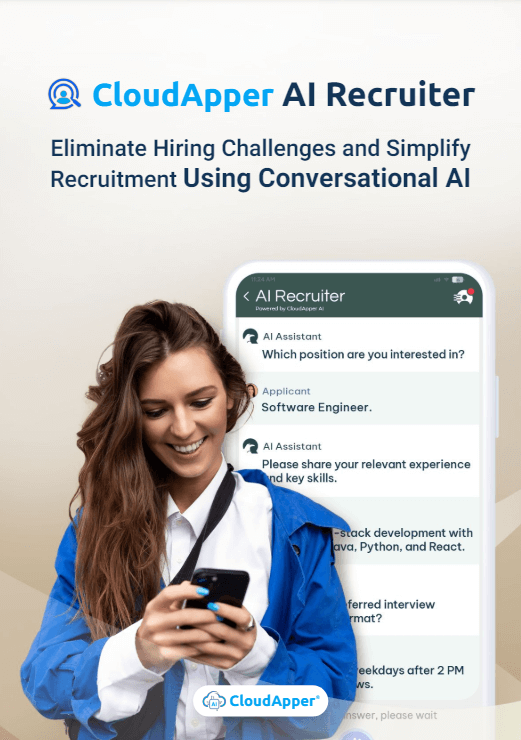
You need different metrics, automated tracking, and tools that can handle thousands of applications without breaking. This is where recruitment analytics for high-volume hiring becomes essential. CloudApper AI Recruiter does exactly this with its multi-agent AI system. The Analytics Agent tracks everything automatically while the Screening Agent processes thousands of resumes simultaneously.
In this guide, I’ll show you which metrics actually matter when hiring at scale, why traditional analytics fail with high volume, and how to track performance when you’re managing hundreds or thousands of applications.
Why Traditional Recruitment Analytics Fail at Scale
I’ve seen this pattern repeat over and over. A company has great analytics for regular hiring. They track time-to-hire, quality of hire, and source effectiveness. Then they need to hire 300 people in 60 days, and suddenly nothing works. Here’s why:
- Quality of hire is too slow for volume decisions: You need six to twelve months to properly measure quality of hire through performance reviews, retention rates, and manager satisfaction. When you’re filling 200 positions next month for seasonal demand, you can’t wait half a year to know if your process worked.
- Individual candidate tracking becomes impossible: When you have 50 candidates in your pipeline, you can look at each person’s journey. When you have 5,000 candidates, trying to track individuals is like counting raindrops in a storm. Your ATS slows down, recruiters lose track, and people fall through the cracks.
- Standard interview-to-offer ratios don’t apply: Traditional hiring might interview 5 people to make 1 offer. High-volume recruiting often interviews 20 people to make 15 offers because you need to fill positions fast and candidate quality varies more widely across large applicant pools.
- Cost-per-hire calculations get skewed by volume: If you spend $50,000 and hire 10 people, that’s $5,000 per hire. If you spend $80,000 and hire 400 people, that’s $200 per hire. The economics are totally different. You need to look at cost-per-qualified-candidate instead to understand true sourcing efficiency.
- Manual data tracking breaks down entirely: At scale, if you’re not automating your analytics, recruiters waste 15+ hours weekly just updating spreadsheets instead of actually recruiting. Manual tracking simply can’t keep pace with hundreds of daily applications.
Read my complete guide on recruitment analytics to see how you can make data-driven hiring decisions.
Essential Metrics for High-Volume Recruitment
Let me walk you through the five metrics that actually matter when hiring at scale. These are the foundations of effective recruitment analytics for high-volume hiring.
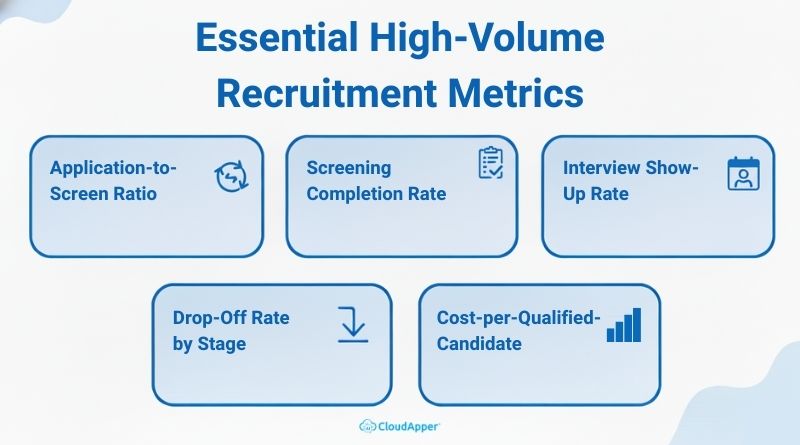
Application-to-Screen Ratio
This is your most critical metric for volume hiring. It tells you what percentage of applicants are actually qualified for your role.
The formula to find out your Application-to-Screen Ratio is simple: divide screened candidates by total applications, then multiply by 100. If you got 2,000 applications and screened 300 as qualified, that’s a 15% ratio.

Your benchmark should be 10-20% for a healthy pipeline. If you’re below 10%, your sourcing is broken. You’re attracting the wrong people. If you’re above 25%, you might not be reaching enough people.
If only 2% of your 5,000 applications are qualified, you have 100 candidates for 200 open positions. You’re going to miss your hiring goal no matter how good your interview process is. You need to fix your sourcing first.
Screening Completion Rate
This measures what percentage of applications actually get reviewed. In high-volume hiring, many applications never get looked at. They sit in a queue for weeks while recruiters try to catch up.
Your target should be 100% of applications screened within 48 hours. Every application. Every time.
Good candidates slip through when volume overwhelms recruiters. Most recruiters can screen 20-30 resumes per hour. That’s 3-4 hours for 100 resumes. If you get 500 applications in a day, that’s 20 hours of screening work. You’re immediately behind.
CloudApper’s Screening Agent reviews every single application automatically. It doesn’t matter if you get 50 applications or 5,000. Every candidate gets evaluated against your requirements with consistent criteria. No one falls through the cracks.
Interview Show-Up Rate
This measures the percentage of scheduled interviews where candidates actually show up. Your target should be 75-85% for volume roles.
Why does this matter at scale? Because no-shows waste massive amounts of time. If you schedule 50 interviews in a week and 15 people don’t show up, that’s 15 hiring manager hours wasted.
The common problem is manual scheduling with long delays between screening and interview. A recruiter screens someone on Monday, emails them Tuesday, waits for a response Wednesday, suggests times Thursday, confirms Friday, and the interview happens the following Tuesday. That’s 8 days from screen to interview. The candidate has probably accepted another offer by then.
CloudApper’s Scheduling Agent automates interview booking immediately after screening. The time gap shrinks from days to hours. Faster scheduling means higher show-up rates because candidates haven’t moved on or lost interest.
Drop-Off Rate by Stage
This shows you where you’re losing candidates in your process. At scale, even small improvements in drop-off rates mean dozens or hundreds more hires.
Track drop-off at every stage. Application completion should be 40-60%. Post-screen to interview scheduling should be 70-80%. Interview show-up should be 75-85%. Offer to acceptance should be 85-90%.
A 5% improvement at any stage translates to real numbers. Improve application completion from 40% to 45% in a campaign with 10,000 initial clicks, and you get 500 more completed applications. That might be 50 more qualified candidates and 10 more hires.
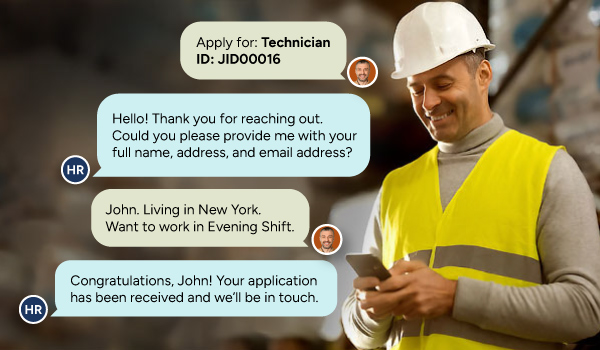
The 92% application drop-off problem is especially bad in high-volume hiring. Traditional applications ask people to upload a resume, then manually re-enter everything into form fields. CloudApper addresses this with conversational AI. Instead of forms, candidates have a natural conversation. This approach gets you to 40-60% completion rates.
Cost-per-Qualified-Candidate
This is more useful than cost-per-hire for volume hiring. It separates sourcing effectiveness from final hiring decisions.
The formula is: total recruitment costs divided by number of qualified candidates screened. If you spent $20,000 on a hiring campaign and screened 400 qualified candidates, that’s $50 per qualified candidate.
This shows you which sources give you the best return on investment. You might have one job board that sends 2,000 applications at $5,000 cost but only 50 are qualified. That’s $100 per qualified candidate. Another source sends 400 applications at $2,000 cost, and 100 are qualified. That’s $20 per qualified candidate. The second source is 5x more efficient.
CloudApper’s Analytics Agent automatically tracks performance by source. You see in real time which channels are giving you the best quality per dollar spent.
Tracking these metrics manually breaks down the moment application volume spikes.
How CloudApper AI Recruiter Handles Analytics at Scale
Let me show you exactly how CloudApper makes recruitment analytics for high-volume hiring actually manageable.
Instant Data Collection Across All Agents
CloudApper’s multi-agent system automatically feeds data into your analytics without any manual tracking. The Screening Agent logs every resume reviewed and scored. The Scheduling Agent captures interview coordination times and show-up rates. The Communication Agent tracks every candidate interaction and response. The Analytics Agent pulls all this data together instantly, giving you a complete picture of your high-volume campaign in real time.
Real-Time Dashboard for Volume Campaigns
Your dashboard updates continuously whether you get 50 applications or 5,000 in a day. You see your application-to-screen ratio, screening completion rate, interview show-up rate, drop-off rates at every stage, and cost-per-qualified-candidate all in one view. No waiting for weekly reports. No manual data compilation. If 800 applications come in overnight, your metrics refresh automatically by morning.
Multi-Location and Multi-Role Visibility
When you’re hiring for 15 different positions across 5 locations simultaneously, the Analytics Agent consolidates everything in one place. You compare performance across different locations and roles instantly. You identify which positions are easy to fill and which need more resources. One retail chain opening 8 new stores used this visibility to shift advertising budget mid-campaign to underperforming locations and filled all positions on time.
Seamless Integration Without Manual Work
CloudApper works with your existing ATS and HRIS systems like SAP SuccessFactors, Workday, Greenhouse, Oracle, Lever, UKG, and BambooHR. You’re not manually exporting data or building spreadsheets. Everything syncs automatically. Your analytics pull from all your systems in real time, whether you have 100 applications or 10,000. This is critical for high-volume hiring where manual data management simply breaks down.
Real-World High-Volume Recruitment Analytics Examples
| Industry | Typical Hiring Scenario | Analytics Challenge | How CloudApper Analytics Agent Helps | Key Metrics Tracked |
| Retail | 400-500 seasonal store associates across multiple locations in 6-8 weeks | Tracking performance across dozens of stores with thousands of applications; identifying which locations need more support | Real-time dashboard shows application volume, screening completion rate, and interview show-up rate by location; alerts when specific stores fall behind | Application-to-screen ratio by location, cost-per-qualified-candidate by source, time from application to screen, location-specific conversion rates |
| Healthcare | 150-250 nursing staff, CNAs, and medical assistants across hospital network in 8-12 weeks | Complex credential requirements create screening bottlenecks; high drop-off rates; difficult to track license verification status | Analytics Agent tracks screening completion including credential verification; monitors drop-off rates at each stage; identifies which credentials cause delays | Screening completion rate, credential verification time, drop-off rate by stage, cost-per-qualified-candidate, source quality for licensed vs. non-licensed roles |
| Logistics/Warehouse | 250-350 warehouse workers and drivers for peak season in 4-6 weeks | Massive application volume creates backlogs; candidates accept other offers while waiting for screening; no visibility into geographic sourcing effectiveness | Instant visibility into screening queue depth; tracks time-to-first-screen; analyzes candidate proximity to warehouse locations; monitors interview show-up rates | Screening completion rate, time-to-first-screen, interview show-up rate by distance, application-to-screen ratio, batch conversion rates by week |
Hire Smarter at Scale with the Right Analytics
Effective recruitment analytics for high-volume hiring requires different metrics than traditional recruitment. Focus on application-to-screen ratio, screening completion rate, interview show-up rate, drop-off rates at every stage, and cost-per-qualified-candidate. These metrics help you identify problems fast and optimize your process while hiring hundreds or thousands of people.
CloudApper AI Recruiter’s multi-agent system handles thousands of applications simultaneously while tracking all your critical metrics automatically. The platform integrates seamlessly with your existing ATS and HRIS systems. Your dashboards update in real time, whether you have 100 applications or 10,000.
High-volume hiring doesn’t fail because teams move too slowly but because they can’t see what’s happening fast enough.

What is CloudApper AI Platform?
CloudApper AI is an advanced platform that enables organizations to integrate AI into their existing enterprise systems effortlessly, without the need for technical expertise, costly development, or upgrading the underlying infrastructure. By transforming legacy systems into AI-capable solutions, CloudApper allows companies to harness the power of Generative AI quickly and efficiently. This approach has been successfully implemented with leading systems like UKG, Workday, Oracle, Paradox, Amazon AWS Bedrock and can be applied across various industries, helping businesses enhance productivity, automate processes, and gain deeper insights without the usual complexities. With CloudApper AI, you can start experiencing the transformative benefits of AI today. Learn More
- Useful Links:
- Agentic AI
- No-Code/Low-Code
- Custom Software
- HCM Personalization
- iPaaS
- FedRAMP
CloudApper AI Solutions for HR

- Works with








- and more.
Similar Posts

How to Assess Candidate Communication Skills Before the First Interview

How to Reduce Interview Rounds Without Lowering Your Hiring Standards